Papuan Church Leaders request dialogue during meeting with Indonesian President

SATURDAY, DECEMBER 17, 2011

by Andreas Harsono
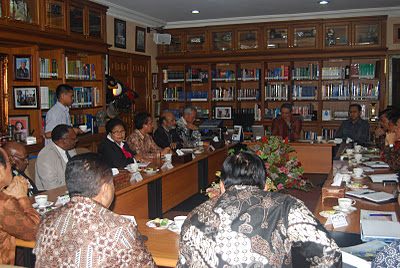
President Susilo Bambang Yudhoyono and Vice President Boediono met four Papuan church leaders in Yudhoyono's private library on Dec. 16, 2011. The Papuan priests presented a letter with several recommendations to Yudhoyono. ©Frederika Korain

FOUR PAPUAN church leaders met Indonesian President Susilo Bambang Yudhoyono, Vice President Boediono and several cabinet members as well as Indonesia’s military commander and its police chief in President Yudhoyono’s private residence in Cikeas, outside Jakarta, on Friday Dec. 16.

They included Rev. Jemima M. Krey (chairwoman of the Evangelical Christian Church in Papua or Gereja Kristen Injili di Tanah Papua), Rev. Benny Giay (chairman of the Kingmi Gospel Tabernacle Church or Gereja Kingmi di Tanah Papua), Rev. Socratez Sofyan Yoman (chairman of the Alliance of Baptist Churches in Papua or Persekutuan Gereja-Gereja Baptis Papua) and Rev. Martin Luther Wanma (chairman of the Indonesian Christian Bible Church or Gereja Kristen Alkitab Indonesia). Frederika Korain, a Papuan human rights activist and an Australian National University student, also joined the delegate.

The meeting was initiated by the Communion of Churches in Indonesia (Persekutuan Gereja-gereja di Indonesia) whose board members also took part in the meeting: Rev. Andreas Yewangoe (chairman), Rev. Gomar Gultom (secretary general) and Rev. Phil Erari (deputy chairman).

The church leaders handed over a seven-page letter to President Yudhoyono, asking the Indonesian government to have a dialogue with the people of Papua. They also asked Yudhoyono stopping the Matoa Operation in Paniai, Papua, which had caused 14 dead and some burned villages on Dec. 12.

Other recommendations included retrieving non-organic troops from Papua, releasing Papuan political prisoners and annulling the Government Regulation No. 77/2007 which bans the Morning Star flag.

They also declared that the 2001 Special Autonomy in Papua had failed. They questioned the establishment of the Unit to Accelerate the Development of Papua and West Papua provinces (UP4B) without the participation of the Papuans, calling such a move “non democratic.”

Benny Giay told me Saturday that the meeting was taking place for more than two hours. “It really hurt me when knowing our church members were attacked, their villages being burned, while we’re here in Jakarta.”

Giay came from the village Onago on Lake Tigi in Paniai, near Edadu, where the Indonesian military and police have been organizing a joint military operation since Dec. 13.

They also told President Yudhoyono that most native Papuans have suffered from Indonesian rule since Indonesia took over New Guinea in 1962. Violence created much suffering on the people. They said most Papuans aspired to be separated from Indonesia.

In front of his guests, Yudhoyono immediately asked Indonesian police chief Gen. Timur Pradopo to stop the Matoa Operation. He also mentioned that U.S. President Barack Obama and State Secretary Hillary Clinton had raised the issues of human rights violations in Papua.

Yudhoyono welcomed such a dialogue but he reminded his guests that as president he has to keep the territorial integrity of Indonesia. He promised to enforce the law in Papua and to stop human rights abuses. Yudhoyono promised to have another dialogue with the four reverends in the third week of January.
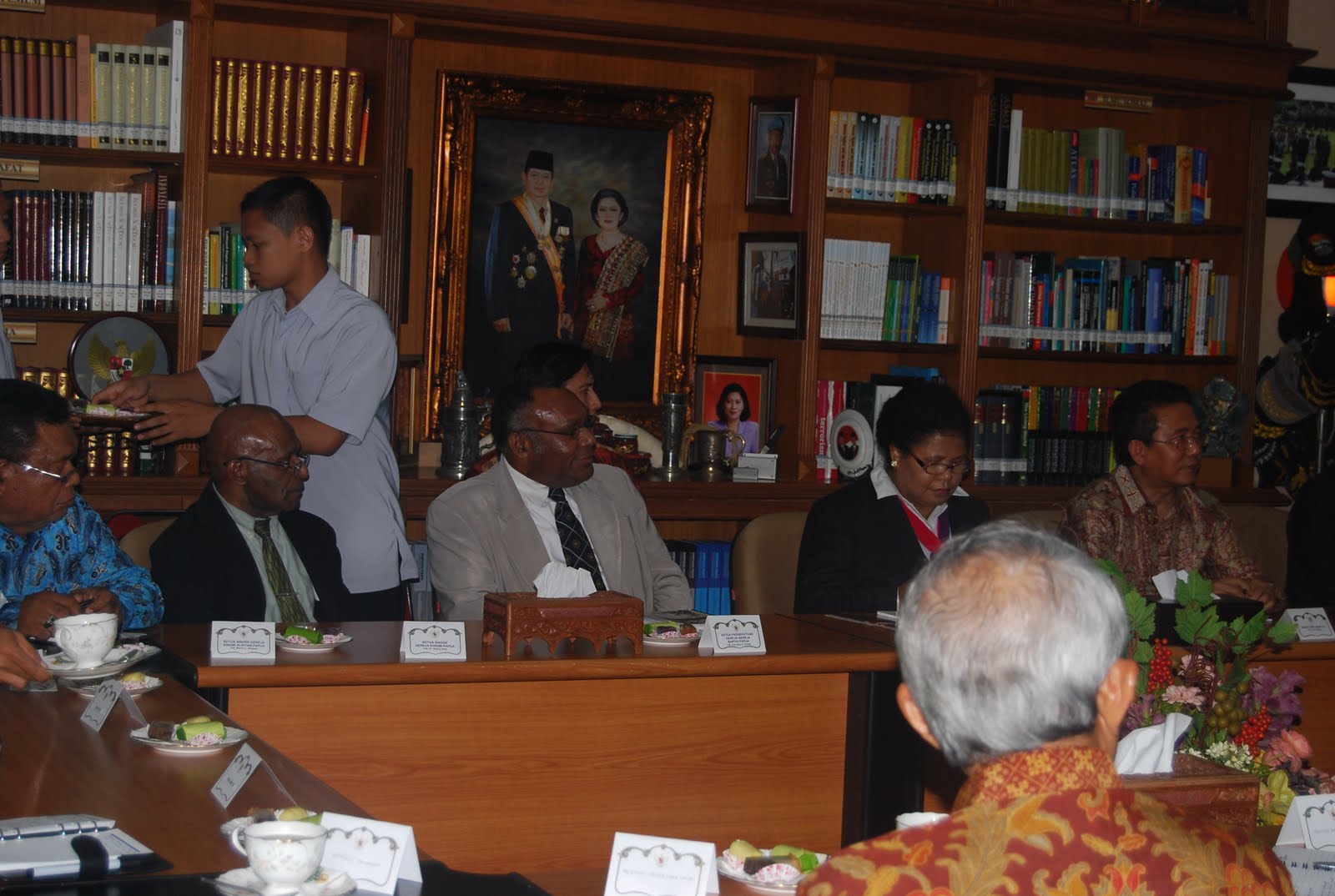
Rev. Martin Luther Wanma, chairman of the Indonesian Christian Bible Church or Gereja Kristen Alkitab Indonesia (blue batik), Rev. Benny Giay, chairman of the Kingmi Gospel Tabernacle Church or Gereja Kingmi di Tanah Papua (black jacket), Rev. Socratez Sofyan Yoman, chairman of the Alliance of Baptist Churches in Papua or Persekutuan Gereja-Gereja Baptis Papua (light grey jacket) and Rev. Jemima M. Krey, chairwoman of the Evangelical Christian Church in Papua or Gereja Kristen Injili di Tanah Papua (black blazer) and Rev. Gomar Gultom of the Communion of Churches in Indonesia (brown batik) talked straight to Indonesian leaders. ©Frederika Korain


The meeting began at 9pm and ended at 11.30pm at Yudhoyono’s private library. Gomar Gultom organized a press conference at the office of the Communion of Churches in Indonesia Saturday morning.

Both Yoman and Giay are under the Indonesian military watch list. An Indonesian military document leaked in August 2011 revealed that Kopassus agents were closely monitoring Giay and Yoman.

Another leaked letter dated April 30, 2011, from the Indonesian military commander in Papua, Maj. Gen. Erfi Triassunu, to the provincial governor, Barnabas Suebu, also shows a military interference in civil society in Papua.

The letter accuses Rev. Benny Giay’s Kingmi Gospel Tabernacle Church of trying to build an exclusive organization based on Papuan ethnicity, which Major General Triassunu viewed as a potential separatist movement, and suggests having the military mediate a conflict between the Kingmi Church (Gereja Kemah Injil or Kingmi Church) and the Indonesian Gospel Tabernacle Church (Gereja Kemah Injil Indonesia or GKII). The letter also urges that if deliberations cannot resolve the conflict, “immediate action” should be taken. Since the letter came to light, Major General Triassunu has publicly apologized for accusing the church of being a separatist organization, claiming a faction of the church had asked for assistance from the military.

Yawan Wayeni

Giay told me that Yudhoyono was surprised when seeing the photo of a dying Papuan activist Wayan Wayeni on the letter. They told him that Imam Setiawan, the Indonesian police officer who led the attack against Yawan Wayeni on Serui Island, in August 2009, was later promoted to be the police chief of Jayapura. In his new position, Setiawan used excessive forces when cracking down the Papuan Congress in October 2011 and arrested around 300 Papuans. But Setiawan got another promotion despite a written warning for his abusive behavior. He’s now the deputy director of traffic in Papua.

Original Letter from West Papuan church leaders on presented at President Yudhoyono’s private residence in Cikeas, outside Jakarta, on Friday Dec. 16, asking the Indonesian government to have a dialogue with the people of Papua. (Bahasa Indonesia: English translation currently unavailable) :

Church officials in Papua Request Troops to be withdrawn from Paniai

from SuaraBaptis http://suarabaptis.blogspot.com

Jayapura – Chairman of the Fellowship Baptist Church of Papua, Socratez Sofyan Yoman, asked the police and TNI members to immediately withdraw from Paniai.  Paniai conflict has given rise to fallen victims and can lead to ongoing violence.
“The Church will not agree when the police stormed the gang falls victim to arise.” That’s barbaric acts, violation of human rights, the authorities what he want. OPM also God’s people, “
“TNI and the police should be immediately withdrawn. There is no reason the authorities are in Paniai in large numbers. First Paniai not like this, secure and peaceful. When there is an apparatus, then there is a conflict, “said Sofyan  Socratez Yoman, Wednesday evening, December 14, 2011.
He said the Papuan independence movement in Paniai not something new. “Why is not the first armed groups approached. Why only now approaching apparatus. What we regret is that approach instead by way of violence, “he said.
Yoman looked at repressive measures will only open the door for endless war between security officers and armed civilian groups. He asked the government and police review the policy of using weapons in the face of the Free Papua movement. “If more of its profits do not use weapons, and more losses through the exchange of fire, it just stopped.”
The Church will not agree when the police stormed the gang falls victim to arise. “That’s barbaric acts, violation of human rights, the authorities what he want. OPM is also God’s people, “he said.
Paniai gunbattle between Brimob and the OPM, Tuesday, December 13, 2011 yesterday, has given such great losses. “There are about 70 houses burned down the police, the commander’s house, we post all of them burned,” said Le Yeimo, a spokesman for the OPM Division II Makodam Pemka Paniai IV.
From the police, Bripka Supono shot in the leg. “The chase continues we did. For while the OPM headquarters in Eduda we have mastered. We are currently seeking a hiding place them again and try to clean up this movement, “says Police Chief Adjunct Senior Commissioner Paniai Police Janus Siregar.
He hopes the group who opposed surrender to avoid a shootout. “We will continue to pursue until they surrendered,” he said.
JERRY OMONA

West Papuan Conflict Begs Political Solution

(note: West Papua Media assisted with this piece)

Originally published by InterPress Service at http://ipsnews.net/news.asp?idnews=106215
Analysis by Catherine Wilson

SYDNEY, Dec 14, 2011 (IPS) – The Indonesian government’s offer of development for West Papua, following the crackdown by security forces on a pro-independence meeting in Jayapura in October, is unlikely to succeed in the absence of political dialogue and calls for self-determination are expected to continue. 

For half a century, the indigenous population of the Indonesian provinces of Papua and West Papua in western New Guinea, who are ethnically and culturally related to Melanesians of the neighbouring Pacific Islands, have campaigned for the self-government first initiated as Dutch colonial rule ended in the early 1960s.

The First Papuan People’s Congress in 1961 was part of decolonisation but thwarted by incorporation of the territory into Indonesia after the United Nations-supervised ‘Act of Free Choice’ on the political future of West Papua in 1969 was apparently manipulated to guarantee a majority vote for integration.

The granting of Special Autonomy in 2001, following the Second Papuan Congress, failed to improve the social and economic status or political freedoms of West Papuans.

The Third Papuan Congress led by Selpius Bobii, Papuan Chair of the National Committee for West Papua (KNPB), was convened in Abepura, Jayapura, with approximately 5,000 attending despite the heavy presence of Indonesian security forces.

At the close of the congress on Oct. 19, and following declaration of an independent West Papua, violence broke out as security officers triggered guns to disperse the crowd, fired tear gas and arrested approximately 300 participants.

Indonesian human rights organisation, Kontras, reported evidence of security forces committing “killings, arbitrary arrests, torture and deeds of other inhumane and excessive use of force” against congress participants, while those arrested suffered “acts of violence in the form of beatings with wood, the barrels of guns and were kicked and beaten.”

Six delegates are now dead and the six who remain arrested, including Selpius Bobii, Forkorus Yaboisembut, Chair of the Papuan Customary Council, and Edison Waromi, president of the West Papua National Authority, are charged with treason.

Large pro-independence demonstrations across the provinces over the past year have been galvanised by escalating frustration at ten years of failed Special Autonomy, impunity of human rights abuses by security forces and the government’s promotion of Indonesian migration to Papua and West Papua, resulting in an indigenous demographic minority.

Concurrently the movement has been boosted by the Vanuatu Government’s decision in 2010 to include support for West Papuan Independence in its foreign policy and a high profile International Lawyers for West Papua conference in Britain in August.

Camellia Webb-Gannon, West Papua project co-ordinator, Centre for Peace and Conflict Studies, University of Sydney, explained: “The central government has failed to pass crucial legislation that would have allowed Special Autonomy to be fully implemented.

“The splitting of West Papua into two provinces undermined Special Autonomy and started the process of ‘pemekeran’ through which Papua and West Papua are being administratively fragmented and thus weakened. Many of the freedoms promised under Special Autonomy, such as the right to fly the (separatist) Morning Star flag, have since been revoked.”

While the government also devolved responsibility for substantial revenues from the giant Freeport-McMoRan-owned Grasberg copper and gold mine in Timika, which generates 50 percent of Papua’s GDP, the province has the lowest human development index in Indonesia.

“Although Papua and West Papua are awash with funds flowing back from the centre, the extent of corruption at the provincial and local administrative levels mean that most of this money never makes its way to the projects and people that need it most,” said Webb-Gannon.

Special Autonomy funds prop up elite corruption and perpetuate military rent-seeking behaviour as there is inadequate restriction on and monitoring of these funds, Webb-Gannon added.

While Indonesia fears secession could lead to national disintegration, ‘makar’ treason laws criminalise separatist demonstrations and the government benefits substantially from the province’s natural resources.

Indonesia has emerged as a strong democracy since the end of the militaristic Suharto regime in 1998, but the power of the armed forces remains extant and their role in human rights abuses, corruption and extortion largely immune to challenges from the state or civil society.

Human Rights Watch reports that: “New allegations of security force involvement in torture emerged in 2010, but the military consistently shields its officers from investigations and the government makes little effort to hold them accountable. Nor was there any progress on a bill before parliament that would give civilian courts jurisdiction to try soldiers accused of committing abuses against civilians.”

Illegal activities of the Indonesian military (Tentara Nasional Indonesia) or TNI in the Papuan provinces includes drug smuggling, prostitution, trade of tropical birds, legal and illegal logging operations, gambling and extorting payments from local villagers.

Corruption watchdog, Global Witness, also revealed in 2005 payments of millions of dollars to the TNI from the Freeport mining company for security services at the Grasberg mine, where recent violent confrontations between the TNI and workers, who have been striking since Sep. 15 over pay grievances, resulted in the death of a miner in mid-October.

Now the Indonesian government has announced the Unit for the Acceleration of Development in Papua and West Papua will be fast tracking development, overseeing allocation of autonomy funds and initiating dialogue with local civilian groups.

Neles Tebay, a priest with the Catholic Diocese of Jayapura, who is campaigning for peace talks, said: “The West Papuan people have not been treated as human beings and the trust has been broken. Trust between the Indonesian government and Papuan people will not be easy.”

Tebay believes that the Indonesian president should appoint a special envoy to initiate political dialogue with West Papuan political representatives.

Positive government pronouncements currently overlook the main demand of the Third Papuan Congress Declaration, namely termination of Indonesian occupation.

“In Timor, a referendum led to the transformation of the peoples’ aspirations and this is what many of the current generation of activists in West Papua are pushing for,” Webb-Gannon said.

(END)

Pacific Church Leaders call for West Papua’s Independence

From Vanuatu Daily Post

December 13, 2011
The Pacific Conference of Churches (PCC) is calling for the independence of West Papua and her people from Indonesia.

In a statement that was endorsed by the church leaders at their recent meeting in Samoa, they declared that, “beginning in 2012, we will celebrate a day of freedom in support of our brothers and sisters in Maohi Nui, Bougainville, New Caledonia, West Papua and peoples who yearn to be free. We call on the Secretariat of the PCC to designate such a day.”

PCC’s Acting General Secretary Reverend Francois Pihaatae said this designated day will be discussed in details during the staff planning retreat in early January of next year.

“The Pacific Conference of Churches is committed to the decolonisation of the Pacific region. We stand beside people under colonial rule and walk with them in their journey towards a future of their own choosing. It is unacceptable that in this day and age we continue to accept the existence of colonies in the Pacific region,” Rev. Francois said.

Rev. Francois is calling on church members in the Pacific to join hands and pray about the situation in West Papua.

“Through the power of the Holy Spirit, we believe that true worship is about true commitment for the good of others. Let’s walk with the people of West Papua through our prayers and ask God to provide them with comfort and protection in this very difficult time they are facing.”

‘Pro M’ Aspirations are guaranteed under the law: Police chief

“….But violations will be dealt with”

Bintang Papua, 7 December 2011

Jayapura: Activities that are conducted by people, such as freedom of
assembly and the expression of opinion or aspirations such as pro-independence for West Papua (‘M’) which are being promoted by some
West Papuan people are guaranteed under the law, said the Chief of
Police Police-General Drs Timur Pradopo, speaking after participating
in a dialogue with stakeholders about accelerating development in West Papua at the office of the governor of Papua.

He went on to say that if this freedom of assembly and talking about
independence aspirations are done in ways that violate the law, it is the responsibility of the police to enforce the law. Nevertheless,
before the law is enforced, certain steps need to be taken. If, for
example, the persons who assemble wish to present their views, it is up to the police at the local level (Polsek) or the regional level (Polres), backed by the regional police chief along with the rest of society and religious leaders, to take action for their protection but they should not act in violation of the law.

‘This is what is always done by police officers in Papua (Polda, Polres, Polsek), so as to safeguard the activities of each side.’

He said any violation of the law will be dealt with by the police. And furthermore, action will be taken against police officers who violate the law, such as maltreating people in the community.

He went on to say that if anyone feels that they have been harmed by the presence of the police, this should immediately be reported, along with facts and data, and there will be a response from Polsek, Polres, Polda or even the chief of police (Kapolri) will deal with the matter when the law has been violated.

‘No one is immune, including police officers.’

Asked whether there could be an increase in the number of police, taking into account the current security situation in Papua, the police chief said that there is no plan in the coming days for the number of police to be increased But what is being done is enforcement of the law.

‘It is the task of the police to preserve a situation of security in
Papua and this should be done in a proper way in order to ensure that
the plans for development and activities by the people can proceed smoothly.

[COMMENT: A shift towards greater leniency seems to be in the air]

[Translated by TAPOL]

Create a website or blog at WordPress.com

Up ↑
