Strike at Freeport settled, even as mine’s scars linger

by John M. Miller | December 17, 2011

This week the union and the U.S.-based mining corporation Freeport-McMoRan announced a settlement to a three-month long strike at its Grasberg mine in West Papua. Workers are expected to be back at work within days. Although the strike has been settled, Freeport and its activities remain controversial in West Papua and Indonesia.

The workers’ union settled for a 40 percent wage increase over two years, as well as additional housing and other benefits. The workers will also receive wages lost during the strike in the guise of a one-time three month “signing bonus.” Prior to the strike, which began on September 15, workers at Grasburg were the lowest paid at any Freeport facility. The company also has mines in the U.S., South America and the Congo. (A two-month strike at Freeport’s Cerro Verde mine in Peru was suspended at the end of November pending government mediation.)

Juli Parorrongan, a spokesperson for the union, said that pre-strike monthly wages range from $361 to $605 a month. He expressed dissatisfaction with the agreement to the Jakarta Post:

However, we decided to agree on the increase because we have to consider the humanitarian aspect, given that the striking workers have not been paid by Freeport for the last three months. We were forced to agree to end the strike, but this is not the end of our struggle.

Workers had blockaded roads in the area at key points and were accused of cutting the pipeline which carries mining concentrate to the port from where it is loaded and shipped for processing. By the end of the strike, the mine was operating at 5 percent of capacity.

Two striking worker was killed and others were injured on October 10 when police opened fire at a large demonstration in Timika, the town near the mine. Attacks by unknown gunmen on a vehicle carrying police and Freeport personnel led to more deaths and injury to two others. Such attacks along the road to the mine are a relatively common occurrence, and it is not clear if the latest ones were related to the strike. These assaults against security and Freeport personnel are believed to result from conflicts among police, military and Freeport security personnel feuding over the spoils from extortion targeting Freeport, as well as conflict over freelance gold-mining efforts by local people. While these attacks are often blamed on poorly armed guerrillas fighting for independence, local police recently said that the shooters were “well trained.”

The strike by 8,000 employees at the controversial open pit mine halted production costing the Indonesian government $8 million per day in taxes, royalties and dividends, which helped to broker an end to the strike.

In the U.S., Occupy Phoenix, the East Timor and Indonesia Action Network, the IWW and United Steelworkers (USW) demonstrated in support of the strikers at Freeport’s Phoenix, Arizona headquarters in late October.

The USW, which represents workers at Freeport’s Chino mine in New Mexico, urged the U.S. Department of Justice to investigate reports that the company was making illegal payments to the police in West Papua. In a letter to Justice’s Criminal Division, the union wrote:

The Indonesian police have recently been quoted in the Indonesian media admitting that they accepted millions of dollars from PT Freeport Indonesia to provide security for the miner’s operations in Papua, Indonesia, and the National Police Chief Gen. Timur Pradopo referred to the payments as “lunch money” paid in addition to state allocated security funding, stating “It was operational funding given directly to the police personnel to help them make ends meet.”

Human rights groups estimated that the payments raised salaries of the police near the mine between a quarter and one half. The payments are illegal under Indonesia law, where official corruption is a major problem. They are illegal in the U.S. if not reported. The Foreign Corrupt Practices Act also “bans companies from paying foreign officials to do or omit to do an act in violation of his or her lawful duty,” the union wrote. It called the payments bribes:

intended to persuade the personnel to act in defense of Freeport-McMoRan’s interests even when those interests conflict with the police and military personnel’s lawful duty to protect Indonesian people…

Five years ago, the company was investigated for payments allegedly made to the Indonesian military The company reported $1.6 million in payments in 2008 to provide a “monthly allowance” to police and soldiers for security at the mine.

In addition to its labor strike, Freeport faces challenges on a number of other fronts.

The Grasburg mine has been an unmitigated environmental disaster. The disposal of millions of tons of tailings and other mine waste has decimated forests and destroyed an entire river system. Local inhabitants have been marginalized by an influx of outsiders. The company’s human rights and environmental practices have long been criticized by major institutional investors. Norway’s government pension fund, divested its Freeport holdings in February 2006. In 2008, it divested from Rio Tinto, a minority owner of the mine. The deep scars from the mining operation can be seen from space.

Last year, the about 90 Amungme tribe members, who live near the mining complex, filed a lawsuit arguing that Freeport had seized their lands illegally. According to the Jakarta Globe, they are “seeking $32.5 billion in material and non-material damages for the alleged illegal acquisition of its ancestral land” in an Indonesian court.

Despite its poor labor, environmental and human rights record, Freeport sometimes receives high marks from those who monitor “corporate socially responsibility.” Recently, Corporate Responsibility Magazine had named Freeport as the U.S.’s 24th-best corporate citizen. “How is this possible?” askedDavid Webster, an assistant professor of International Studies at the University of Regina in Canada. “Well, the survey’s methodology seems to pay no heed to human rights performance.  Only human rights rhetoric matters.”

Unsurprisingly, the Freeport mine is a lightening rod for the pro-independence movement in Papua. The company gained its mining permits in 1967, as Indonesia­with U.S. backing­was undermining West Papuan aspirations for self-determination. (While West Papua and Indonesia share a Dutch colonial heritage, West Papua was not included in Indonesia on independence.) At the time, Indonesia was administering the territory under a U.N. mandate brokered by the U.S. in preparation for an act of self-determination (which was a farce when it finally took place two years later). Under these circumstances, many West Papuans view the granting of mining rights by the Suharto dictatorship as illegal and the outflow of mining profits as theft that has left indigenous Papuans impoverished. These grievances have fueled broad sentiment for greater control over these and other resources, and Timika is a hot bed of pro-independence sentiment.

Meanwhile, the U.S. government has staunchly defended Freeport since it first arrived in West Papua. In Jakarta, the U.S. embassy:

has conspired with Freeport management to defeat legal challenges as well as media and Congressional inquiries into human rights violations and other illegal acts carried out by security forces under Freeport pay and direction. In 2002, it conspired with Freeport and with the Indonesian government to limit and delay an investigation of an attack that cost the lives of three teachers, including two from the U.S.

The Freeport strike brought renewed attention to the company and to West Papua. It came at a time of increasing unrest and repression in West Papua over its political status. The strike also came at a time of increasing labor unrestthroughout Indonesia.

In mid-November, Occupy Jakarta’s general assembly adopted a resolution on Papua. Key points are withdrawal of security forces from the region and an end to violence to against Papuans. It called for Freeport to be brought to “justice for human rights violations, environmental damage and violence towards workers,” and putting the future of the Freeport mine in the hands of its workers and local people.

John M. Miller is National Coordinator of the East Timor and Indonesia Action Network, which co-publishes the monthly West Papua Report.

http://wagingnonviolence.org/2011/12/strike-at-freeport-settled-even-as-mines-scars-linger/
Website: http://www.etan.org

SBS: Indonesia attacking Papuans: claim

19 Dec 2011
By Stefan Armbruster
Download Episode Duration00:03:09 Download2MB
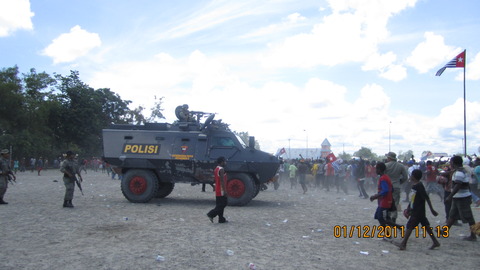
POLRI GEGANA anti-terrorism troops attacking peaceful flagraisers, Taokou Village, East Paniai , December 1 (West Papua Media)

A Papuan human rights group says Indonesian helicopters have been strafing villages, killing more than a dozen people and displacing up to 25,000 others, in their latest operation against the Free Papua Movement, or OPM.

Indonesian media has reported clashed between OPM fighters and the police and military – known as TNI – in the past week in the troubled province.

West Papuans have been seeking independence since Indonesia invaded in 1962, at the end of 130 years of Dutch colonial rule.

Stefan Armbruster spoke with the director of the Institute of Human Rights Study and Advocacy in the Papuan city of Jayapura, Ferry Marisan.

Download Episode Duration00:03:09 Download2MB

SBY: Non-organic troops to withdraw from Papua, UP4B Suspended

Albert Insaf Tarigan – Okezone

Saturday, December 17, 2011

The atmosphere in the Library Meeting SBY in Cikeas.  (Frederika Korain / PGI)

The atmosphere in the Library Meeting SBY in Cikeas. (Frederika Korain / PGI)

JAKARTA – The Indonesian government has promised to withdraw non-organic troops from non-organic provinces of Papua and West Papua.

The promise was delivered directly by the President Susilo Bambang Yudhoyono during a meeting with Papuan church leaders at his residence, Puri Cikeas, Bogor, West Java, on Friday (12/16/2011) night.

The religious leaders present were:

  • Chairman of the Papua GKI Synod, Yemima Kret
  • Chairman of the Baptist Church of Papua, Socrates Sofyan Yoman
  • Chairman of the Kingmi Synod, Benny Giay
  • Martin Luther Wanma
  • Rika Korain

President Yudhoyono was accompanied by Vice President Boediono and several ministers, including Coordinating Minister for People’s Welfare Agung Laksono, Public Works Minister Djoko Kirmanto, National Police Chief Pol Gen Pradopo East, Armed Forces Commander Admiral Agus Suhartono, and Coordinating Minister for Political, Legal and Security Djoko Suyanto.

In a press conference at the office of the Guild of Churches in Indonesia (PGI), Jakarta, this afternoon, the religious leaders expressed appreciation for the government’s intentions.   Moreover, in December, most of the people of Papua  will celebrate the feast of Christmas.

“I convey to the President, this month the month of peace, in love, people should be calm. I asked for the violence to stop, it’s time we embraced each other, ” said Chairman of the Synod to Legal Kingmi Benny Giay, on Saturday (17/12/2011).

Hearing the request, said Benny, the President immediately asked the Police Chief and Commander of the TNI in order to stop the violence,  “President command to the Chief of Police and the Armed Forces (TNI) to stop the violence in Paniai, at least during the month of Christmas, “he added.

Pastor Gomar Gultom, also present at the meeting, explained that the President did not mention a specific deadline for withdrawal of non-organic troops. However, it is still regarded as an important step to begin the process of dialogue between Jakarta and Papua.

“The President ordered all non-organic troops to be withdrawn and stop the security approach as preparation for dialogue, (which) is not possible if there is a security approach,” he said.

Gultom referred to the (military) assault by Army and Police in Paniai from 12 to 15 December 2011 that has killed (at least) 15 people.  The official explanation by police is that they seized and occupied the headquarters of the TPN/OPM (National Liberation Army of West Papua). {West Papua Media note: independent human rights activists and church officials have accused TNI and Police of village burnings, helicopter attacks and massive displacement of 20,000 civilians in the campaign – which is still ongoing}.

According to Gultom, dialogue can not happen if at the same time there are security operations in the territory of Papua.   Until now, it is unknown the exact number of non-organic troops stationed in Papua.  Imparsial, a human rights organisation last August claimed there are approximately 30 thousand troops in Papua.  Of these, 14,000 are organic forces under the control of the Cenderawasih region military command.

Gultom said the two sides have not yet determined the dialogue format, nor points to be discussed, as a new opening meeting last night heard similar views. Furthermore, religious leaders are scheduled to meet again in mid-January 2012 in order to formulate the program in more detail.

However, in general, the President outlined the government’s position in the dialogue within a five point framework, namely the integrity of Indonesian territory and sovereignty integrity and sovereignty of Indonesia, Special Autonomy, Acceleration and expansion of development, with special act for affirmative action, and upholding the rule of law against all who violate the law.

“Affirmative action was meant as long as there is injustice against the people of Papua.  So later given the opportunity to them, for example, sitting in the government and so forth, ” he said.

Gultom added, President  SBY also expressed in the meeting his views about the role of the Unit to Accelerate Development of Papua and West Papua (UP4B) led by Lt. Gen. ( ret) Bambang Darmono. The Religious leaders view was that UP4B was formed unilaterally, and without hearing the aspirations of the Papuan people.

“There is a meeting point agreed upon last night.   All points will be evaluated together, and  UP4B will be stopped until results of the joint evaluation are available,” he said.

The religious leaders (repeated their) call for international third-party facilitated dialogue. In addition, they asked the government to release all political prisoners, and to repeal Government Regulation Number 77/2007 that regarding the prohibition of  the use of “separatist” symbols in Aceh, Maluku and Papua.  This regulation is the government’s basis to prohibit raising the banned Morning Star flag, despite Papuan people being legally allowed to fly the flag by the government of former President Abdurrahman Wahid. (ugo/edited by WestPapuaMedia)

http://news.okezone.com/read/2011/12/17/337/543723/pasukan-non-organik-ditarik-dari-papua-up4b-dibekukan

West Papua Media Note:  this significant news was confirmed on December 18 during telephone conversations with participants and observers at the meeting and this article is was written at the request of observers, however comment has been sought from other parties.  

West Papua Media Editorial comment:  At the face of it, this appears to be  a hughely positive step and announcement.  However, by refusing to set specific deadline, or measurable and achievable guarantees, it remains to be seen whether this is yet more window dressing whilst still refusing to address the root causes of violence in Papua today: which is the behaviour of Indonesian security forces, and suppression of West Papuan peoples basic human rights to self-determination and freedom from persecution, and their desires for West Papuan independence.

Please contact West Papua Media for contact details for meeting participants.

KAMPAK Papua Condemns Police Beating of Human Rights Activist and Legal Aid Lawyer

by Oktovianus Pogau at PAPUAN VOICES

(translation, editing by West Papua Media)

SUNDAY, DECEMBER 18, 2011
Dorus Wakum, human rights activists and Kord Papua Axe (Photo: Papuan Voices)
 Jakarta — Indigenous Papuan Communities Against Corruption  in Papua (KAMPAK) condemned the beating of human rights activists and lawyers from Indonesian Legal Aid Foundation (YLBHI) by Jakarta Police Mobile Brigade, yesterday afternoon, Saturday (17/12) at the YLBHI Office.
Dorus Wakum, a Papuan activist from KAMPAK, in a media interview on  Sunday (18/12), said that the beating incident must be followed up, and unscrupulous Brimob brutality must be prosecuted according to the law.
“If you need to fire corrupt Chief of Police and Mobile Brigade members , because they have clearly committed brutal acts against human rights activists,” he added. Dorus explained that after the incident, police and intelligence officers continued to keep the office of the Legal Aid Foundation under surveillance, and also to block access to the KontraS (Commission for the Disappeared) office on Jalan Borobudur KontraS, Menteng , Central Jakarta.
“This has caused great anxiety for civilians who live around the KontraS  and YLBHI offices.  They (officers) keep passing by with full weapons deployed” .  Dorus said for three days armed forces have been monitoring all activists, and human rights lawyers activities in these two offices.
 “The Metro Jaya police chief should withdraw his officials from around the office YLBHI and KontraS right now,” he said.  The beatings of human rights activists and lawyers from YLBHI lasted until about 05.00 pm yesterday afternoon.
Occurring directly outside the YLBHI office.  a lawyer named Sidik admonished some of the Mobile Brigade officers who were at YLBHI offices without a warrant.  Not thankful for being reprimanded, Sidik was hit directly behind by some Mobile Brigade officers.  At time of writing the beating complaint has not been followed-up the Jakarta Police.
WEST PAPUA MEDIA note:  KontraS, a highly respected Indonesian human rights NGO, has been highly critical of Jakarta’s abuses and military approach to dealing with Papua, and it’s lawyers are regularly targeted by security forces for representing victims of abuse.

A Christmas Message to SBY from Papuan Churches

by Andreas Harsono

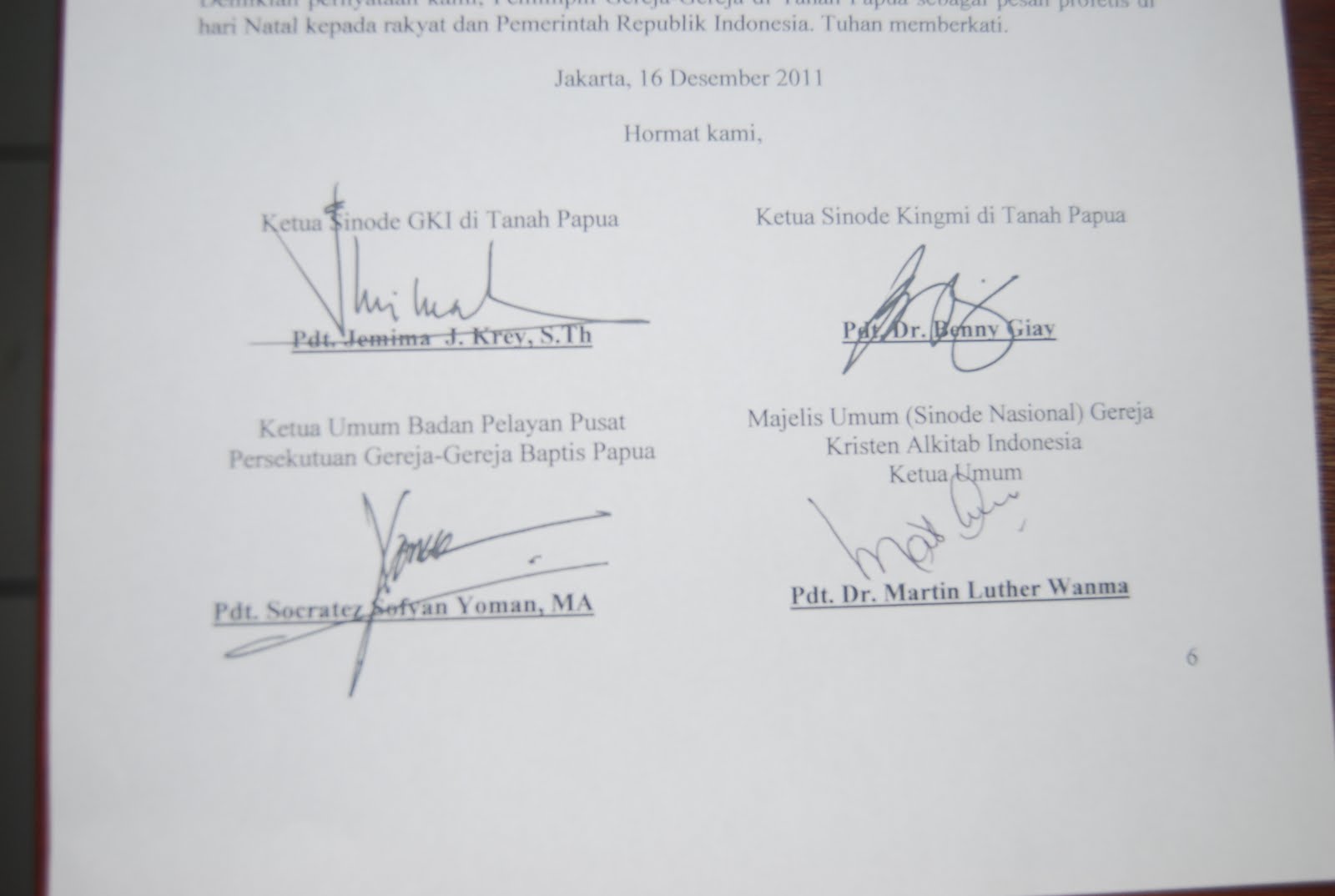
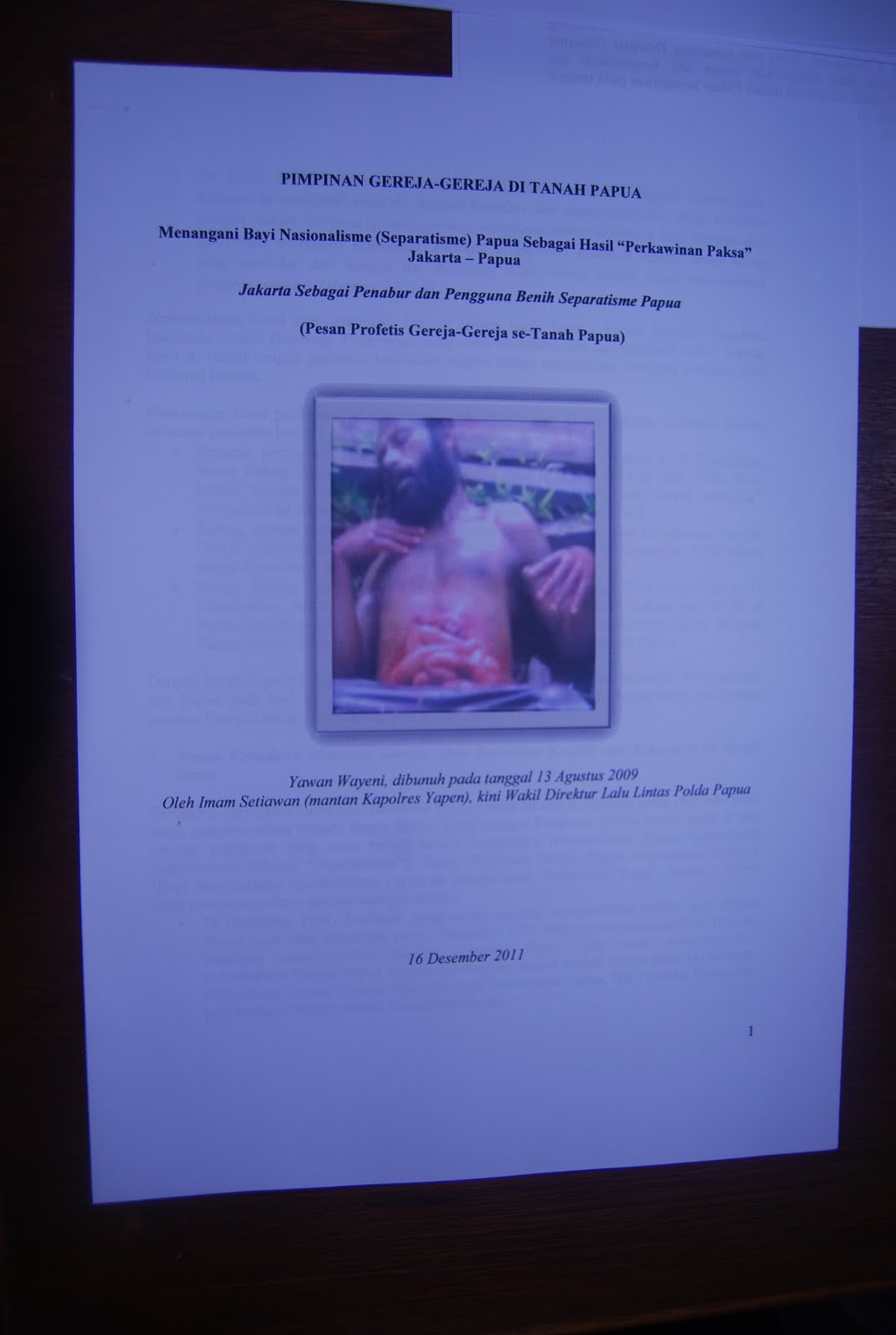
FOUR PAPUAN church leaders drafted and debated about their letter to President Susilo Bambang Yudhoyono while they’re in Jakarta this week. They met Indonesian Coordinating Minister on Politics and Security Djoko Suyantoon Monday, Dec. 12. They spent the next four days to draft the seven-page letter. It was finally signed at about 4pm at the office of the Communion of Churches in Indonesia. They handed over the letter to President Yudhoyono on Friday night at his private residence in Cikeas.They titled the letter, “Pesan Profetis Gereja-Gereja se-Tanah Papua” or the “Prophetical Message from the Churches in the Land of Papua.”

Frederika Korain, a Papuan human rights researcher, thought that it was an important, and histotical moment. She decided to record the moments when the letter was signed.

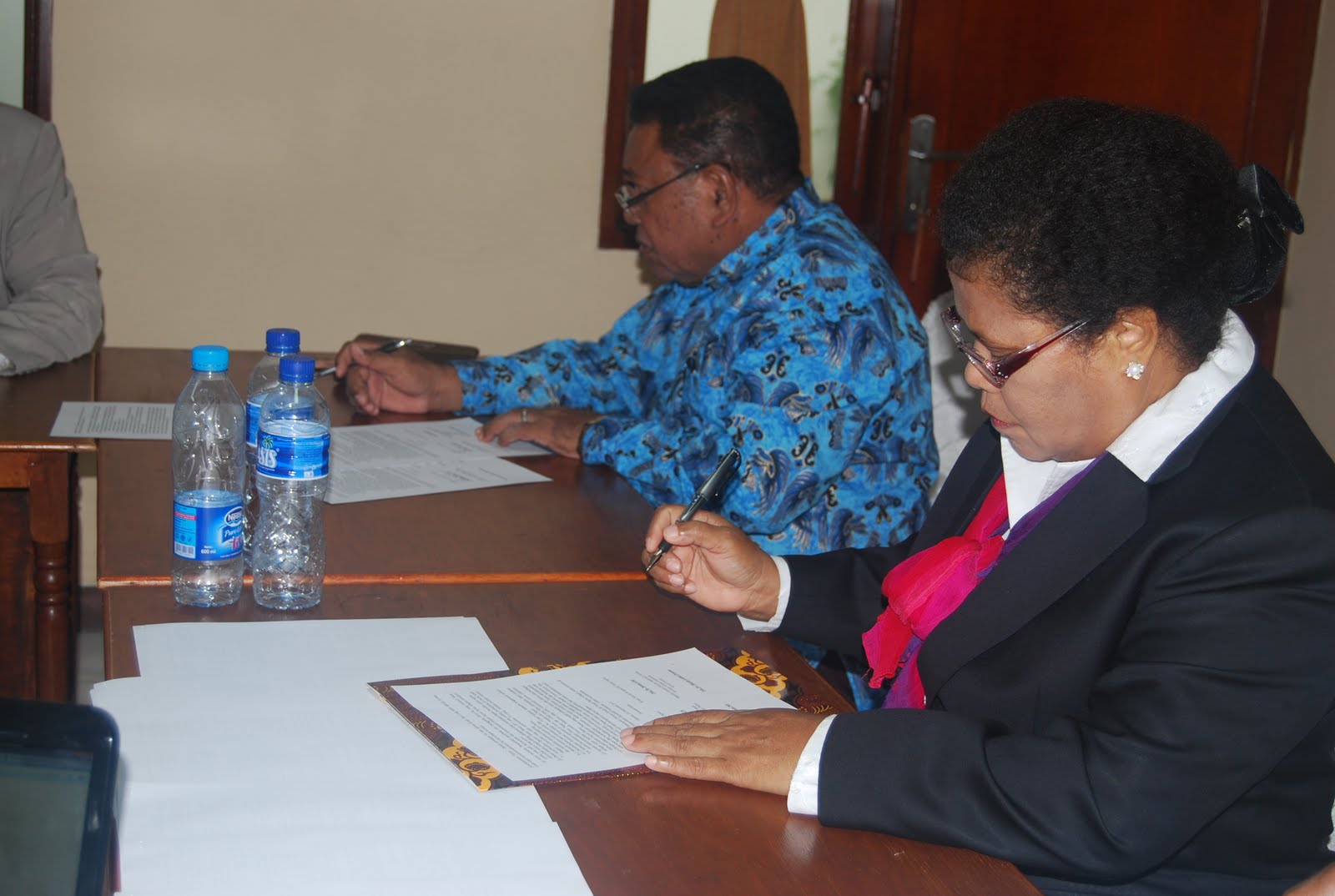
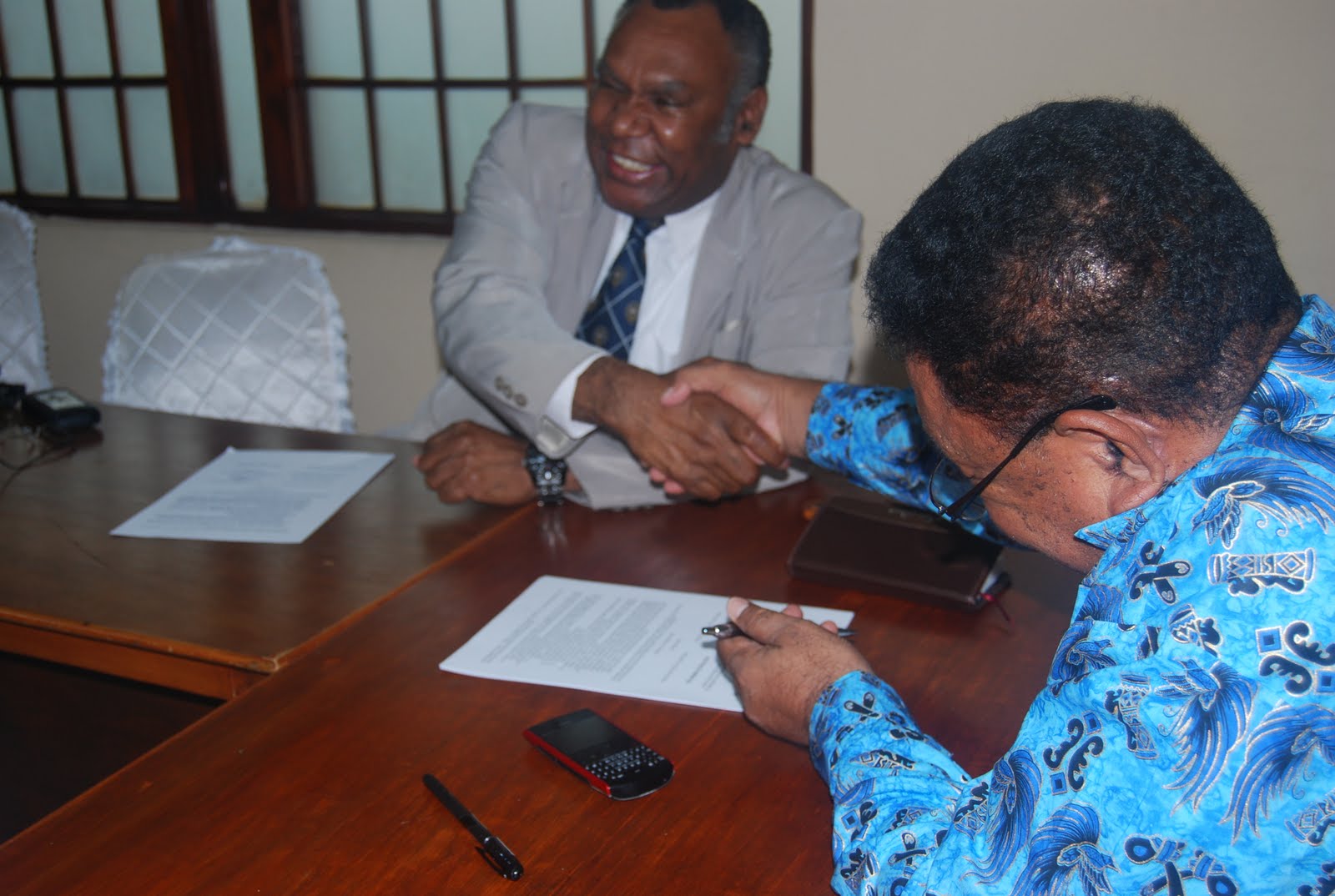
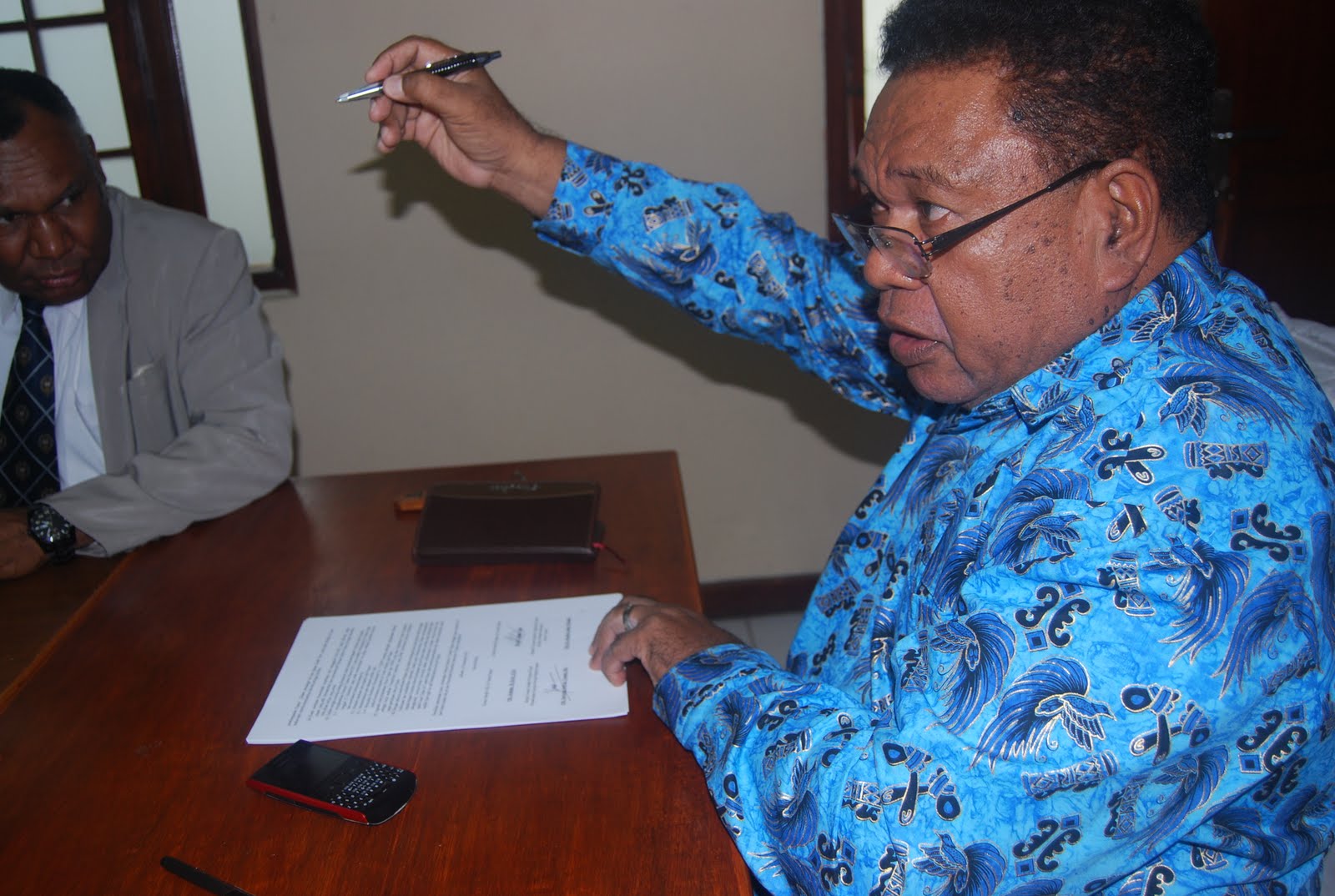
Rev. Martin Luther Wanma, chairman of the Indonesian Christian Bible Church (blue batik) and Rev. Jemima M. Krey, chairwoman of the Evangelical Christian Church in Papua (black blazer and red scarf) signed the seven-page letter. ©Frederika Korain
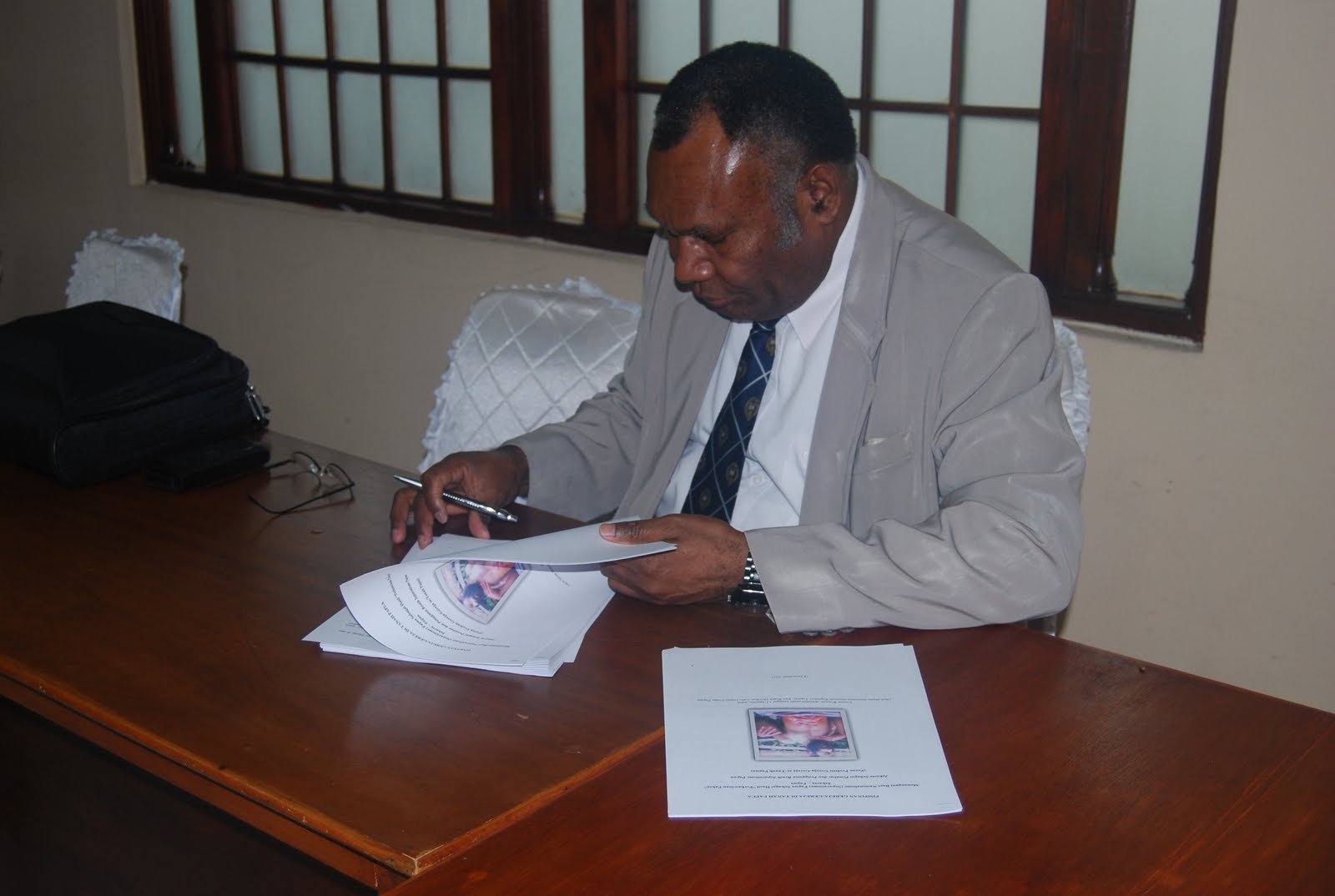
Rev. Socratez Sofyan Yoman, chairman of the Alliance of Baptist Churches in Papua signed the seven-page letter. Yoman is also an author. The Indonesian General Attorney Office bans two of his books, Kucuran Air Mata Umat Tuhan di Papua Barat Harus Diakhiri and Pemusnahan Etnis Melanesia. ©Frederika Korain

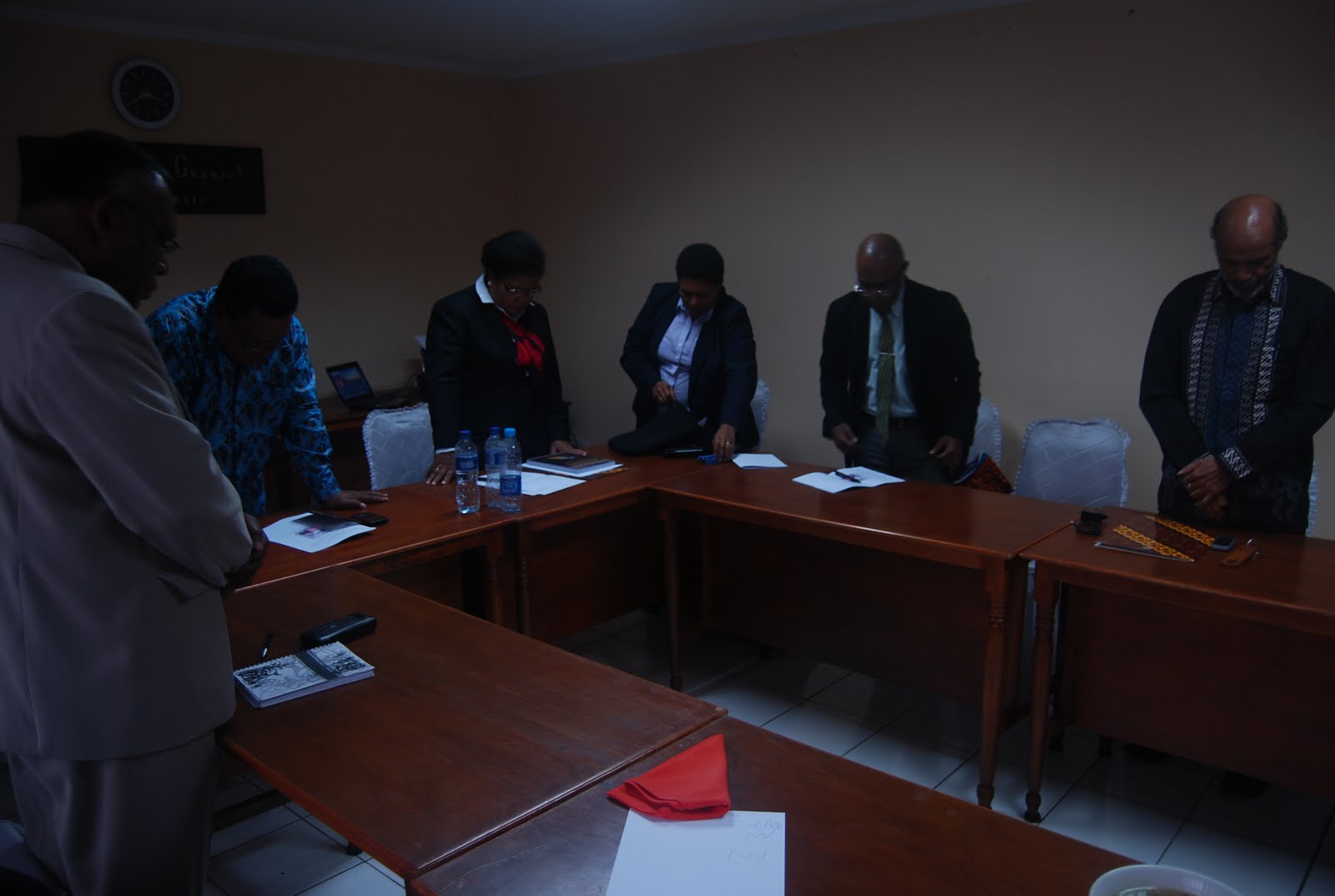
They prayed and shook hands after signing the seven-page letter. They spent most of their time in the office of the Communion of Churches in Indonesia on Salemba Street, Jakarta. It has a Papua Desk dedicated solely on helping Papuan churches doing their businesses in Jakarta. Rev. Phil Erari, a Papuan priest, an environmentalist and a board member at the Communion of Churches in Indonesia, also attended the signing event.

Rev. Benny Giay, chairman of the Kingmi Gospel Tabernacle Church, spent days to discuss the letter with his colleagues. Giay is also an anthropologist educated at the Vrije University in Amsterdam. When meeting Giay, President Susilo Bambang Yudhoyono, himself a Ph.D, asked Giay in what field he wrote his Ph.D thesis. ©Frederika Korain
Rev. Martin Luther Wanma, chairman of the Indonesian Christian Bible Church, gestured to Rev. Socratez Yoman when signing his letter. Rev. Wanma is based in Manokwari unlike the other three church leaders with their offices in Jayapura.©Frederika Korain


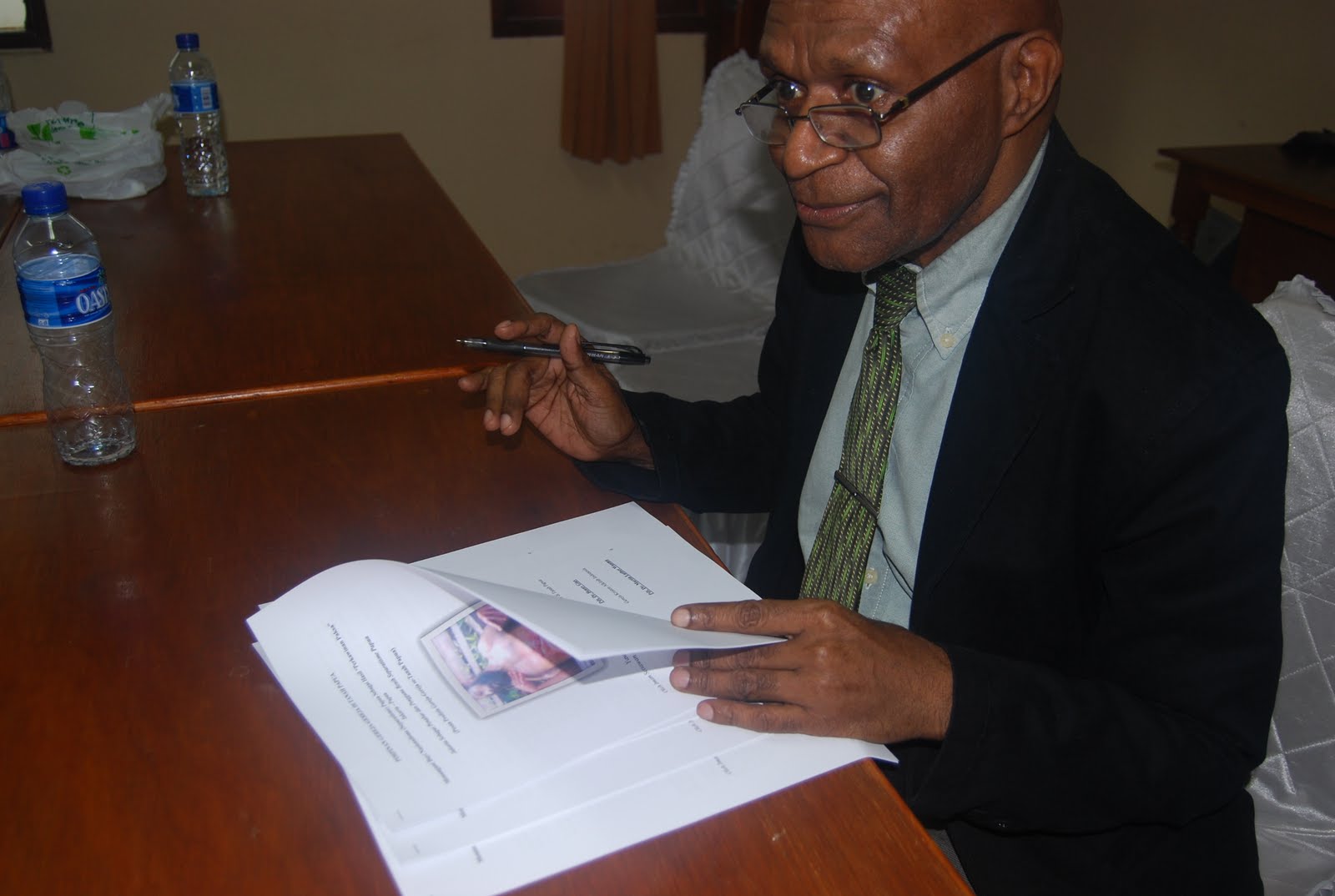
The seven-page letter has the picture of a dying Papuan freedom fighter, Yawan Wayeni. It says that Indonesian police officer Imam Setiawan had killed Wayeni on Aug. 9, 2009 on Serui Island. Setiawan got a promotion. He became the police chief of Jayapura. On Oct. 13, 2011 he led the use of excessive force to crack down the Papuan Congress after one of the leaders read out the 1961 Papua Declaration of Independence. Setiawan is now the deputy director of traffic management at the Papuan police department.

Create a website or blog at WordPress.com

Up ↑