Beata Yaboisembut Akim: The woman who accompanies the ‘President’

Suara Perempuan Papua, 25 March – 7 April 2012

[Translation by TAPOL]

Opinion

Surrendering their lives to God, they remain calm when they face trouble

It was during the week of Christ’s sufferings that Forkorus Yaboisembut was found guilty of treason and sentenced to three years imprisonment. His wife, Beata Yaboisembut was at his side throughout the trial. Dressed in dark brown trousers and a blouse, she sat in the courtroom, calmly following the proceedings. She accepted the result with a feeling of relief.

‘Bapak was always telling us to keep calm. We should not feel troubled and feel grateful that our children are already grown up and can understand what is going on. And please remember that this is the week of suffering and we must all think about the sufferings of our Lord.

Lord Jesus suffered much more than this for our sins. And you must be willing to accept my sentence, said Forkorus’. As a mother and as his wife, she expressed her belief in him.

She first met her husband when they were studying together at the Taruna Bakhti Waene College. They were among the first generation of students at the college and graduated in 1975.After graduating, they were both sent to isolated places in West Papua. Mama Beata was sent to Wamena and Forkorus was sent to Sarmi. In 1976, they decided to get married in Jayapura and after getting married, they each returned to their jobs. Mama Beata was given a job at the Oksibil YPPK primary school and worked there for three years.  She was then sent to Sobron, after the kampung where she was working was attacked.

After her husband became active in the Papuan Customary Council (DAP), Mama Beata saw this as a huge responsibility that was to be borne by him.’Bapak is an Ondoafi, part of our tradition and enjoying the trust of the people. He is greatly respected and loved by the people, just like us, his wife and our children.’

He was the third of six siblings. His two brothers are not with him in Sobron. Forkorus also has two younger brothers and a sister who all live in Nabire.

After being elected as the Chairman of DAP, Beata realised that he no longer belonged just to her but belonged to all the Papuan people. ‘This is why Bapak has always told his children to stand on their own feet.’

As his wife, she realised that his election as the chairman of DAP would have many consequences for herself and for their children which is why he has always stressed the importance of their living their own lives independently.

Fortunately, only two of their children are still studying at Cenderawasih University while their oldest daughter is an expert in civil technology, and the sons have completed their studies in architecture. ‘The youngest is now at sixth grade while his older brother should have graduated last month on 15 March. But never mind, as Bapak is now on trial, his needs are our priority.’ Her daughter’s husband has to rely on the wage he earns as a teacher. As for her own husband, he has not been earning anything since last year.

‘I was not there to see Bapak when he was arrested because I had just returned from Sobron.’  She was preparing food for the [Third Papuan People’s] Congress but before anyone could start eating, the security forces destroyed everything that they had prepared.

When she and the other women heard gunshots and saw tear gas bombs exploding, they ran to the mountains around the Zakeus Field. ‘People can be arrested at any time and I was told never to get worried. On that day,’ she said ‘I tried to keep calm and to find my way home to Bapak so that I could be together with him at all of the court hearings while keeping calm.’

‘Forkorus has always told our children to focus on their education and not to follow him on his chosen path. But the children are always deeply concerned about what is happening to him and they always accompany me when I visit him in prison. I know that they readily accept what is happening to their father. Maybe this is the path chosen by our Lord for this country of ours,’ she said.

During the trial, Bapak stayed overnight at the lodgings of their daughter who lives in Waena. It is a small room, 3 x 4 meters, where the three of them slept. Their home in the kampung is being looked after by Mama. The youngest daughter frequently goes back and forth to visit their grandmother. Because their home in Sobron is 80 kilometres from Abepura, Mama decided to stay with her daughter so that it would be easier for her to visit her husband.

She said that during the time she has been attending the court hearings, neither she nor the children have experienced any terror or intimidation. ‘And Bapak is always telling us to keep calm.’

She visits her husband three times a week, on Monday, Wednesday and Saturday. ‘We are only given 15 minutes to sit together, side by side.

That is quite enough for me,’ she says, ‘because I know that the Lord is there with him.’

She is still busy teaching grade 1 and 2 children at the primary school in Sobron. When she visits her husband, she takes him food and clean clothes. ‘As he is not alone in the prison, I always take food for the other prisoners as well.’

She says that her husband is not fussy about the food she brings, as long as she cooks it. She takes him porridge, vegetables and fish and on special occasions, she cooks him some meat. Ever since he has been in prison, Forkorus has never asked her to bring anything. ‘In fact, when I meet him, he always has a present for me, as well as giving me his dirty clothes to be washed,’ she said, with a laugh.

She can also visit him on Sundays but only to take part in a service together. She is not allowed to take anything except a Bible. They have services twice a day, once in the morning at 8am for the Protestants and once in the evening for the Catholics.

Mama always arrives at 7am to say prayers together with her husband.

Sometimes he asks her to stay for another prayer, after her visit to him has ended. so that she too can receive the body and blood of the Lord, Jesus Christ during the Holy Eucharist as she has continued to be a Catholic.

Mama Beata is the third of six brothers and sisters from Kampung Yuruf Keerom where the majority of the people are Catholics. In December, she will be 59 years old. Because of unsatisfactory conditions in the kampung, the people have been forced to move frequently. Only one of her sisters is still living in Yuruf while one of her brothers died in Vanimo. The two other brothers are living in Vanimo.

‘Prayer is the source of our strength. Everything we achieve, all our happiness and sadness  are part of our lives and my family leaves everything to the one who gives life, to the Lord God Creator of all,’ she said, when she was asked what her future plans for her family were.

This is the first in a series of articles by Suara Perempuan Papua commissioned by TAPOL on the impact of the Papua conflict on women

“The Indonesian Government Occupies, Colonises and Marginalises Indigenous Papuans”

by Socratez Sofyan Yoman

translation by WestPapuaMedia from SuaraPapua.com

April 3, 2012

OPINION

(“…thousands of young Papuans that scream against the impartiality, hope the regional government must be aware that the Special Autonomy Law is present for whom? That the Law was created for what? Because of the demands for Independence “to free themselves from The Republic of Indonesia” for the people of Papua.” (Dr. “HC” Herman A. T. Yoku, SIP, Cenderwasih Post and Papua Star, Friday 30/3/2012).

Noble and respected Opinion readers, in my Opinion piece on the topic ‘The Indonesian Government fails to Develop and Protect Indigenous Papuans’, that was published in the Pacific Post, Tuesday 20th March 2012, and in the Papua Star, Thursday 22nd March, 2012, I quoted the promise and commitment by the Government of Indonesia for indigenous Papuans when Papua was forcibly integrated into Indonesia in 1969 with the engineering of the 1969 Referendum.

The quote is as follows: “Interior Minister stated …. the government of Indonesia, is willing and able to protect the welfare of the people of West Irian, therefore, there is no other choice but to live with the Republic of Indonesia” (Source: United Nations Official Records: 1812th Plenary Meeting of the UN Assembly, agenda item 98.19 November 1969, paragraph 18, P.2). After 31 years from 1969 to 2000, the Government of Indonesia made a promise and commitment that is almost the same, in Act No. 21, Year 2001 on Special Autonomy, for: pemberdayaan (empowerment), perlindungan (protection) and keberpihakan (affirmative action) for the original inhabitants of Papua and the Papuan People that have been forced to live within the Republic of Indonesia.

But the reality is that the people of Papua, Indigenous Papuans and the owners of this land and country, are treated inhumanely and are slaughtered like animals in the name of Indonesia. A concrete example: Three Indigenous Papuans were shot dead by security forces on 19th October 2011 at Zakheus field, the shooters were only given disciplinary punishment. This betrayal of human dignity cannot be tolerated in a context of humanity. There is no reason to kill people. It is the toughest crime committed by the state.

Examples of other facts such as the Cenderwasih Post reported: at the Offical Echelon Inauguration at Keerom District, Community Leader from the Indonesia-PNG border, Keerom, Dr. (HC), Herman A.T.Yoku, S.IP, said: “Many young Indigenous Papuans are treated like step-children in the appointment into the echelons. From 117 new Echelon II, III and IV officials inaugurated a few days ago, if carefully calculated, the number of local young people inaugurated is less than 10, from all of those sworn in. I had hoped that affirmative policy that was mandated in Act No. 21, Year 2001 would necessarily be considered by the local government…’ (Cenderawasih Post, Friday, March 30, 2012, p. 14). “As young Papuans the Governor should be aware that the Special Autonomy Act is for who? At the Echelon Inauguration yesterday (Thursday, 29/3/2012) I have not seen one Papuan child sworn in, let alone one Indigenous Keerom child from this country. I am very sorry as a community leader who fights to expand this area – why is it that the governor can’t pay attention to this area? If for only one interest I requested this position, it is that this region can be considered safe because young indigenous Papuans say themselves it is safe.” (Papua Star, on Friday, March 30 2012, p 5).

In my opinion columns about The Special Autonomy Act No. 21, Year 2001, I continually, frankly and openly present the topic (1) “Special Autonomy has failed in Papua”: Papua Star, Thursday, 09/02/2012, p.5; (2) “It’s Time: Papua People Stand Alone”: in The Pacific Post, March 13, 2012 and Papua star, March 16, 2012; (3) “The Indonesian Government fails to Develop and Protect Indigenous Papuans” in the Pacific Post, Tuesday, March 20, 2012 and Papua Star, Thursday , March 22, 2012.
“Special Autonomy is a political solution or a political bargaining between the peoples of Papua and Indonesia, in order that Papuans remain in Indonesia with a guarantee to protect the people of Papua, the empowerment of indigenous Papuans, and affirmative action for indigenous Papuans. However, “in reality, the Special Autonomy has truly failed. Special Autonomy has truly become a killing machine of God’s people in Papua and a destroyer of a future Papuan society and nation.”

Special Autonomy has really become a potent tool for the process of ethnic cleansing in Papua that is safer, quicker, more systematic and does not raise the suspicions of the international community that cares about humanity. Special Autonomy is an institution that prolongs the agony, drops and flow of tears of Indigenous Papuans. Special Autonomy is a solution and political decision about Papua’s political status within Indonesia that has already failed. Special Autonomy is a destroying machine that really marginalises Indigenous Papuans from every aspect. Special Autonomy is second volume of the 1969 Referendum that has already failed and become a new problem.”

Herman Yoku says: “… i am very sorry as a public figure who fights to expand this area – why is it that the governor can’t pay attention to this area?” From this statement it seems evident that many Indigenous Papuan Officials do not have the critical ability in relation to the strategies and traps set by the Indonesian Government around the expansion of districts and provinces over the land of Papua. I regret very much, the way of looking and thinking of young Indigenous Papuan officials that the expansion of districts, cities and provinces are the result of hard work and struggle. It really is not like that.

The real background of the hectic expansion of districts, cities and provinces over the land of West Papua that is wild and uncontrollable, is purely political, economic, security, and a structural and systematic process of ethnic cleansing of Melanesians. And all the political policies of the Indonesian Government are not interested in progressing, advancing and increasing the welfare of Indigenous Papuans. In my opinion, the key clause in the expansion of districts and provinces is the military operation and new style Transmigration operation for the hastening of the ethic cleansing of Melanesians. I have written in an Opinion Column in the Pacific Post, 25th September 2009, with the topic: ‘district/City and Province Expansion in West Papua is a Military and New-style Transmigration Operation’. Special Autonomy Act No.21, Year 2001, has FAILED.

Expansion of Districts, Cities and Provinces that is not balanced with Indigenous Papuans forms chains of occupation, colonisation, and marginalisation. Indigenous Papuans are now being encouraged to take shelter behind the slogan of national development. “Political pitting (the politics of divide and conquer) such as applied by colonizers in Apartheid South Africa in 1978. Pieter W. Bother became Prime Minister and splintered the unity of South African society by setting up puppet states: The Puppet State of Transkei, Puppet State of Tswana, Puppet State of Venda, Puppet State of Ciskei. In the Papuan context, the Colonial Government of Indonesia has formed many puppet districts and also puppet provinces in order to break up the wholeness and unity of Indigenous Papuans.” (Yoman: p. Destruction of Ethnic Melanesia, Breaking the Silence of the History of Violence in West Papua, 2007: p. 224).

The Author himself has documentary evidence writing about military operations. If readers read my book entitled: ‘The Gate to Free Papua’ (Socratez Sofyan Yoman; 2000. Page. 78-86), it is very clearly found in this book, highly confidential documents released by the interior department Director General of the Office of National Unity and Community Protection (DITJEN KESBANG dan LINMAS) in official notes number: 578/ND/KESBANG/DIV/VI/2000, 9th June 2000 by radiogram Governor (Caretaker) head level 1 Irian Jaya, No. BB.091/POM/060200, dated june 2000, and No: 190/1671/SET/ dated 3rd June 2000. The primary goal is a plan and operation of regional conditioning, development of communication networks and the establishment of provinces and districts in Iran Jaya (Papua).

Implementing this operation of conditioning and expansion is the Interior Department, Department of Defence and Security, Department of Foreign Affairs, especially for diplomatic operations, Indonesian Police, Indonesian Military (TNI), the State Intelligence Coordinating Agency (Bakin), Strategic National Intelligence Agency (BAIS ), SPAM, AD Hearquarters, ASTER, KASTER TNI, SINTEL Headquarters, National Police (POLRI), Army Strategic Reserve Command (KOSTRAD), and Special Forces Command (KOPASSUS), Regional Leaders Forum Iran Jaya (Paupa) Province and other provinces.

Another document is a document from the National Security Council Secretary General, Jakarta, May 27 and May 28, 2003 on ‘Strategy for Conflict Resolution with separatist contexts in Papua Province through a political approach to security’ (this document can be seen in my book: “Voice for the Voiceless” Dumma Socratez Sofyan Yoman: 2009; pg. 117-118).

These two documents show the face and militaristic character of the Indonesian Government that annexed and occupies West Papua, and colonises Indigenous occupants, Melanesian people through political engineering since May 1st, 1963, the 1969 Referendum, and legislation Act 21, Year 2001 on Special Autonomy to this day. After annexation, to this date West Papua is seen by the Indonesian Government without an interest in the principles of justice and humanity along with the future survival of the people – the owners, heirs to the country and land of West Papua. The Indonesian Government administers West Papua as a problematic region and conflict area that needs to be resolved by a security approach. Although a security approach is evidently a total failure and the cause of human rights violations that are ruthless and grieve the heart of God’s people.

The expansion of districts / cities and provinces on a large scale if viewed from requirements such as: population, territory, natural resources and human resources; from all of these requirements in relation to total population and the readiness of human resources it is very ironic. Because the total population of Indigenous Papuans is only 1.5 million that does not need many districts/cities and provinces throughout Papua. Many districts/cities and provinces also need human resources that can fulfil the rank and stratification to occupy positions – both structural and functional positions.

Consequences of the large-scale expansion of districts/cities and provinces in West Papua are:

  1. The sending of officials from outside Papua to occupy important and strategic positions when Indigenous people cannot yet fulfil the criteria of rank, skill, experience, level of education.
  2. The sending and coming of people from outside to take economic opportunities in the regional expansion and the marginalisation and destruction of Indigenous people. Mr Juan Mendez, UN Secretary General Special Adviser in the field of Prevention of Genocide, stated: “West Papua is one area that is very alarming because the indigenous population is in danger of annihilation”. Yale University, USA, and the University of Sydney released a report that in Papua there is ethnic cleansing of Indigenous Papuans occurring.
  3. Construction of military and police bases for reasons of national security along with security and safety of settlers.
  4. Dispossession of the people for reasons of building government offices.
  5. Appropriation of community land for the purpose of building large shops, malls, supermarkets, mega-hotels and restaurants.
  6. The destruction of mountains and hills of the people.
  7. Destruction of sago and palm trees as a resource for income and peoples’ lives.
  8. Destruction and pollution of water owned by original inhabitants.

The Indonesian government and security forces have failed to build and instil the ideologies of Pancasila, the 1945 Constitution, The Unitary Republic of Indonesia, Unity in Diversity into Papua’s original inhabitants. On the contrary, the Government and the Indonesian security forces have been successfully built and strengthened ideology of West Papuan Independence by nurturing separatist stigma, rebellion and OPM. This is a fatal mistake made by the Government and security forces over the years. The approach of the Government and Security forces which does not respect human dignity, to this day has alienated the people’s hearts from Indonesia. The Indonesian government and security forces with violence have only managed to integrate (Papua) economically and politically into Indonesia. The Indonesian government really occupies, colonises and marginalises Papua’s original inhabitants.

Due to the failure of the Indonesian Government in Papua, Dr George Junus Aditjondro said: “The problems in Papua have been very difficult to resolve. Therefore, there is no other option but to follow the passionate demands of the people of Papua who want a referendum. And the Indonesian Government must immediately withdraw from Papua. Only a referendum can determine whether the Papuans still want to be part of Indonesia or not “(George’s Commentary at the launch of a book entitled:” West Papua: International Issues “, in the Kontras Office, Jakarta, Thursday, 11/3/2011).

“It’s only a matter if time, if we like it or not, want it or not, we will lose Papua because we have failed to capture the hearts of Papuans and this has been the problem from the beginning.” (Dr.Adnan Buyung Nasution, S.H. : source: Detiknews, Thursday, 16 December 2011).

“I know, I understand and also I’m aware that which I devote here. Therefore, if you are certain or not, believe or not, like or not, are happy or not, sooner or later West Papuans will gain independence and stand alone as one people and nation sovereign over their ancestor’s land. In this confidence and spirit, whatever the risk of people’s opinions and commentary, with firm believe and determination of conscience, I dedicate my knowledge to writing books of cultural history and every occurrence upon this land. So that the children and grandchildren of this nation, into the future, will learn that this nation has experienced a long history and long, bitter and unspeakable suffering perpetrated by the Indonesian Government.” (Ita Wakhu Purom, Numbay (Jayapura), West Papua, Thursday, June 9, 2011, 21:17 WP). This statement of faith has been immortalized in my 13th book entitled: “West Papua: An International Problem” (Yoman: 2011, p.4).

“Upon this rock I place the civilisation of Papuan people, although people possess high intelligence, reason and Marifa, they cannot lead this nation, this nation will rise up and lead itself” (Wasior, Manokwari, October 25, 1925, Rev.. IS Kijne ).

*Author: Chairman of the Board of the Fellowship of Baptist Churches of Papua.
POLICE SEIZE FUEL, OWN GAS STATIONS IN NABIRE, PAPUA

by John Pakage for West Papua Media

Wednesday, 28 March 2012

Opinion

PROTESTS AGAINST FUEL PRICES INCREASE SWEEP INDONESIA AND PAPUA

In Nabire, Papua, there are gas stations owned by active Police officers, and rumours are circulating that security forces are manipulating subsidized fuel stocks in Papua. While in Papua Police officers own gas stations, elsewhere Police officers are seizing fuel belonging to civilians. Take for example the case in Tuban, East Java: on March 22, 17 drums of diesel fuel were found by police during sweeping raids to counter fuel hoarding in anticipation of the Indonesian government’s increases to fuel prices which come into effect April 1 2012.

Besides this, Police Inspector-General Saud Usman Nasution, Division Head/Community Relations, also stated that there have been no fewer than 266 charges laid in 232 cases of fuel hoarding in Kalimantan, with a further 11 cases still under investigation. If Police are empowered to seize people’s fuel, then who can tackle the Police’s control of fuel stocks in Papua?

Meanwhile though the price of fuel has yet to increase officially, in Papua and especially in the areas of the interior, fuel prices have already skyrocketed up to Rp. 20 000-30 000 ($2.15-3.25 USD) per litre, leaving one to wonder: just how high will prices rise after April 1?

To oppose the program of the SBY (Susilo Bambang Yudhoyono)-Boediono government to raise fuel prices from Rp. 5000 to 6500 ($0.55 to $0.70 USD), mass protests have spread throughout Indonesia. With students and workers leading the way, it is not simply party cadres demonstrating, but even housewives are taking to the streets and refusing to accept the government’s policy.

Regrettably, at the time of these massive demonstrations, President SBY, who was selected by the Indonesian people, has not even been present in Indonesia. Will the President answer the demands of the people, meet with them and comment on their aspirations? Until now no such word has been uttered by the President.

Many parties judge fuel prices increase to be unrelated to world fuel price fluctuations but rather intended simply to increase net revenues, as suggested by Hendrawan Supratikno, member of Committee 5 of the People’s Legislative Assembly (DPR), Tuesday March 27.

Of course, the increase to fuel prices is felt directly by the people, such that a coalition of Papuan students from different Universities in Jayapura have demonstrated in front of the Papua People’s Legislative Assembly (DPRP), Tuesday March 27.

Alas, the government seems unwilling to alter its fuel increase policy even facing masses of thousands organizing actions all over Indonesia.

Still, the efforts to pressure the Indonesian government continue. These actions have brought victims: the protest in Jakarta left 15 people injured after a clash with police at Gambir, Central Jakarta; the victims were taken to Cipto Mangunkusumo Hospital (RSCM).

Here are the names of those hospitalized, as posted at RSCM Emergency Department:

1. Fajar, student from Univertas Pamulang (UNPAM)

2. Makmun, student from UNPAM

3. Pungky, student from UNPAM

4. Erwin, student from Palu, South Sulawesi

5. Fariz, from Lenteng Agung

6. Ahmad Sofyan, student from UNPAM

7. Okki, student at IISIP

8. Alif al hafidi from Bogor

9. Alan Fitnur from Cirebon

10. Moch Taufik

11. Moh. Imam, student from BSI

12. Idris Syahrian, PDIP officer, Bekasi

13. Ahmad Bagja from Komplek Depag, Tangerang

14. Bribtu Dhany, from Mako Den B, Pelopor Cipinang

15. Zein, student from Sulawesi

Besides this, in Makassar as well, Metro TV has reported on the beating of a student by Police. The student’s condition is of course cause for serious concern.

Meanwhile, President SBY continues to sojourn overseas. To counter the mass demonstrations, SBY has deployed thousands of Military (TNI) troops as well as fully armed Police units. Not only this, but Interior Minister Gamawan Fauzi asserted that if the legislation confirming the fuel price increase is made law then local and regional officials known to participate in protest actions will be fired.

The increasing authoritarian and undemocratic character of the State is becoming more visible, as laws guaranteeing freedom of public expression are being pushed aside.

The Interior Minister’s pressure has not succeeded in reducing the number of state officials joining in voicing the people’s aspirations. In East Java, Mayor of Surabaya Bambang Dwi Hartono, who is also a cadre of PDI-P (Indonesian Democratic Party – Struggle Faction), joined the protests rejecting the President’s policy.

Responding to the grave threat from the Interior Minister towards the Mayor of Surabaya, Bambang Dwi Hartono stated that he was chosen by the people of East Java therefore the Minister may go ahead and fire him.

The Mayor’s weighty decision is an example worthy of emulation: putting one’s position on the line for the good of many.

# John Pakage/westpapuamedia

Theo van den Broek on the letter sent to UN by Federal Repblic of West Papua

JUBI 23 March 2012Theo van den Broek, a political commentator about Papua, has said that the United Nations will only respond to letters that come from one of its members whereas all its members are nation-states.

Referring to the decision to register the Federal Republic of West Papua with the United Nations by representatives of the IIIrd KRP (held last October), Theo said that it was necessary to know whether a letter had indeed been sent to the UN and what would happen to it.

‘I understand that they sent a letter but that does not mean that the letter will now be handled by the UN or put onto its agenda. All that will happen will be that the letter was indeed sent but it was passed on to the administration and recorded as a letter that had been received. The letter will be given a number and recorded as a letter that had been received. And that will be it,’ he said.

He said that it would be handled automatically by the administration. He gave an example of what would happen to a letter that he might send to the Dutch government asking to be registered as a Dutch person or perhaps relating to the payment of taxes. It would be registered as a letter coming from a Dutch citizen and an acknowledgement would be received but it would not actually be dealt with because the letter raised problematic matters.

As for the letter from the Federal Republic, it will be recorded somewhere but as it comes from a body that is not recognised by the UN, it will probably never be acknowledged because it does not come from one of its members, given that all its members are nation-states, said Theo. ‘Anyone can send a letter to the UN but if it comes from a body that is not a member of the UN, it is not possible to expect that it will be taken seriously.’

Ban Ki-Moon gets “diplomatic answers” from SBY over Papua

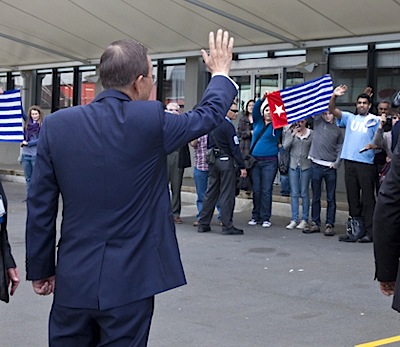
Ban Ki-moon waves to protestors for West Papua, PIF NZ Sept 2011

by John Pakage for West Papua Media

Opinion

President Susilo Bambang Yudhoyono (SBY) and UN Secretary General Ban Ki-moon held a bilateral meeting at the presidential palace in Bogor, West Java, on Tuesday (20/03/2012). In the meeting, human rights abuses in Papua were also discussed.

 UN Secretary General Ban Ki-moon certainly knows in detail about the development of human rights abuses in Papua because he sought a diplomatic answer from the President of Indonesia.

 “Papua is Indonesia and we are obliged to maintain its security, but if there are violations of human rights then there is law enforcement action,” said SBY.

 Of course with this kind of diplomatic answer, SBY wants to hide the number of cases of gross human rights that have occurred, and are continuing to occur now in Papua.  Only at few days before the arrival of Ban Ki-Moon to Indonesia, Forkorus Yoboisembut, Gladius Waromi Edison, Augustine M. Sananay Kraar, Selpius Bobii and Dominic Sorabut were sentenced 3 years in prison on Friday (16/3) with charges of treason for forming the state of West Papua.

 The implementation of the Third Papuan People’s Congress went ahead with official permission from the Indonesian government, both from the central government and the police to hold a congress in Jayapura.   But Indonesia’s military attacked and captured civilians at the Congress without first showing any arrest warrant, in accordance with Indonesian regulation.

 Again and again, military and police forces shot live ammunition at civilians at the Congress, inconsistent with legal process, in stark contrast with Yudhoyono’s promises to Ban Ki-Moon at the Bogor Palace.

The multitude of human rights abuses in Papua, which is tightly closed by state policy that prohibits foreign media and international NGOs from entering Papua,  gave rise to human rights lawyer Jennifer Robinson (lawyer for Wikileaks founder Julian Assange) calling on new Australian Foreign Minister Bob Carr, to immediately urge Indonesia to open Papua up, and allow incoming international NGOs into Papua to conduct human rights investigations independently (see Radio Australia, March 20, 2012).

Indonesia’s policy to cover up human rights abuses in Papua has been harshly rebuked by Human Rights institutions around the world; (see for instance a press release by Franciscans International, TAPOL, the Asian Human Rights Commission, Faith Based Network on West Papua (FBN) and West Papua Network.)

Legal rights agencies lament the unjust decision facing the five civilians who were detained while organising the Papuan Congress, sentenced to three years in prison.   According to these institutions, the Congress was a form of free expression and a fundamental tenet of democracy for communicating opinions.

In addition, humanitarian agencies deplore the attitude of the Indonesian military who with full weaponry arsenal stormed and attacked the Congress participants. This Indonesian Military attack and killed several Papuan civilians. (See: Franciscans International, Release March 16, 2012.)

 Ban Ki-Moon is certainly more aware now of what has happened in Papua since 1969 when Indonesia invaded Papua.   So SBY’s diplomatic answer  of  “SBY diplomacy” might make the number one person in the world confused.

Ban Ki-Moon also mentioned that South Sudan is an example of an area of extended conflict that has embraced the process of ending its fighting.  The UN successfully held a referendum for citizens to determine their aspirations – and they chose independence from the Sudan.

Of course the conditions of ongoing human rights abuses in Papua, covered up by the state policy of denying access to foreign media and international NGOs to Papua, could by its very nature invite a humanitarian intervention to end the conflict in Papua, with (or without) the Indonesian government.

Create a website or blog at WordPress.com

Up ↑
