Papuan Prisoner of Conscience Filep Karma in Jakarta for Medical Treatment

This slideshow requires JavaScript.

Press Release – Karma family

Papuan Prisoner of Conscience Filep Karma in Jakarta

for Medical Treatment

Jakarta, Indonesia [27 September 2012].

Filep Karma, a political prisoner of conscience from Papua, has attended a two-week medical treatment in Jakarta hospital and now is back in the Abepura prison in West Papua. He arrived in Jakarta on September 14 and took a colonoscopy treatment in PGI Cikini hospital, Jakarta.

Indonesian physicians in Jayapura, who earlier examined Karma with simple equipment, suspected that he has a colon tumor. As it is not possible to conduct a colonoscopy in West Papua the physicians referred him to the hospital in Jakarta.

Karma was imprisoned in 2004 and is serving 15 years in prison for participating in a peaceful independence demonstration and for raising the Morning Star flag, an important Papuan symbol of independence.

The UN Working Group on Arbitrary Detention declared him a political prisoner in September 2011, asking the Indonesian government to immediately and unconditionally release Karma. The government, however, denies the existence of “political prisoners” in Indonesia. His injuries were sustained from acts of torture inflicted on him while in prison. He also injured his hip during a falling in 2006.

It took nearly six months for Karma to be able to be transferred to Jakarta despite this referral. Abepura prison officials, under the Ministry of Law and Human Rights, have refused to cover cost of his medical treatment and travel. The Indonesian government’s refusal to cover his costs is in direct contravention of national and international law.

According to United Nations Body of Principles for the Protection of All Persons under Any Form of Detention or Imprisonment (Principle 24), and Indonesian law (Regulation No. 32/1999 on Terms and Procedures on the Implementation of Prisoners’ Rights in Prisons) it is required that all medical costs for treatment of a prisoner at a hospital be borne by the State.

Despite the Abepura prison authorities recently giving permission for Karma to travel to Jakarta, they still refuse to cover the cost of his medical treatment and travel. Funds have been raised through donations from the Prisoners of Conscience Appeal Fund (London), Rev. Socratez Yoman’s church service (Timika), STT Walter Post (Jayapura) and many individuals.

Not only Karma, there are seven political prisoners in Papua with variety of illness. They are Apotnagolik Lokobal (stroke); Ferdinand Pakage (stroke); Forkorus Yaboisembut (impaired vision); Kanius Murib (memory loss); Kimanus Wenda (hernia);  Jefrai Murib (stroke);  and Yusak Pakage (indigestion).  Karma urges the Indonesia government should release all political prisoners immediately and unconditionally and give them the proper medical treatment.

(Note from Andreas Harsono/ HRW: Note: Filep Karma finished his medication on Tuesday and returned to Jayapura Wednesday night. He has arrived safe and sound in Jayapura Thursday morning. But he’s back to his Abepura prison. A number of family members, assistants and friends helped his hospitalization in Jakarta.  I am sending you some photos from his medical treatment in Jakarta as well as the airport departure in Jakarta. His sister Margaretha, daughter Audryne (and her boy friend), assistants Cyntia Warwe and Soleman travelled with him back to Jayapura.


This slideshow requires JavaScript.


The Coverage of Gunfire in Nabire is Public Deception

Tabloid Jubi

September 25, 2012

by Victor Mambor

Jayapura, (25/9) The coverage about gunfire between police and armed civilian groups in Urumusu, Nabire Regency on Monday (24/9) that was reported by national and local media, has been described as ‘public deception’ by human rights activists in Nabire. A resident called Kristian Belau/Zonggona, named by police, was shot in the gunfire.

This allegation of public deception was asserted by the Nabire Kingmi Klasis Church Bureau of Justice and Peace in a chronological report of events received by tabloidjubi.com , on Tuesday (25/9). The Bureau of Justice and Peace of the Nabire Kingmi Klasis Church, which undertook an investigation into this incident says that this was actually a case of police shooting the victim, Kristian Belau/Zonggonau, because of road-blocking elated activity on the Interior Trans-Nabire road, not because of gunfire between police and armed civilian groups.

From the chronolgy collected by the Bureau of Justice and Peace, on Tuesday 25 September 2012, at approximately 6:00am CDT, a group of Moni Youth were road-blocking on the roadside of the Interior Trans-Nabire Road next to the Wadio Atas Elementary School, Gerbang Sadu Villiage, in the West Nabire District of Nabire Regency. Unfortunately, when these young people stopped an Inova type car that was heading inbound and requested money from the passengers, it turned out there was a police officer in the car. The police officer then fired into the air three times, which made all the Moni youth run to safe themselves. But three other Moni youth used a motor bike to travel to the rubbish dump in Wadio Atas and continued their road-blocking actions. The police officer that fired the shots directly reported to Nabire Police District Command (Polres) that there were people carrying out road-blocking in Wadio Atas.

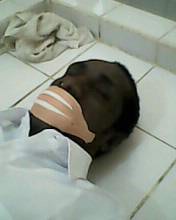
Kristian Belau lying down awaiting the operation to remove the bullet

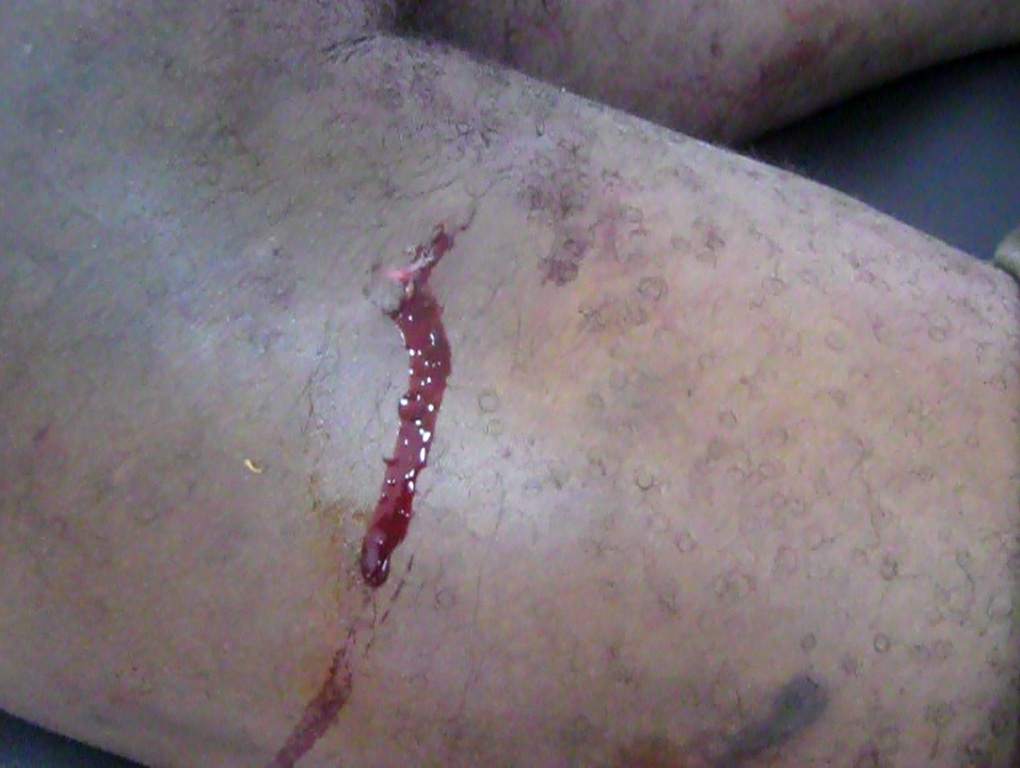
After morning assembly, police from Nabire District Command took one track heading towards Wadio Atas and checked a spot that is often blocked. Upon arriving at the rubbish dump in Wadio Atas, Gerbang Sadu Villiage, Nabire West District, police met with the three Moni Youth. When the police attempted to arrest the three, two escaped. However, one of them, Kristian Belau/Zonggonau, instead advanced towards police. At the time, Kristian Belau/Zonggonau is suspected of being drunk because all night he was drinking heavily. When he advanced towards the police officers, he was shot in the right thigh. Kristian was then lifted to the police patrol car to be taken to the Siriwini Hospital Emergency Room, Nabire. Currently, the victim is in custody at Nabire Police District Command for questioning. According to several citizens in around Gerbang Sadu villiage, road-blocking on the Interior Trans-Nabire Road happens every night. It has been occurring for quite a while. Although police have repeatedly arrested road-blockers, there still are those who road-block. Usually every vehicle that travels inbound is billed according to the type of vehicle. Taxis are billed RP 50,000, private vehicles are billed RP 50,000 and trucks are billed RP 100,000. This issue makes the police angry, to the point that they carried out the shooting of Kristian Belau/Zonggonau.

In the reporting that followed, police said they could not avoid exchanging fire with armed civilian groups in the mentioned location. ‘Because a member was shot, in the end returning fire could not be avoided, one person of the armed group was named Kristian Belau/Zonggonau was shot in his left thigh. Other members of the armed group successfully escaped into the forest whist continually firing at police with revolvers and SS1 type guns’, explained Lieutenant Colonel Gede Sumerta to tabloidjubi.com (25/9),

Based on the investigation carried out, given to tabliodjubi.com the Nabire Kingmi Klasis Church Bureau of Justice and Peace disputes the police explanation. According to them, statements of gunfire between police and armed civilian groups that use revolver and SSQ type weapons is information that has been distributed by irresponsible parties and constitutes public deception. ‘Gunfire between police and armed civilian groups that use revolver and SSQ type weapons is an announcement that is irresponsible and public deception’, said Yones Douw, an activist from Nabire Kingmi Klasis Church Bureau of Justice and Peace to tabloidjubi.com (25/9).

‘Because the Urumusu location is far from the Interior Trans-Nabire road, entering Topo District, Nabire West Regency, a distance from the incident of approximately 45 kilometres. This morning, our human rights activists met with Kristian’s elder sibling and the Moni community in Wadio Atas. They said their children (the three youths who were road-blocking) do not own weapons. If they get drunk and road-block, it’s possible’, continued Yones Douw. (Jubli/Victor Mambor).

a policeman with his weapon guards Kristian Belau

Kristian Belau awaiting operation

right thigh hit by bullet

Kopassus intelligence officer murders Boven Digul man accused of sexual assault: reports

by West Papua Media from sources in Merauke.

September 7, 2012

A local Papuan man has been murdered by an elite Kopassus special forces officer in a village in the remote district of Boven Digul, near the Fly River area adjacent to the West Papua – PNG border, after a local man was accused of sexual assault of a military officer’s wife, according to local human rights sources.

The shooting on Monday September 3, occurred after the victim, Januarius Kimko, was accused by a TNI officer (from the Boven Digul Koramil company of the Merauke 755 Battalion) of sexually assaulting his wife, despite protestations of innocence from the accused man.

West Papua Media has been unable to fully and independently verify the claims from human rights sources, due to the extreme difficulty of communication in these remote areas under military control, however, he investigating sources have been highly reliable in the past.

According to local human rights sources and witnesses interviewed on the grounds by Merauke-based media activists from the West Papua National Committee (KNPB), Kimko was arrested by “Buser” commandos from a joint military/police team in Boven Digul after the military couple reported the alleged sexual assault to the local Police.

The special BUSER ( BU = Berburu (hunting); and SER – serangan (attack))  is a joint “search and destroy” joint SatGas (taskforce) squad between Brimob and Kopassus, whose role is replicated by  part of the “anti terrorist” Detachment 88, funded by Australia.  All sections of this unit receive training and supplies by the Australian Defence Forces.  No information has been received that show if serving members of D88 are present in the Boven Digul unit.

The joint taskforce was immediately activated and conducted house to house raids across the town on Monday night whilst trying to capture the man accused of sexual assault, terrorising local residents.  An ambush was set on the house of Kimko, who was in his home in Ememes Ambonggo complex.  He was arrested and emerged with police without resistance, as he was to be conveyed to the police station for questioning, according to witnesses.

As he reached the street, a Kopassus intelligence officer from the Satuan Gagas Intelijen (Strategic Intelligence Unit) rushed the victim and pressed the muzzle of his weapon (type unknown) against Kimko’s side.  He then shot the victim four times, with the bullets penetrating the victim’s thigh and left wrist.

Witnesses reported to the investigators that as soon as Kimko was shot, members of the Buser Commando and TNI officers at the scene immediately threw his body in to a car, and conveyed him to an unknown location.

Januarius Kimko’s body was discovered by human rights sources at the emergency room of Merauke District l, over 120km from Boven Digul, late on Wednesday September 5.  His body had been in the custody of the TNI of Koramil Kabupaten Digoel from his shooting until the victim’s burial, preventing an independent assessment of his injures.  Kimko’s family were not informed of his death until after his burial.

Full Chronology of Mako Tabuni’s killing

New Chronology from interviews of direct witnesses of the killing of Mako Tabuni on June 14, 2012

West Papua Media has been provided this chronology by a reliable and independent human rights investigator associated with Papuan Churches.

We have held back the publication as we were awaiting further elements of this story from senior international sources, however this source has gone back on agreeing to provide information so we cannot withhold publication of this critical document any further.

View this document on Scribd

The Past That Has Not Passed: Human Rights Violations in Papua Before and After Reformasi

June 28, 2012

joint report released today by the International Center for Transitional Justice (ICTJ) and the Institute for Human Rights Study and Advocacy (ELSHAM-Papua) provides important insight into the ongoing debate on steps required to achieve a sustainable peace in Papua.

Based on more than 100 interviews carried out in 2011 in the districts of Sorong, Manokwari, Biak, and Paniai, the report reviews Papua’s recent history, including the Special Autonomy Law governing the relationship between the Papua province and Indonesia, within a transitional justice framework. It also reveals new information provided in testimonies by victims and witnesses who experienced human rights violations going back to the earliest days of Indonesia’s history as a nation.

“Even as we were conducting this research, new outbreaks of violence and cases of gross human rights violations continued to take place,” said Ferry Marisan, director of ELSHAM. “We interviewed more than 100 victims, many of whom have deep feelings of distrust that are deeply rooted in the past and present experiences of human rights abuse. Official acknowledgement of this violent past is a prerequisite to building peace in Papua,” he added.

“Unless these grievances are not only recognized, but also addressed in a practical way, reconciliation will remain elusive”
Unless these grievances are not only recognized, but also addressed in a practical way, reconciliation will remain elusive. A comprehensive transitional justice strategy could provide effective redress, and should include truth-seeking, criminal accountability, reparations, institutional reform to prevent recurrence of human rights violations, and a focus on the rights of indigenous women.

“The Indonesian government must urgently develop a comprehensive policy for dealing with this legacy of past violations. We are at risk of repeating the past through using force to deal with unrest, instead of opening a process of genuine dialogue. The first step is acknowledgment,” said Galuh Wandita, ICTJ’s senior associate.

Download the full publication here

This joint report by ICTJ and the Institute for Human Rights Study and Advocacy (ELSHAM-Papua) provides important insight into the ongoing debate on steps required to achieve a sustainable peace in Papua. The report reviews Papua’s recent history within a transitional justice framework, and provides expert recommendations on truth seeking, justice, reparations, institutional reform, and enforcing the rights of women victims. Based on more than 100 interviews carried out in 2011 in the districts of Sorong, Manokwari, Biak, and Paniai, the report reviews Papua’s recent history, including the Special Autonomy Law governing the relationship between the Papua province and Indonesia, within a transitional justice framework.

Date published:
6/28/2012

Create a website or blog at WordPress.com

Up ↑