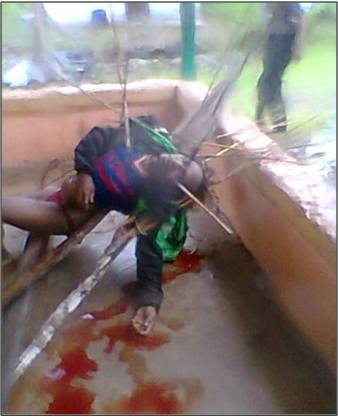
Okto Pogau: Police beating of journalist in Manokwari

Statement by Oktovianus Pogau

SuaraPapua.com

October 23, 2012
I’m going to describe the beating I (Oktovianus Pogau, Journalist) http://www.suarapapua.com experienced by the Manokwari district police in front of Papua State University campus in Manokwari, West Papua, on the afternoon of Tuesday 23rd October.

At about 10.00 am Eastern Indonesian Time I arrived at the place of the incident, in front of the Papua State University campus. I saw around 300 armed officers holding/restraining a crowd of 300 people. The crowd was planning on marching to Lapangan Borarsi, Manokwari. There were three trucks blocking the road, and also 1 TNI (military) truck with dozens of personnel.

There were negotiations between the police and the crowd. Police requested the crowd express their opinion there, on the main road, in front of the campus. The crowd insisted on continuing to Lapangan Borarsi. There was some commotion, then the crowd yielded and didn’t continue to Lapangan Borarsi (except) for a few people who continued there to wait for another crowd of demonstrators to arrive.

At about 10.40 am Eastern Indonesian Time, a police officer neared the crowd and took a photo. The crowd didn’t accept this, and moved nearer to the police and requested that they not take photos so close. Then, several people from the crowd spontaneously threw rocks in the direction of the officers, and from here, the officers responded brutally. Hundreds of people dispersed and the officers loosed thousands of shots in front of the campus Uncen. 11 people were arrested. 2 people suffered from gunshot wounds.

At this time I wasn’t far from where this was happening. I was trying to take footage and photos. A plain-clothed police officer approached me and told me to leave the area in a rude tone. I told him I was a journalist and carried a press card. He demanded I show him my card. I found my wallet so I could show him my card but suddenly a police officer in full uniform turned up. The officer strangled my neck and threatened me, so that I’d leave to the action. I resisted and said I was a journalist, then three more officers in uniform came and barked at me, ‘Where’s your press card . . . where’s your press card.’ I moved to look for it, but one of the police threw punches at my face and lips.
At this time my neck was aching from the strangulation by the officer and my lip was swollen and bleeding. Then several of my journalist friends came and stopped them and said I was a journalist, and only then did they release me.


Wamena Bomb Scenario is false: Open letter from Wamena KNPB chief

Open Letter/ Statement from Simeon Dabi, Chairman of KNPB Baliem

October 15, 2012

On September 20 2012, I, Simeon Dabi, Head of the KNPB (National Committee for West Papua), was in Jayapura and received a telephone call from Kasat Reskrim Agus Supriadi Siswanto about bombings that occurred in two places: a Traffic Police Post at Irian street, Wamena and at the Jayawijaya Province Parliament Building. I was urged to immediately come to Wamena. On the 27th of September I received another telephone call urging me to quickly come to Wamena about the bombing case there. I arrived in Wamena on Friday September 28th, 2012, and when I arrived at Wamena airport I directly headed to the Jayawijaya Traffic Police Post so that I could become a witness to the treason charges against two of my colleagues, Enos Itlay and Semi Sambom who were arrested on July 1st 2012 related to possessing an OPM (Free Papua Movement) document.

Once I arrived at Jayawijaya Police District Command, I immediately met with Kasat Reskrim Agus Supriadi Siswanto in his office. I was asked many questions about the treason case against my two colleagues, then forced to become a witness for my two colleagues from 11:09-15:27 WPB. I was asked a number of questions including: “Where is the KNPB Secretariat at the moment?” to which my answer was that the KNPB does not yet have a clear secretariat; “What is the total number of KNPB members?” to which my answer was the entire Papuan society; “Does the KNPB wish to separate itself from the United Republic of Indonesia?” to which my answer was the KNPB is a medium for the people and the people will decide.

After this I went home. One day later, on Saturday 29th September 2012, at 5:15pm. The Traffic Police together with Densus 88 troops carried out a sweep and ambush of the KNPB secretariat of the Baliem-Wamena Region with goals that are not clear. In my opinion, the sweep of the KNPB secretariat was done because from the time of the bombing until when I arrived in Wamena, officers had not been able to find the bombers, due to the fact that Kasat told me last time that they will give imbalah (poss. transl. money to God?) to find the bombers.

Until now I am deeply surprised and do not believe that the sweep carried out by police officers found homemade bomb materials in the KNPB Baliem-Wamena Secretariat office – it is not true!! This is proof that the police were not able to find the bomber, so the KNPB were framed by the Jayawijaya Chief of Police. It is a political scenario to frame West Papuan civil society, especially people in the central highlands of West Papua.

Sweeping and arbitrary arrests of civilians by the Military/Jayawijaya Police occurred in places including Kurulu district, Wosi and Kimban district on Sunday 30th September 2012, at 5:00am Papuan time.

From then until now, the Military/Jayawijaya Police are carrying out pursuits and arrests of all KNPB members, even KNPB people throughout the entire Central Highlands region of West Papua, and are entering into villages.

From the brief description above, as head of the KNPB Baliem-Wamera, I have several concluding questions:

  1. Why was I, head of KNPB Wamena, made to immediately come from Jayapura in relation to the Wamena bombing case?
  2. What is my connection to the bombings that occurred in Wamena whilst I was in Jayapura?
  3. Why upon my arrival at Wamena did Kasat of Jayawijaya Police force me to search for the bomber?
  4. After I was interrogated at Jayawijaya police, one day later Jayawijaya Police District Command carried out sweeps at the KNPB Baliem-Wamena Secretariat. How and from where did police get an explosive?
  5. Are Papuan people, particularly people of Wamena, capable of designing/creating a homemade bomb?

Conclusion:

The Military/Police have created a political scenario in order to frame the West Papua National Committee (KNPB) Baliem-Wamena with a criminal offence. Police are the main troublemakers in Wamena, the Wamena bombers are themselves actors of state security forces. (emphasis added by WPM)

Police officers of the Republic of Indonesia: Why does a united nation need national security? Police are security for the United Republic of Indonesia. In simple language, police are often called ‘security’. Police are often also called troublemakers in situations of national security?? Is the role and function of Indonesian Police as security or troublemaker?? Especially throughout all parts of West Papua, police are vandals of national security that always act outside the procedure/law of the United Republic of Indonesia.

Simeon Dabi is currently being held in the Jayawijaya Police HQ prison in Wamena and there are grave fears for his safety, his access to legal representation, and the likelihood of a fair and impartial trial.

Related articles

KNPB pleads for international security (force) to prevent ongoing conflict in Timika

October 8, 2012

Timika Conflict Report by Steven Itlay [Chair KNPB Mimika]

Analysis – edited by West Papua Media

Since the civil war broke out on June 2, 2012 in Timika,West Papua the number of victims among the indigenous people continues to grow. Freeport Indonesia Pty Ltd, the army, police and Government of Indonesia have not been able to resolve this insignificant dispute. They have allowed and indeed fostered this civil war.

As a result, at the time of this report (5/10), scores of lives have been lost and many (people) wounded. According to monitoring, the majority of the victims were hit by arrows; however a number were also shot dead by Indonesian Police. Yet others have disappeared as the result of “lightning” (speedy) killings by certain criminal elements. The Government of Indonesia and Freeport have not been able to resolve the conflict; therefore the (local) people are demanding an international security force to protect their lives.

The West Papua National Committee (KNPB) Mimika has been monitoring this situation, and has come to the conclusion that the civil war between clans has been allowed (to occur) by the Indonesian government and Freeport. The situation is trending towards genocide, and the Indonesian authorities – with the American corporation which is established on the Amungsa land – are deliberately permitting genocide in Timika, West Papua.

Chronology of the civil war

The civil war began from a misunderstanding which occurred since May 20, 2012 in Timika, Papua. In the beginning an incident occurred between Ronny Ongomang and Aroki Komangal. (Ronny Onggomang was the son of Hosea Onggomang and Aroki Komangal was the son of Atimus Komangal). At 4.00 p.m. Aroki called Ronny at his house and invited him to go for an evening ride, and .took the streets in the afternoon. The two went out, each using his own motorcycle heading along Old Freeport Street, next to Timika Airport. They sat down and began drinking (liquor).

Not long after that, a youth named Oni Kerembo who had just finished bathing at the side of Old Freeport Street was starting up his motor cycle, was suddenly hit by Ronny Ongomang who was crossing the road with his friend Mickieto while giving a ride on the back of his bike at high speed, despite being affected by alcohol.

After the collision with Oni, Ronny could still stand, and panicking, mounted his motorcycle and sped off about 1 kilometre, stopping at the side of a ditch by the road. According to police information, Ronny fell (from his bike) there and died suddenly (from his injuries). At the same time Oni Kerembo suffered broken bones and was rushed to Mitara Community Hospital RSMM Karitas for treatment.

The following day (21 May 2012), around 8.00 a.m, a citizen discovered the body of Ronny Onggomang in the ditch at the side of the road where he had fallen. The citizen immediately contacted the police, Polantas (traffic) section, and the body was removed to the District of Mimika General Hospital (RSUD Mimika). His parents were notified and identified Ronny Onggomang’s body at RSUD.

On 22 May 2012, his body was buried at the house of his father Hosea Ongomang at Kwamki Narama, Mimika.

On 24-26 May 2012 in Mimika, the victim’s family together with police from Polantas carried out an investigation into Ronny’s death. The police from Polantas said that it was clearly an accident, but the victim’s family did not accept this because there were no signs of scratches or lacerations on the body.

On 29 May 2012, the family of the victim (who) were making accusations everywhere, invited all the elders (including) the father of Aroki Komangal to go at once to the Police, Polantas Section and request clear information on the case. Polantas stated that from their viewpoint it was clearly an accident and there was no perpetrator. However the family of the victim were not satisfied with the police explanation. As a result of this dissatisfaction the family accused Aroki Komangal as the murderer without evidence.

Atimus Komangal and Benyamin Kiwak head of the large Damal clan apologised to the victim’s family but they rejected the apology from the side of the accused, and they wanted to “seek proof in the field” with a traditional physical confrontation or war between the clans, according to traditional custom.

In this small case the police let things be and did not complete the handling of the matter in order that a civil war did not occur. But (by failing to intervene with conflict resolution before violence broke out) it was as if the police provided an opportunity for this war to happen in Timika.

On 2 June 2012 in Mimika Papua, a civil war broke out, The clan of Hosea Ongomang fought against the clan of Atimus Komangal. Finally there was a victim on the Hosea Ongomang side, identified as Deminus Ongomang.

On 5 October 2012, around 8.24 a.m., community leaders, church leaders and womens’ leaders, forcibly chased away the Indonesian police because the police only watched and deliberately encouraged the conflict in Kwamki Narama, even though victims were dying. One Amungme community leader said, “The government of Indonesia, and TNI/POLRI only come to show off in the in an area of conflict like this, because of the political and economic interests of their office. They never truly resolve problems in Papua, especially in the gold mine region of Timika.”

At 09.00 a.m. local time, all the police who were serving in the war area left that war area in shame. All members of community organisations, church groups NGOs and elders regard the Indonesian government army and police (TNI/POLRI) as being incapable, and have failed totally to calm the civil war in Timika.

To the present moment the war is continuing. The Indonesian police have not yet succeeded in calming the civil war. In fact the police are just busy providing security for Freeport Indonesia. They carry out arrests of KNPB activists in the streets. This war which has been encouraged prevents the people from engaging in (peaceful and legitimate free expression) activism. The citizens are afraid to oppose the arbitrary activities of the police.

This slideshow requires JavaScript.

Above: Images from the horizontal conflict of 2012 in Mimika (Courtesy KNPB Mimika)
List of names of the victims (of the war) from 20 May to 5 October 2012
A. From the side of Hosea Onggomang
1. Roni Onggomang (16), died in ditch at side of the road, after motorcycle collision with Oni Kerombo .
2. Deminus Onggomang (30). Killed by an arrow, fired mistakenly by one of his friends.
3. Dominus Ongomang (32) shot dead by police officer in Mimika. Perpetrator: Brimob AKBP Denny Siregar S.IK of Batak descent.
4. Doni Onggomang (28). Shot dead by police. Doni had just seen his older brother Dominus shot by Kapolres (Police). Doni was angry and wanted to attack the Kapolres but he was also shot, by Adjutant Kapolres Abram, native of Jayapura.
5. Antelius Ongomang (24), Killed by arrow.
6. Aroki Tabuni (29). Killed by an arrow.
7. Pak Enos Murib (35). Killed by an arrow
8. Ibu (Mrs) Medina Wenda (24). Killed by an arrow in a plantation outside the battlefield.
9. Seki Tabuni (36). Killed by an arrow.
10. Kamoro Tabuni (30). Killed by an arrow.
11. Herry Tabuni (25). Chased and killed in the street.

B. Victims from Atimus Komanggal’s side
1. Parael Alom
2. Yanuarius Misimbo, killed in a plantation.
3. Nike Misimbo (10). killed in a plantation.
4. Ince Komangal (15). killed in a car.
5. Eterikus Beanal. Killed in a car.
6. Jhon Beanal (29). Disappeared, abducted by person unknown
7. Frans Beanal, (30). Disappeared, abducted by person unknown.
8. Pdt. (Reverend) Barnabas Komangal (57). Killed in family fight.
9. People seriously wounded; 12 men and 2 women, names not yet known.
10. Filemon Hagabal, (35). seriously wounded by an arrow.
11. Head of the Dama clan, Victim of bashing carried out by member of the police force, is now left with paralysis in his left leg and has broken ribs. At present still in detention in Polres Mimika Mil 32.
12. Other victims outside the warring clans, Bapak Tom Yarangga (45 years), Yaranggawas burned in a car (fire) carried out by a specially trained group. (Kelompok yang di lati Khusus?), up to now the murderer has not been identified by the police.
Bapak Nasyum killed by a specially trained person. To date police have not identified the murderer.

(WPM Comment: The “Specially Trained Group” or Orang Terlatih Khusus is a euphemism for terror squads of the Indonesian special forces Kopassus, who are believed to responsible for a massive campaign of shootings, stabbings, muggings and bombings against a variety of targets, blamed on highland Papuans, and engineered by design to discredit the civil resistance movement in Papua. Indonesia, and Kopassus, have used proxy militia and jihadist groupsthis as their standard operating procedure since the bloodbaths of the 1965 Coup.)

Papuan Prisoner of Conscience Filep Karma in Jakarta for Medical Treatment

This slideshow requires JavaScript.

Press Release – Karma family

Papuan Prisoner of Conscience Filep Karma in Jakarta

for Medical Treatment

Jakarta, Indonesia [27 September 2012].

Filep Karma, a political prisoner of conscience from Papua, has attended a two-week medical treatment in Jakarta hospital and now is back in the Abepura prison in West Papua. He arrived in Jakarta on September 14 and took a colonoscopy treatment in PGI Cikini hospital, Jakarta.

Indonesian physicians in Jayapura, who earlier examined Karma with simple equipment, suspected that he has a colon tumor. As it is not possible to conduct a colonoscopy in West Papua the physicians referred him to the hospital in Jakarta.

Karma was imprisoned in 2004 and is serving 15 years in prison for participating in a peaceful independence demonstration and for raising the Morning Star flag, an important Papuan symbol of independence.

The UN Working Group on Arbitrary Detention declared him a political prisoner in September 2011, asking the Indonesian government to immediately and unconditionally release Karma. The government, however, denies the existence of “political prisoners” in Indonesia. His injuries were sustained from acts of torture inflicted on him while in prison. He also injured his hip during a falling in 2006.

It took nearly six months for Karma to be able to be transferred to Jakarta despite this referral. Abepura prison officials, under the Ministry of Law and Human Rights, have refused to cover cost of his medical treatment and travel. The Indonesian government’s refusal to cover his costs is in direct contravention of national and international law.

According to United Nations Body of Principles for the Protection of All Persons under Any Form of Detention or Imprisonment (Principle 24), and Indonesian law (Regulation No. 32/1999 on Terms and Procedures on the Implementation of Prisoners’ Rights in Prisons) it is required that all medical costs for treatment of a prisoner at a hospital be borne by the State.

Despite the Abepura prison authorities recently giving permission for Karma to travel to Jakarta, they still refuse to cover the cost of his medical treatment and travel. Funds have been raised through donations from the Prisoners of Conscience Appeal Fund (London), Rev. Socratez Yoman’s church service (Timika), STT Walter Post (Jayapura) and many individuals.

Not only Karma, there are seven political prisoners in Papua with variety of illness. They are Apotnagolik Lokobal (stroke); Ferdinand Pakage (stroke); Forkorus Yaboisembut (impaired vision); Kanius Murib (memory loss); Kimanus Wenda (hernia);  Jefrai Murib (stroke);  and Yusak Pakage (indigestion).  Karma urges the Indonesia government should release all political prisoners immediately and unconditionally and give them the proper medical treatment.

(Note from Andreas Harsono/ HRW: Note: Filep Karma finished his medication on Tuesday and returned to Jayapura Wednesday night. He has arrived safe and sound in Jayapura Thursday morning. But he’s back to his Abepura prison. A number of family members, assistants and friends helped his hospitalization in Jakarta.  I am sending you some photos from his medical treatment in Jakarta as well as the airport departure in Jakarta. His sister Margaretha, daughter Audryne (and her boy friend), assistants Cyntia Warwe and Soleman travelled with him back to Jayapura.


This slideshow requires JavaScript.


So, who is the real terrorist? West Papua Responses to Australia, U.S. and Indonesia

Opinion

By Victor F. Yeimo
Chairman of the West Papua National Committee [ KNPB ]

September 9, 2012

(text edited/retranslated by West Papua Media for linguistic clarity)

Last week, Australia, the United States and Indonesia strengthened their economic, political and security ties while the people of West Papua were lamenting their oppression. That’s a sure sign that the practice of colonialism and capitalism will continue in West Papua. We do not know how much more blood will be shed as the people of West Papua will fall victim to the Indonesian military.

The world seems blind and deaf to the repression in West Papua. The world does not care about the Papuan struggle in upholding truth, justice, honesty and humanity. Instead, the world (community seems to be) trampling human values, truth, justice, honesty and all the rules of its international law.  The world only cares about its political and economic interests.

West Papua has become the object of economic transactions and political interests of U.S and Indonesia.  This dirty practice is still applied in the so-called “open era”. The lust of economic and political expansion of the states, without feeling of guilt, continues to increase the suffering of the West Papuans. The people of West Papua are not stupid.

People of West Papua fully understand how colonialism and exploitation scenarios work in this modern century.  Labelling and stigmatisation of indigenous people as terrorists, and then kill and take control of land and its natural resources are the ways that are always used by the colonial countries and capitalists.  Australia, Britain, the U.S. and Indonesia are implementing those ways in West Papua.

The peaceful resistance movement in West Papua is being silenced by the Indonesian military forces.  The space of peace and democracy has closed and Indonesia has opened a space of violence, so that they can easily kill and destroy the West Papuan peoples’ struggle with the stigma of terrorism.  Using that stigma to cement military cooperation between Indonesia, the U.S., Australia and other countries is considered essential.  For them, it is important to kill Papuans and to occupy the land of West Papua.

Violence has been created by rulers who oppress and exploit the people and the land of West Papua.  Terrorism is created for global rulers who have an interest in mastering the fields of exploitation.  Terrorism was created by the colonial rulers who invaded to take control of someone else’s land.  The territory of West Papua is controlled by Indonesia. The people of West Papua were massacred by Indonesia. Military power is funded, supported and trained by Australia, the U.S. and other pro-colonial and capitalist countries.

This is evidenced by the attitude of the Australian government and the presence of three ministers from Australia during the visit of the U.S. Secreatary of State Hillary Clinton to Indonesia while increasing support for the Indonesian defense forces. Meanwhile, thousands more Indonesian troops are being deployed to West Papua, and police in West Papua, led by the former head of Detachment 88 Anti-Terrorism Tito Karnavian, and detectives at the Criminal Investigation Unit of Papua Police are now controlled by members of Detachment 88.
Their goal is only one, to kill all members of the peaceful resistance movement in West Papua, to eliminate the people of West Papua, and to rule the roost on this land for the benefit and prosperity of colonialism and global capitalism.

So, who is the real terrorist?

Create a website or blog at WordPress.com

Up ↑
