Densus 88 shoot and arrest KNPB leaders near Wamena as tensions rise

Hubertus Mabel  (Photo via Buktar Tabuni)
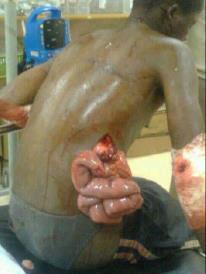
Shooting victim believed to be either Hubertus Mabel or Natalis Alua (CONFIRMED PHOTO; unconfirmed identity) in Wamena hospital, 16 Dec 2012. Both Victims died from their wounds by sunset, according to human right reports.  (Photo via Buktar Tabuni/KNPB)

compiled from reports of  Tabloid Jubi, Victor Mambor and West Papua Media stringers in Wamena

December 17, 2012

A West Papua National Committee (KNPB) activist has been killed, and a farmer has died from his wounds in hospital, after being shot by members of the Australian-trained anti-terror unit Detachment 88 outside Wamena on December 16, following raids that arrested at least six activists on Sunday morning, according to multiple sources.

KNPB activist Hubertus Mabel (aged 30) died shortly after being taken by police to Wamena hospital after the shooting at 1030am in the village in Milima (or Kugima) in Kurulu district outside Wamena.  Local farmer Natalis Alua (34) died in coma in hospital after being shot in the same incident, according to latest reports from human rights sources in Wamena.

According to journalist Victor Mambor, at this time Hubert was still alive and this was confirmed both by the police and Victor Yeimo (National KNPB Chairman).  “Police told me that Hubert was shot in the leg at 09.30 (morning). Hubert was taken to hospital by police and then died at the hospital because of loss of blood….  At 6 (afternoon), Hubert claimed by police died in hospital.”
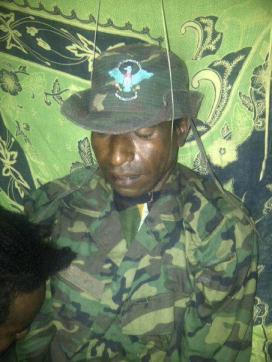
Hubertus Mabel's body being prepared for burial, late December 16, 2012 (photo: KNPB/ West Papua Media)
Hubertus Mabel’s body being prepared for burial, late December 16, 2012 (photo: KNPB/ West Papua Media)

“Some peoples  in the Kugima Village, the place where Hubert was shot, told us police entered the village in full force. They brought two people who had been arrested before (Meky Kogoya and Wene Gombo) to the village to tell them where Hubert lived.”
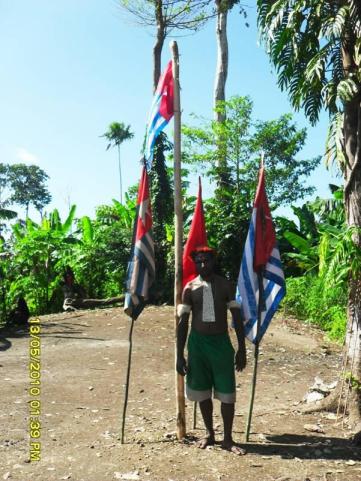
Hubertus Mabel (Photo: KNPB)

At 9am, the same joint police/army and Densus 88 squad conducted a armed raid in the village of Kosi Hubi Holima, in Wamena.  KNPB Wamena Chairman Simion Daby was arrested with human rights activist Baroy Sambon, Meki Jikwa (Kogoya), John Huby, Pie Huby, Herae Huby, and Ima Mebel, allegedly at the house of Meky Kogoya, who was accused by police of being responsible for a bombing incident in Wamena.  They were all taken forcefully by police to Jayawijaya police headquarters.

It is believed that human rights worker Sambon was arrested as he was trying to alert international media to the situation, but this has not been verified.

The KNPB have repeatedly denied involvement in planning or carrying out acts of violence or bombings in Papua, a view supported by the Churches, human rights organisations and legal networks in Papua.  Police have yet to provide any credible evidence that shows their involvement, despite millions of dollars being provided to Densus 88 by Australia for forensic evidence analysis.

Alleged TPN retaliation questioned
There have been reports of an alleged West Papuan National Liberation Army (Tentara Pembebasan Nasional or TPN) retaliation against police over the shooting of Hubertus Mabel, but human rights workers have cast doubt on the involvement of TPN forces, instead accusing Indonesian security forces of acting up to continue to create a false scenario for conflict.
According to a report in Tabloid Jubi, the sound of gunfire could still be heard up to 11pm on 16 December in Wamena.
‘On 10.25pm, there was an exchange of fire between the TPN-OPM (the military wing of the OPM) and the TNI/Polri , Indonesian army and police, somewhere between Misi Market and  Sinakma, Yusodarso Road. The situation in Wamena was said to be tense and there were calls for help,’ according to a local report as quoted by Jubi.A local resident, Yason, confirmed reports of the sound of gunfire which was still continuing. It is alleged that this was in response to the shooting of Hubertus Mabel.  Another local resident named Vita told JUBI that the local police station had been burned down in response to the shooting of Hubertus Mabel. According to Vita, ‘Mabel and member of the KNPB was shot by the security forces as he was suspected of a bombing the Wamena, which led to the police station being burned down.’The local police chief later confirmed to JUBI that there had been an exchange of fire, but West Papua Media was unable to find any witnesses or evidence that any armed TPN unit was in the area.

However long time human rights worker Markus Haluk told West Papua Media that local  investigators had been visiting witnesses and have compiled a chronology that sits at odds with this account.  According to Haluk, at around 8pm local time, a number of drunk people set fire to one market stall at Pasar Misi/Bungsu.  Haluk also reported that at 11pm local time, police arrived on the scene with the Deputy Chief of Jayawijaya Police and opened fire with a barrage of shots, all from one side, with no clear target apart from civilians who had gathered.  Police then moved to the Dewan Adat Papua offices less than a kilometre from the scene, and set fire to them in retaliation, despite the burning market stalls having no connection to either the DAP leader or council staff.

Markus Haluk said that the “Alleged drunks burning kiosks in the market (is) scripted by the security forces to divert attention from the arrests and shootings of civilians and KNPB activists, and is a conscious Scenario consciously to burn the office and create psychological pressure against the leaders and members of the Papuan Customary Council Lani Pago Baliem Region.”

Local human rights workers believe this latest round of security force misbehaviour is due to the payment to the new Papua Police Chief Tito Karnavian (former Densus 88 commander) of Ten Billion Rupiah (approx US$1 million) from the Papuan Governors office, for the provision of “Phase 2”  security for the Papuan Gubernatorial Election campaign, which was also earmarked to maintain a peaceful environment in the lead-up to Christmas.

“Many parties are upset with these incidents,” said Haluk. “For catching, shooting in Wamena occurred on Sunday, when people were seeking to church to worship. While the arson of the DAP offices were do middle of the night, when the community was quiet for the night, ” he explained.

“On receipt of the funds, the Papua Police Chief conveyed the importance of maintaining the security and peace of Christmas and the election of Governor. Instead, he led police officers making arrests, shootings and arson of Balim Traditional Council offices,” an exasperated Haluk told West Papua Media.
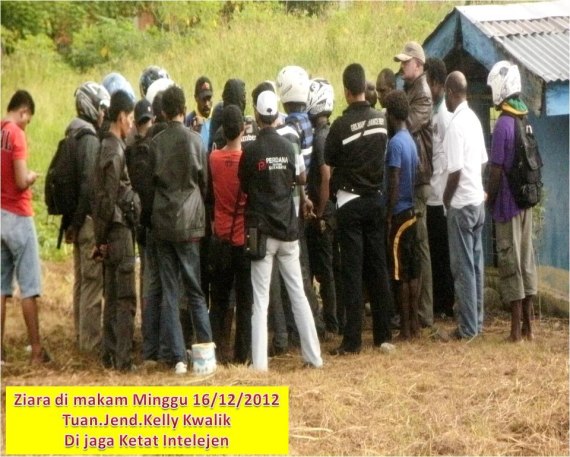
These arrests come amidst a major series of operations by Indonesian security forces across Papua on the anniversary of the Densus 88 assassination of legendary TPN guerrilla leader Kelly Kwalik on December 16, 2009.  Heavily armed Densus 88 personnel, including an unidentified Australian man, were seen to be guarding Kelly Kwalik’s tomb to prevent a memorial service from being held to commemorate the anniversary of Kwalik’s extrajudicial execution.

Papuan homage (16/12) to tomb of murdered OPM General Kelly Kwalik, blocked by heavily armed intelligence personnel (note Buleh Densus 88 advisor)
Papuan homage (16/12) to tomb of murdered OPM General Kelly Kwalik, blocked by heavily armed intelligence personnel (note Buleh Densus 88 advisor). (Photo courtesy Beni Pakage)

Also, in news from the Paniai, Brimob paramilitary police have reportedly shot and captured Yakobus Utii in Enarotoli on Sunday, alleging that he was a senior figure in Jhon Yogi’s TPN command.

West Papua Media

Australian media only tells half the story about West Papua

By Kayt Davies, Edith Cowan University

December 14,  2012

Nbqkkpt3-1355444189
There’s more to the West Papua story than men in Bambi suits. (Photo: Kayt Davies)

Last Friday a picture story appeared on page three of The Age that was ostensibly about events in West Papua. The story was pitched as a quirky yarn, replete with a wacky Disney character, a kilt (always a bit funny) and some large weapons.

All these elements tick boxes on the newsworthiness checklist – but, as US journalist Charles Feldman told a gathering of the Journalism Education Association of Australia in Melbourne earlier last week, “there is a difference between news and journalism”.

The story was about Gerard Michael Little, who presents as a well meaning man dismayed at the death toll in Papua and who allegedly wanted to put his military and paramilitary training to good use in the form of an armed peace keeping force. He was arrested in Brisbane last week under a rarely used law that prohibits hostile activities by armed non-state actors, including planning and training.

To make the charges stick, the prosecutor will have to prove that he was armed and intending to take offensive action.

The story’s first appearance was on Wednesday December 5 when The Australian, ABC Local, the Sydney Morning Herald, The Herald Sun and APN’s Toowoomba Chronicle reported that Little had been arrested. The Jakarta Globe followed up the next day as news emerged from his court appearance.

The articles were all accounts of the bare facts of the court case, in turn highlighting Little’s Victorian and Toowoomba connections, paramilitary training in the Ukraine, disability pension and grandfather status. Reporting a day later, The Age’s Justice Editor Dan Oakes did commendable research on the man and wrote up what he found.

But what was omitted was the context. What is happening in West Papua, in general and in particular this week, goes some way towards explaining Little’s actions.

Having arrived in Melbourne a day ahead of a gathering of journalism educators, I was in town for the December 1 West Papuan flag day celebrations in front of the State Library. West Papuan foreign minister in exile Jacob Rumbiak told the crowd he’d spent a decade in prison for raising a flag in Papua, and that he had many colleagues behind bars for exercising their right to peacefully express their opinion. A young Papuan activist read an open letter to Julia Gillard calling for Australia to take responsibility for the actions of the troops it is training and the atrocities they are committing on Papuan soil.

While Melbourne was sunny and bright, the cloud that passed over the gathering in its final moment at Federation Square was news that Victor Yeimo, the chairman of the West Papua National Committee (KNPB) had been arrested. His crime was to lead a peaceful protest march.

The Melbourne West Papuan community waited for news, as international human rights monitors made enquiries about Yeimo’s status and whereabouts. The next day police announced he had been released, leading to concern that he may have “disappeared”.

But Yeimo surfaced, and filed a report that quoted Jayapura police captain Kiki Kurnia saying, “We are ready to wreak havoc and clash with all of you”. Yeimo called on the international community to take action.

Other positive news that didn’t attract the interest of News Ltd, Fairfax or the ABC: an announcement that the Indonesian Law and Human Rights Ministry had agreed to give sentence remissions to around 20 Papuan political prisoners. This announcement must be backed by vigilant international watchdog journalism to ensure that it delivers the due judicial process it appears to promise.

Tempering the optimism of this announcement was the sad news that political prisoner Timotius Napirem Ap was shot dead – in the feet, neck and back – by police.

This is just one week in the rolling saga of the civil resistance movement in West Papua. It’s a story that involves villagers who live in grass huts in jungles, students who live in dorms in the urban heart of Jayapura, Australian mining executives, and the protesters who gathered in Melbourne.

For them, the flurry of news attention given to Little’s arrest must seem odd. That events like these would prompt a military-trained man to step in and try to do something about the void of international neglect and media disinterest is not surprising. But he’s a symptom, not the cause, and his story is just a quirky tangent to a real story that is mostly ignored by Australia’s mainstream media.

Kayt Davies does not work for, consult to, own shares in or receive funding from any company or organisation that would benefit from this article, and has no relevant affiliations.

The Conversation

This article was originally published at The Conversation.

The Conversation
Read the original article.

Baptist leader calls for unconditional release of Forkorus

Bintang Papua
11 December 2012
The Indonesian government has been urged to free all political prisoners in Papua, including Forkorus Yaboisembut and Filep Karma. On the occasion of World Human Rights Day,  the human rights defender Socrates Sofyan Yoman spoke about the activities throughout 2012 of organisations such Polri (the police force), the TNI (the Indonesian military) and vicious armed civilian groups. He said 90  incidents of violence had been committed by these groups in all parts of Papua during the year so far.’As we celebrate Human Rights Day,’ he said, ‘we defenders  of human rights urge the Indonesian government to take the following actions:

‘Firstly, in accordance with its constitutional responsibility to safeguard its citizens, the government should acknowledge that the way it treats prisoners, convicts and the citizens in general is brutal, inhumane and demeaning. This includes the way it treats Papuan civil society and Papuan political prisoners. Such activities  should be prohibited, along with all practices that violate the law. Torture must be clearly identified  and criminalised. This would be seen as a concrete sign of Indonesia’s commitment to the International Covnention Against Torture which it officially ratified  by enactment of Law 5/1998

Secondly, the government should agree to adopt a policy that recognises Papuan citizens as victims. In those cases where legal processes have been resorted to, rehabilitation not imprisonment should be the method  chosen. The government should also adopt measures to  inform the general public about the many civilian victims in Papua.

His next point was to ensure that whenever the law on treason is used in a court of law, this should be non-discriminatory and concrete action should be taken to put an end to all criminal activities by the security forces, including judges, public prosecutors and all those people who are in charge of the prisons.

Furthermore,  the rights of all Papuan political prisoners must be safeguarded, including ending all illegal detentions. In cases where confessions were made under duress and without the presence of legal counsel, they should not be accepted as evidence in a court.of law.

The government should create mechanisms for people to be able to initiate charges. Such mechanisms should be available everywhere and in all places of detention and imprisonment.And in cases where charges are brought by detainees, this must be followed through by independent investigations by law-enforcement institutions as well as the National Human Rights Commission.

His next point  was to urge the National Human Rights Commision, the National Commission to End Violence Against Women and the Ombudsman  of the Indonesian Republic, to establish a mechanism  for a fully independent National Protection Unit to visit all places of detention, especially places of detention where persons charged with treason (/makar/) or other political prisoners  are being held as part of the state’s responsibility to act in accordance with the Anti-Violence Optional Convention.

The seventh point was to press the Indonesian government to enter in peaceful dialogue on the problem of Papua, mediated by a third party, one of the aims of which would to end torture and other forms of violence throughout the Land of Papua.

The eighth point was to press the Indonesian government to invite  the UN Special Rapporteur against Torture and Arbitrary Detentions to visit Papua.

The ninth point was to press the Indonesian government  to allow foreign journalists to visit Papua.

The tenth point was that the Indonesian government should accept responsibility for incidents of gross violations of human rights such as the incident in Abepura on 7 December 2000, the Wasior 2001 incident, the Wamena  2003 inicident and other incidents that have already been investigated by the  National Human Rights Commission, and to ensure that  the results of these investigations  are considered at the human rights court and dealt with in accordance with the principles of justice.

With regard to the role of the churches in Papua, it should be acknowledged that their main mission  has been paralysed by the state and governmental system in Indonesia.

Moreover, its prophetic voice is hardly ever heard in Papua, particularly since Papua was integrated into the Indonesian republic by military means and this the integration was preceded by the bloody events surrounding the Act of Free Choice, which continue to the present day.

‘The churches have forgotten or refused to recognise that Christianity arrived in Papua three centuries ago, on 5 February 1855.’

These thoughts were expressed by Socrates Sofyan Yoman during his opening address of the Congress of the Alliance of Baptist Churches in Papua at the Baptist Church in Wamena in October 2012.

He pointed out that his church  has supported the Papuan people with education, religious belief, healthcare and in the economic sphere, and has helped to improve access to the most remote areas by establishing small airfields which cater for small aircraft, with alll the risks this involves.

The church’s  missionaries live in close proximity with the Papuan people and help to foster the dignity of the Papuan people.in sharp contrast to what Indonesia has done since Papua’s integration, when it became a colonial power, a fact that is rarely criticised by the churches.

As a church leader, Yoman said that he not only studies the Bible but also learns from the history of Papua.  He has learned a great deal from this history, in particular the many untruths that have been told.  It is the role of the churches to insist on correcting these untruths, he said

Until now the churches talk about  ‘peace and well being’ but God’s people are continually  stigmatised as treasonous and accused of being part of the OPM.

As a church leader, he rejects all these allegations  and believes that Christians  must reflect of God’s will, as is stated in Genesis 1:26.  For all these reasons, he said in conclusion:

‘I will continue to speak out and will do everything I possibly can to share in the sufferings of God’s people. There is no future for Papua if it continue to remain a part of Indonesia. Papuans cannot live normal lives The churches must speak out about this and integrate themselves with those people whose very identity has been destroyed. It must speak out about  justice, equality  and the freedom  of all humankind regardless of race, ethnicity, culture or religion.

[Translated by TAPOL]


Papuan women angry about failure to provide them with permanent market

Tabloid JUBI
6 December 2012
Jayapura: The Rev Dora Baluban, co-ordinator of Solpap, Solidarity of Indigenous Papuan traders,  said that their organisation is being treated like a ping pong ball by the provincial administration because of their failure for so many years to provide women traders – mama-mama – with a permanent market-place.’We have made so many attempts to get a permanent market place  for indigenous Papuan women  but as yet, nothing has happened,’ she told journalists.Solpap has been trying to get a permanent market place for the women traders since 2004 but after six years, nothing has happened. Back in 2009, the government promised that they would make available land used by Perum Damri (Indonesian Government national transport company ) but to this day, nothing has happened. ‘ It is apparent that Damri is not willing to vacant the land.

She said that they have had so many promises by the government  but to no avail. She said that  the government is treating Solpap like a ping pong ball,  hitting us here, there and everywhere.

The government also promised    to provide Rp 10 billion to build the market place but this has not yet happened either. One of the traders, Yuliana Pigai, said the government has made so many promises but has failed to do anything.

‘This is our right and the government should keep its promises,’ she said.

[Translated by TAPOL]

Papuan serving 20 years dies in prison

via Tapol
December 12, 2012
The following information has been received from a reliable source in Papua:This is to inform everyone who struggles consistently about the problem of human rights in the Land of Papua that one of the Papuan political prisoners, Kanius Murib, died on 10 December. He died at his family home in Hokilik Village, district of Wamena, Papua.

He had been suffering from 2010 up until December 2011. The prison authorities reached an agreement with his family that, in accordance with the family’s wishes, he would be able to stay with the family so as to ensure that he died surrounded by his family because of his physical condition as well as the fact that he had become mentally unstable.

1. Kanius Murib was serving a sentence of twenty years.

2. The government paid little attention to his state of health and just allowed his condition to linger on.

3. None of his children have been able to go to school.

The way he was treated is extremely unjust. This is the way all Papuans are being treated. The Indonesian government has ignored the recommendations made during the Universal Period Review, while the Co-ordinator Minister for Politics and Human Rights said while on a visit to Papua in 2012 that there are no political prisoners in Papua.


Create a website or blog at WordPress.com

Up ↑
