7.30 Report (ABC): West Papua arrests highlight Australian Detachment 88 links

Australian Broadcasting Corporation

Broadcast: 04/10/2012

Reporter: Hayden Cooper

An Australian-funded police unit in West Papua has again been implicated in a crackdown on the region’s independence movement.

(Note:  Syndicated here as this story was produced by ABC with the assistance of West Papua Media, after we originally broke this story at https://westpapuamedia.info/2012/10/01/wamena-arrests-as-australian-funded-anti-terror-troops-conduct-raid-amid-increasing-repression-on-knpb-political-activists/ )

Transcript

LEIGH SALES, PRESENTER: An Australian funded counter-terrorism unit in West Papua is facing new accusations of abusing its power in the troubled Indonesian province.

The notorious squad known as Detachment 88 has launched a fresh crackdown on independence activists, in the wake of an expose by this program in August.

Eight men have been detained and accused of bomb-making.

Separatist leaders claim the explosives were planted and they’ve been framed to justify the squad’s activities.

Hayden Cooper has this report.

HAYDEN COOPER, REPORTER: Jayapura, West Papua is a city marred by violence and tension, where independence leaders have been arrested, beaten, killed. And where police have been confronted by unruly and angry demonstrations.

When 7.30 travelled to the province in August, the crackdown on the independence movement was already severe, resulting in several deaths, including of this man, independence leader Mako Tabuni, shot in this street, witnesses say, by the Australian trained and funded police unit Detachment 88.

ERSON WENDA, RELATIVE (last month, voiceover translation): Clearly, it was them who killed him because we saw them shoot him and take him to their hospital.

HAYDEN COOPER: Since then, the crackdown has worsened. Victor Yeimo succeeded Tabuni as leader of the West Papuan National Committee, KNPB. This week, he sent this video to 7.30.

VICTOR YEIMO, CHAIRMAN, KNPB: We are the non-violent activists in West Papua. We will fight for our right of freedom according to the peaceful means in West Papua. We demand our right of self-determination to a referendum to be held in West Papua by UN peacefully and democratically.

HAYDEN COOPER: But the Indonesian authorities don’t believe his claim of non-violence and they’re pursuing KMPB like never before. In June, Indonesian soldiers went on a rampage in the highlands town and KNPB stronghold of Wamena, and now in a new development, police have raided the homes and offices of KNPB members in the area. Last weekend eight were arrested and witnesses say once again Detachment 88 was involved.

VICTOR YEIMO: When they arrest the KNPB brothers in Wamena, we saw Detachment 88 with one car, and another car with police, joined in by TNI.

HAYDEN COOPER: Indonesian police accuse the eight KNPB members arrested of making bombs and claim to have found explosives during the raid. Victor Yeimo rejects that and says his group is being framed as terrorists to justify Detachment 88’s presence.

VICTOR YEIMO: This is how Indonesia is now making a scenario with the terrorist issue in West Papua. As you know that in West Papua we never know how to make a bomb, how to create bomb.

HAYDEN COOPER: Some international observers and West Papuan advocates back that view

CAMMI WEBB-GANNON, SYDNEY UNI: I don’t think that the KNPB has any reason to be making bombs because they believe in a peaceful approach to pursuing independence. They want a referendum on independence in West Papua.

HAYDEN COOPER: In West Papua the Institute for Human Rights Advocacy, known as ELSHAM, has studied the arrests and suspects the explosives recovered by police were part of an elaborate set-up.

CAMMI WEBB-GANNON: They don’t have the capacity to gain the materials, so ELSHAM has actually said that the materials were probably planted in the KMPB members’ houses where they found the explosives and that’s not an unusual thing for security forces to do.

HAYDEN COOPER: The weekend raids follow the appointment of a new police chief in Papua, Brigadier General Tito Karnavian. His background as the former head of Detachment 88 generates serious unease among some Papuans, despite his assurances of a new inclusive approach.

CAMMI WEBB-GANNON: They will be opposed to his former role as the head of Densus 88, and as a police chief this just – it doesn’t seem to mesh with his new approach of working – to win the hearts and minds of Papuans.

RONNY KARENI, WEST PAPUAN EXPATRIATE: I have no doubt there’ll be definitely more crackdowns on KNPB members and those who are very active and very vocal in pursuing and calling for independence for West Papua, and that is for sure, that that’s one thing that Jakarta is aiming to shutting down political activists in West Papua.

HAYDEN COOPER: Ronny Kareni is one of many West Papuans living in Australia. He uses music to promote the independence cause on behalf of his friends at home.

RONNY KARENI: Every day, like, I got SMS coming through my phone and then the information is that their lives are under intimidation and they always live in state of fear and they’re being followed and it’s sad, but this is the reality in West Papua.

HAYDEN COOPER: 7.30 put several questions to the Indonesian Government but received no reply. Attempts to contact the new Papuan police chief were also unsuccessful.

As for Victor Yeimo, he is pushing for the release of the eight activists arrested on the weekend, and with his supporters here, he’s pressuring Australia to rethink its funding for Detachment 88.

RONNY KARENI: The Papuans will be pretty much living like prisoners in our own land where our movement, what we do, will be censored, will be monitored, will be followed, and as I said, there’s no room for democracy at all.

LEIGH SALES: Hayden Cooper reporting.

Original URL http://www.abc.net.au/7.30/content/2012/s3604232.htm

Wamena arrests as Australian-funded anti-terror troops conduct raid amid increasing repression on KNPB political activists

by West Papua Media

September 30, 2012

Unconfirmed photo from Sep 29 Detachment 88 raid on KNPB in Wamena (Supplied/KNPB)

Troops from the Indonesian army (TNI) and Australian-trained Detachment 88 counter-terror unit conducted a major raid on Saturday against activists from the West Papua National Committee (KNPB) in Wamena, according to several credible sources in the West Papuan highland town.

The raid on the secretarial office of KNPB Baliem Region at the Potikelek complex in Wamena, just before 6pm on Saturday night, resulted in the arrests of 8 KNPB members. Sources reported to West Papua Media that at least two platoons each of TNI, D88 and regular Police (arriving in 2 trucks, 11 vehicles and 14 motorbikes) were involved in the raid, with many detainees being subjected to brutal beatings and on-the-spot interrogations by security forces according to independent witnesses.

According to Simon Dabi, the Baliem region chairman of KNPB, the troops “said tomorrow they will return and burn the hut.”

“We are not aware of the reason for the arrests, but there’s a possibility it could be connected to a scenario that’s been created to make out KNPB activists to be terrorists, by connecting us to the recent bombing in Irian Road, Wamena,” explained a clearly exasperated Dabi, relayed through KNPB sources.

Those confirmed arrested are:

• KNPB Secretary General (Baliem Region) Janus Wamu (aged 26);

• Eddo Doga (aged 26);

• Irika (Ribka) Kosay (aged 19);

• Jusuf Hiluka (aged 52);

• Yan Mabel (aged 24);

• Amus Elopere (aged 22);

• Wioge (Nata) Kosay (aged 18);

• Melianus Kosay (aged 29);

Grave fears are currently held for the safety of the detainees, who were taken for interrogation to the Wamena Regional Police headquarters under the command of Jayawijaya Regional Police Chief Arivin. Simon Dabi told stringers that the arrest was carried out arbitrarily and without proper legal procedure and those arrested “are at present in an unsafe situation”.

West Papua Media repeatedly attempted to seek comment from the operation commander Kapolres Arivin, and written questions were submitted to clarify details of the raid, however, Arivin hung up twice upon answering and then switched his phone off.

The Papua-wide General Chairperson of KNPB, Victor Yeimo, also urged the Chief of Jayawijaya Regional Police to release the KNPB members. “I have just telephoned direct but the phone was unanswered, so I was only able to send an SMS to the Head of Regional Police to insist that the 8 young ones I am responsible for, be immediately released as their action (in arresting the 8) is uncivilized and improper” asserted Yeimo.

Yeimo ridiculed the police assertion that the arrested activists were involved in the attack on the police station, or in making or using bombs, or engaging in acts of terror.  “West Papuan people are not involved with these bombs, and still do not know how to make bombs,”  Yeimo told West Papua Media.  KNPB has previously and publicly pledged its commitment to non-violence, saying that it is committed to the use of “civil power”

KNPB members have reason to be concerned for the safety of their colleagues. On September 23, 6 local youth members of KNPB were arrested, tortured and beaten in arbitrary arrests following an apparently suspicious death of an Indonesian colonist, and then all released without charge. “Having done no wrong, KNPB activists are constantly being chased, arrested, intimidated and killed by NKRI (the Indonesian state),” said Yeimo.

Members of the KNPB have also been subject to an escalating wave of repression by Indonesian security forces across Papua, since the beginning of an anti-violence civil resistance campaign earlier in 2012, in response to a series on mysterious “unknown persons” (OTK) shootings that had killed over 20 people since 2011. These shootings, widely believed across Papuan civil society to be the work of Kopassus Indonesian special forces creating violence to be used as a pretext for a declaration of martial law, peaked with the brazen daylight execution by Detachment 88 officers of KNPB Jayapura Chairman Mako Tabuni on June 6 this year,

After his appearance on a major report on Australia’s ABC TV describing the tactics of the Detachment 88 state terror campaign against Papuan non-violent activists, Victor Yeimo, found himself with other KNPB members on the Daftar Pencarian Orang (Wanted persons list) in a clear retaliation for speaking out to the international community.

In recent weeks, many non-violent activists engaging in peaceful acts of political expression across Papua have been targeted by security forces including those from D88.

Saturday’s so-called “anti-terror” raid in Wamena is the first major raid since the former head of Detachment 88 Tito Karnavian was appointed as the new police chief in West Papua. Karnavian loudly promised a new “hearts and minds approach” to reducing violence across Papua, and “vowed to take a grassroots approach to stopping the violence”. However, according to Papuan activists across the occupied territory, it seems that the only approach is the intensification of repression of grassroots people.

Westpapuamedia

Activists threatened with twenty years jail for organising a nonviolent march about media freedom in West Papua

by Alex Rayfield

28 September 2012

Two West Papuan activists currently in police detention in Yapen Island in West Papua are being threatened with twenty years jail by the Indonesian police for organising a nonviolent march in support of the United Nations International Day of Indigenous People which this year celebrated the role of indigenous media.

Edison Kendi (37 years) and Yan Piet Maniamboy (35 years) from the pro-independence group West Papua National Authority were arrested by Indonesian police on 9August 2012.

The activists were leading a march of approximately 350 people in support of the International Day for Indigenous People. Police used force to break up the march. According to witnesses they beat up several Papuans and repeatedly discharged their weapons into the air. Sixteen people were arrested at the scene and a laptop, hard disk, modem, digital camera, documents and three Morning Star flags were later seized by police.

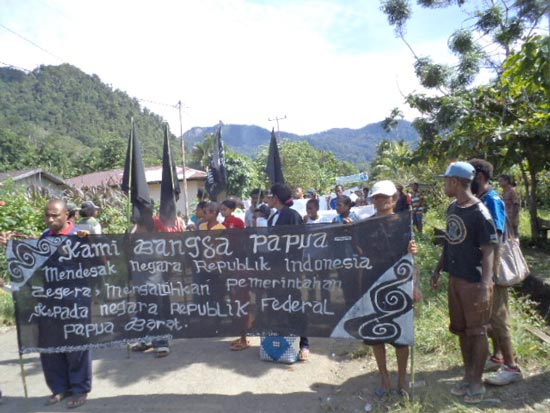
Banner at freedom of expression rally rejecting Indonesian rule in Papua on the International Day for Indigenous People. Photo via Alex Rayfield from West Papua Media stringers in Yapen.

Those arrested were subsequently released except for Edison Kendi and Yan Piet Maniamboy who remained in police custody. A local stringer told West Papua Media and New Matilda that Indonesian police investigators Sudjadi Waluyo and Arip Marinto have charged the two men with rebellion (makar) under section 155 of the Indonesian Criminal Code. Both defendants have been told that the police will seek jail sentences of 20 years each.

The controversial charge of makar has come under intense criticism from Papuan lawyers Yan Christian Warinusy from the Legal Aid Institute in Manokwari and Gustaf Kawer and Olga Hamadi from the Commission for the Disappeared (Kontras Papua). The lawyer argues that the charge of makar has been used as a tool of political repression to deny nonviolent activists their right to free speech. The law actually dates back to Dutch times and was used extensively by the former dictator to repress dissent in Indonesia. Suharto was overthrown by a nonviolent student movement in May 1998 but the law has remained on the statute books. Amnesty International and Human Rights Watch have also called for the makar provisions to be struck from the criminal code and all political pisoners in Papua to be released.

The WPNA march was organised to commemorate the International Day of Indigenous Peoples. Ironically the United Nations theme for this year was to celebrate indigenous media. Yapen is extremely isolated. International media is banned in West Papua and local media is censored. So the very fact that story got out in the first place is testimony to the growing power and skill of indigenous media activists in West Papua.

Kendi and Maniamboy told New Matilda and West Papua Media by text message from their jail cell that they want the international community to help them. “We don’t want Autonomy or to remain with Indonesia. We want to be free! Don’t continue to let us be killed and thrown in jails” they said. WPNA media activist and Governor of Jayapura (under WPNA’s parallel political structure), Marthen Manggaprouw said his organisation wants the Indonesian government to negotiate with the independence movement to resolve the conflict. “The basic rights of indigenous Papuans are not respected in West Papua. There is no democratic space for us Papuans. We are criminalised simply for expressing our opinion” said Manggaprouw.

The men number amongst some 100 West Papuan political prisoners currently languishing in Indonesian jails. Although the Indonesian constitution technically guarantees freedom of speech in reality basic rights are routinely denied to the indigenous Papuan population. Papuans calling for genuine political freedoms are vigorously repressed by Indonesian police and military.

This is the original article to one which appeared in New Matilda

IHRC Media Release: Indonesia Human Rights Committee applauds NZ Superannuation Fund decision to divest from Freeport McMoran on ethical grounds

PRESS RELEASE
Indonesia Human Rights Committee,

 26 September 2012

IHRC is delighted that the NZ Superannuation Fund has decided to pull its investments from the Freeport McMoran mining giant. (NZ Superannuation Fund Media Release 26 September, 2012. )

‘We have been campaigning for the Superannuation Fund and other Crown Financial Institutes to divest from Freeport for six years and we know the news will be welcomed the West Papuan people who have been campaigning about the mine’s impact on their communities for decades.’

‘The Norwegian Pension Fund divested from Freeport several years ago on environmental grounds, but the NZ Superannuation Fund has stated that the breaches of human rights by the security forces were the critical factor in their decision making. So this is an advance.’

‘We intend to call to the Super Fund Offices in Auckland on Friday to make a personal acknowledgement of this important step.’

Freeport has been directly or indirectly responsible for gross human rights abuses in West Papua since it was first granted a highly favourable contract to exploit gold and copper in the days of the Suharto dictatorship.  These abuses include torture, illegal detentions, and killings.   These days the area close to mine is no-go area and an area where the Indonesian security forces rule the roost.   Shooting deaths are regular occurrence on the access road and last October police killed a miner and injured several others who were carrying out a lawful strike.

According to Rev Socrates Yoman a leading human rights advocate Freeport is like an ATM for the security forces – when there is conflict they can be sure of money.

The mine has destroyed a mountain considered sacred by the indigenous Amungme people and displaced thousands, destroying their forest-based subsistence lifestyle in the process.  Local people live below the poverty line- only Jakarta and the mining magnates get the wealth from the enormously profitable mining enterprise.

Freeport uses a system for disposing of the mine waste tailings in the river system -outlawed almost everywhere else in the world.   Over 200, 000 tonnes of waste a day are deposited in the river leading to the creation of vast dead zone where nothing grows.

For further information; Maire Leadbeater; 09-815-9000 or 0274-436-957

WEST PAPUA: NZ Super Fund ends investment in Freeport mine over human rights breaches


Wednesday, September 26, 2012

Item: 8112

WELLINGTON (Radio NZ International / Pacific Media Watch): Human rights breaches have prompted the New Zealand Superannuation Fund to end its investment in the huge Freeport McMoRan copper and gold mine in Indonesia’s West Papua region.

Until now, the fund, of just over US$15 billion, has had just over a US$1 million directly invested in the Grasberg mine, and had rejected calls that this was an inappropriate investment of public money.

But the manager for responsible investment, Ann-Maree O’Connor says the fund has become concerned at a recurrence of security issues at the mine and she says human rights breaches are a key factor.

“The context is such that there have been fatalities at the mine, that there have been reports by MSCI and other sources of information that these have breached human rights standards so we believe that the situation is one that could continue well into the future, and those are the standards that we look at when we considering reviewing the behaviour of companies.”

– The New Zealand Superannunation Fund’s manager for responsible investment, Ann-Maree O’Connor.

The NZ Green Party co-leader, Russel Norman said this was a very positive development.

“The people of West Papua will, I think, receive the information very gratefully, the fact that the New Zealand government, the New Zealand Super Fund is taking a stand against the terrible practices at this mine. I think it’s great news.”

Dr Russel Norman said it was “great” that the Super Fund was taking a stronger ethical stance.

PMW editor: The NZ Superannuation Fund’s involvement in the controversial Freeport mine was challenged in a major investigative article in Metro magazine last December.

The article, written by AUT communication studies student and photojournalist Karen Abplanalp, featured a long-running strike at the mine and the shooting of miners in “suspicious circumstances”.

The allegations were widely reported by Pacific Media Watch.

PMW article on the Super Fund issue


http://www.pmc.aut.ac.nz/pacific-media-watch/west-papua-nz-super-fund-ends-investment-freeport-mine-over-human-rights-breache


Create a website or blog at WordPress.com

Up ↑