This is the 88th in a series of monthly reports that focus on developments affecting Papuans. This series is produced by the non-profit West Papua Advocacy Team (WPAT) drawing on media accounts, other NGO assessments, and analysis and reporting from sources within West Papua. This report is co-published with the East Timor and Indonesia Action Network (ETAN). Back issues are posted online at http://etan.org/issues/wpapua/default.htm Questions regarding this report can be addressed to Edmund McWilliams at edmcw@msn.com. If you wish to receive the report via e-mail, send a note to etan@etan.org.
Summary: Thousands of Papuans peacefully took to the streets August 2 to support calls for a referendum on West Papua’s political future. The demonstrations proceeded despite the presence of armed security forces intended to block the demonstrations and the presence of Jakarta-backed militia provocateurs. Violence erupted near Jayapura and in Puncak District on the eve of the demonstrations. Over 50 international organizations publicly called for the Indonesian government to respond positively to appeals by Papuan NGOs and churches for justice, an end to human rights violations in West Papua, and protection of human rights advocates and journalists. WPAT called on Secretary Clinton to raise with Indonesian officials the ongoing military sweep operations in Puncak Jaya, West Papua. These operations have had devastating affects on innocent Papuan civilians. Secretary Clinton called for dialogue to settle disputes over West Papua. Her repetition of US Government support for “special autonomy” made clear that the Obama administration is deaf to the voice of Papuans who have rejected “special autonomy” repeatedly. Efforts by Indonesian security forces to cover-up the human cost of their military sweep operations in Puncak Jaya have failed. Komnas Ham has proposed a dialogue about violence in Puncak Jaya. A peace conference which convened in West Papua has explored the possibility of advancing dialogue with the Indonesian government. Renowned international academics, lawyers and Papuan activists will convene in Oxford to discuss the continuing denial of the right of self-determination to Papuans. The military commander in West Papua has apologized to the Papuan Kingmi church over intimidating language he employed against the church.
Contents:
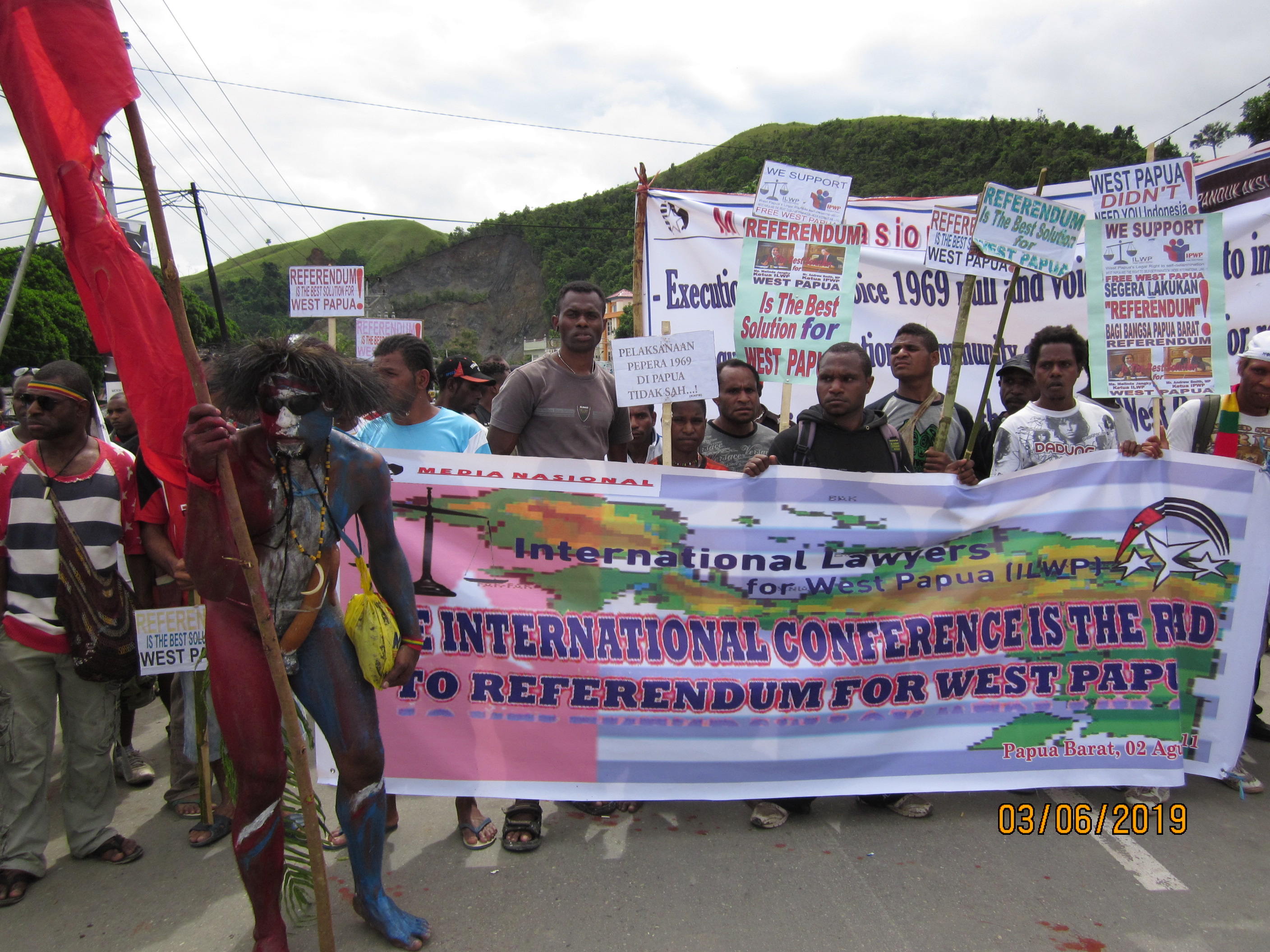
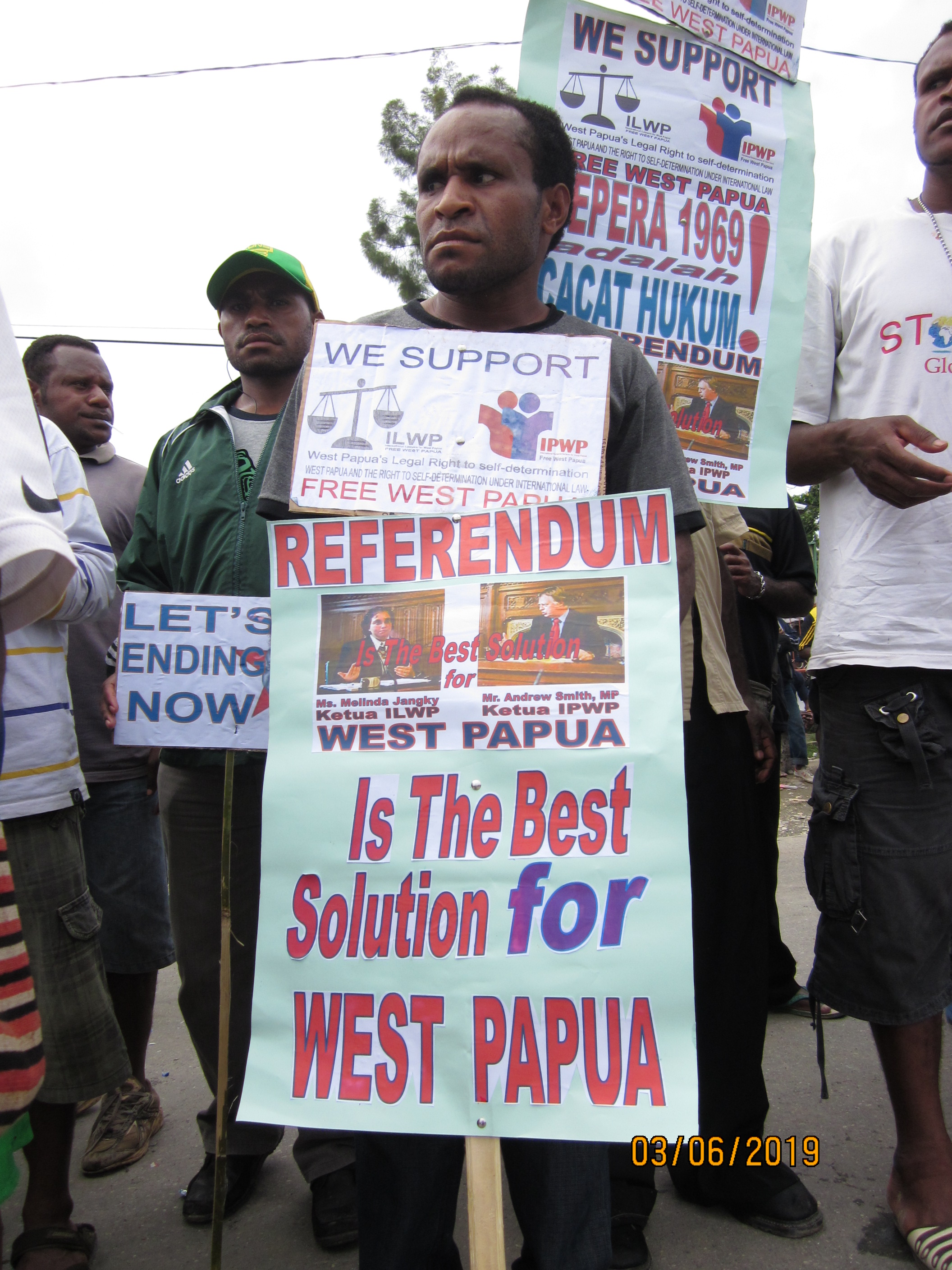
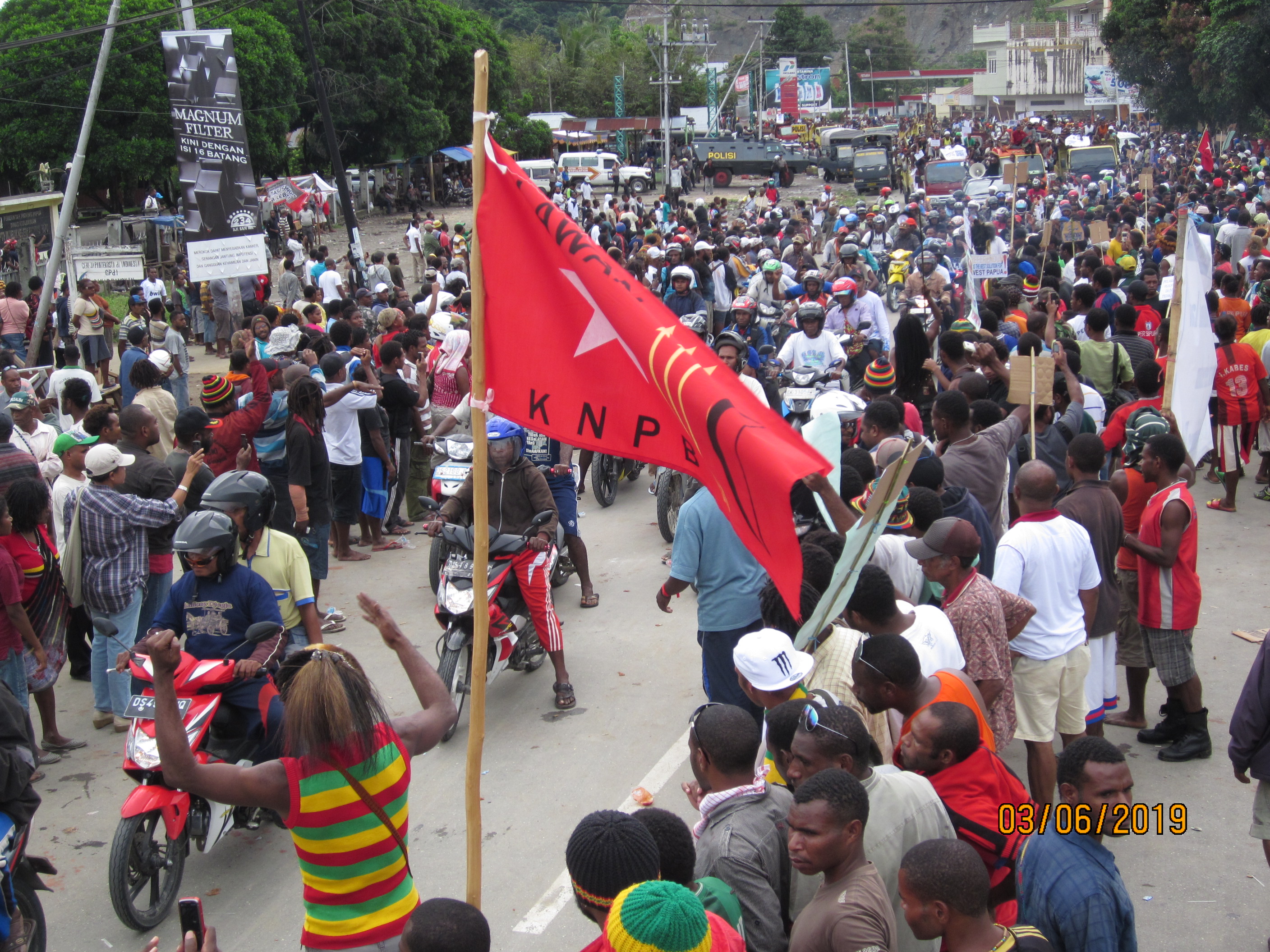
Thousands of Demonstrators in West Papua Demand Referendum
 |
|
| August 2 demonstration in Wamena. (KNPB) |
|
Thousands of Papuans took to the streets in West Papua centers including the capital, Jayapura, to demand a referendum on West Papua’s political future. The August 2 demonstrations were planned to coincide with a conference in Oxford, England, which addressed the fraudulent 1969 “Act of Free Choice” which facilitated Jakarta’s annexation of West Papua. (see below)
The demonstrations in Jayapura have taken place despite the heavy presence of armed security forces deployed to deter demonstrators. Similar efforts by armed security forces to block demonstrations have been reported in Manokwari and other major towns such as Wamena, Biak, Nabire, Paniai, and Timika. The protests were organized by the West Papua National Committee (KNPB).
WestPapuaMedia, which has a network of reporters inside West Papua, reported that members of two pro-Indonesian militias — Besar Merah Putih and Aswain (Eurico Guterres) — have been deployed widely across the Jayapura area in conjunction with security forces. Guterres is the notorious leader of pro-Indonesia militias which worked in conjunction with Indonesian security forces to commit atrocities in East Timor in the run-up to that nation’s pro-independence referendum in 1999.
WestPapuaMedia sources also report that members of Kopassus special forces in plain clothes may also be on the streets. There are suspicions among observers inside West Papua that these forces, including both Kopassus and the militias, may be behind a spate of violent incidents that have transpired in recent days. (See following article on this violence.) This violence may have been organized as an attempt to spread fear, panic and division in order to prevent the protests going ahead.
WestPapuaMedia notes that with tensions extremely high after the violence, the organizers of the August 2 rallies across Papua have banned even symbolic traditional weapons from the gatherings. They also have worked with the Dewan Adat Papua (Papuan Customary Council) to deploy hundreds of peacekeepers from the uniformed Community Security Force of Petapa, or “The Guardians of the Land of Papua.”
 |
 |
 |
| Jayapura |
Sorong |
Timika (photos via KNPB) |
Deadly New Violence in West Papua
As this edition of the West Papua Report was being finalized, there were reports of significant violence in two locations. The seemingly unrelated incidents transpired in Abepura District near the capital Jayapura and in the more remote Puncak District.
In Abepura, unidentified personnel armed with firearms, machetes and axes attacked a transport vehicle on August 1 killing four and wounding 15. All the victims in the pre-dawn attack were migrants and one was a low ranking soldier. Jayapura Police chief Adj. Sr. Comr. Imam Setiawan accused the Free Papua Movement (TPN-OPM) for the attack in which unidentified assailants sprayed a small bus with bullets as it passed through Nafri village. However, a New York Times report quoted Colonel Wachyono, a spokesperson for the Provincial police, as stating “We can’t yet conclude that it was the TPN-OPM or not.”
Fokorous Yoboisembut chairperson of the Dewan Adat Papua (Papuan Customary Council), told media that in the past such violence has been orchestrated on the eve of popular demonstrations such as those held August 2.
In the Puncak District initial reports indicated Papuans backing rival local political leaders came to blows in July 30. A total of 19 were killed according to police. Markus Haluk, the secretary general of the Central Highlands Papuan Student Association, told media that according to witnesses, police fired into the crowd killing three. The rioting rival groups reportedly accounted for additional deaths.
International Community Support for Papuan NGOs’ Appeals for Justice
Organizations based in more than a dozen countries issued a statement of support for West Papuan NGO’s and churches calling for justice and human rights. The Papuan organizations have “decried the failure of the Indonesian government to ensure justice for or protect Papuans who have been the victims of security force brutality, including extra-judicial killing, torture, abduction and imprisonment,” the statement said. The statement noted in particular that human rights advocates and journalists attempting to cover abuses have been targeted.
The international organizations expressed their “support for these courageous appeals” by the Papuan organizations and pledged “to pressure our individual governments and international organizations to press the Indonesian government to act positively and immediately on these demands for justice and the protection of human rights defenders.”
The international statement added that the “continuing violation of human rights starkly demonstrates the limits of ‘democratization’ in Indonesia.”
The statement was endorsed by 54 international, regional, national and local organizations. It was initiated by Tapol , West Papua Advocacy Team and East Timor and Indonesia Action Network (ETAN)
Letter Urges Secretary Clinton to Raise with Indonesia Brutal Military Sweep Operation in Puncak Jaya
|
We urge you to use the opportunity of your visit to Indonesia to call on the Indonesian President to halt all military operations in West Papua and return all military personal to their barracks as a way of easing tension and saving lives. We also urge you to raise with senior Indonesians, the plight of dozens of Papuan prisoners of conscience who were jailed as result of peaceful dissent.
|
On July 20, the U.S.-based West Papua Advocacy Team wrote to Secretary Clinton on the eve of her visit to Indonesia to urge her to raise with senior Indonesians the Indonesian military’s ongoing military operation in Puncak Jaya, West Papua. The letter noted the history of such operations which have repeatedly entailed grave harm to Papuans who have been driven from their villages. Many Papuans have died due to these operations.
The letter to Secretary Clinton noted that Papuan civil society leaders, non-governmental organizations, churches as well as ordinary civilians have long called for transformation of Papua into a “Land of Peace,” a concept that would demilitarize West Papua and end the Indonesian government’s reliance on a “security approach” to address peaceful, political dissent. The letter also reminded the Secretary that many Papuans are incarcerated in prisons due to their peaceful exercise of freedoms of speech and assembly which are denied them by the Indonesian government.
The letter concluded:
We urge you to use the opportunity of your visit to Indonesia to call on the Indonesian President to halt all military operations in West Papua and return all military personal to their barracks as a way of easing tension and saving lives. We also urge you to raise with senior Indonesians, the plight of dozens of Papuan prisoners of conscience who were jailed as result of peaceful dissent and who now face health and even life-threatening conditions in Indonesian notorious prisons.
As is unfortunately common practice, the U.S. State Department failed to acknowledge the letter in any way. Secretary Clinton however, was pressed on human rights abuse by security forces in West Papua during a press conference with the Indonesian Foreign Minister in Bali (see following item).
see also ETAN Urges Secretary Clinton to Condition Security Assistance to Indonesia on Rights
Secretary Clinton Supports Dialogue To Resolve Papuan Issues, but Persists in Support of “Special Autonomy”
 |
|
| Indonesian Foreign Minister Marty Natalegawa, right, and US Secretary of State Hillary Rodham Clinton at joint press conference , Bali, Indonesia. AP/Saul Loeb, Pool) |
|
During her late July visit to Indonesia to attend a regional foreign ministers’ summit in Bali, Secretary of State Clinton was questioned about repression of Papuans in West Papua. The questioning followed calls by U.S. NGO’s for her to raise Indonesian security force actions against civilians in West Papua.
Responding to a question regarding this repression Secretary Clinton stated that the United States supports “open dialogue” between the Indonesian government and Papuan representatives to address regional grievances. Secretary Clinton added: “This is a matter for the Indonesian government and they are addressing it and we hope to see full implementation of the special autonomy law for Papua, which is a commitment on the part of the Indonesian government to address many of the concerns that have been expressed.” Clinton also reiterated United States support for the territorial integrity of Indonesia.
|
Like previous U.S. administrations, President Obama and his foreign policy team are neglecting burgeoning problems of human rights abuse and unaccountable security/intelligence forces in Indonesia.
|
For his part, Indonesian Foreign Minister Marty Natalegawa claimed that the Indonesian government was addressing human rights concerns and that “doesn’t take an external party” to point out the country’s problems.
WPAT Comment: Secretary Clinton’s support for “open dialogue” between Jakarta and Papuans to address “regional grievances” was positive but her contention that “repression,” which was the question posed to her, was a “matter for the Indonesian government” was jarring. Was the Secretary unaware of or simply not briefed about ongoing military operations in West Papua that are harming civilians and driving many from their homes? Was she unaware of or not briefed regarding growing demands for justice and accountability in the face of decades of abuse of Papuans by military, police and intelligence forces? And was she unaware or not briefed that the “special autonomy” she touted has been broadly and publicly rejected by Papuan people, NGOs and religious leaders? Like previous U.S. administrations, President Obama and his foreign policy team are neglecting burgeoning problems of human rights abuse and unaccountable security/intelligence forces in Indonesia.
Security Forces Try Unsuccessfully to Block Coverage of Continuing Military Sweep Operation in Puncak Jaya
Police and military intimidation of journalists and organizers of a press conference forced cancellation of the event. The conference was to have provided an update on an ongoing military sweep operation in the Puncak Jaya region.
Security force efforts to block coverage of its sweep operation in the Puncak Jaya region have not been completely successful. WestPapuaMedia reported an early July incident in which the Indonesian military shot three children and a mother. All survived the July 12 attack. Ny Dekimira, 50, was hit on the right foot, and the three children, Jitoban Wenda 4, and their neighbors Dekimin Wenda, 3, and Dimison Wenda, 8, all had bullets hit their left legs after Indonesian troops fired indiscriminately into the honai (huts) just before dawn on July 14, according to local witnesses. WestPapuaMedia, which has earned a reputation for accurately reporting major developments notes further that:
Credible reports about the scale of the offensive are beginning to filter through from the remote and inaccessible area about the scale of the offensive The Indonesian government has closed off access to the Tingginambut district to both Indonesian and foreign human rights and media observers, and local activists have had to march for days across rugged terrain to get out verified information. Local human rights observers and Papuan activists have independently reported to West Papua Media that TNI headquarters staff have threatened their safety if they alert journalists to abuses carried out by Indonesian security forces against West Papuan people.
Matius Murib, deputy head of the Papua branch of the National Commission on Human Rights (Komnas HAM), confirmed the account of the four civilian victims. He added that hundreds of residents of Kalome village had fled their homes in the wake of this shooting, because they feared becoming victims of the violence.
Having failed to block coverage of developments the military has sought to deny emerging reports. Maj. Gen. Erfi Triassunu, head of the Cendrawasih Military Command, which oversees operations across Papua, said that reports of these or other civilian casualties was unlikely. “You seriously believe that in a remote and isolated area like that, with such hostile terrain, there would be people living there? Much less kids running around playing?” he said. “Honestly, I’m lost for words. This is the first time I’ve heard of this.” “We would be very surprised if there were any civilian casualties, because what would anyone be doing in such an area?”
WPAT Comment: General Triassunu’s comments would be laughable if they were not so inciting. The general, who has responsibility for the ongoing sweep operation, would appear not to know that there are civilians in the area of the operation. He also appears fundamentally unaware of the circumstances of the assault on the civilians: the wounded children were not “playing around” as the general speculates: rather, they were shot inside their homes in the pre-dawn attack by troops the general supervises.
A Dialogue about Violence in Puncak Jaya?
The Indonesian National Commission on Human Rights (Komnas HAM) (a state institution) plans to pursue dialogue with armed Papuan groups in a bid to end violence in the Puncak Jaya region of West Papua. The region is the scene of an ongoing military sweep operation that has already caused civilian casualties.
The Commission intent to pursue dialogue with armed elements and others was announced by commission deputy chairman Nurkholis who spoke to the media on July 15 following his meeting with the Cendrawasih/XVII Military Regional Commander Maj. Gen. Erfi Triassunu. Nurkholis, added that the Commission would coordinate the dialogue initiative with the Coordinating Legal, Political and Security Affairs Ministry and that the initiative would also engage all local leaders in Puncak Jaya in order to “determine the root of the armed conflict and why it continues to occur and claim victims from both the military and civilian sides.” The role of the military in the dialogue was left unclear.
If the initiative proceeds it could offer a window into the repression and human rights abuse that military sweep operations such as the one currently underway have brought about in the Puncak Jaya in recent decades. Any serious dialogue about violence in Puncak Jaya would require access to the area and to the victims of violence, something that the Indonesian military in the past has always sought to prevent.
Peace Conference Convenes in West Papua – Urges Dialogue with Jakarta
A range of Papuan organizations including religious, customary, women’s, youth, academic, student and resistance groups convened in a “conference for peace” at in Abepura at Cenderawasih University, 5-7 July, 2011.
The conferees issued a statement which emphasized that conflicts should be resolved through peaceful means and identified the following principles:
- We declare that dialogue is the best way to finding the solution to the conflict between the Papuan people and the Indonesian Government,
- We determine to find the solution to political, security, legal, human rights, economic, environmental and social-cultural issues in Papua by means of dialogue between the Papuan people and the Indonesian Government, mediated by a neutral third party,
- We welcome the initiative of the central government in support of the preparatory processes for a Jakarta-Papua dialogue
The conferees also agreed on the qualities of those who should be chosen to represent Papuans in the dialogue with Jakarta and identified a list of five prominent Papuans to play that role.
Those making presentations at the conference on the theme of “Let us together make Papua a ‘Land of Peace’ included:
Djoko Sujanto, Minister-Coordinator for Politics and Law of the Republic of Indonesia
Barnabas Suebu, Governor of the Province of Papua
Bekto Suprapto, Chief of Police of Papua
General Erfi Triassunu, Commander of the Military Command XVII/Cenderawasih
Leo Laba Ladjar, Bishop of the Diocese of Jayapura
Tony Wanggai, Chairman of the Papuan Provincial Branch of NU and representative of the Papua Muslim Council
Sokrates Sofyan Yoman, Chairman of the Synod of the Alliance of Baptist Churches in Papua
Forkorus Yaboisembut, Chairman of the Papuan Customary Council
(WPAT Comment: Support for dialogue between Papuans and the Jakarta administration continues to grow. The formula proposed by this conference resembles the dialogue process which brought an end to most fighting in Aceh province, although with Aceh international mediators were key. It is important to keep in mind while that process yielded important agreements, Jakarta has failed to implement some of them, such as a truth commission and a human rights court. The Aceh negotiations offer both positive and negative lessons for a similar process focused on West Papua.)
“Road to Freedom” Conference Convenes
In an historic gesture of international support for Papuans right to self-determination, international lawyers and human rights activists are joining Papuans at Oxford in the UK to discuss Papuans’ political future. The meeting, convening on August 2 will be chaired by UK Member of Parliament Andrew Smith, and will include renowned academics as well as academics. Among those scheduled to speak were:
Jennifer Robinson – International human rights lawyer
Powes Parkop – Governor of Port Moresby and the National Capital District, PNG
Benny Wenda – West Papua independence leader in exile (and a leading organizer of the conference)
Frances Raday – expert Member of the UN Committee for the Elimination of Discrimination Against Women
John Saltford – historian and expert on the 1969 Act of Free Choice
Clement Ronawery – Witness to the 1969 Act of Free Choice
Ralph Regenvanu – Vanuatu Justice Minister
Charles Foster – co-founder of the International Lawyers for West Papua
The Mayor of Oxford has agreed to fly the Morning Star flag above Oxford Town Hall on the day of the conference to signal support for the conference and in solidarity with the Papuan peoples struggle.
WPAT will have more on the conference next issue.
Military Commander in West Papua Apologizes for Threatening Papua Kingmi Church
In a remarkable turnabout, the chief of the Indonesian military in West Papua has issued an apology to West Papua’s Kingmi Church in the wake of the leak of a letter which was widely seen as constituting a threat to the Papuan church and its leaders. In a July 18 media statement, West Papua Army commander Major-General Erfi Triassunu, issued a public apology to the leadership and congregation of the Kingmi Papua Church. The General wrote “if I caused any offence to the Kingmi Papua Church I am sorry.”
In the originally “secret” April 30, 2011 letter Triassunu repeats claims made by representatives of Kingmi Indonesia, an Indonesian-wide church, that Kingmi Papua is a separatist organization. Kingmi Papua and Kingmi Indonesia have long been at odds. The general acknowledged in his recent letter that he had weighed into an internal church conflict. In words widely recognized as threatening, Triassunu originally wrote of taking “assertive action.” Triassunu indicated that such action would be forthcoming if Kingmi Papua continued to pursue an independent course from Kingmi Indonesia.
Reverend Benny Giay, a leader of the Kingmi Papua church, said that in the past such aggressive talk by senior military figures often served to signal to nationalist militias to take matters into their own hands.
WPAT Comment: Such military involvement in internal church matters affecting Batak Christians in Sumatra often led to violence. More to the point, Kingmi Papua’s pastors have been killed at the hands of the Indonesian military or their militias.
(see Alex Rayfield’s article in New Matilda for broader coverage of this development.)





 West Papua Media Alerts