Karma continues his hunger strike; KomnasHAM unable to visit Filep and Buchtar

via Tabloid JUBI, 9 December 2010

Karma continues his hunger strike
The political prisoner, Filep Karma has said that he will continue with
his hunger strike, not taking food or drink, until he is returned to
Abepura Prison in Jayapura.

‘I will continue with my hunger strike until I am returned by the
police,’ he said when he met with JUBI. He said he was very
disappointed with the way he was being treated, being accused with
Buchtar Tabuni of causing a riot in the prison last Friday, 3 December.

‘There is no justification for all this treatment towards us,’ he said.

According to JUBI who met him at the police headquarters, even though he is on hunger strike, he looks healthy and keeps smiling.

The head of the District Office of the Department of Law and Human
Rights, Nazaruddin Bunas said that Karma and Tabuni were transferred to police custody because they were the ones who were behind the rioting in Abepura Prison, which is why they are at present in police custody.

The director of Abepura Prison said that he knows nothing about the
transfer of the two prisoners.

——————

JUBI, 8 December 2010

KomnasHAM unable to visit Filep and Buchtar

The deputy head of the National Human Rights Commission in Jakarta, M. Ridah Saleh has expressed his disappointment at not being able to meet Filep Karma and Buchtar Tauni and regrets the fact that their families are not being given access, either

‘The police told us that we should make contact with the prison, even
though we have been given permission to meet them by the police (in
police custody),’ said Ridah Saleh.

He said that the rights of prisoners should be fully protected and
KomnasHAM and members of their families should be given the opportunity to visit the two men. Access to them must not be closed’

Their rights to get medical treatment must also be respected, to avoid
any further problems.

Members of their families are also hoping for access because this is in
accordance with the procedures. This should also apply to the other
three prisoners.

Before going to the police, they had paid a visit to the direskrim
(criminal investigation) where they met Petrus Waine, who said that
KomnasHAM could come and discuss the matter of there being no access to the two prisoners but when they arrived there, no disreskrim people were available to meet them.

‘This is very disappointing indeed, because we were given a promise but when we went there, there was no one who wanted to meet us to discuss this matter.’

The plan of KomnasHAM to visit Filep and Buchtar also had to be
abandoned because these two political prisoners had been moved away from Abepura Prison.

Video Testimony of Torture Victim Tunaliwor Kiwo

Video Testimony of Kiwo

(Subtitle – English)

From Dewan Adat Papua via EngageMedia.org

In this video West Papuan farmer Tunaliwor Kiwo recounts the details of his torture by Indonesian soldiers on May 30 2010. Indonesian soldiers arrested Kiwo and his neighbor Telangga Gire on May 30 in Papua’s Puncak Jaya regency. This video was shot on October 23, 2010 and released by the Papuan Customary Council. Kiwo describes the torture he suffered for 2 days before escaping from the soldiers on June 2.


Related content

* News Item Transcript of Kiwo’s Torture Testimony (English)
* Video Torture of Tingginambut men (Papua) – English Subtitles
* Video Video Testimony of Kiwo (Subtitle – Bahasa Indonesia)
* News Item Transcript: Tunaliwor Kiwo Testimony (Bahasa Indonesia)
* Video Kiwo Testimony, High-res, no subtitles

Full Description

After the public release of the torture video the Indonesian government promised to investigate but now claims it cannot identify the perpetrators and is dragging it’s feet on taking action.

In the 10-minute torture video previously released to the public on October 18, soldiers are seen kicking Kiwo’s face and chest, burning his face with a cigarette, applying burning wood to his penis, and placing a knife to Gire’s neck. Indonesia is party to the UN Convention Against Torture and has strict obligations to promptly investigate and prosecute all incidents of torture and to ensuire that victims and witnesses are protected against all ill-treatment or intimidation as a consequence of any complaint or evidence given.

Copyright 2009, by the Contributing Authors. Cite/attribute Resource. dewanadatpapua. (2010, November 19). Video Testimony of Kiwo (Subtitle – English). Retrieved November 23, 2010, from EngageMedia Web site: http://www.engagemedia.org/Members/dewanadatpapua/videos/kiwotestimony_en.

This work is licensed under a Creative Commons License

Powerful images from Manokwari show mass opposition to Indonesian occupation of West Papua

westpapuamedia.info

November 9, 2010

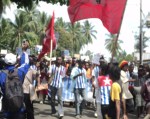
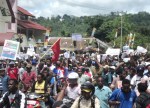
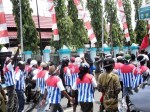
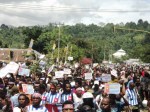
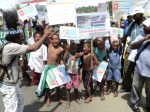
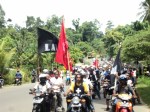
Manokwari, West Papua:  Powerful images have emerged from mass actions calling for  US President Barak Obama to stop assisting Indonesian state violence, and to seek a lasting peaceful solution to West Papuan people’s suffering.

West Papua National solidarity for Obama (SONABPO) called the peaceful demonstration held on November 8 in Manokwari, to coincide with the visit to Indonesia of Obama.  After two separate protest marches combined, the crowd grew to at least 6200 people.  Despite fears of unrestrained Indonesian security forces in attendance, events were largely peaceful, with the large crowd outside Sanggeng stadium listening to hours of speeches demanding both Indonesia and the US to take responsibility for their role in the systemic brutality of the Indonesian colonial occupation.

(more below)


The demonstration was also in support of the Washington Solution conference on West Papua starting on the 9th November

The main demands of the rally were:1.    The USA must review their 1962 New York Agreement that transferred West Papua to Indonesia.

2.    President Obama and US Congress must review how US assistance to Indonesian military can be leveraged to solve human right abuses in West Papua.

3.    Indonesian government as a political body that is the cause of problems in West Papua,  must open themselves to solve the problems in West Papua.

4.    We West Papuan Melanesians strongly reject the failed Special Autonomy (package imposed by Indonesia) and call for referendum

5.    We West Papuan Melanesians,  support the Washington Solution (self determination) to be held on the 9th of November 2010 in Washington DC USA.

6.    We West Papuan Melanesians demand for the referendum to be conducted in West Papua for democracy and justice.

7. United Nations – Nations (UN) must soon send a team / International Observer Force to West Papua.8. We West Papuan Melanesians are asking for International community to support West Papua Transitional Government to meet Indonesian Government.

After they expressed their political views, representatives from the DPRD promised to continue working according to Papuan aspirations but conceded the were hobbled by being an instrument of  Jakarta.

The rallies dispersed by themselves peacefully.

PAPUA STUDENTS: Freeport should close; US must be hed responsible for Crimes Against Humanity

image

image

image

PAPUA STUDENTS ALLIANCE (AMP)


PRESS RELEASE

Freeport McMoRan copper and Gold should be closed down and the United States should be held responsible for crimes against humanity and against the environment in Papua.


(JAKARTA, 09 November 2010) – The history of Papua is a history manipulated by the political and economic interests of other countries, especially the United States which eventually encouraged Indonesia to carry out the annexation of West Papua.  The political process that occurred prior to the implementation of the 1969 Act of Free Choice is a process in which the ideological interests of the world played an important role in the process of the history of Papua.  The Capitalist Bloc (the West) led by the United States and the Socialist Bloc led by the Soviet Union played a major political part in the political bargaining which led to the decisions concerning the political fate of the Papuan people up until today.

On the one hand there was the United States which played a role in cutting off political access of the Dutch Government to its colony in West Papua and in encouraging the Netherlands to accept a project of political diplomacy drafted by American diplomat, Elsworth Buncker, which resulted in the so-called Buncker plan in which important political concepts were drawn in relation to the right to self-determination of the West Papua people.  The Buncker plan was at the origin of the famous document known as the New York Agreement (NYA) signed by the Dutch and the Indonesians, under the auspices of the United Nations, which established the technical principles regarding the implementation of a process of consultation of the people on their right to self-determination.  This so-called Act of Free choice (Pepera) took place in 1969 and it was unfair, undemocratic and highly discriminatory towards the people of Papua.

In addition to playing the role of political diplomacy in the Western Block, the United States was also acting out of personal economic interests in order to safeguard its access to the natural resources in West Papua, an area extremely rich in natural gas, mining deposits, minerals, petroleum, forest products, fishery, plantations  and a number of other economic resources which proved to  be very profitable for the interests of the exploitation of foreign capital, especially for the United States, in Papua.  Evidently, the economic interest is Freeport McMoran Gold & Copper, with its basis in New Orleans, one of the largest mining company in the United States, a company which would later cause great problems concerning the political rights of the People of West Papua.  The political intervention of the United States and its behavior towards the Netherlands resulted in an insignificant political support from the Dutch with regard to protecting the right to self-determination of the people of West Papua.   Also the backing by the United States of the clique within the Indonesian army between 1965 and 1966 which facilitated the coming to being of the New Order authoritarian militaristic regime under the leadership of General Suharto, had as a direct result the annexation of West Papua, turning it into a colonized area for economic purposes, as well as a killing field where gross human rights violations were and still are perpetrated by the Indonesian army, an area fully controlled by the United States and the economic interests of the capitalists.

It is common knowledge that the Freeport company funds the Indonesian military with billions of rupiahs to secure the exploration area of PT. Freeport. In a report from the New York Times entitled “The Cost of Gold, The Hidden Payroll: Below a Mountain of Wealth, a River of Waste” (27 Dec 2005)  it is clearly described how much dirty money is received by high-ranking Indonesian military.

Over the past 32 years of control over Papua by the militaristic regime of Suharto, there have been numerous cases of violations of human rights as a result of many Military Operations conducted in Papua.  This situation did not stop after the period of reform in Indonesia in 1998. Regime change was not accompanied by fundamental changes to the system in Indonesia. Evidence of continuous gross human rights violations by the Indonesian military forces up until today can be seen, as two torture videos were circulated on the Internet some time ago.  These two films depicting scenes of torture were published by the Asian Human Rights Commission (AHRC), based in Bangkok, through the Youtube site. A few days later, after meetings with President Yudhoyono at the State Palace, Co-ordinating Minister for Political, Legal and Security Affairs, Djoko Suyanto, confirmed in front of reporters that gross acts of torture had indeed been perpetrated by members of the military, on two civilians who were suspected of being members of the Free Papua Movement (OPM) in the District of Puncak Jaya, Papua. These cases of torture were committed by the Indonesian army, which has long established ties with the American Government in the field of military cooperation.

Considering the complexity of the problems in which Papua finds itself today, where there is no recognition of the democratic rights of the people of Papua, the Papuan Students Alliance states its position as follows:

1. Freeport McMoRan copper and Gold in the land of Papua should be closed down immediately and the United States should be held responsible for crimes against humanity and against the environment in Papua.

2. We demand that the Government of the United States, the United Nations and Indonesia be held accountable for the political conspiracy surrounding the 1969 so-called Act of Free choice, which was in effect a miscarriage of justice and morality, an act full of intimidation and manipulation.

3. We strongly call on the termination of the bilateral military cooperation between the United States and Indonesia.

4. We demand that there be a thorough and comprehensive resolution of all cases of human rights abuses.

5. We demand the withdrawal of the organic and non-organic military troops from Papua.

6. We demand the implementation of the right to self-determination or a referendum for the nation of Papua.

We raise these issues in our statement to the American government, Indonesia, the United Nations and all parties associated with the dark history of the Papuan people to date, so that they may address these matters of concern in an urgent manner.


Jakarta, 9 November 2010

General Coordinator

Rinto Kogoya


Action PR

Okto: 082112808445


Indonesian authorities suspected of launching cyber attacks on NGO websites

The websites of several NGO groups campaigning for human rights in West Papua have been under a serious DDoS attack for most of this week, forcing them offline as their servers have been overloaded. In the UK press, the finger of suspicion is focusing on the Indonesian authorities.

Survival International, the Asian Human Rights Commission, Friends of
People Close to Nature, Free West Papua Campaign and West Papua Media Alerts have seen their websites crippled in what is being described as a ‘coordinated cyber terrorism act’. All these campaign groups hosted video footage showing Indonesian troops torturing West Papuans, which has heaped shame on the Muslim majority country .

Channel 4 News in the UK tonight broadcast a report which also included footage from a demo held in West Papua earlier today. Newspapers including the Guardian and Yorkshire Evening Post have published reports on the cyber attacks, with more expected tomorrow.

Toby Nicholas, a new media expert at Survival International, said “What
they’ve done is remarkably effective and expensive – that’s why we think it’s linked to the Indonesian government or military authorities. There is no way this will stop our campaign for the tribespeople in West
Papua. If anything it makes us more determined.”

At the time of writing all the NGO websites remain down.

Links to news reports so far below. TV news report to follow:

Guardian newspaper:
http://www.guardian.co.uk/society/2010/oct/28/survival-international-website-torture-video

Press Association:
http://www.google.com/hostednews/ukpress/article/ALeqM5j6fx4NxV3iaYoS8jalBIv5svH4dA?docId=N0036491288275207847A

Orange:
http://web.orange.co.uk/article/news/cyber_attack_on_rights_charity#newscomments

Yorkshire Evening Post:
http://www.yorkshireeveningpost.co.uk/news/Cyber-attack-on-human-rights.6603648.jp

Create a website or blog at WordPress.com

Up ↑