Papuan youth set alight by Indonesian civil security officers

TAPOL Press release

3 November 2011 – Evidence has emerged of a horrific attack on a Papuan student in the town of Wamena in West Papua‘s central highlands.
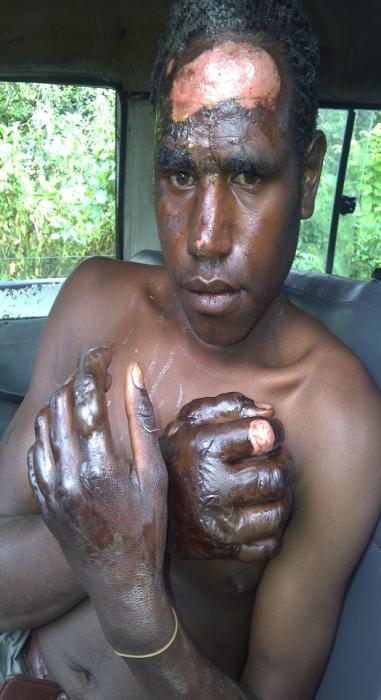
Yusuf Hiluka, set alight by police officer in Wamena on Oct 19 (via TAPOL)

According to a report received by TAPOL, at around 04:45 am on Wednesday 19 October, Yusuf Hiluka, 23, was stopped outside the office of the Regent of Jayawijaya District by two officers from Satpol PP (Satuan Polisi Pamong Praja), the district civil security unit, while making his way from a friend’s house to the Wamena bus terminal.

Without questioning Mr Hiluka, the Satpol PP officers poured glue on his head and set it alight. Mr Hiluka’s head and the back of his neck were engulfed in flames.

Mr Hiluka fled screaming to the nearby police station to seek protection. The perpetrator was detained immediately and held in police detention. An investigation has been conducted, and in accordance with customary law, a payment by the perpetrators to the victim’s family is being arranged.

Mr Hiluka suffered burns to his forehead and hands [1], and according to reports he is still awaiting hospital treatment for his wounds. The motive for this attack is not known, but it is yet another unexplained incident in a series of violent events that have devastated West Papua in recent months. It occurred on the same day that up to six people were killed during the violent dispersal of the Third Papuan Peoples’ Congress by Indonesian security forces in the provincial capital, Jayapura [2].

TAPOL calls on the regional Chief of Police, Inspector General Bekto Suprapto, to recognise the gravity of this cowardly attack, ensure that a thorough independent criminal investigation is carried out and that those responsible are brought to justice. The use of customary law in such cases cannot be deemed sufficient, either in obtaining justice for the victim, in punishing the perpetrator, or in acting as a deterrent against future violations.

ENDS

Contact: Paul Barber +44 (0) 7747 301 739 or paul.barber@tapol.org

Notes:
1. Photos of Mr Hiluka and his injuries are available on request from TAPOL.

2. See TAPOL/WPAT/ETAN press release, ‘Indonesian crackdown on Papuan
Congress sparks outrage’, 20 October 2011, at
http://tapol.gn.apc.org/press/files/pr111020.pdf.

Current condition of tapol Kimanus Wenda and funds needed for operation and travel costs

Received from Solidaritas Korban Pelanggaran HAM Papua (Solidarity for Victims of Human Rights in Papua)
[Translated by TAPOL]

Papuan prisoners continue to be subject to discrimination in a number of ways such as the lack of finance, the lack of access to health facilities and racist insults against Papuan people. There are no NGOs, church groups or individuals who are regularly monitoring the situation of Tapols/Napols [this differentiates between political and non-political prisoners in Papua] who are currently in prison in Papua.

Take the example of Filep Karma who was for nine months left unattended in Dok II Hospital in Jayapura, in 2010. Ferdinan Pakage was tortured and sustained permanent injuries in his right eye from a prison official in Abe Prison, Abepura, in 2008. And most recently, Kimanus Wenda who, according to the recommendation of a doctor, needs to have operation for a tumour in the abdomen, but there has been no response from the prison officials in Nabire prison. He was even shackled with handcuffs and kept in an isolation ward in May 2011

The condition of Kimanus Wenda in Nabire Prison is now critical; he has been vomiting because of the tumour. Last Thursday at 12 midnight, he was vomiting and so dizzy that he urged an official to be transferred to hospital but this was refused. [precise meaning of a sentence in the text here is unclear]. Although he had asked to be transferred to Jayapura a number of times as recommended by the doctor, there was no response from the officials at the prison.

In view of the present condition of Kimanus Wenda, the SKPHP had a meeting with the Kanwil (?) and then with the Papua department of law and human rights [Depkum HAM Papua] on 19 September. However, the head of Depkum HAM, Daniel informed his family of a number of conditions:

* A guarantee from the family
* A formal request from the family
* A statement from Nabire Hospital
* Confirmation from the doctor
* A request for police to provide guards.

Solidaritas Korban said that it was prepared to find all these documents and that his family would provide the funds but only for a ticket for Kimanus to make the journey from Nabire to Wamena, meaning that funding for the guards was the responsibility of the state.

On 19 September, Solidaritas Korban had a meeting with Kontras Papua at which the following was agreed:

A division of tasks regarding the documents required.
We would need to raise money for the journey by two persons to Nabire
We would find the money for the stay in hospital, the operation and other requirements after Kimanus was in Jayapura
Information about these decisions would remain confidential.

Once the money for the tickets was available, Solidaritas Korban would:

Lobby the doctor.
Issue a press release
Seek contributions from the general public out in the streets
Lobby for funds to cover the costs of the hospital stay, the operation, the tickets to Nabire and so on.

The amount of money required is as follows:

Rp 1,347,000 x 2 for a total of Rp 2,694,000 for one-way tickets.
Airport tax and local transport, Rp 1,000,000
Solidaritas Korban transport costs incurred to handle arrangements for Kimanus
The total amount of money needed: is Rp 4,694,000

Jayapura, 19 September 2011
Solidaritas Korban Pelanggaran HAM Papua

Komnas HAM calls for harshest punishment for killing civilian

In a statement issued today, 25 July, the Papuan branch of Komnas HAM, the National Human Rights Commission, has called on the authorities to mete out the harshest possible punishment for the member of the army who murdered the Rev. Ginderman Gire and wounded Gembala Pitinius in Tingginambut on 17 March 2011.Deputy chairman of Komnas HAM, Mathius Murib,  said he appreciated the decision of the Indonesian army to launch legal proceedings against  those who tortured and killed Rev Ginderman and wounded Gembala Pitinius. The latter man survived after being tortured. in Tingginambut, Puncak Jaya district. ‘We very much hope that the perpetrators  will be punished as harshly as possible according to the law so as to act as a deterrent, to ensure that such a crime doesn’t happen again.’

This was in connection with the forthcoming trial of the three army officers  who had committed acts of violence against two civilians

As has been reported, the trial is now under way before a military tribunal of three officers: First Sergeant  Torang Sihombing, NCO Hery Purwanto and NCO  Hasirun. The three are charged with using violence and torture according to articles 351 and 103 of the Military Code for causing the death of Ginderman Gire.

The crime againt Ginderman occuurred on 17 March 2010, At the time, First Lieutenant  Sudarman as commander of Post Illu Puncak Jaya had ordered the three accused to go on patrol in Pos Illu Post, in the Mulia area  in Puncak Jaya. The three men followed a convoy of vehicles which were transporting foodstuffs. After reaching Pintu Angin Alome, one of the drivers of the trucks reported to First Sergeant Saut Torang Sihombing that a local man named Ginderman Gire had asked for fuel. whereupon the sergeant asked why  he was asking for fuel, when another man Pitinius Kogoya also asked for fuel. When they said nothing, Sergeant Sihombing became very angry and struck Ginderman in his chest and hit Pitinus in the face.

After being struck, Ginderman said: ‘I’m not afraid of the army and I have friends up in the mountains who are well armed.’

The sergeant then handed the two men over  to another soldier, Hery Purwanto for questioning. During the questioning, the two men were beaten. Pitinus was able to escape  and jumped into a ravine. One of the soldiers fired shots into the air as a warning while Ginderman tried to grab a weapon from Hery Puwanto.  The officer fired his SS3 V-1 hitting him in the chest. The soldiers looked down and realised that the man they had shot was dead.

The soldiers then reported the incident to their  superior and were ordered to get rid of the body. The body of Ginderman was then loaded onto a truck and driven away. When they reached the Tingginambut bridge,they threw the body into the river.

JG: Low-Ranking Soldiers Indicted Over Torture, Killing in Papua’s Puncak Jaya

[The Papua Customary Council (DAP), however, disagreed with the Army’s
version of events. It said Kinderman was a local priest and had no
ties to the OPM.

“He was waiting for a delivery from Wamena, so when a convoy
approached he immediately went up to check for his package,” DAP
member Markus Haluk said. “There are thousands of innocent civilians
in Papua accused of being OPM to justify military tortures and
killings. This trial is just for show, like the previous one.”]

The Jakarta Globe
July 21, 2011

Low-Ranking Soldiers Indicted Over Torture,
Killing in Papua’s Puncak Jaya

by Banjir Ambarita

Jayapura

A military tribunal in Papua indicted three low-ranking soldiers on
Wednesday for the killing of a civilian in Puncak Jaya district last
year.

The defendants were identified as First Sgt. Saut Sihombing, Second
Pvt. Hery Purwanto and Second Pvt. Hasirun. All three serve in the
Army’s Nabire Infantry Battalion, as did four soldiers sentenced in
November for torturing two civilians in the village of Gurage in the
same district.

That incident resulted in international condemnation after a video of
the torture was posted on the online video-sharing site YouTube in
October.

Military prosecutor Capt. Jem C.H. Manibuy charged the three
defendants in this latest case with torture. They are accused of
beating and shooting to death a civilian, identified as Kinderman
Gire. The killing occurred near a military checkpoint in the village
of Illu on March 17 last year, just two weeks prior to the Gurage
incident.

The indictment says Saut, Hery and Hasirun accompanied a civilian
convoy that was delivering food supplies to Mulia, the capital of
Puncak Jaya district, around 10 hours by road from Wamena, Jayawijaya.

Kinderman, according to the indictment, stopped the convoy near Kalome
village in an attempt to extort gasoline from the driver of one of the
vehicles.

Saut disembarked from his vehicle and approached Kinderman who was
with another civilian, Pitinus Kogoya. The indictment says that
Kinderman then said, “I am not afraid of the military. I have 30
friends in the mountains and they are armed,” suggesting that
Kinderman was a member of the separatist Free Papua Movement (OPM).

Kinderman and Pitinus were then beaten while being interrogated by
Hery and Hasirun, the indictment says. Pitinus was able to escape by
jumping down an embankment.

The military tribunal was told that Kinderman tried to grab a rifle
from Hery, who reacted by firing at Kinderman. The shot hit Kinderman
in the chest, killing him instantly.

Saut said he reported the incident to his superior, Sudarmin, who told
the three not to say anything about the shooting.

The three soldiers took Kinderman’s body to their vehicle before
dumping it in a river from a bridge in Tingginambut subdistrict, the
indictment says.

The Papua Customary Council (DAP), however, disagreed with the Army’s
version of events. It said Kinderman was a local priest and had no
ties to the OPM.

“He was waiting for a delivery from Wamena, so when a convoy
approached he immediately went up to check for his package,” DAP
member Markus Haluk said. “There are thousands of innocent civilians
in Papua accused of being OPM to justify military tortures and
killings. This trial is just for show, like the previous one.”

Human rights NGOs in Papua may seek international action about violations in Papua

Bintang Papua, 14 June 2011
Jayapura: On the occasion of the tenth anniversary of the Wasior
incident, which was described by Komnas HAM – the National Human Rights
Commission – as a gross violation of basic human rights, two leading
human rights organisations in West Papua, BUK – United for Truth – and
KontraS-Papua – Commission for the Disappeared and the Victims of
Violence, held a press conference in Jayapura.

They said that there has been a failure to show any serious concern
about the violation of basic human rights in Papua. In view of this,
they said that they now intend to bring these cases up before an
international mechanism. ‘There has as yet been no international move
to take action on these cases, but we intend to raise these issues by
waging a campaign in the hope that this will bring pressure to bear on
the Indonesian government to resolve these cases,’ said Selpius Bobii,
the BUK co-ordinator. who was accompanied as the press conference by
the co-ordinator of KontraS-Papua, Olga Hamadi.

He also said that they would make formal approaches by letter to a
number of government institutions as well as NGOs.

‘Immediately after this press conference, we will be sending letters to
Komnas HAM, to the attorney-general’s office, to Amnesty International ,
to the media in Papua as well as to NGOs in Germany and elsewhere.’

The organisations felt that such action was now called for as a way of
exerting pressure so as to ensure that these cases are recognised as
gross human rights violations and are brought before a court of law.

‘It seems that it is necessary to bring pressure to bear on the various
NGOs and on the government to persuade them to be more serious about
resolving a number of human rights cases in Papua,’ they said.

According to data that has been collected by BUK, these cases resulted
in the deaths of six people at the time of the incidents, while seven
others died subsequently as a result being subjected to torture. Seven
people are reported to have disappeared, while no fewer than 305 others
were subjected to sweeping operations known as ‘Tuntas Matoa’.

‘There has also been discrimination against the families of the victims
because their parents have been branded as separatists. This is apparent
from the way that /respect /funds have been distributed, bearing in mind
the fact that the families have been treated differently than others in
the community.’

With regard to the human rights violations that have been perpetrated in
Papua at the hands of members of the Indonesian army (TNI) and the
Indonesian police (POLRI), in all these cases, it has been virtually
impossible to bring them before a court of law. ‘In the case of those
incidents that were actually taken to court, nothing was done to side
with the victims; the perpetrators were protected with the argument that
whatever had been done was in the interest of the security of the state.
An example of this was the Abepura case where those who were found
guilty are no longer behind bars.

The Wasior incident occurred on 13 June 2001. It was triggered when a
person demanded compensation for the theft of his traditional land
rights but this failed to solicit any response. On the contrary, the
people concerned were accused of disrupting security and were arrested,
tortured, and in many cases killed or made to disappear.

‘Cases that have been identified by Komnas HAM as gross violations of
human rights have reached a stalemate.after disputes between Komnas HAM
and the attorney-general’s office, with the latter using formalistic
excuses.

They went on to say that the Wasior case as well as the Wamena case (the
fatal shooting of Opinus Tabuni in August 2010) had been acknowledged by
Komnas HAM as gross violations of human rights but it had been virtually
impossible to deal with such cases because the administrations of the
provinces of Papua and West Papua which came into being following the
special autonomy law (OTSUS) had also failed to respond.

In view of all this, the representative of BUK made the following demands:

1. The president of Indonesia should immediately resolve the Wasior and
Wamena cases and in doing so recognise the fact that Papuans are
citizens of the Unitary Republic of Indonesia, NKRI which means that
their standing and dignity within the state is in keeping with the
values of the Papuan people as citizens of Indonesia.

2. The attorney-general’s office should end its machinations with regard
to the Wasior and Wamena cases and co-ordinate with other state
institutions so as stop their activities which have resulted in
reinforcing the cycle of impunity.

3. The administration of the province of Papua, along with the DPRP,
Komnas HAM-Papua and the MRP (Majelis Rakyat Papua ) should act together
as quickly as possible to ensure that the Wasior and Wamena incidents
are brought before a human rights court in the Land of Papua.

4. A Papuan Human Rights court should be set up immediately.

5. If the government fails to deal seriously with the Wasior and Wamena
cases, we as representives of all the victims of human rights
violations in the Land of Papua will bring these matters before an
international court of law.

Create a website or blog at WordPress.com

Up ↑
