NZ: Harawira discusses West Papua with Ban Ki-moon

Mana Party Hone Harawira is trying to initiate mediation between the Indonesian Government and the indigenous people of West Papua by the UN (NZPA pic)


By Lloyd Burr

Mana Party leader Hone Harawira took the opportunity to talk about the indigenous affairs of Indonesia with foreign delegates at the Pacific Islands Forum in Auckland yesterday.

Mr Harawira called for the United Nations to support peace talks between the indigenous people of the Indonesian province of West Papua and the Indonesian Government.

One of the delegates he spoke to at the Forum was United Nations Secretary General Ban Ki-moon and Harawira says he “took the opportunity with both hands”.

Mr Harawira released this press statement this morning:

It’s not often that you get to meet somebody as important as Ban Ki-moon, Secretary General of the United Nations so Hone Harawira, MANA leader and MP for Tai Tokerau, took the opportunity with both hands.

“Welcome to Aotearoa, Mr Secretary General,” said Mr Harawira. “Can I please ask that you support peaceful dialogue between the Indigenous People of West Papua and Indonesia, to put an end to the killings there and to find a strategy to get Indonesia out of a land that isn’t theirs.”

Harawira met the UN Secretary General at the formal welcome for all the leaders attending the Pacific Forum, which was held yesterday at The Cloud down on the Auckland waterfront.

“Pity I didn’t have some information packs to hand out because they were all there,” said Harawira, “but I did manage to speak to a number of the leaders about West Papua and I think some of them quietly agreed with the suggestion that Indonesia quit West Papua as soon as possible.”

Back in the early 1960s when the former Dutch New Guinea was being prepared for independence, Indonesia waged a bloody campaign to invade and occupy the territory, with the support of the US. That occupation was ended when the UN approved West Papua being incorporated into Indonesia in 1969, following a rigged referendum of only 1,000 hand-picked West Papuans.

“The people of West Papua have been fighting for their independence ever since” said Harawira, “and New Zealand has had a role in that war – training the Indonesian military and police in return for favourable trade deals with the Indonesian government.”

“New Zealand has the opportunity to put that distasteful period in the past,” said Harawira, “by supporting two simple requests of the people of West Papua – a fact-finding mission to clarify the situation in West Papua, and peaceful dialogue between the Indigenous people of West Papua and the Indonesian government.”

“To do any less would be to sanction our support for the brutal military occupation of West Papua and to ignore the killings of an indigenous people who lack the capacity to defend themselves.”

3 News

Read more: http://www.3news.co.nz/Harawira-discusses-West-Papua-with-Ban-Ki-moon/tabid/419/articleID/224955/Default.aspx#ixzz1XLgVB7bz

Statement from the West Papua solidarity gathering at Nga Wai o Horotiu, Tamaki Makaurau / Auckland, Aotearoa New Zealand

from Peace Movement Aotearoa

 8 September 2011

We are very encouraged by the statement of the United Nations Secretary-General, Ban ki-Moon, at a media conference in Auckland yesterday, 7 September 2011, that West Papua should be discussed by the Decolonisation Committee of the United Nations General Assembly.

Noting with appreciation the Secretary-General’s statement that “whether you are an independent state or a non-self-governing territory or whatever, the human rights is inalienable and a fundamental principle of the United Nations”, and “we will do all to ensure” that the human rights of the people of West Papua are respected, we therefore call on:

The United Nations Secretary General to act without delay, and:

  • appoint a Special Representative to investigate the situation in West Papua – to review the circumstances and outcome of the 1969 ‘Act of Free Choice’, as well as the contemporary situation; and
  • use his good offices to persuade the Indonesian government to allow free access to West Papua for media representatives from the international community and for non-governmental human rights organisations.

The Pacific Island Forum Leaders meeting in Auckland to act without delay, and:

  • send a fact-finding mission to West Papua to investigate the human rights situation;
  • support the West Papuan people in their call for peaceful dialogue with the Indonesian government;
  • grant observer status to West Papuan representatives who support the people of West Papua’s right of self-determination; and
  • recommend to the United Nations General Assembly that West Papua be put back on the agenda of the Decolonisation Committee.

The New Zealand government to act without delay, and:

  • play a role in mediating and beginning the process of peaceful dialogue between West Papuan representatives and the Indonesian government; and
  • cease all military ties with Indonesia until the human rights of the people of West Papua are respected.

Civil society to:

  • support the West Papuan call for peace and justice, and for a process of peaceful dialogue with the Indonesian government; and
  • take every opportunity to support West Papuans working for peace, justice, human rights and environmental sustainability.

Participating organisations: New Zealand non-governmental organisations Bicultural Desk of the Auckland Catholic Diocese, Caritas Aotearoa New Zealand, Christian World Service, CORSO Inc., Indonesia Human Rights Committee, Pax Christi Aotearoa New Zealand, Peace Movement Aotearoa, Philippine Migrant Centre, and the Women’s International League for Peace and Freedom, Aotearoa Section; New Zealand based Coalition for Democracy in Fiji; and Australian non-governmental organisations Australia West Papua Association (Sydney), Institute of Papuan Advocacy and Human Rights,  Medical Association for Prevention of War, Missionaries of the Sacred Heart Justice and Peace Centre (Australian Province), Pax Christi Australia and the Women’s International League for Peace and Freedom, Australia Section.

Photos from some of the West Papua solidarity actions in Auckland: are available at http://www.facebook.com/PeaceMovementAotearoa
Formatted copy of this statement: is available at http://www.converge.org.nz/pma/wp-ngos0911.pdf
 

The legal road for West Papua: a dead-end?

The legal road for West Papua: a dead-end?


Jason MacLeod[1] and Brian Martin[2]


Legal actions might assist the West Papuan struggle for freedom, but this approach is extremely difficult and entails significant risks. Using the courts plays to the opponents’ strengths: it may not do much to erode Indonesian rule in West Papua, and risks reinforcing it. Priority needs to be put on nonviolent strategies involving large numbers of ordinary people, particularly inside West Papua.

Risks of a legal strategy

Firstly, using legal channels requires considerable money and resources and thus restricts involvement by ordinary people. Even with high profile pro-bono support, any legal case will be extremely expensive. Although West Papua is rich in natural resources, the movement is short on cash. The Indonesian government will do all it can to delay and derail the case going to court, both in Indonesia and internationally. If the case does make its way to the courts, the Indonesian government will spare no expense in fighting it. Legal battles are not won solely by money, but it definitely helps. In court, the movement will be fighting an opponent with more money and resources.

Secondly, a legal strategy favours the powerful. In terms of access to people of influence on the world stage, the Indonesian government has more power than the movement. Government power is not the only kind of power operating, but it is worth factoring the Indonesian government’s considerable international influence into an assessment of whether to pursue legal actions or how such a strategy might be strengthened.

Thirdly, there are technical legal issues. There is a risk that the case might never be heard simply because the court accepts objections such as that the plaintiffs are mischievous and or the court does not have jurisdiction. Even if the case does get to an international court there is no guarantee the challenge will be successful. A failure to win the case, even on technical grounds, could undermine the cause for self-determination by giving a legal stamp of approval to the Act of Free Choice.

Fourthly, even if the case is successful, there is no guarantee of any subsequent political change. This is the lesson from many other struggles relying on courts and official bodies.

Consider the United Nations. There have been numerous resolutions by the UN General Assembly and Human Rights Commission condemning the Indonesian government’s invasion of East Timor and the subsequent human rights violations committed under the occupation. All were ignored by the Indonesian government, some for decades.

In the 1990s, the International Court of Justice was asked to rule on the legality of nuclear weapons under international law. The court gave an opinion, some parts of which supported the goals of anti-nuclear campaigners. However, no government with nuclear weapons took any substantial action, such as moving to disarm, in response to the court opinions.

The situation is similar in West Papua. The Indonesian government’s occupation is clearly illegal, as Saltford[3] and Drooglever[4] have shown convincingly. The Indonesian Government will be unlikely to give up its rule of West Papua just because an international court rules the occupation illegal.

Finally, a legal strategy could act as a dampener on dissent inside West Papua. It could reinforce the belief that Papuans themselves don’t have to actively struggle for their own liberation, because powerful outsiders will save them.

Courts are examples of “official channels” – and they do not work well when dealing with powerful perpetrators, such as governments. People often believe that official channels provide justice, yet they heavily favour those with more money and power. Official channels are usually very slow, can be expensive, and restrict opportunities for non-experts to participate. Issues are taken out of the public domain and moved it to more restrictive arenas, such as courts, that are usually less sympathetic. Even when official channels come up with good recommendations, governments often do not act on them.[5]

The case of West Papua is essentially about power politics and vested economic interests. Therefore, winning in the court of public opinion (in other words building a powerful social movement) and raising the political and economic costs of the Indonesian government’s continued occupation will be more decisive than a legal victory. However, the two strategies could be complementary.


Strengthening a legal case through building a people’s movement

In the past 25 years, international boundaries have been dramatically redrawn and numerous countries have become independent. On 9 July 2011, South Sudan became the world’s newest state. Before that Kosovo and East Timor became independent. During the late 1980s and early 1990s several republics of the former Soviet Union also became independent. The overwhelming majority – with the exception of Romania – did so through nonviolent means. Some, like Estonia, Latvia and Lithuania, won national liberation even though half their population was made up of Russian immigrants. What was decisive about all these movements was that they undermined the occupiers’ legitimacy and disrupted their rule. That outcome can be achieved through violent or nonviolent action.

By nonviolent action we mean sustained, unarmed and extra-parliamentary collective action in the pursuit of political and social goals. Nonviolent action has been used in dozens of countries. Also called people power or civil resistance, nonviolent campaigns have ousted dictators, resisted coups and been effective in challenging racism, exploitation and other injustices.[6]

The history of the international movement against nuclear weapons shows that governments have been most constrained when protest is vigorous. When protest has waned, military races have accelerated.[7]

Recent research into  self-determination struggles waged between 1900 and 2006 shows that struggles for independence or national liberation and territory are very difficult to win, even more difficult than removing a dictator like Suharto or Mubarak. Chenoweth and Stephan compared whether armed or nonviolent struggle was more likely to produce self-determination outcomes (like independence). They found that violent and nonviolent struggles had roughly equal chances of succeeding – about 25%.[8]

With equal odds of success, nonviolent struggle is definitely more desirable: it causes less loss of life, allows for greater participation of ordinary people, and lays the basis for a free and open society after independence. In contrast armed struggle results in higher casualties, less participation and a greater likelihood of post-independence repression. Mixing armed and nonviolent struggle tends to contaminate the gains won by nonviolent struggle.

So what helps these movements succeed? Specifically, what might improve the prospects of the West Papuan freedom movement? Here are some possibilities that could be part of a nonviolent struggle.

  1. Make the violence of the Indonesian government and the nonviolent resistance of the Papuans visible to transnational networks that mobilise on behalf of Papuans.
  2. Expose the failure of governance in West Papua by withdrawing support for, or co-opting, state institutions like the Majelis Rakyat Papua (MRP), Dewan Perwakilan Rakyat Papua (DPRP – the two Provincial parliaments in Papua Province and Papua Barat Province), local parliaments (DPRD – Dewan Perwakilan Rakyat Daerah) and the civil service.
  3. Use nonviolent sanctions to impose economic and reputational costs on transnational corporations in West Papua.
  4. Take the struggle to mainstream Indonesia and the societies of the Indonesian government’s elite allies, for example Australian and British governments and corporations.
  5. Coordinate with transnational activist networks to alter the Indonesian government’s willingness to maintain the occupation and to affect its capability to do so.

When it comes to challenging the Indonesian government’s legitimacy in West Papua, it is also vitally important that local Papuan and transnational solidarity movements continue to expose not only the historical denial of self-determination but also the ongoing failure of governance. This includes collecting and publicising the testimonies of surviving participants in the Act of Free Choice, participating in strikes, boycotts, noncooperation with Special Autonomy, establishing autonomous cultural, religious, economic and political institutions and other forms of mass based nonviolent challenges to Indonesian rule. Student and youth groups in particular have taken many initiatives; other groups can become more active, including churches, members of the MRP, members of the Papuan civil service, teachers, health workers, Papuan workers in resource extractive industries – and people like those gathered here today.

A legal strategy has the potential to strengthen the case that Indonesian rule in West Papua is totally illegitimate, but only if, at the same time, Papuans themselves are actively refusing to cooperate with, and nonviolently disrupting, Indonesian rule in West Papua. Faced with an adverse legal opinion, but without sustained and widespread protest, the Indonesian government will simply and legitimately point out that Papuans are participating in elections, that local Papuan politicians are in the positions of Governor and Bupati, that the MRP, provincial and local parliaments represent Papuan interests, and that there is a large Papuan civil service running the country.

A legal strategy without a powerful people’s movement is like a bird of paradise with only one wing. It looks appealing but it won’t fly.


[1] Solidarity activist, civil resistance educator and doctoral candidate at the School of Politics and International Studies at the University of Queensland.

[2] Professor of Social Sciences, University of Wollongong, Australia, http://www.bmartin.cc/.

[4] Pieter Drooglever, An Act of Free Choice: Decolonisation and the Right to Self-Determination in West Papua, Oxford: Oneworld Publications (2009)

[5] Brian Martin, Justice Ignited: The Dynamics of Backfire, Lanham, MD: Rowman & Littlefield (2007); “Backfire materials,” http://www.bmartin.cc/pubs/backfire.html.

[6] Kurt Schock, Unarmed Insurrections: People Power in Nondemocracies, Minneapolis: University of Minnesota Press (2005); Gene Sharp, The Politics of Nonviolent Action, Boston: Porter Sargent (1973); Adam Roberts and Timothy Garton-Ash, Civil Resistance and Power Politics: The Experiment of Nonviolent Action from Gandhi to the Present, Oxford: Oxford University Press (2009).

[7] Lawrence S. Wittner, The Struggle against the Bomb (3 volumes), Stanford, CA: Stanford University Press, 1993–2003).

[8] Erica Chenoweth and Maria Stephan, Why Civil Resistance Works: The Strategic Logic of Nonviolent Conflict, New York, NY: Columbia University Press (2011).

The hope for Papua’s freedom: ‘Go International’

image

Apologies for delay in posting

Tuesday, 03 May 2011 19:58

Editor : Markus

Tabloid JUBI — The struggle of the native people of Papua for freedom from all the evils they have suffered since their annexation into the Unitary Republic of Indonesia on 3rd May 1963, still echo to this day, not only on the local and national scene, but already internationally.

“At this time, our hopes for freedom for the People of West Papua depend on the support of the world. Privately and through our own organisations we are struggling, but now we have the help and sympathy of all the countries of the world,” said the Head of the National Committee of West Papua, Mako Tabuni, on Tuesday 3rd May 2011.

Support from the international world is growing and becoming stronger,for example from Israel.  This is a long campaign, and this is the way to do it – by gaining friends. “The problems of West Papua are also world problems, and Indonesia has to open itself up to recognise the truths of its history, of what happened some decades ago,” said Mako.

The formation of  two  bodies called International Lawyers for West Papua (ILWP) and International Parliamentarians for West Papua (IPWP), said Mako, came about as a result of the world’s notice and support for West Papua. ‘We are being well supported by the ILWP and the IPWP, which are fighting for the fate of West Papua.”

He said this as on the day after Monday 2nd May, when thousands of people had marched peacefully to assemble at the Post Office in Abepura, Jayapura.

The KNPB (National Committee) had emphasised several important points which are tied to our history, status and the sad fate of the people of Papua.

Firstly, the people of West Papua have not, did not nor ever will give their consent to join the Unitary Republic of Indonesia (NKRI) to become a part of their republic, West Papua.

Secondly, the process of making West Papua part of the NKRI, beginning in 1963 and finishing in 1969, organised jointly by Indonesia, United States of America, the Netherlands and the United Nations, was engineered as a false process, not following the Principles of international justice. The owners of the area of West  Papua were never involved in the process, and the international talks and arrangements took no account of their wishes.

Thirdly, the agreement called “The New York Agreement” was not supervised by the whole of the United Nations, resulting in the “referendum” of 1969, where the people of West Papua were not given their political right to vote on the basis of “one person, one vote”; this “vote” consisted of only 1025 people chosen by Indonesia to “represent” West Papua. This is a violation against the political rights of the people of West Papua.

Fourthly, NKRI has killed and destroyed many of the native citizens of West Papua since they began their DOM (Local Military Operation) to take up possession of the land of West Papua in 1963.

Fifthly, NKRI has pursued, intimidated, terrorised and killed many of the citizens of WP since this operation began.

Sixthly, Special Autonomy was offered as a solution to these problems. This policy was never really implemented as promised and published as policy by Indonesia.

Seventh, the only thing which is supporting Special Autonomy, which is the one thing the NKRI is offering, is part of their colonisation of Papua which nullifies the political rights of the native people of Papua, because the foremost problem for them is their right to determine their own future for themselves, which has been suppressed and undermined by the unilateral annexation of Papua through the so-called Act of Free Choice of 1969.

“We do not recognise the right of the Government of Indonesia, and all the institutions of that country, to stand in the nation of West Papua,” said Mako Tabuni, reading from a petition which had been signed by the whole assembly which had attended the march.

What we, the KNPB, are demanding is, firstly: that Indonesia stop all political manoeuvres using the Special Autonomy, formation of the MRP and the UP$B program in the land of West Papua.

Secondly, Indonesia and West Papua be the subject of an international legal process so that the political status of West Papua can be brought to the table at the International Cpurt, to determine a just policy about the validity of Indonesia’s annexation of the land of West Papua, and a justice for the people of West Papua.

Thirdly, in order to determine the will of the people of West Papua, a Referendum be held in a democratic way by the United Nations, to find a final solution to the political conflict in West Papua.

To find a framework to support this process to end the problems in West Papua via an international legal and political process, the KNPB puts forward the name of  Ms. Melinda Janki as Head of the ILWP, Mr. Charles Foster and all the members of the ILWP.

Also,  Mr. Andrew Smith as Head of the IPWP, Mr. Caroline Lucas together with all members of the IPWP to support the political process to bring the matter before an  internasional forum, together with the support of a free Papua. Also, the Government of the Republic of Vanuatu, as a member of the United Nations, also gives a similar mandate  to determine the legal status of West Papua through an international legal process at the International Court of Justice.

At the same time, the Spokesperson of the International KNPB, Victor Yeimo, can be a representative and coordinator to express the hopes and expectations of the people of West Papua. For this to happen, we need to form a representative body: a National Council of West Papua.

“It is not just anyone, it is the people of Papua alone who can bring about freedom. So, let us, the people of this land, come together and work and struggle,” said Yeimo.

About twenty Papuan representatives who addressed the assembly signed a petition before the demonstration ended at about 6 pm.

 (Markus)

SONAMPMA: Photo Report of Show of Support by Papuan people for Referendum

Port Numbay,  Papua.

from National Organisation for Student Solidarity of Papua.

 Peace and Freedom !

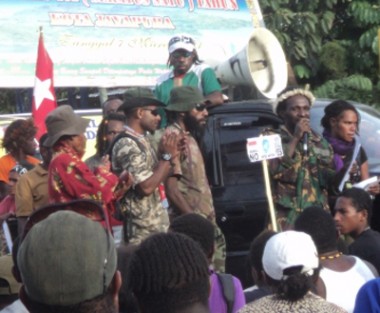
 We are reporting on the  Demonstration of the People of Papua demanding a Referendum about Self-determination on May 2, 2011 ; for the people of Papua to have the right to determine their own fate. The demonstration took place at the Post Office in Abepura, Jayapura, as shown below :

 – The Show of Support by the people of Papua was coordinated by the National Committee of West Papua, made up by the following organisations :  Organisation of Students and Youth, DAP, Women, Religions, Intellectuals of Papua, and the whole people of Papua from this area. They marched from Sentani, through Waena and Abepura, towards Jayapura (Imbi Park), starting at 8 am.

This slideshow requires JavaScript.

While waiting for the people to arrive from Sentani, there were political speeches from the coordinating body, and from several support organisations , all carrying street banners, leaflets and pamphlets, attracting the close  attention of the security forces, there to  « keep the peace », also tried to obscure some of the pictures.  Some of the banners  were saying :  Some of the leaflets said « Papua, Yes ; Indonesia No. », with each of their flags illustrated. Others said « Referendum » and « Papua Merdeka ».

 –          At another coordination point (the campus of USTP) that morning a group began to gather in front of the campus gateway fronting onto Jalan Raya, Sentani, while others came from the campus of UnCen-Abepura. They had banners saying REFERENDUM. There were speeches and the people began to move towards the main square of the campus.

 –          A large group of people assembled at Imbi Park in the early morning, not to avoid observation, because there were thousands of people already assembled there.

 –          About 5 or 6 detachments of Police from Jayapura were there and 3 units of Brimob (mobile police), observing the demonstration with some bodyguards, using 7 or 8 trucks and other vehicles, some of them equipped with weapo

–          Speeches went ahead until about noon, with 600 people who had arrived from Sentani began to assemble at Expo Waena. The whole procession gathered there were about 1000 people, preparing for the Long March to the Post Office at Abepura.

 –          The Long March began at 1 pm, and proceeded towards Abepura.  At the TNI  post at SIPUR, the demonstrators were surprised by an escort of Mobile Ambulance, together with a group of TNI (Army), fully armed, who accompanied the demonstration.

 –         Mass action continued its long march to the Central (shopping) centre , Post Office-Abepura escorted by security parties mentioned above.

–          There were speeches, which were answered by cries of « Referendum » and « Papua Merdeka ».  They stopped at the traffic lights at the Post Office at Abepura and began to sit on the road. All other activities in the town were halted and the town closed down early.

–          The total number of people eventually numbered about 2000 to 2,500. At about 2.15, the procession from Jayapura began to arrived and gathered together with the others at the Post Office.  The numbers swelled even more. The demonstrators stayed at this place, and listened to speeches from some of the leaders of the different groups representing the protestors.

– This demonstration was carried out peacefully until 6 pm, helped by vehicles which helped to keep the peace,   dispersing the people peacefully,  after which they resumed normal economic activities on the streets.

– The demonstration today, after marching well with vehicles and on foot, went off well and peacefully without any violence.

This report that we have made is completed by the Organising Committee for the Demonstration, 2nd May 2011, with great care, and we thank you for reading it.

SONAMAPA

Create a website or blog at WordPress.com

Up ↑