At Papuan Congress, a Brutal Show of Force

via Jakarta Globe

by Oktovianus Pogau

October 22, 2011

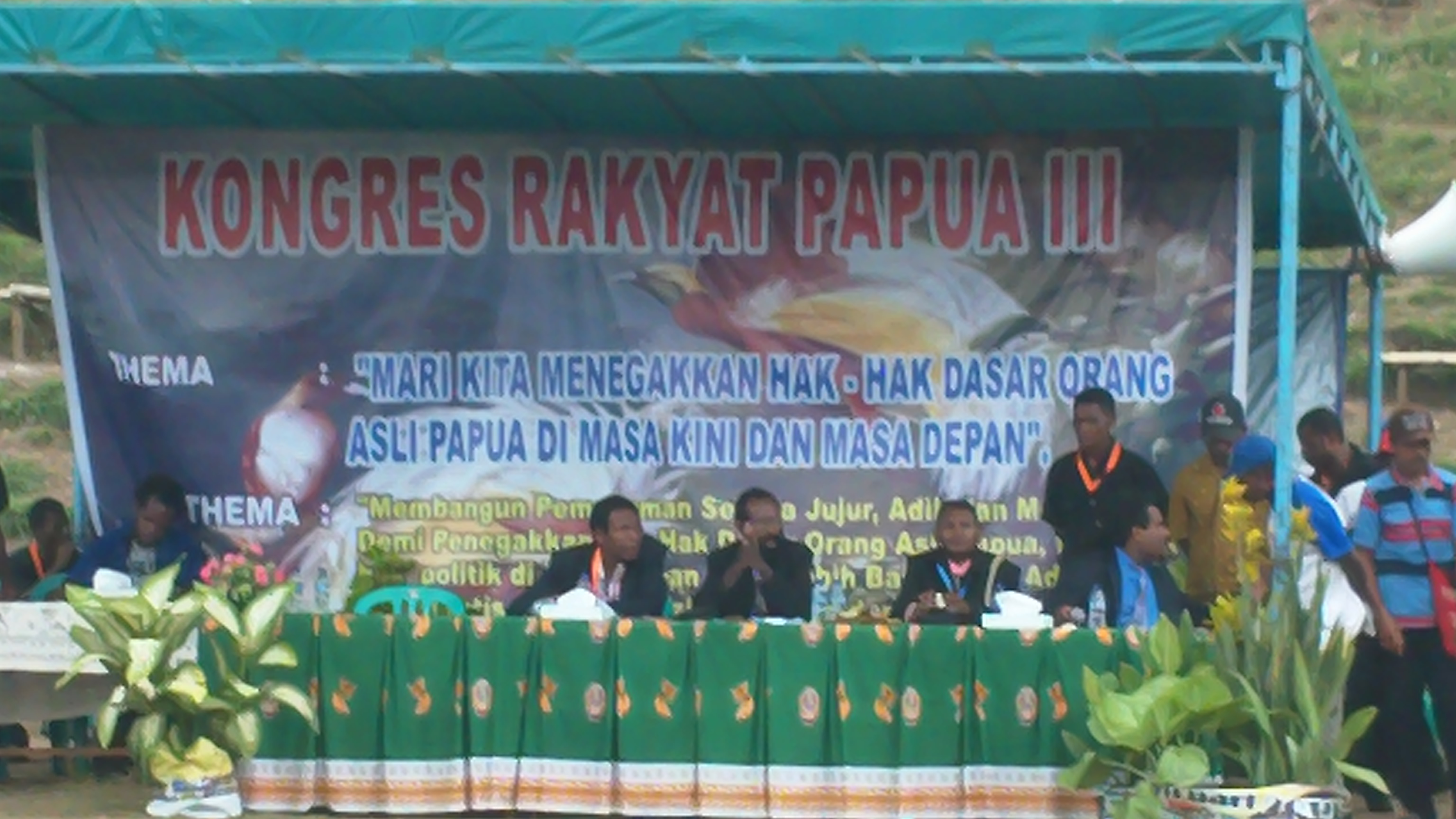
Jayapura, Papua. Anxiety was apparent among the participants of the Third Papuan People’s Congress on Wednesday as they marched toward the event venue in Abepura, passing by lines of military and police officers in full combat gear and holding assault rifles.

By 8 a.m. that morning, the final day of the three-day congress, security officers were standing at the ready. Five Barracuda armored jeeps were parked not far from the Zakeus oval, the site of the event, as were seven police trucks and three trucks from the region’s Cendrawasih Military Command.

As the congress drew to a close, the 3,100 officers sprang into action, marching toward the venue with their fingers on the triggers of their Pindad SS1 assault rifles. As the prospect of a full-blown attack became evident, fear could be seen in the eyes of many congress-goers.

Minutes later, the situation descended into violence.

Soldiers from the Armed Forces (TNI) and police officers fired bullets into the air and ordered the participants to disband. Some of the officers pointed their weapons directly at the unarmed civilians.

As the crowd dispersed in panic, the troops pressed forward.

A four-by-three-meter gate collapsed, shaken down by TNI officers. It fell onto the some 100 members of the Papuan Caretakers Movement (Petapa) who were guarding the congress.

Those outside the gate did not escape unscathed. Soldiers and police beat them with batons, bamboo poles and the butts of their rifles. Man after man fell to the ground, pleading with the officers to stop the show of force. Their pleas were met with kicking, stomping boots.

“Disband them, disband them immediately,” a high-ranking officer ordered his men. “They have committed acts of treason. Disband them now.”

Several men wearing kotekas, the traditional Papuan penis gourd, tried to push authorities back, but they were greatly outnumbered.

Less than 100 meters from the congress was a monastery and a pastors’ dormitory. Security forces raided it.

“Nobody leave the house. Everyone stay where you are,” several TNI officers shouted, shooting into the air and toward the pastors’ homes.

Later, bullet holes could be seen in some of the walls, and bullet fragments were found in some bedrooms.

“Dozens of officials forced their way into the monastery and walked back and forth for two hours in front of us,” the Rev. Adrianus Tuturu said. “We were so afraid we hid in our rooms.”

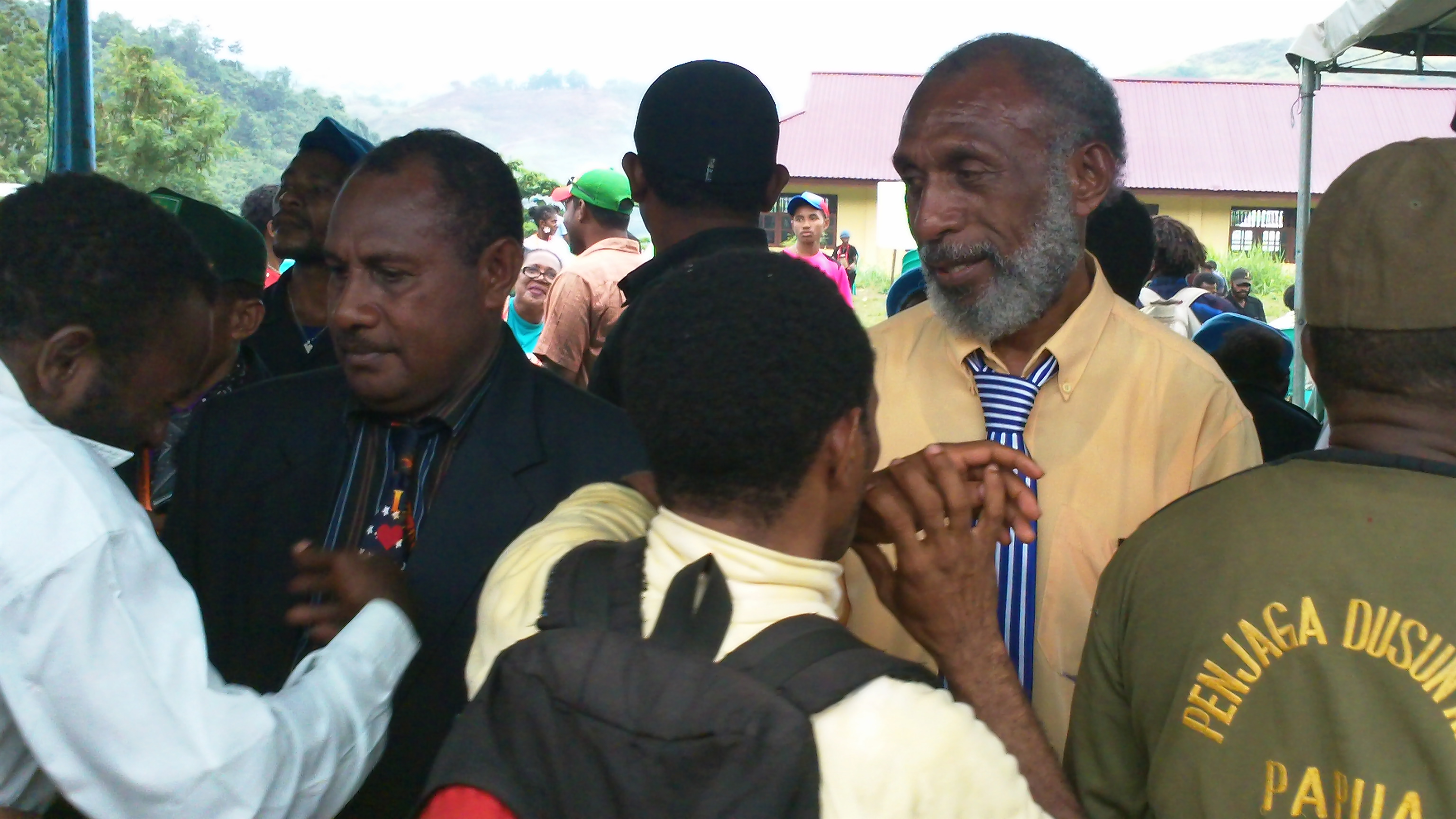
More than 300 people were arrested. They included Forkorus Yoboisembut, chairman of the Papuan Customary Council (DAP), and Edison Waromi, president of the West Papua National Authority. The congress had earlier declared the men as president and prime minister of an independent Papua, respectively.

“So you want to be the president of Papua?” an officer told Forkorus, grabbing his shirt. “Try to protect your citizens who we are arresting.”

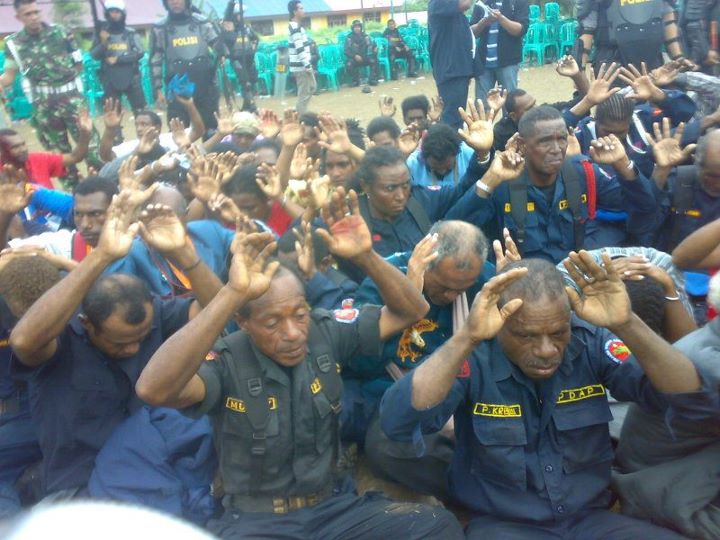
The arrested were told to squat down with their hands behind their heads for two hours. Some were made to take off their trousers and shirts and lie on the earth. Blood stained many of the Papuans’ cheeks.

“Papua will never be independent. Don’t you dare dream. Forkorus will not set you free,” witness Yustinus Ukago quoted a police officer as saying.

Eventually, security forces told the men to march, still squatting, to the police trucks. As the congress-goers made their way slowly forward, some officers kicked them in the back and side.

Some Papuans managed to escape. They hid in nearby food stalls and pretended to be innocent bystanders or made for bushes or gutters. Others fled into the forest.

Free expression or treason? 

Papua has seen a low-level insurgency since Indonesia annexed the resource-rich province in 1969. Following the annexation, exploitation of Papua’s mineral resources, most notably at the hands of American mining company Freeport McMoRan, and a massive security presence fueled resentment toward Jakarta.

In 2000, Indonesia granted the province special autonomous status, giving Papuans greater control over their economy. But the plan opened the floodgates for migrants into the province, further marginalizing the natives.

The recent congress was a continuation of a similar one in 2000, held to unite Papua’s seven tribal areas and discuss the natives’ basic human and political rights.

This year’s congress once again declared independence. “The Papuans’ freedom and independence must be restored in the West Papua country which was stolen by the Indonesian government in 1962,” leaders there proclaimed, announcing the Victoria Crowned Pigeon as a national symbol, the banned Morning Star flag as the national banner and the song “Hai Tanahku Papua” (“Oh My Land Papua”) as the national anthem.

Amnesty International condemned the crackdown, saying it “believes that the right to freedom of expression includes the right to peacefully advocate referendums, independence or any other political solutions that do not involve incitement to discrimination, hostility or violence.”

The heavy-handed repression, the group said, was “a clear violation of the rights to freedom of expression, opinion and peaceful assembly which are guaranteed under the International Covenant on Civil and Political Rights, to which Indonesia is a state party, as well as the Indonesian Constitution.”

But chairman of the House of Representatives commission on defense, Mahfudz Siddiq, said security forces “should have been firmer” and refused to issue a permit for the congress.

The Jayapura Police chief said he would do whatever it took to quash subversion.

“Whoever supports separatism or subversion activity, I will do the same as yesterday [the day of the congress]. I’ll finish them,” Adj. Sr. Comr. Imam Setiawan told state news agency Antara.

Imam said the congress had not been conducted according to the permit it had been issued, so he was forced to take action. He said he was paid to protect civilians and the unity of the nation.

“If there is anyone supporting such movements, I’m ready to die and finish them,” he said. “This is my duty.”

Djoko Suyanto, the coordinating minister for political, legal and security affairs, also defended the government’s tactics, according to Antara.

“The police raided the rally because it was considered as a coup d’etat,” Djoko said. “They declared a state within a state and did not recognize the president of Indonesia.”

The brutality of the crackdown was further revealed the following day, when all but six of the arrested were released. Many of the congress-goers had sustained cuts and bruises, and one man who had been beaten with an automatic rifle had marks all over his body.

Another man had scrape marks on his stomach. He said they came from police dragging him, face down, on the field’s jagged ground.

Of the six who remained in custody, five were charged with treason. The lone exception was Gat Wenda, who was charged under the 1951 Emergency Law for carrying sharp weapons.

The five who face treason charges are Forkorus, Edison and event organizers August Sananay Kraar, Dominikus Sorabut and Selpius Bobii.

Despite military and police claims that security forces only fired warning shots, three dead bodies were found on Thursday morning just behind a military compound some 50 meters away from the congress venue. They were 25-year-old university student Daniel Kadepa and Petapa members Maxsasa Yewi, 35, and Yacob Samonsabra, 53.

That afternoon, three more bodies were uncovered: James Gobay, 25; Yosaphat Yogi, 28; and Pilatus Wetipo, 40.

“The security forces should have used dialogue and persuasion to disperse the crowd,” said Matius Murib, deputy chairman of the Papua branch of the National Commission on Human Rights (Komnas HAM). “Next week, officials from the central Komnas HAM office will conduct an investigation.”

The Rev. Benny Giay, a respected religious leader and human rights advocate in Papua, said the TNI and police had used disproportionate force by using heavy fire power to quell a meeting of unarmed civilians.

This report is supported by the Pantau Foundation.

RAW FOOTAGE OF THE ATTACK ON THE PAPUAN PEOPLE’S CONGRESS

by Numbay Media — via our partners EngageMedia.org

This is raw footage of Wednesday’s attack by the Indonesian military and police on the Third Papuan People’s Congress in Jayapura. The footage shows people dancing, soldiers closing in, and gun shots. The video was shot by several observers. The last sequence was shot while the camera person was hiding from gunfire. Police have now confirmed that five people were killed in the attack – human rights groups say it was more.

1530 21/10/2011 Updates From West Papua

By Newmatilda.com and westpapuamedia.info

CURRENT:
Arrests
Anywhere between 300 and 800 activists arrested, most released
Core group of 5 in custody at least but could be more, all feared tortured:

– Forkorus Yaboisembut – elected as leader of the broad based movement for peace and justice – possibly paralysed witnessed by another detainee
– Edison Waromi – deputy leader
– Argus Krar
– Selfius Bobii
– Dominikus Sorabut

Released
– Abraham Kareni (who’s son lives in Melbourne) with fractured skull

Charges include treason, rebellion, crimes of hatred against the state. These are colonial laws left over from the Dutch era and they carry long sentences — in some cases up to 20 years.

Police violence, dead and wounded
DFAT have confirmed four people are confirmed dead, activists claim six
People identified (all from Petapa or family of:
– Dani Kabepa
– Yakovus Sabonsaba
– Mathias Maidepa
– Martinus Siep
– Tanepi Kobeta
– One additional unidentified member of Petapa, the West Papuan paramilitary guard formed to protect Forkorus Yaboisembut, the man delegates elected as their leader.


Claims:
– Numerous people have been savagely beaten, many are in hiding for fear of arrest or worse
– Unverified claims people were shot at point-blank range and bundled into armoured personnel carriers and other vehicles.
– Five people at the Dian Harapan Hospital suffering several wounds: ”One is a woman, Ana Ana Adi, 41. She has got wounds at her right thigh. Pilatus Wetipo, 40, was shot in the right leg. Wiler Hobi (22) has some wounds in his head because of being beaten by the weapon, the other two have blistered wounds
– four people in Sabron Yaru wounded

  • Members of the community security force (Petapa) are arrested. Photo: West Papua Media Alerts

Reports of violence by Indonesian troops continue to emerge from West Papua. New Matilda is in contact with local sources. We’re publishing regular updates on the situation here. (Warning: graphic content)

On Thursday, New Matilda published a report on the violence at the Third People’s Congress in West Papua. Indonesia military and police opened fire on participants and took activists and leaders into custody. Reports of fatalities and injuries continue to emerge from Jayapura.

Read Alex Rayfield’s initial report here.

New Matilda is in contact with local sources and will continue to update this page as new information emerges.

UPDATE, Friday 21 October, 10am:
This is a phone interview with journalist Alex Rayfield.

“Ferry Marisan, the director of Elsham — a leading human rights organisation based in the capital, Jayapura — has said that six people are confirmed dead.

“We think that a couple of people were shot as the security forces raided the stage, and some later. There are also lots of people with gunshot wounds, some of whom are in hiding and too scared to get medical assistance.

“We’ve had multiple reports that there were 800 people in jail. Many of those have been released, but a core group is still detained, charged with a range of offences including treason, rebellion, crimes of hatred against the state. These are colonial laws left over from the Dutch era and they carry long sentences — in some cases up to 20 years.

“It’s important for people to know that [Congress] is not a radical fringe movement. It’s made up of mainstream Papuan society: academics, church leaders and senior tribal leaders. In fact the radical fringe stayed away from this event because they think it’s not radical enough. So if the Indonesian government thinks this is a minority view, they are sadly mistaken. It is a mainstream view.

“Meanwhile, we should add for Australian audiences, that the strike continues at the Freeport mine [which is part owned by Anglo-Australian company Rio Tinto]. The two events are intimately connected.”

For more information on the Freeport strikes read New Matilda’s coverage here andhere.

UPDATE Friday 21 October, 4.30PM
These photos were sent by a credible source to West Papua Media Alerts and allegedly show injuries suffered in police custody. They have not been verified by New Matilda.

Photo: West Papua Media Alerts

Photo: West Papua Media Alerts

Photo: West Papua Media Alerts

MORE INFORMATION
Listen to an interview with Elsham’s Ferry Marisan here.

Read Amesty International’s statement on the incident here.

Read an article on Australia’s foreign policy response by Greens spokesperson on West Papua, Richard di Natale, here.

Third National Papua Congress Declaration

[as received in english from Papua National Consensus Team. This was scanned copy. Typos not corrected. – JMM]DECLARATION

FORMING FEDERAL STATE OF WEST PAPUA

On this day Wednesday ,19 October 2011 at the Third National Papua Congress, the people of Papua in Country of West Papua declare:

I.

Proclamation recover and Restore the independence and sovereign of West Papua which was lost to Indonesia annexation on December 1, 1961.

II.

Going into effect Constitution of Federal of West Papua by forming Governance of Federal State of West papua in the form of lifting President and elect Leader of Governance-The Prime Minister.

III.

Government of Federal State of West Papua guarantees the rights of live and rights of endeavor of everyone in the Country of West Papua.

IV.

Indonesia immediately terminates its occupation of West Papua pacifically and prestigious as civilized nation and member of the United Nations.

V.

The Nation Members of the United Nations to confess the Independence of the nation of Papua parallel with the other independences in the globe.

VI.

United Nations Security Council immediately register the Federal State of West Papua becomes the permanent or regular member state of the United Nations

VII.

Authorized the mandate to Papua National Leadership for run of the power of governance, Legislative, Judicative and Commander in Chief of Defense and also as soon as during one year carry out the general Election to chosen the Prime Minister of definitive Governance.

The People of West Papua greatly appreciate on your understanding of the historic injustice that we have suffered and are most grateful for your goverment’s support and recognize for restoration of our sovereign righs.

God Bless us all Sincerely

Forkorus Yaboisembut, SPd.
Head of Papua Customary Law Council Executor of Presidency of West Papua

CC:
1.Secertary General of United Nations
2. The President of United States
3. President of Indonesia
4. Netherland Kingdom
5. Pope in Vatican- Rome
6 .US Members of Congress and Senate

UN wants to send Special Rapporteur to Indonesia to investigate MIFEE


Bintang Papua, 12 October 2011The UN Commission to Combat Racial Discrimination and Protect the Rights of Indigenous People has sent a letter to the Indonesian ambassador to Geneva, Anwar Kemal, regarding several matters.

In the first place, to agree to invite the UN Special Rapporteur on Human Rights to visit Indonesia in connection with MIFEE, the Merauke Integrated Energy and Food Project in West Papua. In the second place to hold talks with CERD for this matter to be discussed at the forthcoming meeting of the Committee in Geneva from 13 February – 13 March 2012. And thirdly, to to make available comprehensive information regarding all the matters contained in the afore-mentioned latter.

This was made  public following a meeting by a number of NGOs in Jayapura on 12 October which was attended among others by Foker-NGO-Papua, Sawit Watch, Greenpeace, Justuce and Peace Commission/Jayapura, Walhi and Sorpatom in Jayapura on 12 October.

The Coalition of NGOs said that the response of the UN to the MIFEE project had exerted pressure on the Indonesian government to halt all activities related to the MIFEE project and to invite the UN Special Rapporteur on Human Rights to investigate this project before 13 January 2012.

The coalition said that MIFEE would have a strategically significant inpact on the availability of foodstuffs and energy resources in Indonesia.

This project will cover an area of 1.6 million hectares which will be used to produce millions of tons of rice, corn, beans and sugar as well as promote cattle-rearing. Dazzled  by this massive project, they have closed their eyes to a huge problem that will confront the population of Merauke whose land will be consumed by the MIFEE.project.

The MIFEE project is a highly ambitious mega  project of the Indonesian Government based on a slogan to produce food for the whole world. They intend to take control of an area of 1.6m ha of land for agri-business purposes. The resultant food will be exported, meaning that MIFEE is directed towards the export market. Thirty-six companies have already been attracted by the MIFEE project with investment capital to the value of Rp 18.9 trillion, along with domestic capital.

Research undertaken by various organisations has identified a number of problems.

First of all, this project which will cover a total area of  altogether 2m ha of land belonging to the indigenous people will have a direct impact on the traditional rights of the these people.

Furthermore,  this expansion will cut down forests belonging to indigenous people in order to grow  palm oil and will result in the influx of a huge number of people from outside the area, threatening the local people’s livelihoods and destroying their traditional economic practices.

These developments will exert huge pressure on the Malind people and their traditions in particular, and the Papuan people in general, turning them into a minority people in their own land.

In addition, these developments which are supported by various state forces will require the protection of the Indonesian army.

Fourthly, the decisions regarding exploitation of natural resources are hugely dependent on the central government and are being developed in accordance with national laws that ignore the indigenous people, despite the adoption of the Special Autonomy law in 2001, the aim of which was to decentralise decision-making to the provincial level with regard to a number of issues, while nothing has happened regarding the introduction regulations.for the implementation of this law.

Fifthly, it is understood that most of the MIFEE area has been classified as ‘forest’ and placed under the jurisdiction of the forestry department, whose interpretation of the forestry laws impinge on the rights of the indigenous people.

Finally, there are reports that local communities have been manipulated by investors and government officials so as to secure their signatures  to provide the legal basis for certificates affirming their right to the land of the indigenous people.

Create a website or blog at WordPress.com

Up ↑