Papuan state leaders warn Papuan not to be provoked on 1 December

Bintang Papua, 17 November 2011The Federal Republic of West Papua (Republik Federasi Papua Barat) has issued an instruction to Papuan people everywhere  to beware of certain groups of people who will try to provoke the Papuan people to raise their flag, which will trigger a response from the security forces who may start shooting people. This is particularly necessary for 1 December which is Independence Day of the Papuan people.

The instruction was issued by Forkorus Yaboisembut, president of the Republic, and Edison Waromi, its prime minister.

The instruction was conveyed in a press conference  held by the spokesman of the transitional government, Jack Wanggai and a member of his staff, Heppi Daimboa, on Thursday.

He also said that  there are groups called the TPN which have been set up by the Indonesian army and police, who will try to provoke the Papuan people.

He also said that the name of the flag which until now has been publicised as Bintang Kejora is now called Bintang Fajar. This is in accordance with a decision taken at  th Papuan People’s Congress held from 24 May till 4 June, 2000 when it was decided to change the name of the flag from Bintang Kejora to Bintang Fajar. This decision was re-affirmed by a decision taken at the third Papuan People’s Congress  held from 17 – 19 October 2011, which also adopted decisions regarding the currency, and the seven tribal regions which are now called the seven federated states.

The President and the Prime Minister also called on  all Papuans to take part in thanksgiving prayers in locations that will be identified and should consist of peaceful actions, long marches and other activities. ‘Anything that happens outside these instructions are not the responsibility of the President and the Prime Minister,’ he said.

Shocking video confirms Indonesia’s brutal suppression of West Papuan rally ahead of US visit

16 November

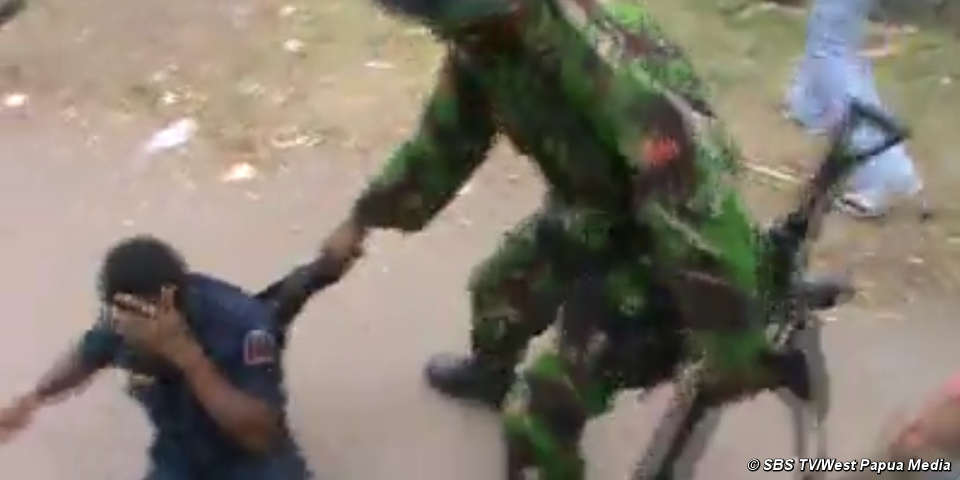
The shocking footage shows Indonesian soldiers beating West Papuans
© SBS TV/West Papua Media

Alarming video of Indonesian forces shooting, beating and kicking civilians at a peaceful rally in West Papua has emerged ahead of a US visit to the region.

Ten people are believed to have died when Indonesian security forces broke up the rally of independence activists last month.

Watch footage of the attacks (©SBS TV/West Papua Media,WARNING: DISTURBING CONTENT):

Indonesia’s brutal attack on West Papuan rally
Shocking scenes of Indonesia’s brutal suppression of a West Papuan rally on October 19 2011©SBS TV/West Papua Media

The video comes ahead of a visit to Bali by the US President and Secretary of State, for a regional summit. The US has applauded its ‘new partnership’ with Indonesia, but only last week Hillary Clinton criticized its human rights abuses.

The disturbing footage was smuggled out of West Papua exactly one year after scenes of Indonesian soldiers torturing Papuan mencaused worldwide revulsion.

These latest clips allegedly show a local police commander giving the order to break up the rally on the outskirts of Jayapura – and the brutal and unprovoked violence that ensued.

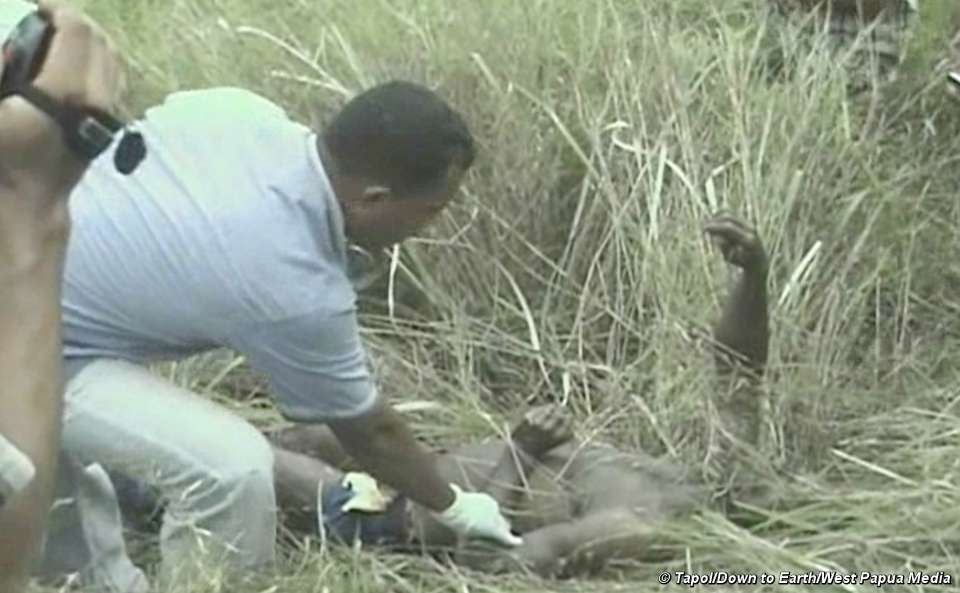
Victim is found after Indonesia's violent crackdown on West Papuan Congress
Victim is found after Indonesia’s violent crackdown on West Papuan Congress
© Tapol/Down to Earth/West Papua Media

Indonesian security forces, many in plain clothes and wearing crash helmets, are seen randomly firing their weapons and arresting scores of people, many of whom are punched, kicked, beaten or forced to crawl along the ground.

Reverend Benny Giay from West Papua says violence has escalated since the Congress was dispersed. ‘I think maybe this is the Indonesian military and police’s response to the international pressure.  The response is that they are being sent to Papua to kill, terrorize and abduct Papuans, but please do keep on the international pressure. Please tell people what is happening here for the sake of our future, our lives, our culture, our identity and our very existence.’

West Papua has been ruled by Indonesia since 1963, and more than 100,000 civilians are believed to have been killed during its occupation.

Survival’s Director Stephen Corry said today, ‘Indonesia’s brutal occupation of West Papua is a catalogue of some of the worst human rights abuses and violations of tribal peoples in recent times. Hillary Clinton should use her visit to the country to highlight the horrific violence that Indonesia is wreaking on all those who dare to oppose its rule.’

Note to Editors:

A Survival campaigner who has been to West Papua is available for interview.

More clips are available for download from West Papua Media

More Brutal Footage emerges from Congress crackdown

Fresh footage has emerged from last month’s brutal crackdown by Indonesian security forces on the Third Papuan People’s Congress in Abepura on October 19.

SBS Television broadcast the following footage which was also sent to West Papua Media.  The footage shows plain clothes and uniformed security personnel shooting hundreds of rounds into the crowd, beating and brutalising scores of participants, and violently attacking the elected President of the West Papuan Transitional Government, Forkorus Yaboisembut.

West Papua Media has also been provided with the remainder of the Congress footage through a source inside West Papua (via Tapol/ Down to Earth).  We have decided to make this available for the use of all media.  Please spread  widely.  Please be aware this contains images of extreme Indonesian state violence against unarmed civilians.


MEDIA NOTE:  For access to this original footage, please visit the contact page on this site and send an email or contact the number.

AI – Government must act on Komnas HAM’s findings of human rights violations at Papuan Congress

AMNESTY INTERNATIONAL  PUBLIC STATEMENT

8 November 2011

The Indonesian government must immediately act on the Indonesian National Human Rights Commission’s (Komnas HAM) findings that human rights violations were committed by Indonesian security forces at the Third Papuan Peoples’ Congress on 19 October 2011.

The Komnas HAM investigation team found a range of human rights violations allegedly committed by the Indonesian security forces, including opening fire on participants of the peaceful gathering and beating and kicking them. The Commission, which made its findings public on 4 November 2011, has called on the Indonesian National Police chief to investigate these human rights violations.

It was reported on 7 November that the President’s office had rejected the findings of Komnas HAM, stating that the police were still handling the case.

The Indonesian authorities must initiate an independent, thorough and effective investigation into the Commission’s findings. If the investigations find that the security forces committed unlawful killings or torture or other ill-treatment, then those responsible, including persons with command responsibility, must be prosecuted in proceedings which meet international standards of fairness, and victims provided with reparations.

The failure to bring perpetrators of these violations to justice in fair trials will reinforce the perception that the security forces in Papua operate above the law and fuel the ongoing climate of mistrust towards the security forces there.

On the afternoon of 19 October 2011, police and military units violently dispersed participants of the Third Papuan People’s Congress, a peaceful gathering held in Abepura, Papua province. The bodies of Demianus Daniel, Yakobus Samonsabara, and Max Asa Yeuw were found near the Congress area. An estimated 300 participants were arbitrarily arrested at the end of the Congress. Most were released the following day but six have been charged. Five people were charged for “rebellion” and “incitement” under Articles 106, 110 and 160 of the Criminal Code, while one was charged for “possession of weapons” under Emergency Law No. 12/1951.

According to Komnas HAM, the three people who were found dead had gunshot wounds on their bodies. The Commission was not able to confirm whether they were killed by the police or military, and have called for police forensics investigators to examine the bullets. Komnas HAM also found that at least 96 participants had been shot, kicked or beaten by police officers.

Komnas HAM further reported that security forces had raided a Catholic monastery and seminary. They shot at the building and broke the windows when the monks refused to hand over alleged separatists to the police. Many Papuans are now afraid to leave their homes because of the continued security checks and raids. The Commission also raised concerns that security forces had confiscated mobile phones, laptop computers, printers, cameras, cars, motorcycles and millions of rupiah in cash, and called for these items to be returned to the owners.

The Commission stated, contrary to statements by the Indonesian authorities that the Congress was illegal, that the Indonesian Minister of Law, Politics and Security had in fact directed the Director General of Regional Autonomy at the Home Affairs Ministry, to attend the Congress and give the opening speech.

The Commission made a series of recommendations including calling on President Susilo Bambang Yudhoyono to accelerate the dialogue with the Papuan people and to evaluate the deployment of a large security presence in the area.

The Komnas HAM investigation indicates that security forces appear to have violated the rights to life and to freedom from torture and other ill-treatment, both of which are non-derogable under the International Covenant for Civil and Political Rights (ICCPR), to which Indonesia is a state party.

By using unnecessary and excessive force and firearms against the participants, the Indonesian security forces have also violated the Convention against Torture and Other Cruel, Inhuman or Degrading Treatment or Punishment, which Indonesia has also ratified. Moreover, the right of all people in Indonesia to be free from torture and other ill-treatment is guaranteed in the Indonesian Constitution and the 1999 Law on Human Rights.

The actions of the security forces also appear to contravene the UN Basic Principles on the Use of Force and Firearms by Law Enforcement Officials which provide, among other things, that force should be used only as a last resort, in proportion to the threat posed, and should be designed to minimize damage or injury.

New Report Reveals Extent of Papua Human Rights Violations

Press Release from Tapol, Franciscans International, Asian Human Rights Commission and Faith Based Network on West Papua (FBN)


NGOs meet in Geneva to address their concerns on the situation of Human Rights in Papua

Geneva, 3 November 2011

 Following last month’s violent dispersal by Indonesian security forces of the Third Papuan Peoples’ Congress in Jayapura, Indonesia has been confronted with the full scale of human rights problems in Papua by the new Report ‘Human Rights in Papua 2010/2011’.[1] This was launched yesterday in Geneva, by the Faith Based Network on West Papua (FBN), Franciscans International (FI), and the Asian Human Rights Commission (AHRC).

The Report portrays the bleak reality of the abuse of civil and political rights, as well as economic, social and cultural rights in Papua in 2010 and 2011. The aim of the Report is to raise awareness of the human rights situation in Papua and to create in Papua a ‘land of peace’.

More specifically, the Report draws attention to the hardship faced by national and international civil society as well as by local human rights defenders who are too often victims of intimidation, harassment and arbitrary detention on the charge of makar (treason) while exercising their right to freedom of expression in their struggle for justice and accountability. The Report further denounces the policy of the Government of Indonesia aimed at discrediting, limiting and jeopardizing the work of international human rights organizations working in Papua, including denied access to international media through the manipulation of bureaucracy. As a result, certain international organizations are directly or indirectly forced to withdraw from the country, as was the case of the International Committee for the Red Cross (ICRC) and Peace Brigades International (PBI).

With a view to presenting the Report and raising awareness on the recent tragic events, Franciscans International organised a round table discussion. This was attended by representatives of the Faith Based Network on West Papua, Geneva for Human Rights, Human Rights Watch, Papua Peace Network (JDP -Jaringan Damai Papua), Special Rapporteur on the situation of human rights defenders TAPOL, World Organization Against Torture (OMCT), and the Permanent Mission of the Republic of Indonesia to the United Nations.

In response to the numerous issues and concerns raised during the discussion, the representative of the Permanent Mission of Indonesia made an official statement asserting that “human rights protection is a national priority”. Despite the appreciation for the participation of the Permanent Mission of Indonesia, this statement was visibly met with strong disagreement by NGOs. They attested that “Political statements are not enough to address human rights violations in Papua, since – the reality is -a climate of fear prevails in Papua”.

The NGOs present concluded by calling upon the Government of Indonesia to: Immediately release all political prisoners; Immediately cease intimidation, harassment and physical violence against human rights defenders, journalists, and religious leaders in Papua; to criminalise torture and ratify the Optional Protocol to the Convention against Torture; ratify the International Convention on Enforced Disappearances; and to Start a genuine dialogue with national and international civil society.

For more information on the report Human Rights in Papua 2010/2011, please contact:

Kristina Neubaeur –Faith Based Network on West Papua, Coordinator

Francesca Restifo – Franciscans International, International Advocacy Director

Paul Barber – TAPOL, Coordinator: +44 7747 301 739; paul.barber@tapol.org

Wong Kai Shing – Asian Human Rights Commission, Executive Director

1] Available at http://tapol.gn.apc.org/press/files/Human-Rights-in-Papua_Report-2010-2011.pdf

Create a website or blog at WordPress.com

Up ↑