Ban Ki-Moon gets “diplomatic answers” from SBY over Papua

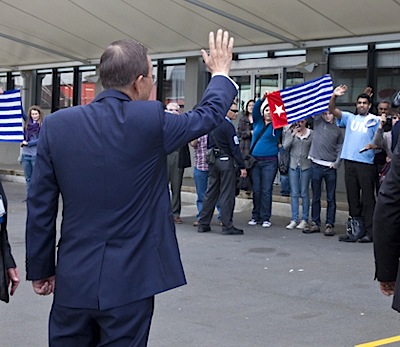
Ban Ki-moon waves to protestors for West Papua, PIF NZ Sept 2011

by John Pakage for West Papua Media

Opinion

President Susilo Bambang Yudhoyono (SBY) and UN Secretary General Ban Ki-moon held a bilateral meeting at the presidential palace in Bogor, West Java, on Tuesday (20/03/2012). In the meeting, human rights abuses in Papua were also discussed.

 UN Secretary General Ban Ki-moon certainly knows in detail about the development of human rights abuses in Papua because he sought a diplomatic answer from the President of Indonesia.

 “Papua is Indonesia and we are obliged to maintain its security, but if there are violations of human rights then there is law enforcement action,” said SBY.

 Of course with this kind of diplomatic answer, SBY wants to hide the number of cases of gross human rights that have occurred, and are continuing to occur now in Papua.  Only at few days before the arrival of Ban Ki-Moon to Indonesia, Forkorus Yoboisembut, Gladius Waromi Edison, Augustine M. Sananay Kraar, Selpius Bobii and Dominic Sorabut were sentenced 3 years in prison on Friday (16/3) with charges of treason for forming the state of West Papua.

 The implementation of the Third Papuan People’s Congress went ahead with official permission from the Indonesian government, both from the central government and the police to hold a congress in Jayapura.   But Indonesia’s military attacked and captured civilians at the Congress without first showing any arrest warrant, in accordance with Indonesian regulation.

 Again and again, military and police forces shot live ammunition at civilians at the Congress, inconsistent with legal process, in stark contrast with Yudhoyono’s promises to Ban Ki-Moon at the Bogor Palace.

The multitude of human rights abuses in Papua, which is tightly closed by state policy that prohibits foreign media and international NGOs from entering Papua,  gave rise to human rights lawyer Jennifer Robinson (lawyer for Wikileaks founder Julian Assange) calling on new Australian Foreign Minister Bob Carr, to immediately urge Indonesia to open Papua up, and allow incoming international NGOs into Papua to conduct human rights investigations independently (see Radio Australia, March 20, 2012).

Indonesia’s policy to cover up human rights abuses in Papua has been harshly rebuked by Human Rights institutions around the world; (see for instance a press release by Franciscans International, TAPOL, the Asian Human Rights Commission, Faith Based Network on West Papua (FBN) and West Papua Network.)

Legal rights agencies lament the unjust decision facing the five civilians who were detained while organising the Papuan Congress, sentenced to three years in prison.   According to these institutions, the Congress was a form of free expression and a fundamental tenet of democracy for communicating opinions.

In addition, humanitarian agencies deplore the attitude of the Indonesian military who with full weaponry arsenal stormed and attacked the Congress participants. This Indonesian Military attack and killed several Papuan civilians. (See: Franciscans International, Release March 16, 2012.)

 Ban Ki-Moon is certainly more aware now of what has happened in Papua since 1969 when Indonesia invaded Papua.   So SBY’s diplomatic answer  of  “SBY diplomacy” might make the number one person in the world confused.

Ban Ki-Moon also mentioned that South Sudan is an example of an area of extended conflict that has embraced the process of ending its fighting.  The UN successfully held a referendum for citizens to determine their aspirations – and they chose independence from the Sudan.

Of course the conditions of ongoing human rights abuses in Papua, covered up by the state policy of denying access to foreign media and international NGOs to Papua, could by its very nature invite a humanitarian intervention to end the conflict in Papua, with (or without) the Indonesian government.

FORKORUS’ AND FOUR OTHERS’ SENTENCE VIOLATES HUMAN RIGHTS LAW

Joint Press release from TAPOL, the Asian Human Rights Commission, the Faith-Based Network on West Papua, Franciscans International, and the West Papua Netzwerk

FORKORUS’ AND FOUR OTHERS’ SENTENCE VIOLATES HUMAN RIGHTS LAW

16 March 2012 – The Jayapura state court today found five Papuan leaders guilty of treason, sentencing them each to three years imprisonment. TAPOL, the Asian Human Rights Commission, the Faith-Based Network on West Papua, Franciscans International, and the West Papua Netzwerk seriously regret the verdict and question the fairness of the trial proceedings. The verdict is another example of the severe restrictions by the Indonesian authorities on the right to freedom of expression of the Papuans. We call upon Indonesian President Susilo Bambang Yudhoyono to order that all convictions which do not reflect international legal standards be overturned and the prisoners be immediately released.

Today’s verdict represents a setback in the relationship between Jakarta and Papua, suggesting that Indonesian authorities still see arrest and detention as the best ways to respond to expressions of Papuan aspirations. As a country widely applauded for its burgeoning democracy, Indonesia should be promoting peaceful political activity, not punishing it.

Forkorus Yaboisembut, Edison Waromi, Selpius Bobii, Dominikus Surabut and August Kraar were arrested in October 2011 for their roles in the Third Papuan People’s Congress, a peaceful gathering at which the leaders declared that Papua has been independent since 1961. As the gathering began to disperse, security forces fired shots into the crowd and carried out mass arrests and beatings. Three people were shot dead.

While the leaders of the Congress now face three years in jail for their peaceful actions, those responsible for the violent response to the Congress received a slap on the wrist, and investigations to determine who was responsible for the killings have led to neither justice nor accountability.

The five men were convicted of treason under Article 106 of the Indonesian Criminal Code. While the treason laws are intended to prosecute serious crimes against the state, alleged members of the armed resistance are rarely if ever brought to trial in Papuan courts; they are beaten, tortured or shot. Article 106 is instead used to charge those engaged in peaceful actions such as raising the Papuan national ‘Morning Star’ flag or organising and attending public events at which Papua rights and aspirations are asserted.

The denial made by the Coordinating Minister for Law and Human Rights of any political prisoners this month shows a lack of commitment to uphold human rights norms that are applicable to Indonesia according to international law, including that the peaceful expression of political opinions cannot be persecuted.

There are serious doubts about the fairness of the trial proceedings. Armed members of the security forces maintained a heavy presence during the trial sessions, and one of the senior lawyers for the defence, Gustav Kawer, is being threatened with prosecution, in violation of his right under Indonesian law and international standards to carry out his professional duties in defending clients in court. There have also been questions about the independence of the judges, who were reportedly visited by senior military, police and government officials just one hour before the trial began.

According to TAPOL’s data, the five men will join at least 27 other Papuan political prisoners currently in jail for treason under article 106. All those detained for peaceful political activities should be immediately and unconditionally released.

ENDS

Contacts:

Paul Barber, TAPOL, +44 7747 301 739

Rallies reject Indonesian status quo in Papua, and demand referendum

This slideshow requires JavaScript.

February 22, 2012

By Nick Chesterfield at WestPapuaMedia.info with local sources

Thousands of people took part in peacful rallies across West Papua on Monday, February 20,  rejecting attempts by Indonesia to impose new development policies on Papua, and demanding an internationally supervised referendum as the key step towards solving the Papua problem.

The rallies, organised by the West Papua National Committee (KNPB), took place in Jayapura, Biak,  Manokwari, Timika, Nabire, Wamena, Yakuhimo and Merauke.  According to initial reports, all rallies remained peaceful despite standard Indonesian security force threats to forcibly break up proceedings.

This slideshow requires JavaScript.

In Jayapura, a long march was held from Abepura to the offices of the Papuan People’s Assembly (Majelis Rakyat Papua or MRP) with the crowd of close to a thousand people shouting “we want referendum”; “Special autonomy has failed, why start it again”; and “We reject the dialogue between Jakarta and Papua and demand a Referendum”.

Mako Tabuni, on behalf of the KNPB, told the gathering that the the plans by Indonesian President Susilo Bambang Yudhoyono to impose a new body U4PB (or Program to Accelerate Development of Papua and West Papua) to implement the failed Special Autonomy package is not a solution to the problems in Papua and was thoroughly rejected by West Papuan people.  Only a Referendum would address those grievances, and it must be. held soon.  U4PB, with authority over all of Papua, is to be headed by former army intelligence chief Bambang Darmono, himself subject to numerous allegations of human rights abuses whilst stationed in Aceh.

Tabuni expanded: “when in Papua, there are two paths of narrow and wide roads. Papuan Special Autonomy the road is paved with a lot of money, including UP4B, but the road is narrow.  The road to independence is a wide open road, like the road to referendum being fought KNPB”.

Former Political Prisoners Yusak Pakage and Saul Bomay echoed the KNPB concerns and demanded that Indonesia just try to listen to the will of the people and stop trying to implement policies proven to have been a failure, like Special Autonomy.

The demonstrators dispersed peacefully with a promise of escalation of mass actions.

westpapuamedia

Presidential palace still fails to understand the situation in Papua

General SBY - Military approach will not solve Papua's problems

Bintang Papua, 19 February, 2012Manokwari: The holding of constructive dialogue or communications between Jakarta and Papua as mentioned by President Susilo Bambang Yudhoyono (SBY) is regarded in some circles as being part of the solution to the problems occurring in Papua.In the opinion of Mervin Komber, a Papuan member of the DPR, the Indonesian Parliament, such a dialogue should take its cue from the road map for Papua, and lead to better living conditions for the  Papuan people. According to Komber, in order to achieve this, the agenda for such a dialogue should reflect the actual conditions currently confronted by the  Papuan  people.

With regard to the leaders who should be invited to participate in such a dialogue, they should be  people with the ability to deal with all aspects of the situation, including governance, parliament, customary groups, spiritual leaders as well as including people from the ranks for ordinary Papuans who enjoy the confidence of their respective groups.

‘All of us  who are in favour of dialogue must seek to achieve something positive for Papua,’ he said in Manokwari recently.

While he supports dialogue, Komber is critical of recent steps taken by SBY in his attempts to work out the best format  for the dialogue. In his opinion, the President’s decision to ask Papuan religious leaders  for their opinion  about the format and the agenda for this dialogue was a mistake. Komber believes that the religious leaders will themselves be  part of the dialogue, which means that the President should not have discussions with them about the format of the dialogue. But the President should summon provincial and local leadeers such as members of the DPRD, the DPD and academia to get their views on the format.

Moreover, if  only some elements are asked to discuss the format, he fears that this could result in misunderstandings as a result of the various inputs received by SBY. ‘If there are disagreements between some of these leaders, the people around SBY might end up passing on erroneous information about the situation in Papua,’  said Komber  who is a former activist from the Catholic students organisation, PMKRI.

The same might also occur with regard to the final objective of the dialogue, according to Felix Wanggai, a special staff member [not clear what staff this refers to] who looks forward to seeing Papua become a zone of peace. In his opinion, this may mean that the  people at the presidential palace do not properly understand  what it is that the Papuan people want. ‘The dialogue we have in mind is only intended to accelerate development in Papue,’ he said.

Jakarta has still not take any decision about when this dialogue or constructive communication should take place. According to Komber, the Jakarta-Papua dialogue is very urgent indeed and SBY should not postpone it. He went on to say that the dialogue is closely related to the implementation of special autonomy, OTSUS which was enacted eleven years ago. This means, in his opinion, that this dialogue should take place some time before the end of 2012.

‘I very much hope  that it will take place during the course of this year because OTSUS will remain in force for only another ten years, whereas the dialogue should occur while OTSUS remains in force.’

Finally he said that as far as he is concerned, the venue of the dialogue is not  a problem . The crucial thing is that the dialogue should be inspired by the determination to achieve a long term solution for Papua. ‘The dialogue could be held in ways that accord with Papuan traditions, such as those used by customary groups, sitting in their honai, or other such places,’  this young legislator said in conclusion.

[Translated by TAPOL]

LP3BH: Military Intelligence Operations are still underway in Papua

Statement by Yan Christian Warinussy, Executive-Director of LP3BH,  Papua[Translated by TAPOL]

The appointment and deployment of Major-General Mohammad Erwin Syafitri (former deputy chief of BAIS, Indonesia’s joint strategic intelligence  agency) as commander of KODAM XVII Cenderawasih Papua is clear proof that the Land of Papua is still an area of operations of Indonesian military intelligence.

As a result, the top leadership of the military territorial command in this region has been placed under the command of a leader who has a background in intelligence or at the very least a history of involvement in Indonesia’s intelligence agency.

This is important in order to protect the collaboration between military activities or security and intelligence which acts as the front line for gathering information and deploying security forces in the area.

It is important to point out that in the opinion of human rights activists in Papua, the Land of Papua is still isolated from the international community, bearing in mind that access to the area has been made difficult for several humanitarian and human rights institutions such as the International Committee of the Red Cross and Peace Brigades International, as a result of which they have closed their offices in Papua and left Indonesia in November last year.

The same goes too with regard to the presence of international observers as well as foreign journalists. And for the past five years, it has been difficult for foreign diplomats based in Jakarta to gain access to Papua. This situation  has come about because of the powerful influence of the Indonesian army – TNI – and the Indonesian police, so as to make it more difficult for international observation of developments with regard to the rule of law and basic human rights in the Land of Papua.

As a human rights defender in the Land of Papua, I see a close connection with  the upsurge in demands being made by the Papuan people  to the Indonesian government to find a solution to a number of problems by means of a Papua-Indonesia dialogue, as an important theme which is continually being confronted by certain elements, such as the TNI and the Indonesian police, both of whom have their own vested interests in the Land of Papua.

Bearing in mind that President Susilo Bambang Yudhoyono stated on 9 November 2011 that he is ready to enter into dialogue with all forces in the Land of Papua, I have not yet seen  any response to this from TNI or from the Indonesian police, to indicate whether they agree with this or indeed whether they support the wishes of the President.

Although in this connection, the military commander and the chief of police of Papua said in their presentations to the Papuan Peace Conference on 5-7 July 2011 that they too support dialogue as the way to solve the conflict in the Land of Papua.

I believe that the Indonesian army and police must clearly reveal their attitude towards the question of dialogue.which is what the vast majority of Papuans support, along with their non-Papuan brothers here in Papua. Even the central government in Jakarta is supporting this, which is clear from the fact that President SBY  has appointed Deputy President Boediono to take the lead in efforts to prepare the way for this Papua-Indonesia dialogue.

The idea of dialogue has moreover won positive support from a number of countries around the world, including the USA, Australia, Germany, the UK and the European Union, all of whom are close allies of Indonesia and support the territorial integrity  of the Republic of Indonesia.

6 February 2012

Create a website or blog at WordPress.com

Up ↑