Anatomy of an Occupation: The Indonesian Military in West Papua

Full Report is available for download and distribution as a pdf Anatomy of an Occupation: The Indonesian Military in West Papua

and the Secret report is available Here

By Jim Elmslie and Camellia Webb-Gannon, with Peter King

Report for the West Papua Project at the Centre for Peace and Conflict Studies (CPACS), The University of Sydney, August 2011

Executive Summary

This report deals with a series of Indonesian military documents that were passed to the West Papua Project (WPP) in early 2011.[1] The documents provide remarkable insights into how the Indonesian military (Tentara Nasional IndonesiaTNI), operates within the disputed territory of West Papua (disputed, that is, between the vast majority of Papuans and the Indonesian government), and how they view West Papuan civil society. The documents reveal the names and activities of Indonesian intelligence agents; describe how traditional Papuan communities are monitored; and include a detailed analysis of both the West Papuan armed guerrilla groups and the non-violent civil society organisations which promote self-determination. Identifying so many West Papuan leaders and others as “separatists”, these documents effectively show that support for independence is widespread and surprisingly well organised. West Papuans have long complained of living under an Indonesian military “occupation” and these documents go a long way to Anatomy of an Occupation: The Indonesian Military in West Papuasubstantiating this claim.

The authors of this report have sought to verify information contained in the documents where possible. Much of this information on individuals and Papuan organisations is already well known, although presented here more comprehensively in some respects than ever before. We can therefore be relatively confident that the documents are not fabricated or deliberately misleading, although they do contain inaccuracies, omissions and many obvious examples of false or misleading precision. Names of Indonesian intelligence agents, both Papuan and non-Papuan, are impossible to verify and have been left out of our report. We do believe, however, that the general modus operandi revealed in the documents is a fair representation of how the Indonesian military operates. As many diverse and disputed claims are made about the conflict in West Papua by the Indonesian and other governments, by international commentators and by the Papuans themselves, we believe that this information should be in the public sphere to increase understanding of this little-known, but intense, bitter and long-standing conflict.

The report is split into two sections. The first deals with the 97 slide PowerPoint presentation entitled, Anatomy of Papuan Separatists. The presentation itself can be viewed at http://sydney.edu.au/arts/peace_conflict/research/west_papua_project.shtml. This section acts as a running commentary on the slide show, explaining and contextualising what is an intriguing exposition of the West Papuan armed liberation movement and its non-violent civilian counterpart. The forensic details of the Anatomy leave the reader in no doubt as to the level of military scrutiny under which the Papuans live. It shows just how seriously the Indonesian forces take the threat of “separatism”, especially its attempts to reach out to an international audience. The presentation could accurately be renamed as an Anatomy of the Papuan Occupation.

The second section deals with an assortment of other leaked documents that flesh out the day-to-day reality of living under Indonesian occupation. In both images and text the daily tasks of security force members are outlined as they maintain a close surveillance on communities of traditional Papuans. Details of Indonesian agents  – who they are, where they work, what information they can provide – are listed as small links in the heavy chain mesh of an occupation which has at its core the modern practice of “psychological warfare”, PSYOPS. This pernicious system of social control has created a pervasive atmosphere of terror amongst the Papuan population as their lives are manipulated by state actions and threatened with “black operations”. Unsolved, indeed uninvestigated, killings, beatings and rapes occur against a background of a rapidly changing demography as hundreds of thousands of non-Papuan Indonesians move into the province. Predominantly Muslim, the newcomers are adding another layer of tension and fear, as the Muslim-Christian divide widens – taking its cue from the threatened growth of radical Islam in Java and elsewhere.

PSYOPS, as practiced in West Papua, is analysed initially from a general perspective and then from the personal experience of several individual Papuans. As a tool of social control it has been effective in dividing the Papuan people, some of whom now form a Papuan elite that has prospered economically under the bureaucratic “reforms” enacted by the Indonesian government, particularly the creation of two provinces and some 23 new administrative regencies in Papua. However, these documents show that, despite PSYOPS and divide-and-rule administrative policies, there is a high degree of cohesion and unity amongst the West Papuan nationalist majority. Indeed, looking at the Papuan individuals identified in these documents it can be seen that West Papuan nationalism is spread throughout civil society, in the churches, youth groups, customary bodies and political organisations. Far from the desire for self-determination dying out, the younger generation of Papuan leaders is now stridently demanding the rights to which they are entitled by Indonesian law, albeit increasingly as a non-violent, civil resistance movement.

These documents show that Indonesian rule over West Papua can be characterised as an ongoing military/police occupation. Inevitably this involves the systematic infliction of human rights abuses on a civilian population. Our report concludes that Australia should not be co-operating as it does with the TNI elite special forces, Kopassus, because it directly implicates the Australian army and taxpayer in the suffering of the Papuan people. And all Australian military aid to Indonesia should be seriously reconsidered while the military dominated system of occupation persists in Papua. The political and administrative reforms that have benefited so much of Indonesia since 1998 need to be properly implemented in West Papua. Until then West Papua will remain a blight on Indonesia’s international reputation and a place of suffering for its indigenous Melanesian population.


[1] The West Papua Project, at the Centre for Peace and Conflict Studies, The University of Sydney, has operated since 2000 as an academic think tank and research center examining the conflict in West Papua between the indigenous Melanesian people and the Indonesian state and its security forces. During this period the WPP has held many conferences, workshops and briefings, and its affiliates have produced a wide range of publications including books, scholarly articles and reports.

Introduction

This report is based on a series of documents recently leaked into the public domain that relate to military and intelligence operations in West Papua.[1] The most important is entitled Anatomy of Papuan Separatists and it gives observers unprecedented insight into how the Indonesian army views the situation there. Organised as a confidential briefing document, presumably for senior Indonesian military, political and government figures, it clarifies a situation that is generally regarded as opaque. Other documents relate to the use of Papuan and non-Papuan intelligence agents by the TNI and efforts by soldiers to socialise with Papuan village communities (these documents are analysed in the second section of this report). While the Indonesian government bans foreign journalists and researchers from Papua’s two provinces, now confusingly named Papua and West Papua, in an attempt to block information on the situation from reaching the outside world, here is a case where the Indonesians themselves are providing a frank and comprehensive assessment. While undated, the Anatomy document’s reference to US President Barack Obama suggests it was written, or at least finished, sometime after his election on November 4, 2008.

Anatomy of Papuan Separatists is an extraordinary document in the form of an extended PowerPoint presentation. Produced by the TNI,[2] it is a systematic and detailed analysis of the West Papuan political landscape, mapping who the various actors are and where they fit into a larger picture. Almost every leading West Papuan political and military player is included in this analysis – leaving one with the distinct impression that there is no other game in town except “separatism”. In fact the goal for most of the West Papuan leaders in this analysis is independence, which implies that this is also the desired outcome for the overwhelming majority of the Papuan people. So this document is both a study in “separatism” and a blueprint for a military occupation meant to combat that separatism. Separatism is shown to be not a rare sentiment held by the few, but rather the glue which binds together the West Papuan ethnic and political consciousness. We are given a valuable insight into how West Papua and its Indonesian occupation actually work.

The Anatomy file comprises 97 slides and methodically works through the various ways in which the West Papuans confront the Indonesian state. In broad terms the conflict is split between military and political spheres, with some overlap. Both of these spheres are explored in remarkably frank detail. The military analysis of the “separatist” movement is the most detailed ever undertaken, or at least revealed publicly, and shows just how extensive the armed opposition to Indonesian rule is. The Anatomy document provides details of 31 armed groups of the TPN (Tentara Pembebasan Nasional –the National Liberation Army), the military wing of the OPM (Organisasi Papua Merdeka—the Free Papua Movement) that are spread right across the two provinces (Papua and Papua Barat) that constitute the region referred to collectively in this report as West Papua. Rather than being the ragtag bunch of malcontents – which the OPM/TPN are usually portrayed as — this Anatomy shows them to be a relatively cohesive and deeply entrenched resistance army, highly committed to achieving their goal of independence from Indonesia, even though the Anatomy often seems to imply that all the dozens of groups it identifies across a 40 year period are still functioning pretty much as when first identified.

Before proceeding with analysis of the document we have three general comments.

First, we wish to highlight the pervasiveness of the phenomenon of “separatism” as seen from the (Indonesian military) author’s point of view. Demands for dialogue; the “return” of Special Autonomy to Jakarta, and for  demilitarisation, improved human rights, an end to discrimination, economic marginalisation and environmental devastation in West Papua — all amount to only “separatism” in the Anatomy. And separatism is viewed as a legitimate thing for the military to attack; separatists are enemies of the Indonesian state, and therefore enemies of the military and the police. There is no attempt to understand where this sentiment comes from, just to identify its existence to be targeted for destruction. That there are so many separatists does not seem to faze the author(s) of the Anatomy; just to reinforce his (their) sense of mission.

There is little discussion of those Papuans who are not separatists. There are undoubtedly Papuans who have thrown in their lot with Indonesia, one of whom is identified in the Anatomy, Franzalbert Joku. He is the only person of the hundreds listed who has “returned to Indonesia”. Joku is a well-known former independence activist who has given up the struggle as a hopeless cause and works hard to convince other “separatists” to do the same. Later in this report we will explore Joku’s views further as well as those of other prominent Papuans who have eschewed the struggle for freedom.

Second, it is noteworthy that there are so many “separatists” identified in the Anatomy, and that they include so many of the most prominent people from the three generations since the Indonesian takeover of Papua in 1962-3 is striking. While most outside observers dismiss the chance of achieving independence as remote if not impossible, given the power and determination of the Indonesian state and the comparative weakness of the Papuans, many Papuans do not. They are fully committed to the struggle. In fact these documents show that the younger generation, those in their 20s and 30s, are as committed as the older generations. Together the Papuans listed in this document represent most of the current leading figures in West Papuan society. The Anatomy shows how seriously the Indonesian state and military consider the threat of separatism, and indeed it places the people named under grave threat of targeted assassination. Some of them have indeed already been killed since the publication of the document (for instance OPM leader Kelly Kwalik). This has led some informed readers of the Anatomy to describe it as a “hit list” of people targeted for removal.

Thirdly, this document tells us how the Indonesian military views the West Papuan political structure. To an outside observer it is hard to grasp how all the multiple military, social and political Papuan groups relate to each other. Here this complex situation is laid out with surprising clarity: there are traceable lines of authority and engagement — even between various “factions” and geographically isolated groups. One reason that Jakarta has given for refusing to negotiate with the West Papuans over the myriad problems that beset the province is that “we do not know who to negotiate with”.[3] This document undermines that pretext.


[1] These documents have been referred to in a blog site on the internet dated January 30, 2011 at www.nokenlama.blogspot.com/2011/01/kisah-tentang-kekerasan-seksual.html in an entry entitled “Story About Sexual Violence in West Papua [By] Army Personnel”, which refers to “an article titled An Anatomy of Separatists in Papua, [by] Maj. D. Arm Fence”.  The article was published by the Secretariat for Justice and Peace, Archdiocese Merauke, Papua. Some others of these documents have been quoted previously (see allannairn.com), although many appear to be new, or at least to have received no public analysis; hence this report.

[2] The author of the Anatomy document is named as Major Arm Fence D Marani.

[3] Private conversation with senior Indonesian officials accompanying President Yudhoyono on his visit to Australia, Sydney University, 8 March, 2010.

JUBI: Conditions in Keerom very bad

JUBI, 1 August 2011

Conditions in Keerom are very bad

The Coalition for Justice, the Rule of Law, Human Rights and Public Service (K2PH2P2) has expressed its concern about conditions in the district of Keerom during the first months of this year.

It said that the governing body is far from being capable, responsive and accommodative. Government workers are largely incapable and unresponsive and lacking in discipline in their work. In a press release issued on 1 August in Abepura, a group of leaders including church leaders, civil society leaders and human rights activists expressed their fear that development in the district which was intended for transmigrants is stagnant.

‘Discipline in the civil service is very bad. They live in Jayapura, arrive in their offices at 9am and go home soon afterwards, which means that the service they provide is very bad,’ said Bonefasius A. Muenda of the Keerom Social Institution. Most of them live in Jayapura and arrive in their offices quite late in the morning. Even worse, some of the civil servants only go to their offices twice or three times a week. For the rest of the time, they stay at home.

But there are other problems as well, according to the Coalition. In education for example, Pastor John Jonga, a leader of the Catholic Church in Keerom, said that hundreds of children receive no attention at all because there are no teachers. He said this was more likely to be thousands of children, not hundreds. Ironically, billions of rupiahs are allocated to education but the children are waiting for their teachers.

‘In Towe Hitam, 36 members of the armed forces are paid for by the government but there are no teachers. This is a crime,’ said Pastor Jonga who is a recipient of the Yap Thien (Hien) award.

But that is not all. Medical facilities are worryingly poor in this new district that was set up just a few years ago. Another pastor, Eddy Togotly was of the opinion that there is no serious intention on the part of the government to develop Keerom. ‘People dont come to Keerom to help with development. On the contrary.’

Meanwhile, the chairman of commission A of the provincial legislative assembly, Yosep Turot, said that some officials are so far from adequate that they should be sacked from their jobs. He said that there are a number of reasons for this, including the purchase and sale of certificates among officials which has an impact on the performance of the government.

In view of all this, the Coalition is calling for the appointment of a new local government chief who should be credible, intelligent, creative and concerned about the conditions of the people.   And they say that the new chief should pay full attention to the performance of his staff so as to ensure that they work for the development of Keerom and not for their personal interests.’

Amnesty: URGENT ACTION FEARS FOR SAFETY of Human rights defender Yones Douw

AI has released an Urgent Action Update for Yones Douw. (5 August 2011)
The original Urgent Action concerning Yones was Issued on the 17 June 2011and is below the present one.


————————————

http://www.amnesty.org/en/library/asset/ASA21/023/2011/en/95040490-098a-445d-81e2-20f94150781e/asa210232011en.html

DOCUMENT – INDONESIA: FURTHER INFORMATION: FEARS FOR SAFETY OF INDONESIAN RIGHTS ACTIVIST

FU UA: 188/11 Index: ASA 21/023/2011 Indonesia Date: 5 August 2011

URGENT ACTION

fears for safety of indonesian rights activist

Human rights defender Yones Douw has received medical treatment after he was beaten by military officers on 15 June. However, he continues to fear for his safety and the safety of his family after he received information that he is under surveillance by members of the Indonesian security forces.

On 1 July Yones Douw travelled to Jayapura, Papua province in Indonesia, to seek medical assistance for the injuries he sustained while monitoring a demonstration on 15 June. X-rays revealed a blood clot in his head and a fracture to his hand. He is still receiving medical treatment for these injuries and continues to feel pain at the back of his head and in his hand. He also suffers from frequent headaches.
While he was travelling to Jayapura for treatment, Yones Douw received information that a senior police officer in Nabire had contacted police intelligence officers in the district by SMS asking “Has Yones left Nabire, please check and keep a close eye on him”. On 15 July he was informed by a credible source that the Nabire District Police Station had ordered officers to monitor Yones Douw’s movements in Nabire. Since then Yones Douw has seen strangers waiting in the vicinity of his house and heard motorcyclists revving their engines as they pass by. Human rights groups have raised concerns in the past about individuals and groups being hired to intimidate human rights defenders, minority groups and others. Yones Douw fears for his safety, and the safety of his family.

Yones Douw was beaten while monitoring a demonstration calling for accountability for the stabbing and killing of Papuan Derek Adii on 14 May, reportedly by military officers. To Amnesty International’s knowledge there has been no investigation into the death of Derek Adii.
Please continue to write in English, Indonesian or your own language:
Urge the authorities to take immediate action to ensure the safety of Yones Douw, in accordance with his wishes;
Call for an immediate, effective and impartial investigation into the unnecessary and excessive use of force used against Yones Douw, with the results made public and those responsible brought to justice in fair trials;
Call on the authorities to initiate an independent investigation into the possible unlawful killing of Derek Adii, and ensure that, should the allegations be verified, those responsible be brought to justice in fair trials and the victims receive reparations;
Call on the authorities to ensure that all members of the police and military are made aware of the legitimate role of human rights defenders and their responsibility to protect them, as set out in the UN Declaration on Human Rights Defenders.
P LEASE SEND APPEALS BEFORE 16 SEPTEMBER 2011 TO :
Minister of Justice and Human Rights
Patrialis Akbar
Ministry of Justice and Human Rights
Jl. H.R. Rasuna Said Kav No. 4-5
Kuningan, Jakarta Selatan 12950
Indonesia
Fax: +62 21 525 3095
Salutation: Dear Minister
Papua Police Chief
Inspector General Bekto Suprapto
Papua Regional Head of Police (Kapolda)
Jl. Samratulangi No. 8 Jayapura,
Papua, Indonesia
Fax: +62 967 533763
Salutation: Dear Kapolda
And copies to:
Chairperson National Human Rights Commission (Komnas HAM)
Ifdhal Kasim
Jl Latuharhary
No.4 Menteng Jakarta Pusat
10310, Indonesia
Fax: +62 21 39 25 227
Also send copies to diplomatic representatives accredited to your country.
Please check with your section office if sending appeals after the above date. This is the first update of UA 188/11. Further information: www.amnesty.org/en/library/info/ASA21/014/2011/en
———————————————————————————————————————————-

DOCUMENT – INDONESIA: PAPUAN ACTIVIST AT RISK FOLLOWING BEATING

UA: 188/11 Index: ASA 21/014/2011 Indonesia Date: 17 June 2011 Date: 17 June 2011
URGENT ACTION

PAPUAN ACTIVIST AT RISK FOLLOWING BEATING
Yones Douw , a human rights activist in the Indonesian province of Papua , was beaten by military officers on 15 June and has been denied medical treatment . He fears for his health and safety , as he has previously been detained and assaulted as a result of his human rights activities.
A protest took place at the 1705 District Military Command (Kodim) base in Nabire, Papua province, on the morning of 15 June, to call for accountability for the stabbing and killing of Papuan Derek Adii on 14 May 2011, reportedly by military officers from the 1705 District Military Command. At about 9am on 15 June, Yones Douw, a 42-year-old human rights activist, heard that a protest, which included family members of Derek Adii, was about to take place, and he went to the base to monitor it. Thirty minutes after he arrived, a group of protesters turned up in three trucks, broke into the front entrance of the base and started to shatter the windows and throw objects. Yones Douw immediately rushed into the base to calm the protesters.

In response, the military fired shots into the air and started hitting the protesters. Yones Douw was struck on the head with pieces of wood many times. He also sustained injuries on his shoulder and wrists from the beatings. As he was beaten he heard the military threaten to shoot the protesters saying “these animals should be taught a lesson”. A military officer also hit the father of Derek Adii, Damas Adii, with a piece of wood. After the beatings, Yones Douw travelled to the Siriwini hospital for treatment and to obtain a medical report, but was told by medical staff that he required a letter from the police before they could treat him. He then decided to go home and is still suffering from the injuries. He fears for his health and safety.
Yones Douw is a respected human rights activist in Papua and has been documenting human rights violations by the police and military over the last decade.


PLEASE WRITE IMMEDIATELY in Indonesia n , English or your own language:
Urging the authorities to take immediate action to ensure the safety of Yones Douw, in accordance with his wishes, and ensure his immediate access to medical care;
Calling for an immediate, effective and impartial investigation into the beatings and the threats against Yones Douw, with the results made public and those responsible brought to justice in fair trials;
Calling on the authorities to initiate an independent investigation into the possible unlawful killing of Derek Adii, and ensure that, should the allegations be verified, those responsible be brought to justice in fair trials and the victims receive reparations; and
Calling on the authorities to ensure that all members of the police and military are made aware of the legitimate role of human rights defenders and their responsibility to protect them, as set out in the UN Declaration on Human Rights Defenders.
PLEASE SEND APPEALS BEFORE 29 JULY 2011 TO :
Minister of Justice and Human Rights
Patrialis Akbar
Ministry of Justice and Human Rights
Jl. H.R. Rasuna Said Kav No. 4-5
Kuningan, Jakarta Selatan 12950
Indonesia
Fax: +62 21 525 3095
Salutation: Dear Minister
Chairperson National Human Rights Commission (Komnas HAM)
Ifdhal Kasim
Jl Latuharhary
No.4 Menteng Jakarta Pusat
10310, Indonesia
Fax: +62 21 39 25 227
Salutation: Dear Ifdhal Kasim
Papua Police Chief
Inspektur Jenderal Bekto Suprapto
Papua Regional Head of Police (Kapolda)
Jl. Samratulangi No. 8 Jayapura,
Papua, Indonesia
Fax: +62 967 533763
Salutation: Dear Kapolda
Also send copies to diplomatic representatives accredited to your country. Please check with your section office if sending appeals after the above date.
URGENT ACTION
PAPUAN ACTIVIST AT RISK FOLLOWING BEATING

ADDITIONAL INFORMATION

In January 2009, police officers kicked and punched Yones Douw during his arrest, after he attempted to intervene to stop clashes between police and demonstrators in Nabire. He and seven other demonstrators were denied access to the outside world and he was deprived of food and drinking water during his one day detention.
In recent years, there have been a number of cases of intimidation and attacks against human rights defenders and journalists in Indonesia, and human rights defenders are regularly intimidated and harassed in Papua. International human rights observers, non-governmental organizations and journalists are severely restricted in their work there.
Amnesty International continues to receive credible reports of human rights violations by the security forces in Indonesia, including torture and other ill-treatment and the unnecessary and excessive use of force. There are often no independent investigations into allegations of human rights violations, and those responsible are rarely brought to account before an independent court. In January 2011 three soldiers who had been filmed kicking and abusing Papuans were sentenced by a Military Court to between eight and 10 months’ imprisonment for disobeying orders. The fact that the victims were not able to testify because of the lack of adequate safety guarantees raised serious concerns about the trial process. Amnesty International believes that the civilian courts are much more likely to ensure both prosecutions for crimes involving human rights violations and protection for witnesses than the military system, which is unlikely to be impartial and independent.
While Amnesty International acknowledges the difficulties faced by security forces in Indonesia, especially when confronted with violence, the power to use force given to security forces is restricted by relevant international human rights law and standards, the basis of which is the right to life. The Indonesian authorities must ensure prompt, independent and impartial investigations into all credible allegations of human rights violations by the security forces. Those found responsible, including persons with command responsibility, should be prosecuted in proceedings which meet international standards of fairness, and victims provided with reparations.
UA: 188/11 Index: ASA 21/014/2011 Issue Date: 17 June 2011

Photo Report: Mass ralllies show Papuans refuse to accept Indonesian Occupation

by Westpapuamedia.info sources

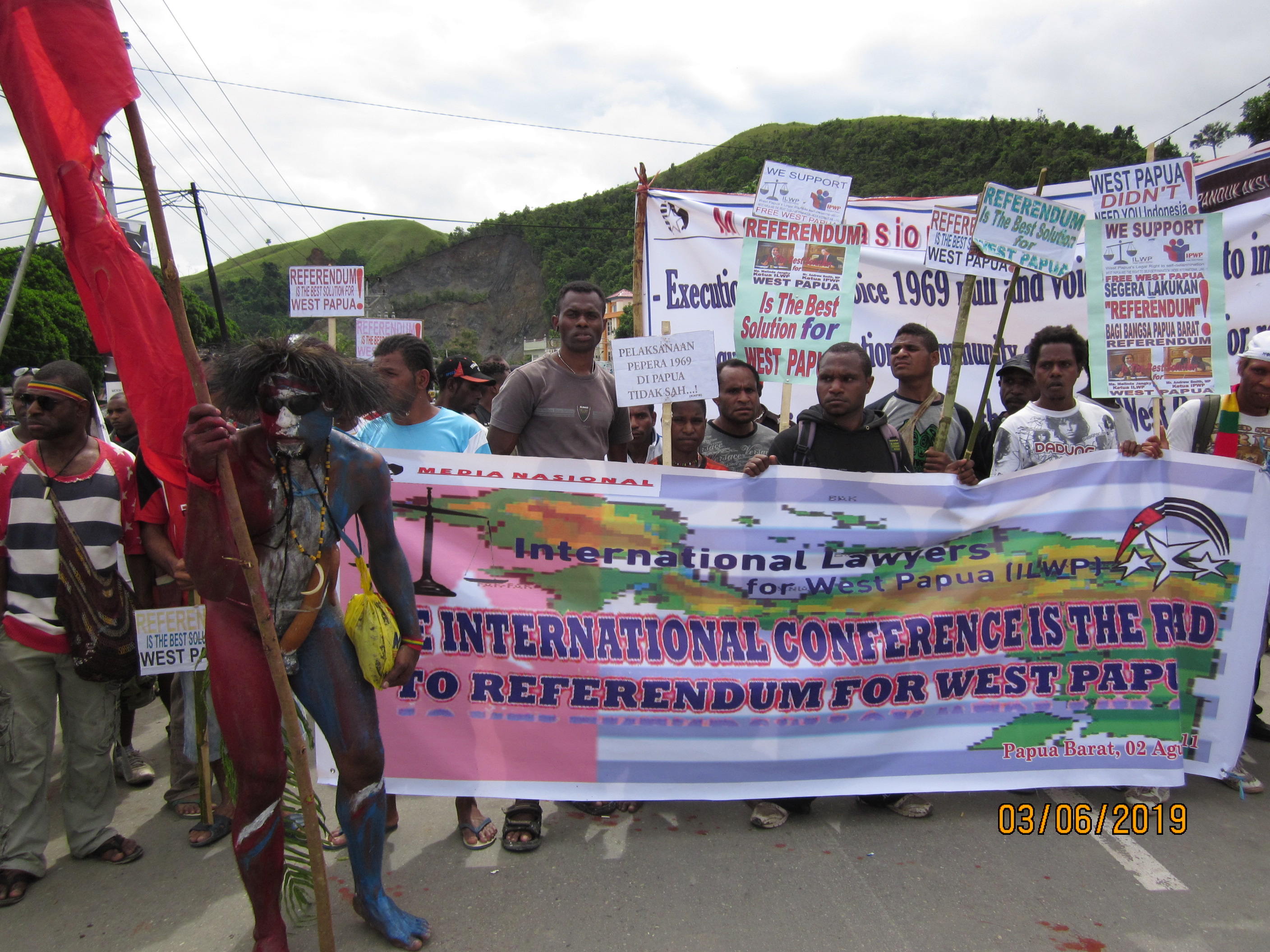
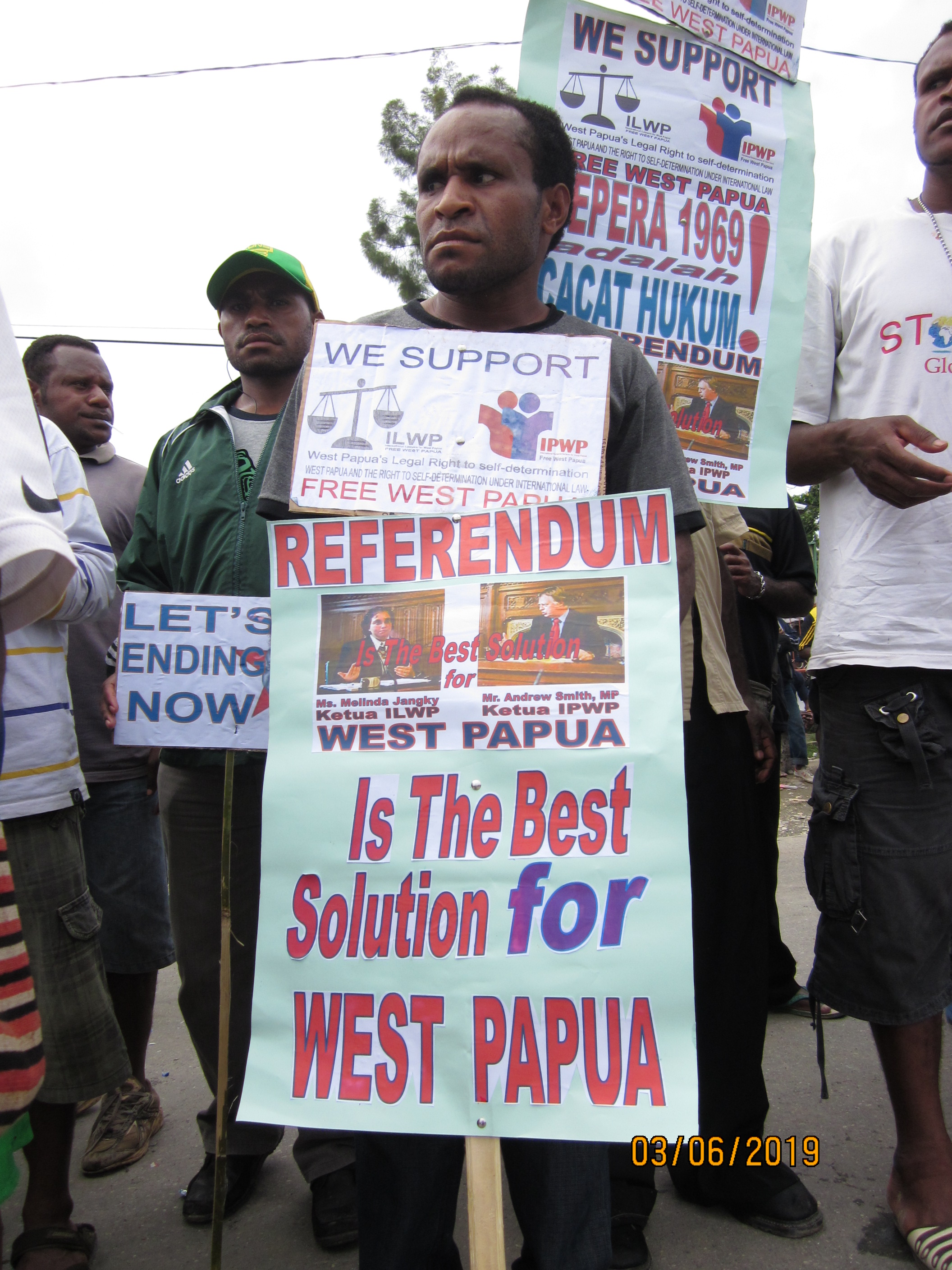
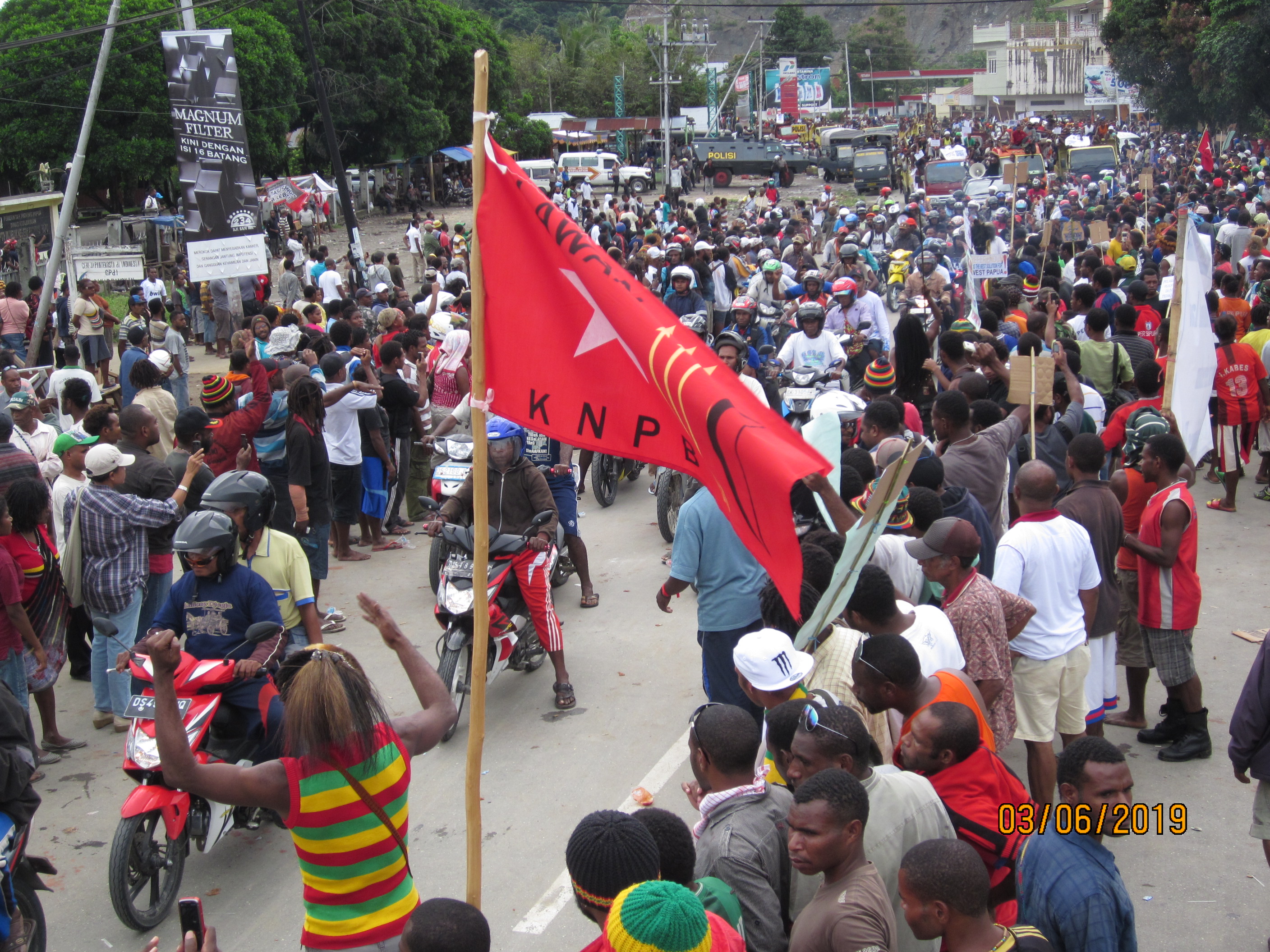
Social Media across West Papua is abuzz with declarations of relief and pride for the successful and peaceful mass mobilisations called by the West Papua National Committee (KNPB) to support the “West Papua: Road to Freedom” conference in in Oxford UK, on August 2.   The Photo Galleries below demonstrate unequivocally the scale of Papuan opposition to Indonesian rule.

Despite threats of heavy-handed Indonesian security force actions preventing free expression, attempts by the army to blocakade demonstrators, and unexplained act of violence suspected by many to be the work of Special Forces prior to mobilsations, tens of thousands of people across Papua took to the streets to demand their universal human rights to self -determination and a Referendum on the future of Papua.  Though vibrant and very loud, the rallies across Papua reportedly proceeded without any violence or provocations from security forces or proxies.

Bukhtar Tabuni, Chairman of KNPB, said “My appeal to all West Papuans living in jungle, in prison, in various parts of Papua and those living in exile that today all West Papuans must show their solidarity to support the KTT ILWP in Oxford. This event is important because it will conclude whether “Act of Free Choice” in 1969 was illegal and because the UN involved in the transfer of West Papua, it is an international issue.”
Terrianus Yoku, President National Congress West Papua National Authority said, “WPNA fully supports the rally organised by KNPB and appeal for international advocacy to monitor the current situation because it’s very volatile and unsafe.”
In Jayapura, the Rally coordinator from KNPB, Bernard Tabuni, explained that by mid afternoon the marchers paralysed Abepura, with traffic jammed, shops and schools closed and the marchers stretching for well over a kilometre with around 15,000 demonstrators.  The marchers were painted with mud on their body and also painted with stylised depictions of the banned Morning Star flag, thereby upholding the agreement with security forces that no flags would be flown.  The marchers were exuberantly singing and chanting, playing traditional instruments along the route, joined in the Long March by over 30 trucks, 20 station wagons, 17 Kijangs, 400 motorbikes of people joined the long march.”
With its roots in ancient Papuan traditions, demonstrators had planned several marches, called Long Marches, to converge on the DPRP – the focal point for the day’s events.  Troops from the TNI and Brimob riot police attempted to blockade one Abepura-bound Long March at Waena, but demonstrators outwitted the security forces by getting into vehicles and driving around them.  Exuberant scenes of yelling and singing greeted the procession of vehicles as they joined the main body at Abepura.
Daniel Wenda, secretary of KNPB, mentioned that four TNI truckloads of red and white uniformed Barisan Merah Putih (Pro-Indonesian militia) also organised a rally outside DPRD office in Jayapura.   Slogans on the banners stated “Reject the ILWP Summit” (KTT ILWP),  “Don’t lie to the people”, “Detain all corruptors.” and also “anti-Corruptor”.  Observers i Papua have taken the BMP slogans with mirth and irony given that their chief, Ramses Ohee, is regularly the beneficiary of corrupt dealings, has extensive illegal business interests, and receives significant funding from the notoriously corrupt Kopassus special forces.
“This demonstration is aimed to attract attention and counter our main rally but we will not be provoked”, said Daniel Wenda.
Bernard Tabuni reported that undercover military intelligence officers were amongst the demonstrators, and four truckloads of fully armed security forces were following behind the marchers.  TNI and Kopassus were also amongst the bystanders with cameras recording every movement.
A screening of a live internet stream from the Road to Freedom conference in Oxford was planned to be held at the grave of Theys Eluay on Tuesday night, but there are conflicting reports on the success of this.
A carload of armed BMP members appeared at the KNPB Secretariat in Waena late on Tuesday evening.  According to Daniel Wenda, the militiamen – a mix of Javanese and older Papuan men – attempted to gain entry, allegedly to abduct Mako Tabuni, KNPB Vice Chairman.  Tabuni was quickly bundled by KNPB security to a safe location.

In Wamena in the Baliem Valley, almost 17,000 people to a mass gathering that saw scenes of exuberance, singing and dancing.  After several hours of speeches and music, demonstrators peacefully dispersed.

In Sarmi, Yakuhimo and Keerom, reports are filtering out that flagraising ceremonies were held successfully without incident.

The slideshow below shows the August 2 actions in (in this order) Abepura, Waena and Wamena; and also those of  the weak counter-demonstration of Barisan Merah Putih militias funded by the Indonesian special forces, Kopassus, that was held close to the DPRP, or (Papua Province People’s Representative Council).

This slideshow requires JavaScript.

WEST PAPUA – INDON SECURITY FORCES FAIL TO BLOCK ACCESS FOR DEMONSTRATIONS ACROSS PAPUA, MILITIAS ON STREETS IN JAYAPURA

by Nick Chesterfield, westpapuamedia.info

Tuesday, August 2, 2011
Jayapura, 1340: The streets of several centres across West Papua are being blockaded today by heavily armed Indonesian security forces in an attempt to prevent a planned gathering of tens of thousands of protestors who are demanding a Referendum on the future of the province.

However, thousands of Papuans have reportedly ignored the strong military presence and are marching the streets of Jayapura, paralyzing the provincial capital with their huge numbers.

The protests, called by the West Papua National Committee (KNPB) and actively supported by the entirety of pro-independence movement, are being held to demonstrate both opposition to Indonesian rule and to the Indonesian-run dialogue process, in favour of legitimate internationally-mediated dialogue that takes into account the wishes of West Papuan people. The demonstrations are demanding a Referendum as the only lasting and credible solution to determine the future of Papua for Papuans.

Outside Jayapura, protests are also being held in Wamena, Biak, Nabire, Manokwari, Paniai, and Timika.

West Papua Media stringers on the ground in Abepura are reporting that the demonstrations outside the main Post Office were being blocked by hundreds of heavily armed riot police and soldiers. This is despite official permits being issued by the Jayapura police for the demonstration to proceed without hindrance.

At 10am local time, three truckloads of soldiers and BRIMOB riot police then decamped and headed to Waena to intercept a long march of several thousand people who were attempting to join together with the Abepura march and then head to Jayapura, in information conveyed to West Papua Media by Daniel Wenda, Secretary General of KNPB. It is unknown at time of writing whether the march has pushed through the security force blockade or if any casualties or arrests have been sustained.

Local human rights sources have reported that a recent spate of violent acts may have succeeded in keeping away crowds of over 10,000 people, with one person stabbed and wounded by a militiaman at a pre-rally gathering in Angkasapura. However in news just to hand, organisers of the rally are reporting that security forces have relented and several thousand people have now successfully joined the demonstration, which is continuing to grow.

With tensions extremely high after the violence, the organisers of today’s rallies across Papua have been at pains to ensure that no symbolic traditional weapons be brought to the gatherings, and have worked with the Dewan Adat Papua to deploy hundreds of peacekeepers from the uniformed Community Security Force of Petapa, or The Guardians of the Land of Papua.

This slideshow requires JavaScript.

Telephone communication to Jayapura has been sporadic with many calls being cut off and SMS communication delayed, making confirmation of events difficult. It is unclear if the security forces are currently preventing West Papuan people from actively communicating to the outside world.

Reports are filtering through that other political actions are occuring throughout Papua simultaneously with the mass protests, with the KNPB suggesting that those who could not make it engage in innovative and non-violent economic disruption actions, such as strikes by ojek drivers, street vendors and bus drivers.

Independence activists are also reporting that members of two pro-Indonesian militias — Besar Merah Putih and Aswain (headed by Euricio Guterres) — have been deployed widely across the Jayapura area in conjunction with security forces.

Witnesses reported that late last night, a PELNI ship suspiciously landed 92 unfamiliar men at the main Jayapura dock, who are widely believed by activists to be members of Kopassus special forces in plain clothes. Activist surveillance of military facilities has indicated that special forces officers have not been seen at regular barracks for the past three days at least.

Suspicions have also been cast on unidentified forces responsible for a spate of violent incidents prior to the nonviolent mobilisations, who are believed to be connected to the Indonesian security forces, in what many observers see as an attempt by the security forces to spread fear, panic and division among the demonstrators to prevent the protests going ahead.

In the early hours of Tuesday morning, an arson attack on the Rectorate of the Cenderawasih University, Abepura, was foiled by Papuan students. The fire was detected before it took hold by alert from student security and was quickly extinguished.

After attacks yesterday by unknown assailants on Indonesian transmigrants in Nafri, Abepura, sources are reporting that one person has been killed and an unknown number injured in another attack in Koya, where SMS reports from credible local sources have described several incidents involving shootings and stabbings.

The Indonesian military has long had a policy of using civilian proxies and plain-clothes agents to carry out acts of violence to provoke civil resistance movements into self-defence. This has often been used as a pretext to engage in a security crackdown, which reinforces military dominance over the region.

Elsewhere in Papua, the mass rally also being held simultaneously in Manokwari was prohibited by security force, according to organisers from the KNPB. However negotiations succeeded in Indonesian security forces relenting, and the rally is currently ongoing with several thousand people participating. This rally marched from the office of Dewan Adat Papua, and is currently outside the Department of Information in Sanggeng. The atmosphere is described as relaxed.

West Papua Media is monitoring events closely, and will provided updates on the situation throughout the day.

MEDIA NOTE:  CONTACTS FOR SPOKESPEOPLE AND STRINGER ON THE GROUND ARE AVAILABLE.  PLEASE CONTACT +61450079106 or editor<@>westpapuamedia.info

Related articles

Create a website or blog at WordPress.com

Up ↑