Jayapura – Chairman of the Fellowship Baptist Church of Papua, Socratez Sofyan Yoman, asked the police and TNI members to immediately withdraw from Paniai. Paniai conflict has given rise to fallen victims and can lead to ongoing violence.
“The Church will not agree when the police stormed the gang falls victim to arise.” That’s barbaric acts, violation of human rights, the authorities what he want. OPM also God’s people, “
“TNI and the police should be immediately withdrawn. There is no reason the authorities are in Paniai in large numbers. First Paniai not like this, secure and peaceful. When there is an apparatus, then there is a conflict, “said Sofyan Socratez Yoman, Wednesday evening, December 14, 2011.
He said the Papuan independence movement in Paniai not something new. “Why is not the first armed groups approached. Why only now approaching apparatus. What we regret is that approach instead by way of violence, “he said.
Yoman looked at repressive measures will only open the door for endless war between security officers and armed civilian groups. He asked the government and police review the policy of using weapons in the face of the Free Papua movement. “If more of its profits do not use weapons, and more losses through the exchange of fire, it just stopped.”
The Church will not agree when the police stormed the gang falls victim to arise. “That’s barbaric acts, violation of human rights, the authorities what he want. OPM is also God’s people, “he said.
Paniai gunbattle between Brimob and the OPM, Tuesday, December 13, 2011 yesterday, has given such great losses. “There are about 70 houses burned down the police, the commander’s house, we post all of them burned,” said Le Yeimo, a spokesman for the OPM Division II Makodam Pemka Paniai IV.
From the police, Bripka Supono shot in the leg. “The chase continues we did. For while the OPM headquarters in Eduda we have mastered. We are currently seeking a hiding place them again and try to clean up this movement, “says Police Chief Adjunct Senior Commissioner Paniai Police Janus Siregar.
He hopes the group who opposed surrender to avoid a shootout. “We will continue to pursue until they surrendered,” he said.
Harrowing accounts of terror and intimidation are emerging from villagers and human rights workers in the remote Paniai district in West Papua overnight, as a massive Indonesian military assault against National Liberation Army guerrillas continues.
Local human rights and church sources are reporting that ordinary villagers are being subjected to significant human rights abuses by a combined Indonesian police and military force, and have called for immediate international intervention in West Papua to stop the violence.
Over four full strength combat battalions of Indonesian army (TNI) Kostrad commandos from Battalion 753, Brimob paramilitary police, and elite counter-terrorism troops from Detachment 88 – all units armed, trained, and supplied by the Australian Government – were deployed in an offensive to surround the headquarters of the Paniai Free Papua National Liberation Army (TPN-OPM), under the command of General Jhon Yogi.
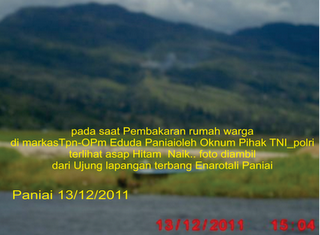
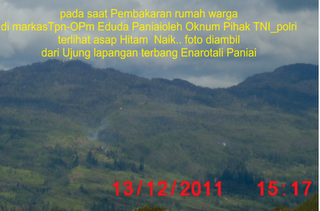
TPN/OPM headquarters Markas Eduda burning after TNI attack, 13/12/2011, Paniai, PapuaPaniai villages burning after TNI attack, 13/12/2011, Paniai, PapuaTPN/OPM headquarters Markas Eduda burning after TNI attack, 13/12/2011, Paniai, Papua
Punitive village burnings and raids are continuing in remote villages around the TPN/OPM headquarters of Markas Eduda. At the time of writing, seventy-five houses, six schools, and about 25 other buildings have been recorded as burnt down in a total of 27 villages by Indonesian security forces.
Eighteen people are now confirmed dead – fifteen from gunshot wounds, and three refugees who allegedly succumbed to starvation in the so-called care centres under the control of security forces. The victims’ names from the attack in Eduda are:
Dead:
Tapupai Gobay (30) was shot in the chest.
Tawe Bunai Awe (30) head crushed*.
Uwi Gobay (35) was shot in the abdomen.
Wate Nawipa (25) was shot in the back.
Martinus Gobay (29) head crushed*.
Owdei Yeimo (35) was shot in the back.
Ruben Gobay (25) was shot in the abdomen.
Paul Gobay (42) was shot in the abdomen.
Bernadus Yogi (23) was shot in the chest.
Demianus Yogi (15) was shot in the back.
Simon Kogoya (40) was shot in the abdomen.
Simon Yogi (30) was shot in the head.
Luke Kudiai (25) was shot in the chest.
Alfius Magai (20) head crushed*
Note: those with “head crushed” allegedly sustained these fatal injuries through severe beatings with rifle butts and “boot stamping”, according to sources
Wounded:
Paschal Kudiai (15) hit by a bullet in the head.
Martinus Kudiai (30) was shot in the hand.
David Mote (40) was shot in the thigh.
Amandus Kudiai (43) was shot in the arm.
Yohan Yogi (21) was shot in the leg.
Mon Yogi (20) was shot in the back.
Credible reports have also confirmed that two civilian “company” helicopters were provided to Security forces, and were allegedly used to drop live grenades and chemical dispersal weapons onto villages surrounding Eduda, and strafe villages with sniper and machine-gun fire on December 13, 14, and 15. Several independent witnesses have claimed to West Papua Media, and reported elsewhere across social media, that the helicopters are well known in the area for local non-military operations.
"Company" Helicopter alleged by local sources to be used in Indonesia security force offensive in Paniai. Source claims photo taken on Dec 13 aas helicopter was circling group. This photo is not independently verified, however analysis shows the image is consistent with independent witness descriptions, and the terrain and weather conditions are consistent with other photos supplied. (West Papua Media source)
Witnesses interviewed by local human rights workers have claimed that at 0800 local time on December 13, the Company helicopter launched CS gas salvos into the village of Markas Eduda, the TPN headquarters, to flush out villagers and guerrillas. According to a separate account sent to West Papua Media by TPN/OPM sources, the helicopters landed troops and occupied Eduda for most of the day, with guerrillas taking to forests in retreat. In retaliation, TPN/OPM fighters shot at the helicopters, unsuccessfully, and several hours of intense fighting ensued which was suspended when Free Papua fighters witnessed many village houses and schools being simultaneously burnt in the surrounding area. According to the TPN/OPM source, villages were set on fire around Eduda and gunshots were heard for the rest of the day and through the night. Free Papua fighters have retreated to the forest and are awaiting orders for their next moves, according to the source.
Villagers from across Paniai are continuing to be displaced by the operations, forced to flee en masse into areas around Enaratoli, on the opposite side of Lake Paniai. As reported on December 14 by West Papua Media, over 131 villages have been abandoned causing at least 10800 Paniai villagers to flee the military operations.
Church sources have further reported that refugees seeking shelter in the Enaratoli area are enduring worsening conditions without any relief. Armed Indonesian security forces have established a police supervised secure “Care Centre” at Uwatawogi Hall in Enaratoli, and have crammed into it 1715 people from Kopabutu and Dagouto villages. According to local activists in reports to West Papua Media, local residents are being threatened with arrest and beatings if they try to provide detainees with adequate humanitarian relief. Police are also preventing people held at the hall from leaving for food or sanitation needs, according to sources. At the time of writing, three people have died at the “care Centre” since December 9 from Diarrhoea. They are :
OTOLINCEA DEGEI age 2 years , died 8:20pm, 9/12/11;
YULIMINA GOBAI Age 4, died 3pm, 14/12/2011;
ANNA DEGEI Age 47, died 1030pm, 14/12/2011.
No food, sanitation or medical aid has been made available by any government agency to give relief to this large number of internally displaced people.
Over 9000 refugees are either hiding in the forest or seeking shelter with their own extended families in the region area. Those with their families are considered safe, however their needs and conditions are difficult to monitor and assess given their isolation
Local teachers have also been in contact with West Papua Media’s stringers. Since 27 November 2011, teaching and learning activities have been suspended indefinitely in all village schools surrounding Markas Eduda. Schools such as SD YPPK in Badao Dei, Yimouto, and Obayauweta villages have been suspended, as has Primary, Junior High, “shop” (trade school) and Elementary Instruction in the towns of Dagouto, and Uwani. The students of these schools have been evacuated with their parents.
A teacher in junior YPPGI Uwani said while repression was occurring in the villages that: “For while we have closed the schools, because school children are frightened and fled with their parents. In addition, we as teachers do not feel safe to make teaching and learning activities. All the teachers have fled Paniai district, and to Nabire. “
On December 15, the army / police battalions have returned to the villages of Uwamani, Dei and Obaipugaida to prepare a major attack for a new phase of the campaign. It is believed strongly by local activists that the “company” helicopter will still be used in addition to Unconfirmed reports have been received by West Papua Mediathat the Indonesian arsenal against civilians in Paniai includes one Mil Mi-24 SuperHind gunship, one of two usually stationed near Jayapura.
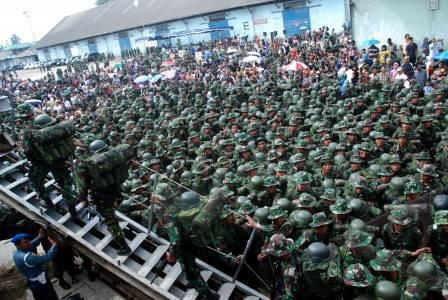
650 Kostrad troops from Battalion 142 being deployed from Palembang to Paniai in Papua, boarding their troop ship on December 9, 2011
West Papua National Committee (KNPB) activists in Paniai reported on December 15 that after the assaults on villages, the Indonesian military forces are now arresting, intimidating and carrying out interrogation on all residents across the districts of Toko, Kopabaida and Uwamani. According the KNPB, Indonesian police have arrested scores of children and adults, and are conducting brutal and physical interrogations and questioning from 11.00 am until the end of the day
The offensive was ongoing throughout December 15, with Indonesian security forces opening fire in many locations around Eduda. Overnight, from 0200 to 0600, heavy gunfire erupted across the Degeuwo River valley. Human rights sources in villages and also with refugees conveyed reports that people were being shot at by snipers if they were moving anywhere after dark, even to collect, food, water, or to secure pigs. It is not known how many people were killed during the night, but local source are expecting the toll to rise.
According to a report provided tonight by a local pilot, Indonesian security forces shot eleven times into houses in the village of Gekoo, where mourners were gathering for a the funeral of a local man who died from illness. Villagers alleged that some bullets even landed in their cooking fires, exploding their food pots.
Witnesses reported a series of helicopter raids from 11am on December 15, with helicopters being used to machine-gun the villages of Obaiyepa and Uwaman. Human rights workers have been unable to access these areas to see if any casualties were sustained.
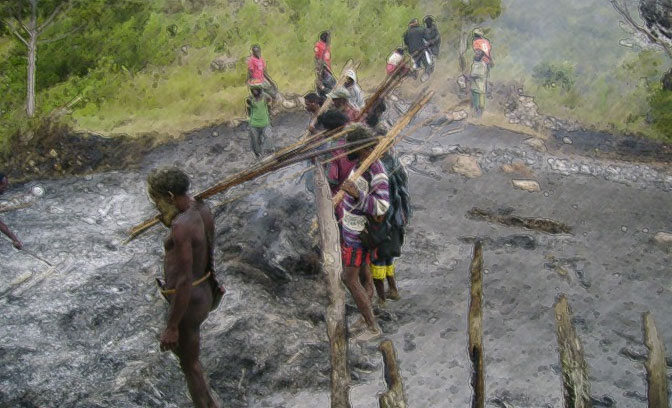
Unidentified village burnt down 13, dec 2011, near Eduda, Paniai
Helicopters landed at Eduda ceremony ground 11 times from 11:00 to 13:00 hours, and residents suspect logistics, ammunition and additional forces were being deployed.
The area around Paniai has been long subject to conflict and heavy Indonesian military offensives against civilians, however in recent months the Indonesian police have taken charge of punitive operations against West Papuans harbouring pro-independence sympathies. The conflict has recently escalated over land rights and the control of local gold mining operations, with Brimob deeply involved in both joint venture security, and direct involvement in gold businesses and associated activities. The Australian gold mining company Paniai Gold is also operating in the Degeuwo River region.
Indonesian soldiers in Paniai, December 2011
Civilians in the foothills are in panic and reliving the trauma of past operations, according to the report from a local pilot. “They are concerned emotions again will open in Wegeuto of the 1982 war Memoria Passionis (memory of suffering) and again when the Army conducted ongoing military operations (DOM – Daerah Operasi Militer) from 1989-1993 across the Badauwo area, near Eduda, ” the source said via email. He explained that during the last DOM period the army accused and stigmatised civilians as being members of the TPN-OPM, and subsequently tortured thousands of villagers. Human rights sources at the time documented villagers being waterboarded / tortured for 24 hours; residents’ houses burned, raped girls and married women, extrajudicial killings, burning off fingers, moustaches and beards, pulling fingernails and quartering villagers with armoured vehicles. Troops also conducted burning and destroying food gardens, killing livestock and pets, and fouling water supplies.
Residents are concerned that the current angry and emotional behaviour by the TNI-police toward TPN / OPM will be vented on civilians living on the slope of the hamlet Wegeuto especially, directly adjacent to Markas Eduda. In a message delivered to West Papua Media local villagers have pleaded for International Advocacy to get Military and Police immediately withdrawn from Eduda and Paniai in general.
Much trauma is being felt by civilians across Paniai as a result of the offensive. Independent journalist Sonny Dogopia, from Papuan Voices , interviewed local villagers by telephone on December 14. Magda Tekege, a housewife from Deiyai District, said civil society is very scared and depressed. ” Here also TNI / Police beat us and put us under surveillance, and are one full alert status, ” she explained. Deiyai Magda called the situation unusual , “this is probably due to invasion by TNI / police in Paniai, therefore Deiyai also suffer the effects.”
Reports from Tuesday described the exercises that the Australian trained, funded and armed Brimob Gegana unit, upon arriving in Enaratoli proceeded to take over the streets immediately, causing normal town life to be immediately disrupted as local people emptied the streets to hide.
On December 6, Human rights, church sources and local activists had independently claimed that 542 people have been forcibly evacuated by troops from the Special Gegana Brimob “Counter” terrorist police unit. The villages of Dagouto and Kopabatu and surrounding hamlets in the Dagoutu Paniai district were evicted after the Gegana unit decided it wanted to expand a new headquarters facility to deploy in the offensive against Jhon Yogi, the local leader of the armed guerrilla unit of the National Liberation Army (TPN-OPM).
The Gegana unit, a specialised elite anti-terrorist unit of the Indonesian police has been deployed heavily across Papua to crackdown on pro-independence activists engaged in non-violent resistance, as well as to eliminate the armed struggle groups. Gegana is one of several elite Indonesian police units that receives arms, funding, and training from the Australian Government, and was blamed on December 3 for burning down a church and school in Wandenggobak, in the highland regency of Puncak Jaya.
As this article was going to press, an update was received from a trusted human rights worker in Paniai. “At 2300 in the evening, Brimob Coconut Battalion 2 burned down buildings of Paniai Districts’ tourism assets, located in Bukit Dupia, in the same location as the Regent’s residence. This evening in Paniai the situation is very tense”. TPN fighters reportedly have returned fire on the attack and heavy fighting is still occurring,
The situation is ongoing and developing and West Papua Media will continue to closely monitor events.
Please urgently help us continue this work. @westpapuamedia ia working tirelessly to end impunity in Papua with effective journalism. But we need your help – PLEASE DONATE NOW wp.me/P1aPlR-116
SYDNEY, Dec 14, 2011 (IPS) – The Indonesian government’s offer of development for West Papua, following the crackdown by security forces on a pro-independence meeting in Jayapura in October, is unlikely to succeed in the absence of political dialogue and calls for self-determination are expected to continue.
For half a century, the indigenous population of the Indonesian provinces of Papua and West Papua in western New Guinea, who are ethnically and culturally related to Melanesians of the neighbouring Pacific Islands, have campaigned for the self-government first initiated as Dutch colonial rule ended in the early 1960s.
The First Papuan People’s Congress in 1961 was part of decolonisation but thwarted by incorporation of the territory into Indonesia after the United Nations-supervised ‘Act of Free Choice’ on the political future of West Papua in 1969 was apparently manipulated to guarantee a majority vote for integration.
The granting of Special Autonomy in 2001, following the Second Papuan Congress, failed to improve the social and economic status or political freedoms of West Papuans.
The Third Papuan Congress led by Selpius Bobii, Papuan Chair of the National Committee for West Papua (KNPB), was convened in Abepura, Jayapura, with approximately 5,000 attending despite the heavy presence of Indonesian security forces.
At the close of the congress on Oct. 19, and following declaration of an independent West Papua, violence broke out as security officers triggered guns to disperse the crowd, fired tear gas and arrested approximately 300 participants.
Indonesian human rights organisation, Kontras, reported evidence of security forces committing “killings, arbitrary arrests, torture and deeds of other inhumane and excessive use of force” against congress participants, while those arrested suffered “acts of violence in the form of beatings with wood, the barrels of guns and were kicked and beaten.”
Six delegates are now dead and the six who remain arrested, including Selpius Bobii, Forkorus Yaboisembut, Chair of the Papuan Customary Council, and Edison Waromi, president of the West Papua National Authority, are charged with treason.
Large pro-independence demonstrations across the provinces over the past year have been galvanised by escalating frustration at ten years of failed Special Autonomy, impunity of human rights abuses by security forces and the government’s promotion of Indonesian migration to Papua and West Papua, resulting in an indigenous demographic minority.
Concurrently the movement has been boosted by the Vanuatu Government’s decision in 2010 to include support for West Papuan Independence in its foreign policy and a high profile International Lawyers for West Papua conference in Britain in August.
Camellia Webb-Gannon, West Papua project co-ordinator, Centre for Peace and Conflict Studies, University of Sydney, explained: “The central government has failed to pass crucial legislation that would have allowed Special Autonomy to be fully implemented.
“The splitting of West Papua into two provinces undermined Special Autonomy and started the process of ‘pemekeran’ through which Papua and West Papua are being administratively fragmented and thus weakened. Many of the freedoms promised under Special Autonomy, such as the right to fly the (separatist) Morning Star flag, have since been revoked.”
While the government also devolved responsibility for substantial revenues from the giant Freeport-McMoRan-owned Grasberg copper and gold mine in Timika, which generates 50 percent of Papua’s GDP, the province has the lowest human development index in Indonesia.
“Although Papua and West Papua are awash with funds flowing back from the centre, the extent of corruption at the provincial and local administrative levels mean that most of this money never makes its way to the projects and people that need it most,” said Webb-Gannon.
Special Autonomy funds prop up elite corruption and perpetuate military rent-seeking behaviour as there is inadequate restriction on and monitoring of these funds, Webb-Gannon added.
While Indonesia fears secession could lead to national disintegration, ‘makar’ treason laws criminalise separatist demonstrations and the government benefits substantially from the province’s natural resources.
Indonesia has emerged as a strong democracy since the end of the militaristic Suharto regime in 1998, but the power of the armed forces remains extant and their role in human rights abuses, corruption and extortion largely immune to challenges from the state or civil society.
Human Rights Watch reports that: “New allegations of security force involvement in torture emerged in 2010, but the military consistently shields its officers from investigations and the government makes little effort to hold them accountable. Nor was there any progress on a bill before parliament that would give civilian courts jurisdiction to try soldiers accused of committing abuses against civilians.”
Illegal activities of the Indonesian military (Tentara Nasional Indonesia) or TNI in the Papuan provinces includes drug smuggling, prostitution, trade of tropical birds, legal and illegal logging operations, gambling and extorting payments from local villagers.
Corruption watchdog, Global Witness, also revealed in 2005 payments of millions of dollars to the TNI from the Freeport mining company for security services at the Grasberg mine, where recent violent confrontations between the TNI and workers, who have been striking since Sep. 15 over pay grievances, resulted in the death of a miner in mid-October.
Now the Indonesian government has announced the Unit for the Acceleration of Development in Papua and West Papua will be fast tracking development, overseeing allocation of autonomy funds and initiating dialogue with local civilian groups.
Neles Tebay, a priest with the Catholic Diocese of Jayapura, who is campaigning for peace talks, said: “The West Papuan people have not been treated as human beings and the trust has been broken. Trust between the Indonesian government and Papuan people will not be easy.”
Tebay believes that the Indonesian president should appoint a special envoy to initiate political dialogue with West Papuan political representatives.
Positive government pronouncements currently overlook the main demand of the Third Papuan Congress Declaration, namely termination of Indonesian occupation.
“In Timor, a referendum led to the transformation of the peoples’ aspirations and this is what many of the current generation of activists in West Papua are pushing for,” Webb-Gannon said.
SPECIAL REPORT By Nick Chesterfield at West Papua Media, with local sources
Thousands of people have reportedly fled in terror from a large area in Paniai, West Papua as a massive combined Police and military offensive attacked villages on December 13, attempting to break armed resistance from pro-independence guerrillas.
Credible human rights sources are claiming up to 20 local people have been shot dead by Indonesian security forces around the jungle centre of Markas Eduda, during a brutal operation that is reported to have razed 26 villages, and caused over 10,000 people to flee to the relative safety of Enaratoli.
Over four full strength combat battalions of Indonesian army (TNI) Kostrad commandos from Battalion 753, Brimob paramilitary police, and elite counter-terrorism troops from Detachment 88 – all units armed, trained, and supplied by the Australian Government – were deployed in a cordon to surround the headquarters of the Paniai Free Papua National Liberation Army (TPN-OPM), under the command of General Jhon Yogi.
Urgent text messages were received reporting an attack on Markas Eduda by Brimob and the TNI. According to people in Paniai and those close to sources near Markas Eduda, by 13:30 local time the base had been surrounded by troops. At 14:05 local time a Paniai based contact reported to West Papua Media that the TNI and Brimob had entered Eduda and surrounding hamlets and proceeded to torch homes. Ground and air attacks (by helicopter) were both reported.
In a massive escalation to constant military operations that have been carried out across Paniai since April 2011, Indonesian forces dropped ground troops by helicopters into 26 villages surrounding the TPN headquarters.
An office of a non-government “Peace and Justice Secretariat” was amongst those burnt to the ground in Eduda.
Helicopters were used repeatedly before and during the attack, with a witness reporting via SMS that t upon sunrise at 0615 local time helicopters began strafing the villages in the operation area and firing teargas upon local residents. Local sources claimed that Indonesian troops fired live grenades, “bombs” and tear gas from the helicopters while storming the villages surrounding Eduda.
Unconfirmed reports described the helicopters as firing live rounds and also dropping fuel onto traditional huts which were then set on fire.
Combined forces of the military, police, BRIMOB and Detachment 88 were ferried by further helicopters into 14 locations around the headquarters, and proceeded to clear every village. Multiple contacts were reported throughout the day from both sides, and heavy fighting was occurring from resistance forces.
According to credible reports from local sources, by the close of Tuesday, Police failed to arrest any member of the OPM led by Yogi, and the Eduda headquarters were still controlled by the TPN / OPM. However reports of a heavy gun battle with troops and police Mobile Brigade was still evident as night drew close. However unconfirmed reports stated that seven helicopters were landed on the Eduda parade ground and had occupied the village, but TPN forces had retreated to the forest.
One Indonesian police officer is confirmed dead from after ongoing firefights with TPN troops, and and another seriously injured. Human rights sources have also claimed that the TPN sustained casualties, though the number or condition is unknown at this stage.
Independent West Papuan journalist Oktavianus Pogau was also in close contact with local witnesses. Yustinus Gobay, a villager Paniai who spoke with Pogau via phone, said he hold grave fears for casualties. “At OPM place we still do not know, but chances are there definitely are a lot of victims, because they were attacked from the air by helicopter,” explained Gobay.
At least 130 named villages in the Military Operations Area (Daerah Operasi Militer. DOM) have been reported by credible local human rights sources as being abandoned by residents. As each village has a minimum of four large families (min 40 people), with many housing up to ten families each (80 people), a simple demographic extrapolation indicates that between 5400 and 10800 Paniai villagers have had to flee the military operations. (Full list of villages follows report).
Church sources have reported that the refugees are seeking shelter in the Enaratoli area and are relying on traditional kinship reciprocities. No food, sanitation or medical aid has been made available by any government agency to give relief to this large number of internally displaced people.
“We do not know how long the war between the military / police and the TPN / OPM will continue,” Gobay told journalist Pogau. “We have fled our homes due to fear, and the attention of the local government doesn’t exist,” said Gobay
Local residents have expressed grave fears via SMS to West Papua Media that the current operations are designed by the Indonesian security forces as a “final push to push us over the edge of genocide, to make Orang Asli (Indigenous people) spent and murdered, fast and quick”.
Messages sent to West Papua Media from multiple sources claimed that “State of Indonesia is considered a country hostile to humanity and is implementing Terrorism Program in Papua since May 1, 1963”, referring to the date of invasion by Indonesian forces.
Since 7 December, civilians from the villages and around Dagouto and Eduda have been progressively evacuated, with no regard for welfare, by security forces. Many were housed in a multipurpose hall Uwatawogi Enarotali. This evacuation was carried out at the request of Chief of Police, Secretary of Paniai District and Commander of the Special Team Gegana Brimob, to broaden the battlefield between the TPN and the Mobile Brigade. Paniai Civilians became increasingly restless and frightened, and had little access to food or basic needs, their starving even more pronounced.
According to human rights sources, security forces have been constantly targeting remote communities that inhabit the foothills along the West-East mountain range which extends from the Grasberg to Cape Dagouto-Lake Paniai.
Local leaders led by the Chairman of the Regional Indigenous Council (DAD) in Paniai, Jhon Gobay, complained earlier this month to the National Commission on Human Rights (Komnas HAM) in Jakarta about the unrest and violence against citizens in the district due to the presence of members of the Police Mobile Brigade from Paniai.
During the meeting, DAD Paniai firmly ask the President and Chief of Police to immediately withdraw troops from Mobile Brigade Paniai district. Gobay said the situation of occupation has caused many people becoming victims of security force harassment due to the stigma of being OPM attached to the citizens of Papua, especially in the Paniai District.
The President of the Federated Republic of West Papua, Forkorus Yaboisembut, speaking from his cell in Jayapura where he is awaiting trial on treason charges, appealed to the United States and international community to urge Indonesia to show respect for human rights and democracy in West Papua.
The situation is ongoing and developing and West Papua Media will continue to closely monitor events.
Please urgently help us continue this work. @westpapuamedia working tirelessly to end impunity in Papua with effective journalism. But we need your help – PLEASE DONATE NOW wp.me/P1aPlR-116
Full list of villages burnt and attacked by Indonesian security forces:
Muyadebe,
Kegomakida,
Bokowa,
Uwamani,
Kugitadi,
Badauwo,
Obaikebo,
Woubutu,
Yagiyo,
Gekoo,
Tokou,
Bibida,
Odiyai,
Papato,
Timida,
Kopo,
Uwibutu,
Madi,
Ipakiye,
Nunubado,
Awabutu,
Kogekotu,
Bobaigo,
Iyaitaka,
Toputo,
Aikai
Puteyato.
Full list of villages forcibly evacuated by Indonesian Security forces:
JUBI, 9 December 2011
Abridged in translation by TAPOL
The Rajawali Group plans to open up 10,000 hectares in the district of Malind, Paniai for a sugar beet plantation. In preparation for the planting, seeds have already been brought from West Java after undergoing tests.
The manager of the Rajawali Group Abdul Wahab said that the seeds are currently being prepared in readiness for planting. The process should take six months but because of the heat in the past few months, it may take eight months. Some of the seeds have dried up because of the heat.
The planting of sugar beet is planned to begin in 20112 but difficulties have arisen because of the unrealiability of some of the contractors. They are busy at the moment with construction work and road building which may require some adjustments.
Wahab also said that a factory will be built in 2012 and it is hoped that by 2014, the crop will have been harvested and we are able to produce red sugar. ‘This is the target for the company and it must be realised,’ he said.
COMMENT by Tapol
The item just posted about the Rajawali Group’s opening up of 10,000 hectares of land for the production of sugar beet in Malind district of Paniai fails to raise the issue of who holds proprietary rights over the land which the company plans to ‘open up’ for beet.
There is no indication about whether there are people who are now living on the land or whether it is an area where the Malind people hunt or fell trees to build houses or for fuel to cook their everyday meals.
Did Rajawali seek the permission of local communities that live on or use the land that the company plans to use for a beet plantation? Were the local communities who, we may assume, use the land for their homes or livelihoods, ever consulted about the use of the land or offered compensation? What will happen to people who currently live on this land? Will they be evicted or paid compensation for the seizure of their land?
Using the land for the cultivation of beet will require a considerable input of labour. Where will these labourers – and their families – come from? Will this require the influx of labour from outside Papua, thus shifting the demographic composition in favour of migrants from other parts of Indonesia and further intensifying the marginalisation of the Papuan people?







 West Papua Media Alerts