Selection of MRP members should stop, say church leaders

Abridged in translation by TAPOL

Bintang Papua,11 January 2011

Given the growing concern about the implementation of Special Autonomy
(OTSUS) as reflected in the decisions of the Grand Assembly of the MRP
and the Papuan Indigenous People held on 9-10 June 2010, several church
leaders have called on the Indonesian president, the governors of the
provinces of Papua and West Papua and the chairmen of the provincial
legislative assemblies to halt the process of selecting members of the
MRP (Majelis Rakyat Papua – Papuan People’s Assembly) until such time as
there are clear answers to the eleven recommendations that were
submitted to the provincial assembly (DPRP) on 18 June 2010, according
to a joint communique by the churches The signatories include the head
of the Evangelical Church, the GKI, Rev. Jemima Krey, the head of the
Kingmi church, Rev. Benny Giay, Rev. Socrates Yoman and the head of the
Pentacostal Church, Rev. Tonny Infandi.

The assembly held in June 2010 which was facilitated by the MRP was an
official forum representing the voice of the Papuan people, well within
the framework of the rule of law in Indonesia. On that occasion, the
Papuan people clearly expressed the view that the OTSUS Law 21/2001 had
failed to result in any improvements in the living conditions of the
Papuan people which is why the Papuan people had returned the law to
Jakarta.

The handing back of the law to the two provincial assemblies occurred in
Jayapura and Manokwari on 18 June 2010, when a deadline of one month was
set for members of the asemblies to hold plenary sessions to respond to
the people’s aspirations, but since that time, neither of the assemblies
had adopted any measures to respond to these demands.

The impression is that the the central government as well as the
provincial assemblies are not in any way interested in taking any
action to improve the implementation of OTSUS, which is in direct
contradiction with the wishes of the Papuan people.

The situation has been further aggravated by current moves to set up a
new MRP, a body that has now been rejected by the Papuan people.

There is even the impression that the central government via the
intermediary of the United Agency of the Papuan Provinces, is about to
create a ‘puppet MRP’ within the framework of the OTSUS law that will be
incapable of granting protection and upholding the basis rights of the
indigenous Papuan people.

Church leaders regard the creation of such an MRP as being in serious
violation of the dignity of the Papuan people. The church leaders
therefore state the following:

Firstly, we respect the aspirations of the indigenous Papuan people as
declared in the decisions of the Grand Assembly on 9 -10 June 2010, that
OTSUS has failed and has been returned to the central government.

Secondly, that the central government and the provincial assemblies
should immediately stop all moves to select members of the MRP until
such time as there are concrete responses to the results of the Grand
Assembly that were made public on 16 June 2010.

Thirdly, we call upon the governors of the Papuan provinces to stop
ignoring the aspirations of the Papuan people and to sit down with the
people to hold comprehensive talks about Papuan aspirations in rejection
of OTSUS, democratically and in a spirit of justice.

Fourthly, we call on the central government to enter in dialogue with
the Papuan people so as to bring to an end the protracted legal and
political uncertainty which has brought despair to the Papuan people
who we lead in this Land of Papua.

Fifthly, we reject all attempts or formulations that spread confusion
about the demand for dialogue between the Papuan people and the
government of Indonesia which has for many years been expressed by the
Papuan people.

Sixthly, we urge the Indonesian government to stop all forms of
intimidation and terror and other repressive measures that are aimed at
stifling critical opinions from our community regarding development
that is now under way in the Land of Papua which has failed to respect
the interests of the common people.

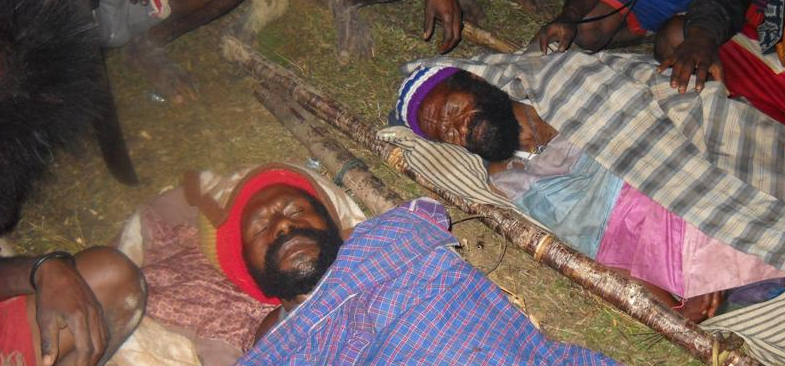
News Flash: 2 Papuan civilians shot dead in military raid on village in highlands

Two West Papuan civilians were shot dead during an independence day raid on their village by the Indonesian military.

The raid, at 1:30am this morning was on the village of Bolakme, Wamena. The same village was the target of burnings last year by the military.

The 2 civilians confirmed dead so far are Asli Wenda and Elius Tabuni. We understand some others have suffered life threatening injuries. All villagers from the surrounding areas have now fled to forests and remain in hiding.

More news on the situation as we get it.

Bintang Papua: Rejection of OTSUS intensifies DPRP should convene plenary session

[All items abridged in translation]

Bintang Papua, 1 November 2010

Rejection of OTSUS intensifies
DPRP should convene plenary session

The rejection of OTSUS, the Special Autonomy Law of 2001,  has intensified  with a demonstration outside the office of the regional legislative assembly, the DPRP calling for it to convene a plenary session to discuss  the eleven recommendations adopted recently by the MRP which included the rejection of OTSUS.

‘We declare that the OTSUS law adopted in 2001 has resulted in no significant  improvements in the living conditions of the Papuan people, and we state that OTSUS has failed.’

The chairman of Pepera PB, Selpius Bobii said that OTSUS provided for a system that sides with the Papuan people, and which protects and empowers them. But in the nine years since the enactment of the law, not a single special regulation as required under the law has been adopted. There have been inconsistencies between the attitude and the actions of the central government.

The chairman of the Customary Youth  of Papua, Wilson Uruway, presented a joint statement to the deputy chairman of the DPRP who was urged to make a statement in response. He said that all the aspirations of the people submitted to the assembly had been discussed. Those concerning the central government would be quickly forwarded to the government in the same way that the eleven recommendations of the MRP has been forwarded.

The joint statement was supported by a large number of groups and NGOs.

Hardly any of the OTSUS funds  has not been used in ways that would assist and help indigenous Papuans but had been misdirected as ‘fictive funds’. The central government was accused of thwarting the MRP at all levels of its activities, as a result of which it has be incapable of struggling for the rights of the Papuan people.

Among the indicators of the problem was the tardiness in adopting special regulations – Perdasi and Perdadus – regarding management of the administration and  for economic development. Dualism between provincial and districts administrations has occurred in their adoption of different regulations

Before demonstrating in front of the DPRP, the crowd gathered at Expo Waena, where they waited for a group from Sentani Customary Council to join them.

One speaker called on the government  to speak out against acts of intimidation, threats and killings of Papuans perpetrated by the TNI/Army and the Police.

A group led by the chairman of DAP Forkorus Yaboisembu arrived at the DPRP travelling on several trucks.

The demonstration was surrounded by two special Brimob units and members of the local police. Nevertheless, the action proceeded peacefully

—————————

Historic Papua day commemorated

Bintang Papua, 19 November 2010

19 November 1969  is a historic day for the Papuan people, a day regarded as been sacred by many sections of the people struggling for independence. On this day in 2010,  groups gathered to recall the historic event when the  Papuan issue was discussed in the US Congress, although it did not clearly stated that the US Congress fully supports Papuan sovereignty.

At a gathering held to socialise the events at the US Congress, Wilson Waimbo Uruwaya  announced that they would hold a peaceful demonstration calling for the peaceful solution of Papua’s status which was discussed by the UN General Assembly in 1969.

Wilson said that all elements of the Papuan struggle were united in their determination to socialise the results of the US Congress on which occasion, a discussion took place about crimes against humanity and the need to seek a solution to the difficult problems that were being faced by the Papuan people to the present day.

The discussions in the US Congress which had occurred for the first time have taken the Papuan people a step forward in their history of struggle.

HRW to Indonesia: Stop Stalling on Investigating Torture Video Episode

Human Rights Watch logo
Image via Wikipedia

http://www.hrw.org/node/94430

HUMAN RIGHTS WATCH
For Immediate Release

Indonesia: Stop Stalling on Investigating Torture Video Episode
Papuan Farmer Describes Days of Abuse by Soldiers

(New York, November 22, 2010) – The Indonesian government should use the newly available video testimony of a torture victim to mount a thorough, impartial, and transparent investigation into the episode, Human Rights Watch said today. The torture of Tunaliwor Kiwo, a Papuan farmer, and his neighbor, was recorded with a mobile phone on May 30, 2010, and the video came to light in October. Kiwo recounted the details of his torture in videotaped testimony only made public in recent days.

Soldiers arrested Kiwo and Telangga Gire on May 30 in Papua’s Puncak Jaya regency. In a 10-minute video of the torture session, soldiers are seen kicking Kiwo’s face and chest, burning his face with a cigarette, applying burning wood to his penis, and placing a knife to Gire’s neck. In the newly available videotaped testimony, Kiwo describes that torture and details other forms of torture he suffered for two more days before he escaped from the soldiers on June 2. Soldiers also tortured Gire, who was finally released after interventions by his wife and mother. The government has promised to investigate, but claims it cannot identify the perpetrators.

“Once again, the authorities are sitting on their hands rather than fulfilling their obligations and proactively identifying and prosecuting the soldiers responsible,” said Phil Robertson, deputy director of Human Rights Watch’s Asia division. “Kiwo has shown tremendous bravery in coming forward – he deserves justice and protection from retaliation, not another half-hearted army investigation and cover-up.”

Indonesia is a party in the United Nations Convention Against Torture and has strict obligations to investigate and prosecute promptly all incidents of torture and to ensure that victims and witnesses are protected against all ill-treatment or intimidation as a consequence of filing a complaint or giving evidence.

Kiwo said in his testimony that he and Gire had been riding a motorcycle from their hometown, Tingginambut, to Mulia, the capital of Puncak Jaya, when soldiers stopped them at a military checkpoint in Kwanggok Nalime, Yogorini. Kiwo said that soldiers seized and hit them, bound their arms with rope, dragged them to the back of the army post, and tied their feet with barbed wire. He said the soldiers tortured him for three days, beating him with their hands and sticks, crushing his toes with pliers, suffocating him with plastic bags, burning his genitals and other body parts, cutting his face and head and smearing the wounds with chilies, and using other forms of abuse.

Kiwo’s videotaped testimony with subtitles in English and Indonesian can be viewed on the Engage Media website.

“The Indonesian government at the highest levels should guarantee that Tunaliwor Kiwo and Telangga Gire will be protected from retaliation and considered witnesses to crimes,” Robertson said. “The testimony of these two men will be critically important in prosecuting the soldiers who tortured them, so protecting them needs to be a top priority.”

The October media coverage of the May 30 torture video prompted President Susilo Bambang Yudhoyono to hold a limited cabinet meeting on October 22, after which the coordinating security minister, Marshall Djoko Suyanto, admitted that the video showed Indonesian soldiers torturing Papuan villagers. Yudhoyono reportedly ordered the military to investigate immediately, but the government has provided no information about the progress of the investigation.

The National Commission on Human Rights (Komnas HAM) estimates that as many as 50 civilians have been killed in the area since the Indonesian military and police began military operations there last year.

Representatives of the Papuan Customary Council provided the video of Kiwo’s testimony to the National Commission on Human Rights on November 5. The Commission set up a team to investigate the torture episode as well as other human rights abuses alleged to have occurred in Puncak Jaya. The Commission has scheduled a trip to Papua to investigate further, though an earlier visit in late October to investigate the Kiwo-Gire torture video was frustrated by a lack of access and cooperation from military and local officials.

Unexpectedly, Maj. Gen. Hotma Marbun, the Indonesian military commander in Papua, was removed from his post on November 12. It was announced as a “routine transfer” even though Marbun had only been in Papua since January. Human Rights Watch has no information indicating that this transfer is punitive or connected in any way with the torture video. His replacement, Brig. Gen. Erfi Triassunu, should ensure that investigations in the torture case are carried out thoroughly and impartially, and that army officials under his command fully cooperate, Human Rights Watch said.

“Changing military commanders will not root out impunity,” Robertson said. “The victims deserve justice. The Indonesian military and police in Papua should fully cooperate with investigators from the National Commission on Human Rights.”

To view the videotaped testimony of Tunaliwor Kiwo, please visit:

Home

To read the October 2010 Human Rights Watch news release “Indonesia: Investigate Torture Video From Papua,” please visit:
http://www.hrw.org/en/news/2010/10/20/indonesia-investigate-torture-video-papua

To read the June 2010 Human Rights Watch report “Prosecuting Political Aspiration: Indonesia’s Political Prisoners,” please visit:
http://www.hrw.org/en/reports/2010/06/23/prosecuting-political-aspiration-0

For more information, please contact:
In Jakarta, Elaine Pearson (English): +1-646-291-7169 (mobile); or +62-812-8222-3591 (mobile)
In Bangkok, Phil Robertson (English, Thai): +66-850-608-406 (mobile)
In Washington, DC, Sophie Richardson (English, Mandarin): +1-202-612-4341; or +1-917-721-7473 (mobile)

Appendix: Confusion over two different torture videos from Papua

March 17, 2010 video
On November 5, 2010, the Jayapura military tribunal opened the trial against Master Pvt. Sahminan Husain Lubis, Pvt. Second Class Joko Sulistiono, Pvt. Second Class Di Purwanto, and their commander Second Lt. Cosmos N. of the Kostrad 753 battalion on the charge of “disobeying orders.” Cosmos led a 12-person unit to man a checkpoint in Kolome village, Illu district, Puncak Jaya. Many international and national reporters, and some Indonesian officials, mistakenly believed the trial was to focus on the torture of Kiwo-Gire as captured in the video of May 30, 2010.

During the trial, it became clear that the case involved a different incident of torture also caught on video but filmed on March 17, 2010. In the proceedings, the soldiers admitted the torture depicted in the video. According to Cosmos, the incident happened when his team conducted a routine patrol. He said he received intelligence information suggesting that there was an AK-47 and Mauser weapons stockpile in Gurage village.

The team entered the village and separated the men and women. One by one, they questioned all the men, and when they did not receive responses they considered acceptable, the soldiers began kicking and punching the villagers. Second Pvt. Ishak used a Nokia N-70 mobile phone to record the interrogations and beatings. He told the court that Cosmos had ordered him to do so.

Observers at the trial reported to Human Rights Watch that a judge, Lt. Col. CHK Adil Karo Karo, told Ishak, “You’re stupid. Knowing how sensitive it was, why did you keep recording it anyway?” It was a quick trial with only two sessions for hearings and not a single external witness was summoned by the court. On November 12, the Jayapura military tribunal found Cosmos and the three privates guilty of “disobeying orders.” Cosmos was sentenced to seven months. The three privates were sentenced to five months each.

May 30, 2010 video
The May 30, 2010 video showed a number of soldiers with two bound Papuan men lying on a dirt road. An electronic analysis of the video showed that it was taken at 1:30 p.m. A Puncak Jaya-based official of the Papuan Customary Council reported in August 2010 that two men had been tortured on the afternoon of May 30: Tunaliwor Kiwo and Telangga Gire. Moribnak had managed to interview Gire in July. Moribnak wrote that the torture had probably taken place in Yogorini village, Tingginambut district, Puncak Jaya regency. It allegedly involved members of Kostrad 753rd battalion. Given government restrictions on international organizations entering these areas, Human Rights Watch has not been able to independently confirm the actual location where the torture took place or the identity of the unit of the soldiers.

Kiwo escaped from the soldiers on June 2, and the soldiers released Gire after his mother and his wife had pleaded for his life.

Human Rights Watch issued a statement on October 20, calling on the Indonesian government to investigate the incident seriously.

Brimob should act professionally and be loved by the people

Bintang Papua, 15 November 2010

Abridged in translation

Brimob should act professionally and be loved by the people
The commander of the Brimob unit in Papua has called on his men to avoid acts of violence in resolving problems that may arise. Speaking on the occasion of Brimob’s 65th anniversary, Police Commissioner Prasetyo said: ‘We need to be firm but without using violence. We may feel angry but we should not act in a spirit of anger.,’ he said.

Saying that these words were aimed at members of the force in Papua, he acknowledged that this would involve a process, over time. ‘It’s not something that is easy to do, like turning your hand upside-down and could take quite a long time.’

He said that the changes must start from the top. ‘We must set an example. We should not behave arrogantly towards the people but behave as leaders towards their subordinates, and stop beating up people.’

Measures were also being taken to reinforce the number of personnel and improve their equipment to ensure that they preserve security in those places where their presence is needed, without bringing in extra forces from elsewhere.

He referred to statements made recently by a number of Papuan leaders concerning the TNI (armed forces) and the police that had been reported in the media about the use of violence towards Papuans. He said that in principle, the presence of Brimob in these places was legitimate.’If any of our members behave incorrectly, then they should face sanctions,’ he said.

The national chief of police spoke abut the history of Brimob which was established in November 1946 as a special police force that had been active during the Japanese occupation of Indonesia. In 1961, Brimob was highly praised by President Suharto.

He said that the occurrence of many disturbances within the community meant that the presence of Brimob was necessary. It was, he said. a unit that was trained to handle all high-intensity disturbances of security.

[Comment: Brimob is a special unit of the Indonesian police force, Polri. Some years ago, it was decided that the Indonesian army, the TNI should take a back seat in West Papua and it would left to the police force to be in charge of maintaining ‘security’ in Papua. Members of the regular police force are frequently condemned in many parts of Indonesia for using violence against ordinary members of the public and for corruption. But as far as we know, it is only in Papua that Brimob has been brought in and deployed on a permanent basis.

As readers will know, several serious cases of the use of torture against Papuans have been condemned after being widely circulated on the internet, and several officers were last week tried before a military court and given very light sentences for these terrible crimes. Reports of these incidents have not identified which police units were involved but it is likely that the personnel involved were members of Brimob. TAPOL]

Create a website or blog at WordPress.com

Up ↑