AP: Military Vows Crackdown in Papua Province [+Reject Calls for Referendum: Lawmaker]

From Joyo

also: JP: Reject Calls for Papua Referendum: Lawmaker

The Associated Press
August 4, 2011

Military Vows Crackdown in Papua Province

Indonesia’s army chief vowed Thursday to hunt down separatist rebels
after a swell in violence in the restive province of Papua killed two
soldiers and three civilians in less than a week.

They will be “chased down” and “cleaned up” by local military units,
said Gen. Pramono Edhie Wibowo, a day after gunmen shot a military
helicopter in the hilly district of Puncak Jaya, a rebel stronghold
and longtime hotbed of separatist violence.

The chopper had flown into the remote region to evacuate Fana Hadi, an
army private who was wounded during an attack on his post Tuesday
morning.

Gunmen opened fire as it passed a hill, killing Hadi with a shot to
his left rib, local military officials said.

That shooting followed the killings of one soldier and three civilians
Monday, shot and hacked to death during an ambush on their minibus and
taxi near the provincial capital of Jayapura.

Five other people were injured.

It was not immediately clear what sparked the uptick in violence.

Papua is a former Dutch colony on the western part of New Guinea. It
was incorporated into Indonesia in 1969 after a U.N.-sponsored ballot.

A small, poorly armed separatist group known as the Free Papua Movement has battled for independence ever since.

Nineteen people were killed in clashes between supporters of rival
political candidates in a seemingly unrelated violence Sunday. Because
of the violence, elections for district chief scheduled for Nov. 9
will be delayed, local media reported Thursday.

———————————-

The Jakarta Post [web site]
August 4, 2011

Reject Calls for Papua Referendum: Lawmaker

by Mariel Grazella

The chairman of the Papua and Aceh special autonomy supervisory team,
Priyo Budi Santoso, urged the government to send the military to Papua
if the referendum movement escalated to a mass rebellion.

Thousands of Papuans across the province have demonstrated to call for
a referendum on independence.

The demonstrations coincided with a series of attacks on police and
military posts in Puncak Jaya that have been blamed on the Free Papua
Movement (OPM).

“I urge law enforcers not to hesitate in taking firm action,” he said.

He added that if the situation escalated to rebellion, the “military
should be sent in if necessary”.

“We should remain persuasive but if the situation leads to [demands
for] a referendum; [we] should not hesitate in sending in the
military,” he said, adding that special autonomy was the “best formula
in addressing the problems of Papua”.”Therefore, I urge the government to firmly reject [the calls for a
referendum] because Papua is part of Indonesia and that is final,” he
added.

JUBI: Conditions in Keerom very bad

JUBI, 1 August 2011

Conditions in Keerom are very bad

The Coalition for Justice, the Rule of Law, Human Rights and Public Service (K2PH2P2) has expressed its concern about conditions in the district of Keerom during the first months of this year.

It said that the governing body is far from being capable, responsive and accommodative. Government workers are largely incapable and unresponsive and lacking in discipline in their work. In a press release issued on 1 August in Abepura, a group of leaders including church leaders, civil society leaders and human rights activists expressed their fear that development in the district which was intended for transmigrants is stagnant.

‘Discipline in the civil service is very bad. They live in Jayapura, arrive in their offices at 9am and go home soon afterwards, which means that the service they provide is very bad,’ said Bonefasius A. Muenda of the Keerom Social Institution. Most of them live in Jayapura and arrive in their offices quite late in the morning. Even worse, some of the civil servants only go to their offices twice or three times a week. For the rest of the time, they stay at home.

But there are other problems as well, according to the Coalition. In education for example, Pastor John Jonga, a leader of the Catholic Church in Keerom, said that hundreds of children receive no attention at all because there are no teachers. He said this was more likely to be thousands of children, not hundreds. Ironically, billions of rupiahs are allocated to education but the children are waiting for their teachers.

‘In Towe Hitam, 36 members of the armed forces are paid for by the government but there are no teachers. This is a crime,’ said Pastor Jonga who is a recipient of the Yap Thien (Hien) award.

But that is not all. Medical facilities are worryingly poor in this new district that was set up just a few years ago. Another pastor, Eddy Togotly was of the opinion that there is no serious intention on the part of the government to develop Keerom. ‘People dont come to Keerom to help with development. On the contrary.’

Meanwhile, the chairman of commission A of the provincial legislative assembly, Yosep Turot, said that some officials are so far from adequate that they should be sacked from their jobs. He said that there are a number of reasons for this, including the purchase and sale of certificates among officials which has an impact on the performance of the government.

In view of all this, the Coalition is calling for the appointment of a new local government chief who should be credible, intelligent, creative and concerned about the conditions of the people.   And they say that the new chief should pay full attention to the performance of his staff so as to ensure that they work for the development of Keerom and not for their personal interests.’

Photo Report: Mass ralllies show Papuans refuse to accept Indonesian Occupation

by Westpapuamedia.info sources

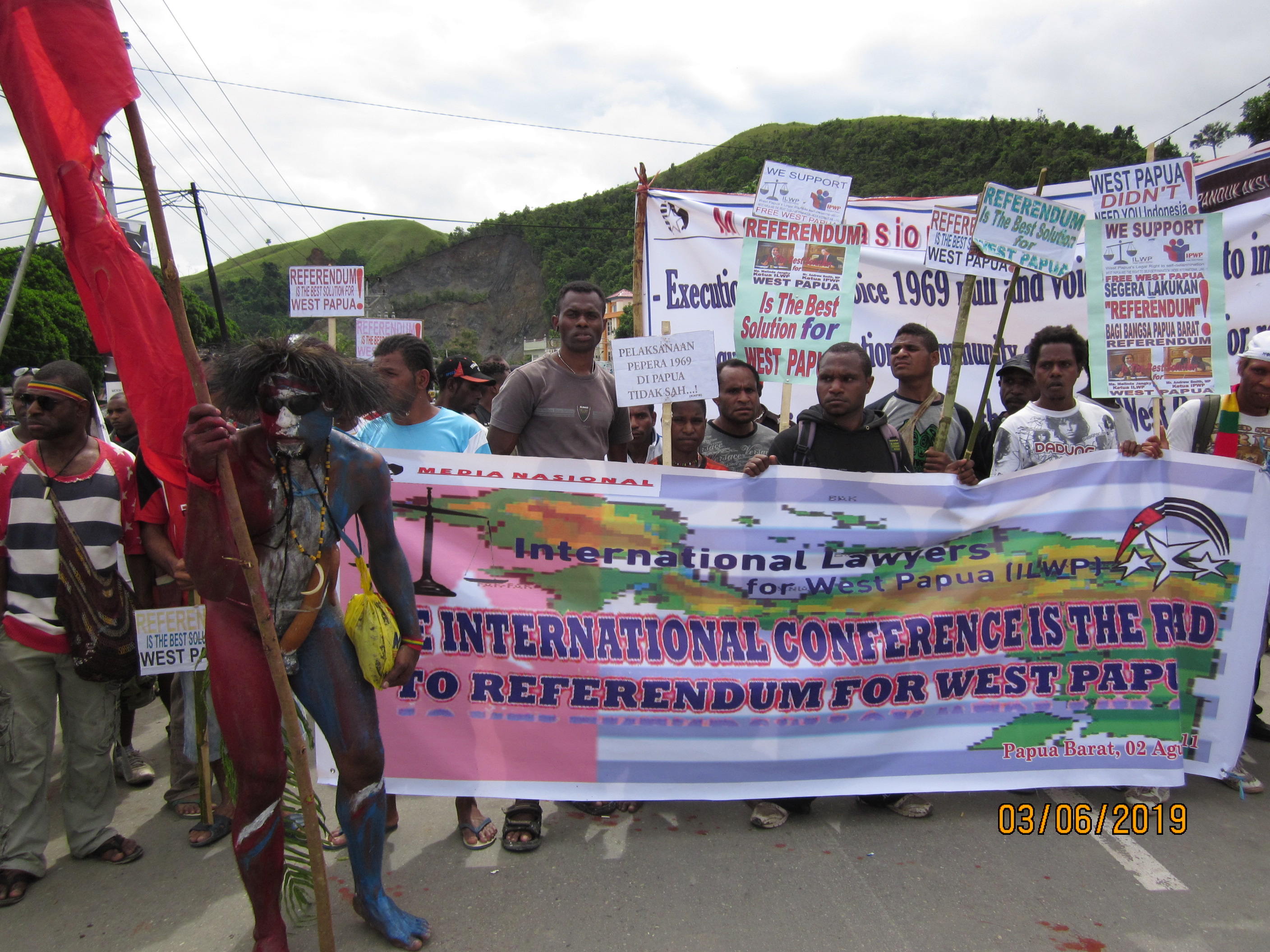
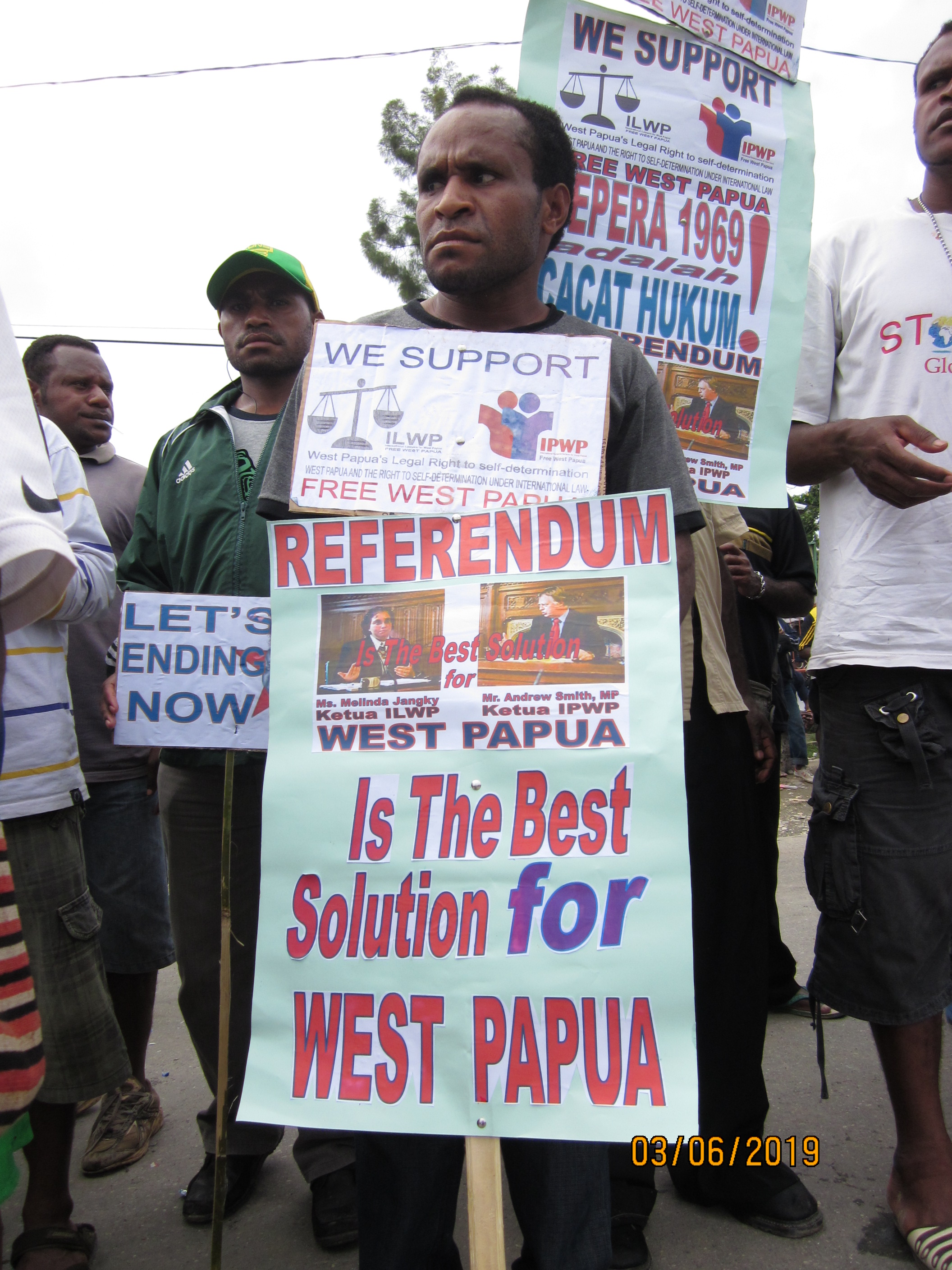
Social Media across West Papua is abuzz with declarations of relief and pride for the successful and peaceful mass mobilisations called by the West Papua National Committee (KNPB) to support the “West Papua: Road to Freedom” conference in in Oxford UK, on August 2.   The Photo Galleries below demonstrate unequivocally the scale of Papuan opposition to Indonesian rule.

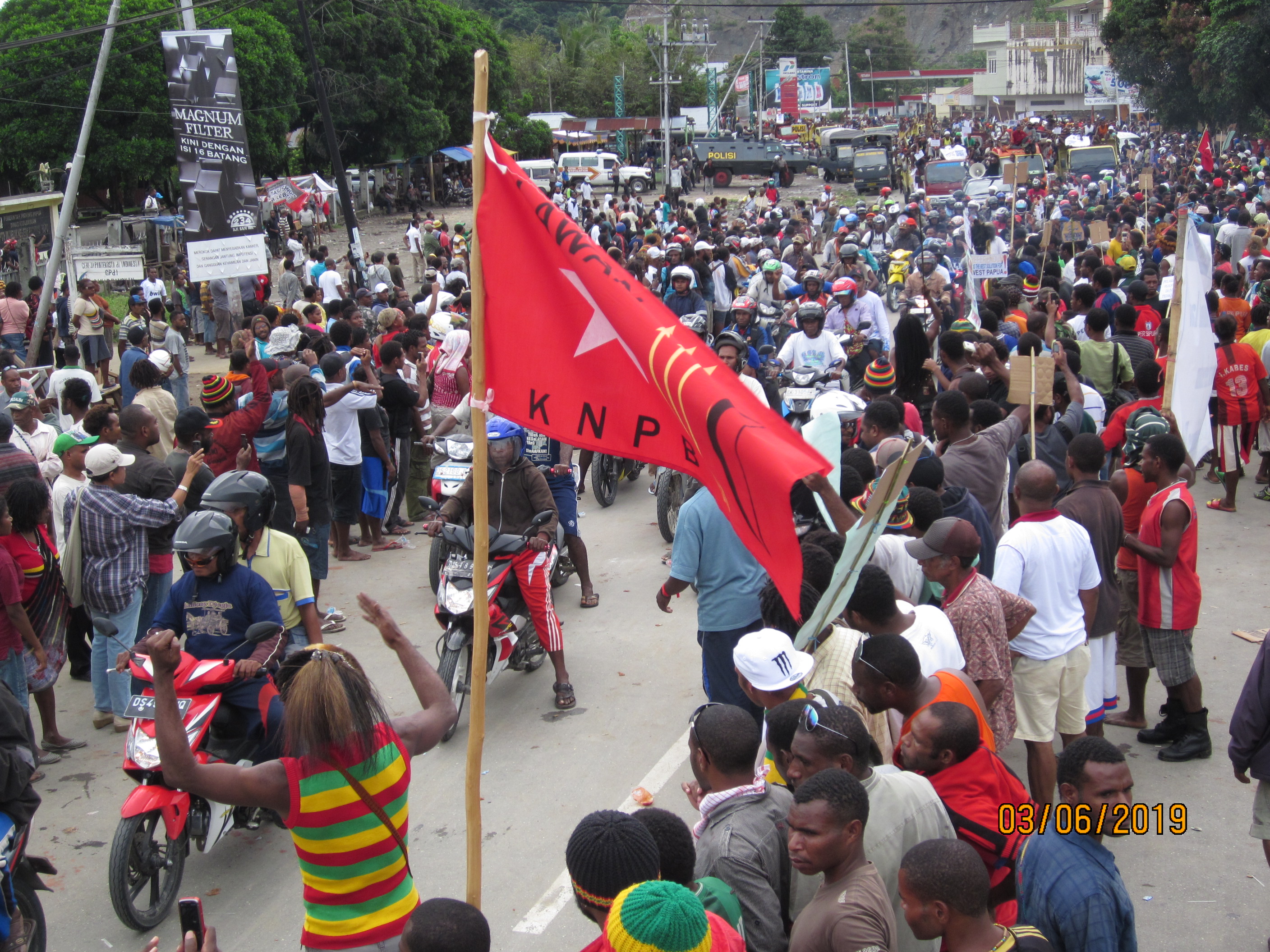
Despite threats of heavy-handed Indonesian security force actions preventing free expression, attempts by the army to blocakade demonstrators, and unexplained act of violence suspected by many to be the work of Special Forces prior to mobilsations, tens of thousands of people across Papua took to the streets to demand their universal human rights to self -determination and a Referendum on the future of Papua.  Though vibrant and very loud, the rallies across Papua reportedly proceeded without any violence or provocations from security forces or proxies.

Bukhtar Tabuni, Chairman of KNPB, said “My appeal to all West Papuans living in jungle, in prison, in various parts of Papua and those living in exile that today all West Papuans must show their solidarity to support the KTT ILWP in Oxford. This event is important because it will conclude whether “Act of Free Choice” in 1969 was illegal and because the UN involved in the transfer of West Papua, it is an international issue.”
Terrianus Yoku, President National Congress West Papua National Authority said, “WPNA fully supports the rally organised by KNPB and appeal for international advocacy to monitor the current situation because it’s very volatile and unsafe.”
In Jayapura, the Rally coordinator from KNPB, Bernard Tabuni, explained that by mid afternoon the marchers paralysed Abepura, with traffic jammed, shops and schools closed and the marchers stretching for well over a kilometre with around 15,000 demonstrators.  The marchers were painted with mud on their body and also painted with stylised depictions of the banned Morning Star flag, thereby upholding the agreement with security forces that no flags would be flown.  The marchers were exuberantly singing and chanting, playing traditional instruments along the route, joined in the Long March by over 30 trucks, 20 station wagons, 17 Kijangs, 400 motorbikes of people joined the long march.”
With its roots in ancient Papuan traditions, demonstrators had planned several marches, called Long Marches, to converge on the DPRP – the focal point for the day’s events.  Troops from the TNI and Brimob riot police attempted to blockade one Abepura-bound Long March at Waena, but demonstrators outwitted the security forces by getting into vehicles and driving around them.  Exuberant scenes of yelling and singing greeted the procession of vehicles as they joined the main body at Abepura.
Daniel Wenda, secretary of KNPB, mentioned that four TNI truckloads of red and white uniformed Barisan Merah Putih (Pro-Indonesian militia) also organised a rally outside DPRD office in Jayapura.   Slogans on the banners stated “Reject the ILWP Summit” (KTT ILWP),  “Don’t lie to the people”, “Detain all corruptors.” and also “anti-Corruptor”.  Observers i Papua have taken the BMP slogans with mirth and irony given that their chief, Ramses Ohee, is regularly the beneficiary of corrupt dealings, has extensive illegal business interests, and receives significant funding from the notoriously corrupt Kopassus special forces.
“This demonstration is aimed to attract attention and counter our main rally but we will not be provoked”, said Daniel Wenda.
Bernard Tabuni reported that undercover military intelligence officers were amongst the demonstrators, and four truckloads of fully armed security forces were following behind the marchers.  TNI and Kopassus were also amongst the bystanders with cameras recording every movement.
A screening of a live internet stream from the Road to Freedom conference in Oxford was planned to be held at the grave of Theys Eluay on Tuesday night, but there are conflicting reports on the success of this.
A carload of armed BMP members appeared at the KNPB Secretariat in Waena late on Tuesday evening.  According to Daniel Wenda, the militiamen – a mix of Javanese and older Papuan men – attempted to gain entry, allegedly to abduct Mako Tabuni, KNPB Vice Chairman.  Tabuni was quickly bundled by KNPB security to a safe location.

In Wamena in the Baliem Valley, almost 17,000 people to a mass gathering that saw scenes of exuberance, singing and dancing.  After several hours of speeches and music, demonstrators peacefully dispersed.

In Sarmi, Yakuhimo and Keerom, reports are filtering out that flagraising ceremonies were held successfully without incident.

The slideshow below shows the August 2 actions in (in this order) Abepura, Waena and Wamena; and also those of  the weak counter-demonstration of Barisan Merah Putih militias funded by the Indonesian special forces, Kopassus, that was held close to the DPRP, or (Papua Province People’s Representative Council).

This slideshow requires JavaScript.

WEST PAPUA – INDON SECURITY FORCES FAIL TO BLOCK ACCESS FOR DEMONSTRATIONS ACROSS PAPUA, MILITIAS ON STREETS IN JAYAPURA

by Nick Chesterfield, westpapuamedia.info

Tuesday, August 2, 2011
Jayapura, 1340: The streets of several centres across West Papua are being blockaded today by heavily armed Indonesian security forces in an attempt to prevent a planned gathering of tens of thousands of protestors who are demanding a Referendum on the future of the province.

However, thousands of Papuans have reportedly ignored the strong military presence and are marching the streets of Jayapura, paralyzing the provincial capital with their huge numbers.

The protests, called by the West Papua National Committee (KNPB) and actively supported by the entirety of pro-independence movement, are being held to demonstrate both opposition to Indonesian rule and to the Indonesian-run dialogue process, in favour of legitimate internationally-mediated dialogue that takes into account the wishes of West Papuan people. The demonstrations are demanding a Referendum as the only lasting and credible solution to determine the future of Papua for Papuans.

Outside Jayapura, protests are also being held in Wamena, Biak, Nabire, Manokwari, Paniai, and Timika.

West Papua Media stringers on the ground in Abepura are reporting that the demonstrations outside the main Post Office were being blocked by hundreds of heavily armed riot police and soldiers. This is despite official permits being issued by the Jayapura police for the demonstration to proceed without hindrance.

At 10am local time, three truckloads of soldiers and BRIMOB riot police then decamped and headed to Waena to intercept a long march of several thousand people who were attempting to join together with the Abepura march and then head to Jayapura, in information conveyed to West Papua Media by Daniel Wenda, Secretary General of KNPB. It is unknown at time of writing whether the march has pushed through the security force blockade or if any casualties or arrests have been sustained.

Local human rights sources have reported that a recent spate of violent acts may have succeeded in keeping away crowds of over 10,000 people, with one person stabbed and wounded by a militiaman at a pre-rally gathering in Angkasapura. However in news just to hand, organisers of the rally are reporting that security forces have relented and several thousand people have now successfully joined the demonstration, which is continuing to grow.

With tensions extremely high after the violence, the organisers of today’s rallies across Papua have been at pains to ensure that no symbolic traditional weapons be brought to the gatherings, and have worked with the Dewan Adat Papua to deploy hundreds of peacekeepers from the uniformed Community Security Force of Petapa, or The Guardians of the Land of Papua.

This slideshow requires JavaScript.

Telephone communication to Jayapura has been sporadic with many calls being cut off and SMS communication delayed, making confirmation of events difficult. It is unclear if the security forces are currently preventing West Papuan people from actively communicating to the outside world.

Reports are filtering through that other political actions are occuring throughout Papua simultaneously with the mass protests, with the KNPB suggesting that those who could not make it engage in innovative and non-violent economic disruption actions, such as strikes by ojek drivers, street vendors and bus drivers.

Independence activists are also reporting that members of two pro-Indonesian militias — Besar Merah Putih and Aswain (headed by Euricio Guterres) — have been deployed widely across the Jayapura area in conjunction with security forces.

Witnesses reported that late last night, a PELNI ship suspiciously landed 92 unfamiliar men at the main Jayapura dock, who are widely believed by activists to be members of Kopassus special forces in plain clothes. Activist surveillance of military facilities has indicated that special forces officers have not been seen at regular barracks for the past three days at least.

Suspicions have also been cast on unidentified forces responsible for a spate of violent incidents prior to the nonviolent mobilisations, who are believed to be connected to the Indonesian security forces, in what many observers see as an attempt by the security forces to spread fear, panic and division among the demonstrators to prevent the protests going ahead.

In the early hours of Tuesday morning, an arson attack on the Rectorate of the Cenderawasih University, Abepura, was foiled by Papuan students. The fire was detected before it took hold by alert from student security and was quickly extinguished.

After attacks yesterday by unknown assailants on Indonesian transmigrants in Nafri, Abepura, sources are reporting that one person has been killed and an unknown number injured in another attack in Koya, where SMS reports from credible local sources have described several incidents involving shootings and stabbings.

The Indonesian military has long had a policy of using civilian proxies and plain-clothes agents to carry out acts of violence to provoke civil resistance movements into self-defence. This has often been used as a pretext to engage in a security crackdown, which reinforces military dominance over the region.

Elsewhere in Papua, the mass rally also being held simultaneously in Manokwari was prohibited by security force, according to organisers from the KNPB. However negotiations succeeded in Indonesian security forces relenting, and the rally is currently ongoing with several thousand people participating. This rally marched from the office of Dewan Adat Papua, and is currently outside the Department of Information in Sanggeng. The atmosphere is described as relaxed.

West Papua Media is monitoring events closely, and will provided updates on the situation throughout the day.

MEDIA NOTE:  CONTACTS FOR SPOKESPEOPLE AND STRINGER ON THE GROUND ARE AVAILABLE.  PLEASE CONTACT +61450079106 or editor<@>westpapuamedia.info

Related articles

Papuan students demonstrate outside UNCEN, Jayapura

Bintang Papua, 30 June 2011
An announcement on Thursday about the selection of students at the
state university led to a demonstration being held by students who also
blocked off the Cenderawasih university campus in Waena. The entry to
the campus was blocked off while a small bonfire was burning in the
middles of the road. The demo was organised by the chairman of the
Students Association of Tolikara, supported by students of the faculty
of law at the university.

Speeches were made and leaflets were stuck on the walls, with demands to
the rector of the university.

One of the leaflets said: ‘Why is it that year after year, indigenous
Papuans account for less than 20 percent of the total while the other 80
percent are non-Papuans?

‘We are asking the rector to account for this, bearing in mind an
earlier promise that Papuans would account for 80 percent,’ said Terius
Wakor, co-ordinator of the action. This was a promise made by the rector
of UNCEN, Prof Dr B Kambuya.

‘We indigenous Papuan students feel very disappointed about this
because the rector promised that priority would be given to indigenous
Papuans with 80 percent of the places. Yet what has happened is that
only 5 percent of the Papuans were accepted into the university.’

Another of the students, Thomas CH Syufi, who also took part in the
demo, said: ‘We as representatives of the Executive Board of the
Students, the BEM of the Faculty of Law, strongly support the views of
our colleagues.’

Following the announcement about the students who were selected, he said
that they hoped that the rector would take account of the views of the
indigenous Papuan students, in view of what the rector promised last
year. ‘We very much hope that the rector will take some action with
regard to the Papuan students who did not pass the selection test. He
suggested that there should be another round of testing for a second
group of students to be accepted to the university.

Meanwhile the deputy rector said that while no promises had been made,
there had been a commitment to increase the percentage of indigenous
Papuan students. He said that at this level (the SNMPTN), it was
difficult to have an effect on the selection of students. He told
Bintang Papua that not enough Papuans were available from the IPS, and
very few had registered with the IPA programme.

[Apologies for not knowing what these initials stand for. TAPOL]

Create a website or blog at WordPress.com

Up ↑