LP3BH report on the trial of five students in Manokwari

Report from LP3BH, the Merauke-based legal aid institute, regarding the charges against five Papuan students who are currently on trial for subversion, makar:First of all, the charges  against the five students, Alex Duwiri, Yance Sekeyab, John Raweyai, Penehas Serongon and Jhon Wilson Wader are not that they unfurled the 14-star flag but that they took part in a long march by students from the State University of Papua – UNIPA – which started at the university campus in Amban, Manokwari on 14 December and went to the Information and Communications Service of the district of Manokwari in Sanggeng, Manokwari.

The five students were arrested  because their faces were identified in photographs taken by a member of the police force in Manokwari while they were taking part in a rally by about fifty students who were on a long march from Amban to show their support for the action to mark the 22nd anniversary of the Proclamation of the Independence of West Melanesia  on 14 December 2010.

Alex Duwiri was arrested somewhere near the the location of the action because his face had been identified in a photograph, while John Raweyai was arrested because he was the Master of Ceremonies of the action. John Wilson Wader was arrested while he was arranging the chairs that were being used during that ceremony, while Penehas Serongan and Yance Sekeyab were arrested outside the Women’s Institute which was about one kilometre from the rally as they were leaving the  event just before it had been broken up by the police. They had left slightly earlier because they wanted to get back to the university to attend a lecture there.

Then, what happened on 14 December 2010 was that Melkianus Bleskadit was taking part in an event to mark the 22nd anniversary of the Proclamation of the Republic of Melanesia that took place  near the premises of the Information and Communications Service  of the district of Manokwari in Sanggeng Manokwari.The event was attended by about one hundred Papuan civilians. Yance who was also there  had been asked to say a prayer and give a vote of thanks at the end of the ceremony.

Bleskadit got onto the platform to deliver his speech but all of a sudden, the crowd started yelling Papua, which they did three times, and Bleskadit pulled out a 14-star flag  and held it up in his hands, whereupon the Manokwari police who were present got onto the platform and arrested him.

Thirdly, the trial of Melkianus Bleskadit and Dance Yenu was held on the following day, Tuesday, 13 June at which  witnesses for the prosecution were heard, as well as some expert witnesses who had come from Makassar. One of the witnesses was an Indonesian language expert, another was an expert in criminal code and the third was an expert in governance law.

Fourthly, the five students are indeed facing the charge of makar based on Article 106 as well as Article 160 on incitement.

Finally, we have not heard anything about pressure being put on the media  regarding their coverage of this case in the Manokwari district court..

From Yan Christian Warinussy

This message was sent in response to a query received by LP3BP from Josef Benedict of Amnesty International.

Urgent need for Truth and Reconciliation Commission and Human Rights Court in Papua

Press Release from LP3BHLaw 21/2001 on Special Autonomy for Papua as amended by Law 35/2008 states the following in article 46, para (1): ‘In order to strengthen unity of the people in the province of Papua, a Truth and Reconciliation Commission should be set up while Article 46 reads as follows: ‘ Within the framework of strengthening unity and unanimity, a Trth and Reconciliation shall be set up.’

‘The task of the Commission (KKR) shall be (a) to reach a clarification of Papuan history to solidify unity and unanimity of the nation within the Unitary State of the Republic of Indonesia and (b) to draft measures towards reconciliation.’

In further elucidation of Article 46, it states the need for reconciliation which shall include the acknowledgement of errors, the need for apology, the offer of forgiveness, peace, the rule of law, amnesty, rehabilitation or other alternatives  necessary to upholding the sense of justice with the community in order to uphold unity and unanimity.

In the opinion of LP3BH-Manokwari, the Association for Research, Advocacy and Development of Legal Aid,  a Commission for Truth and Reconciliation is an integral  part of the implementation of special autonomy that should as a matter of urgency be implemented the Indonesian Government and the regional government in the Land of Papua, namely the governments of Papua and West Papua.

The formation of the KKR is very urgent. There are four issues that need to be dealt with: first, the marginalisation and effective discrimination against the indigenous Papua people as a result of economic developments; political conflicts; and the mass in-migration into Papua since the 1970s.Affirmative action needs to be taken in order to empower the indigenous Papuan people.

The second problem is the failure of development, especially in education, health and economic empowerment. This requires  new paradigms directed towards development that is focussed on improving public services so as to advance the welfare of indigenous Papuans living in the kampungs.

The third issue is the contradiction between the history and political identities of Papua and Indonesia. This problem can only be resolved by means of dialogue such such happened in Aceh.

The fourth issue is the responsibility for state violence committed against Indonesian citizens in Papua. This needs reconciliation between  a human rights court and the truth; to uphold the rule of law and justice for the victims, their families and all Indonesian citizens now living in Papua.

The way to resolve the third and fourth issues  means, according LP3BH, the formation of a truth and reconciliation commission and the setting up of a human rights court in Papua. This is very urgent and pressing and requires the support both of the Indonesian Government and and the governments of the provinces of Papua and West Papua and the various legislative assemblies (DPRP and DRP PB) Why is this so? Because the  historic contradictions and the political identities between Papua and Jakarta all too frequently become the trigger for social-political conflicts  in the Land of Papua. It frequently happens that  when Papuans take action to express their political aspirations in the form of peaceful demonstrations or events held to mark the anniversary of Papuan independence day on 1 December or the anniversary of  the independence of the West Melanesian Republic on 14 December, these incidents become politicised by the state and treaed as criminal acts by the security forces (POLRI) with the arrest of activists of peaceful demonstrators who are then accused of MAKAR or of disturbing the public order and treated as a criminal act in accordance with the criminal code (KUHP).

The security forces frequently use violence amounting to human rights abuses  towards victims either in the form of physical violence or violation of their rights as guaranteed in the KUHAP – the criminal procedural code.

On the other hand, ever since the Act of Free Choice (PEPERA), gross violations of human rights  have been committed by the military against Papuan civilians who are killed, tortured or forcibly disappeared.  Anything between 500 and 1,000 Papuan civilians have been murdered, tortured, forcibly disappeared, and subjected to other forms of violence by members f the military forces (TNI) in virtually all the towns and cities  such as Jayapura, Merauke, Fakfak, Sorong, Manokwari and Biak. In Biak, a number of Papuans who work in the civil service as teachers, nurses, as well as people working for private enterprises, as well as those who worked during the Dutch period  in Serui, Nabire and Biak have been arrested and imprisoned for more than two years at the TNI naval base in Biak.

In addition, properties have been unlawfully and forcibly seized from homes and shops belonging to Chinese inhabitants by members of the armed forces, it being alleged that  they are assets owned by the OPM, which is used as justification. The civilian community in the Land of Papua have themselves felt how  the Indonesian military security forces  entered people’s homes and seized people’s belongings such as transistor radios, tinned food and drinks from The Netherlands All these things were confiscated by the Indonesian military apparatus in 1969 and taken off to Java.

All this has left feelings of bitterness and hatred among the civilian population in the Land of Papua going back many years, which are still being felt today. This is what the Rev. Benny Giay calls Memoria Pasionis.

According to the LP3BH, these matters should have been settled many years ago in accordace with international standards and basic human rights principles.

The LP3BH therefore makes the following demands:

1.    The Indonesian Government should pay attention to the political need to immediately set up a Commission of Truth and Reconciliation in implementation of Law 21/2001, as well as set up a human rights court in Papua.

2.   The provincial governments in Papua and West Papua  should immediately introduce regulations with regard to  the creation of the KKR, its composition, location, and its mode of operation as well as its funding.

3. The DPRP and the DPR PB should take the initiative and play a key role in efforts to set up the KKR and the human rights court in Papua as the  way to solve the social-political conflicts which have continued to persist  from 1969 up to the present day., which should be continued into the future but which have until now been regarded as matters of no importance, and about which nothing has at yet been done to comply with universal legal standards  and basic human rights.

Manokwari, 27 May 2011

LP3BH,
Yan Christian Warinussy, SH

West Papua — Violence against indigenous women

————-
FOR IMMEDIATE RELEASE
AHRC-FAT-021-2011
May 20, 2011

An article from Fien Jarangga & Galuh Wandita, Cultural Survival – Spring 2011 forwarded by the Asian Human Rights Commission

INDONESIA: West Papua — Violence against indigenous women

Fien Jarangga coordinates the Papuan Women’s Human Rights Network, a newly formed network of Indigenous human rights workers from Papua, Indonesia.
Galuh Wandita is a senior associate at the International Center for Transitional Justice.

Papuan women have been suffering terrible violence both outside and inside their homes for the past 40 years, and for most of that time, they’ve suffered in silence. But now a group of women has launched their own truth commission to give support to the victims and to pressure the government to change its behavior.

Papua (the western half of the island of New Guinea) has long been in a state of upheaval. When Indonesia declared independence from the Netherlands in 1945 and achieved international recognition in 1949, Papua remained under Dutch rule. Indonesia contested this situation, and in 1962 the territory’s administration was transferred to the United Nations. Part of that agreement called for an “act of free choice”—a territory-wide vote in which citizens could choose independence or becoming part of Indonesia. The vote was supposed to be universal, but in practice an Indonesian general choose 1,025 men to act as representatives of the whole population, and those representatives voted unanimously for the territory to be absorbed by Indonesia. Some Papuans claim that the process was flawed because it did not follow the one-person-one-vote model and was conducted in a context of on-going military operations, and there has been a low-level resistance movement operating in Papua ever since.

The Indonesian military and police forces, ostensibly acting against these rebels, has committed a wide range of human rights abuses, including murder, rape, torture, and kidnapping, often in secret and rarely with any consequences.

That behavior came to particular public attention in October 2010, with the circulation of a YouTube video showing three Indonesian soldiers torturing two Papuan men. The soldiers were tried by a military court, which sentenced them to less than a year in prison for “not following orders” (the Indonesian military code does not recognize torture as a punishable offense).

Indonesian military presence remains strong in Papua, and the number of Indonesian settlers from other islands is quickly outgrowing the number of indigenous Papuans. Papua was granted “special autonomy” status in 2001, with legislation to establish a human rights court and a truth and reconciliation commission “to clarify the history” of Papua. To date, none of these provisions for justice have been established, while atrocities committed against the Indigenous Peoples continue.

So, more than a year ago, a group of Indigenous Papuan women gathered to talk about the violence that we have experienced. We wanted to look back to the past, because we knew that there needs to be a reckoning, a way to listen to Indigenous women who experienced violence since the time of conflict started more than 40 years ago. We wanted to write down, for the first time, women’ s stories of rape and abuse that took place during military campaigns in Papua. We also wanted to listen to stories of Indigenous women beaten by their husbands, because we know that the violence in our private lives is also connected to the violence that took place during times of political conflict.

In May 2009, 19 Indigenous women and 3 men from 11 organizations across Papua met for 4 days to discuss how we could we begin to collect some of these stories. With support from the National Women’s Commission and assistance from the International Center for Transitional Justice, we developed some forms and came up with a plan to find these women, convince them to tell their story, and write those stories down. Working for more than a year, we were able to collect stories from 261 Indigenous women survivors of violence.

The team worked for more than six months interviewing victims and witnesses, as well as conducting group interviews while making maps and timelines together, to jog each other’s memories. Interviews were analyzed and discussed together by the team, and a report and recommendations were drafted and discussed in workshops held in Jayapura. This participatory approach was used to ensure transfer of knowledge and skills to Indigenous Papuan women involved in this effort.

These are some of the stories we collected:

1967, military operations were conducted in the town of Biak and began to move to the villages. In 1969 went home to Swaipak, Biak staying there during the Sadar operations. The Yospan became a threat to parents, because they had to let their young daughters ; in fact, some parents pressured their daughters to go to the Yospan rather than be targeted with physical violence or threatened… In the middle of the night the people were woken up… the young girls were made to dance Yospan then have sexual relations. The troops said to the parents and husbands, ‘You must understand.’

During a dance party organized by the troops in Jayapura district, around 1989, a fight broke out between some community members. Some soldiers intervened:

The soldiers brought my sister in law and told her to swallow a battery, until she was coughing. They wouldn’t allow us to bring her to the hospital . . . . The next day, they brought me and to their post . . . . They opened our clothes, and told us to stand in water for hours . . . . Then they made us sleep on the beach for about one hour. We were given no food; we were very hungry. Then they forced to rape me. After that they made us walk to the post naked; at the post a picture was taken of us.

But we also heard stories of violence in the home:

Fighting in families in my neighborhood usually happens after our husbands consume alcohol . . .CT (a local brand) . . . . When we wives are beaten to almost half dead by our drunken husbands, the crazed husbands don’t get arrested or taken away. Maybe this is also because other than some people who sell CT, there are also policemen who sell and consume (alcohol). So how will the police take care of security?

And how Indigenous women are susceptible to HIV/AIDS:

I was married when I was 14 years old. When I was in elementary school, in fifth grade, I was forced by my family to enter a traditional marriage with a chief who already had three wives. I tried to resist; I wanted to go to school like my other friends. But the chief kept pressuring my family, so I had no choice . . . . After a year, the chief brought a new wife from the town and told us this is the fifth wife. Since the fifth wife arrived, our family started getting sick . with my husband, who died, then wife number five, then three, then second, and first. They all died in one year… After being examined (at the hospital), I was infected by HIV/AIDS. This is a new illness for us. We were told to take ARV medication regularly.

Finally, on April 19, 2010 we produced a 90-page report called “Enough Already” on violence against women that took place during 1963-2009. We presented this report to the Papuan Indigenous People’s Council, an official body established by the Special Autonomy law for Papua to protect Indigenous People’s rights, and to the National Women’s Commission. The Special Autonomy law was passed in 2001, and it includes the establishment of a truth commission and a court to try human rights violations. But until now, none of these has been established. Many other parts of the Special Autonomy law have also not been implemented.

Main Findings and Recommendations
Our report documents more than 135 cases of state violence against women and 113 cases of violence in the family, using as our guide the definitions in the UN Declaration on the Elimination of Violence Against Women. As mentioned above, we purposefully looked at both state and domestic violence to reflect what we have experienced in our lives. Indigenous women experience violence in the context of the political conflict in Papua, where we are displaced during military action, often becoming victims of rape, abuse, and other human rights violations. At the same time, Indigenous women are reporting high rates of domestic violence perpetrated by their husbands or partners, while receiving little protection from police or state agencies. Ironically, the influx of funds as part of the special autonomy package granted to Papua since 2001 seems to have increased the level of alcohol consumption, unprotected sex, and incidents of domestic violence. Similarly, special autonomy has not become a deterrent to human rights violations. Cases of rape by the military have continued to take place after reformation (1998) and special autonomy (2001). In fact, we found cases where women victims of human rights violations later become victims of domestic violence due to the stigma they experience as victims.

The crimes by the military and police that we documented included killings and disappearances (8 cases), attempted killings and shootings (5), illegal detention (18), assault (21), torture (9), sexual torture (6), rape (52), attempted rape (2), sexual slavery (5), sexual exploitation (9), forced contraception or abortion (4), and displacement (24). And those were just among the women who gave testimony.

Looking at the stories we collected, we made some findings regarding the conditions that perpetuate and contribute to violence against Indigenous women in Papua:

1. The central government maintains a security approach that overuses violence, with impunity for perpetrators of human rights violations, including gender-based violations.
2. There is discrimination against women in the Papuan Indigenous culture which leads to a tolerance towards violence against women.
3. The continued conflict (over natural resources, the political situation, and local-to-national-level struggle for power) has created a context that leads to an increase in incidents of violence against women, both in the public and private realms.
4. There is a lack of response and political will from the government to find a peaceful solution to the conflict in general, and specifically to the problem of violence against women.
5. Indigenous Papuan women experience layers of trauma and disempowerment without access to any interventions, causing a cycle of victimization.

We made recommendations to the Indonesian central government, calling for accountability, including acknowledgment of the truth regarding human rights violations; establishment of a truth commission and human rights court for Papua, as required under the Special Autonomy law; and the political commitment to enter into a peaceful dialogue with Papuan stakeholders.

Reform recommendations, including vetting and trials for those who committed crimes, were made to Indonesia’s armed forces. We also made recommendations to the Papuan local government, legislative body, and the Papuan Indigenous People’s Council to take concrete steps to eradicate violence against women, including developing a comprehensive approach to prevent and respond to domestic violence, and a local mechanism based on law for the rehabilitation of victims.

We handed over the report in a simple ceremony at the Papuan Indigenous People’s Council building in Abepura, where council officials, members of our team, commissioners and staff from the Women’s Commission, representatives of victims interviewed for the report, and other civil society members gathered to witness the handing over of the report. The chair of the council’s Working Group on Religion set the tone of the event when he led the opening prayer by articulating the need for acknowledgment. “We pray for those who have been tortured; we pray that God gives us strength and hope that there will be improvement in our lives. We also pray for those who committed this violence, so that they see themselves for what they have done.” The head of the council praised members of the documentation team as representing “the women of Papua who have won this first battle.” He acknowledged that one of the most difficult challenges is changing their own culture “so that cultural violence can be addressed and acknowledged.” He underlined the need for the elimination of violence, “even when our people say that this is normal.” “We now have to start the second battle,” he said.

A musical group and local choir sang songs that brought tears to all of us attending the ceremony, expressing the deep emotions in the struggle against oppression and racism of the Papuan people. Excerpts from some of the lyrics:

Black is my skin, curly is my hair, I am Papua…
Even when the sky falls down, we are Papua

Small Bits of Truth: Follow-up Activities
The work that we did is an example of how Indigenous groups are beginning to use human rights tools to recover and acknowledge the truth about past violations. In a context of impunity, where the debate about the need for a truth commission may or may not lead to the establishment of one, we are trying to make our voices heard. So far, what Indigenous women have experienced has not been acknowledged by the government. So we are at least acknowledging this ourselves.

Since we finished the report, we have formed a network for further work. We plan to work on how to help the women victims’ take positive steps to healing, while also pressuring the government to recognize their stories, and commit to stopping the violence.

The Arab Spring: a harbinger for a “global spring” against oppressive rule?

(published with especial relevance to West Papua)

by Edmund McWilliams

Democracy, respect for human rights, good governance – these are the themes that have been on the lips of peaceful demonstrators from the Mediterranean to the Arabian sea.

In country after country, Arab men and women, young and old have showed extraordinary courage, facing down dictators and autocrats even when those corrupt leaders have employed the full weight of their armed forces against the unarmed protesters.

The Choice of Papuan People (Photo courtesy KNPB)

The inspiration of one young Tunisian who sacrificed himself in protest has spread from one Arab nation to another, in each country people coming to the profound realization, ‘if they can do it there, we can do it here.’

The largely peaceful demonstrations have not had an Arab or a Muslim character. Rather, common to all these peaceful revolts is a pent up desire for freedom and a new sense that change is possible.

We have seen similar uprisings which have swept vast areas:  the East European spring in the late 1980’s; the anti-colonial movement that followed World War II.  These, like the “Arab Spring” were trans-cultural, and transnational.   They derived their power from a common frustration with abusive, and sometimes foreign rule and a conviction that, in the words of the revolutionary mantra, “a people united can never be defeated.”

So we are left with the question of whether this movement will be confined to
Arab peoples, and largely to Muslims.  Or will this struggle for democracy and respect for human rights extend to non-Arab and non-Muslim cultures and peoples who also have suffered under brutal rule?  Will Tahrir square be emulated in Beijing, in Tashkent, in Hanoi, in Vientiane, in Rangoon and Pyongyang.  Will the Papuans, Montagnards, Hmong and Karen draw inspiration from the “Arab Spring” and break the colonial chains that have enslaved them to demand genuine autonomy or even full independence?  The physical and cultural distance separating Papuans in the Puncak Jaya or Hmong in Phong Saly from the “Arab Street” may seem to place them
in different worlds but they have a common experience in their suffering under undemocratic rule.

Is the “Arab Spring” a harbinger for a “global spring” that challenges oppressive rule around the world? For now, we can only assume that autocrats around the globe are sleeping more fitfully.

May their nightmares come true.

Edmund McWilliams
Retired senior U.S. Foreign Service Officer

SONAMPMA: Photo Report of Show of Support by Papuan people for Referendum

Port Numbay,  Papua.

from National Organisation for Student Solidarity of Papua.

 Peace and Freedom !

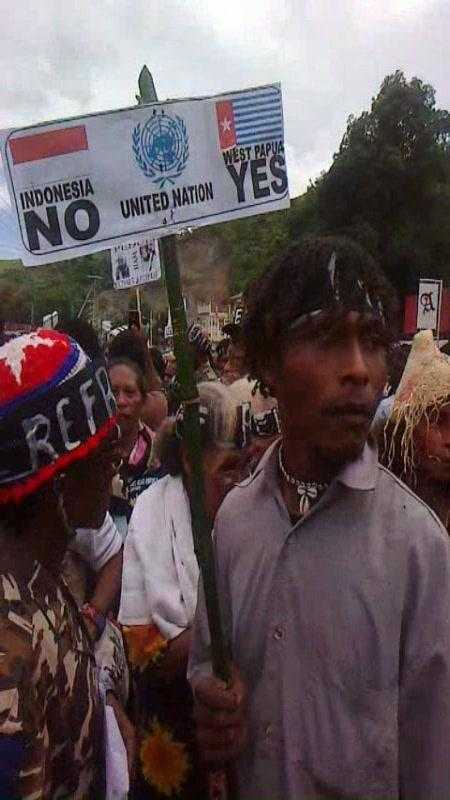
 We are reporting on the  Demonstration of the People of Papua demanding a Referendum about Self-determination on May 2, 2011 ; for the people of Papua to have the right to determine their own fate. The demonstration took place at the Post Office in Abepura, Jayapura, as shown below :

 – The Show of Support by the people of Papua was coordinated by the National Committee of West Papua, made up by the following organisations :  Organisation of Students and Youth, DAP, Women, Religions, Intellectuals of Papua, and the whole people of Papua from this area. They marched from Sentani, through Waena and Abepura, towards Jayapura (Imbi Park), starting at 8 am.

This slideshow requires JavaScript.

While waiting for the people to arrive from Sentani, there were political speeches from the coordinating body, and from several support organisations , all carrying street banners, leaflets and pamphlets, attracting the close  attention of the security forces, there to  « keep the peace », also tried to obscure some of the pictures.  Some of the banners  were saying :  Some of the leaflets said « Papua, Yes ; Indonesia No. », with each of their flags illustrated. Others said « Referendum » and « Papua Merdeka ».

 –          At another coordination point (the campus of USTP) that morning a group began to gather in front of the campus gateway fronting onto Jalan Raya, Sentani, while others came from the campus of UnCen-Abepura. They had banners saying REFERENDUM. There were speeches and the people began to move towards the main square of the campus.

 –          A large group of people assembled at Imbi Park in the early morning, not to avoid observation, because there were thousands of people already assembled there.

 –          About 5 or 6 detachments of Police from Jayapura were there and 3 units of Brimob (mobile police), observing the demonstration with some bodyguards, using 7 or 8 trucks and other vehicles, some of them equipped with weapo

–          Speeches went ahead until about noon, with 600 people who had arrived from Sentani began to assemble at Expo Waena. The whole procession gathered there were about 1000 people, preparing for the Long March to the Post Office at Abepura.

 –          The Long March began at 1 pm, and proceeded towards Abepura.  At the TNI  post at SIPUR, the demonstrators were surprised by an escort of Mobile Ambulance, together with a group of TNI (Army), fully armed, who accompanied the demonstration.

 –         Mass action continued its long march to the Central (shopping) centre , Post Office-Abepura escorted by security parties mentioned above.

–          There were speeches, which were answered by cries of « Referendum » and « Papua Merdeka ».  They stopped at the traffic lights at the Post Office at Abepura and began to sit on the road. All other activities in the town were halted and the town closed down early.

–          The total number of people eventually numbered about 2000 to 2,500. At about 2.15, the procession from Jayapura began to arrived and gathered together with the others at the Post Office.  The numbers swelled even more. The demonstrators stayed at this place, and listened to speeches from some of the leaders of the different groups representing the protestors.

– This demonstration was carried out peacefully until 6 pm, helped by vehicles which helped to keep the peace,   dispersing the people peacefully,  after which they resumed normal economic activities on the streets.

– The demonstration today, after marching well with vehicles and on foot, went off well and peacefully without any violence.

This report that we have made is completed by the Organising Committee for the Demonstration, 2nd May 2011, with great care, and we thank you for reading it.

SONAMAPA

Create a website or blog at WordPress.com

Up ↑