Photo Report: Scores of Morning Star flags flown in Serui demo, despite police objections

from Tabloid JUBI and West Papua Media
20 April, 2012
Over 400 Bintang Kejora (Morning Star) flags were flown by scores of people on a demonstration in Tanggal, Serui, West Papua.  According to media sources, they were demonstrating to  express support for launching of a US branch of International Lawyers for West Papua (ILWP) – this is spelt out as the International Parliamentarians, not Lawyers – in the United States.  However sources on the ground confirmed to West Papua Media that the demo was carried out by over 5000 people in support of the Federal Republic of West Papua, and demanded full international legal recognition of Papuan’s desire for independence and to uphold the universal right to self-determination.

Confirming the event, Aston Situmorang of the NGO Working Forum of Cenderawasih Bay said that thousands of people had gathered to take part in the demonstration from all parts of the district of Serui. The participants first gathered  in three places and then converged on the location of the demonstration.  After they had made their way to Tanggul, a number of speeches were delivered in support of the ILWP.

When the local chief of  police was contacted regarding this demonstration, he denied that anyone had flown the kejora flag. ‘No such thing happened,’ he said. ‘It’s a lie.’ He said that  people marched together but no flags were flown. The demonstrators had only carried banners expressing support for the establishment of the ILWP in the US.

This slideshow requires JavaScript.

Pictures from the mass flaying of banned Morning Star flags, Serui, 20 April 2012.  According to Indonesian police: “No such thing happened… It’s a lie.” 

Organisers of the demonstration contradicted the police version of events, claiming several groups of up to 470 flags (in each group) were flown, after Police and military attempted to blockade the rally with force.  However given the sheer number of flags, security forces did not attempt to intervene and allowed flags to be flown, an act which carries severe prison terms under the provisions of makar (treason).

A successful tactic employed by rally participants was  mass body painting of the Morning Star flag, an act that although challenging makar provisions remains unenforceable under Indonesian Law.

According to another report about the demonstration in JUBI on the same day, the local police chief in Serui had allowed fifty flags to be flown at the demonstration. According to the organisers, the majority  of the participants were waving flags.

[A photo illustrating the article shows a large number of people, certainly more than fifty, and in this section of the crowd, I was able to count about twenty flags. Translator.]

It was reported that the local police had refused to allow people at the demonstration to take photos. According to the organisers, ‘As we were marching along the road, the police prohibited the use of cameras, but after the people arrived  at the location (Tanggul), the police then allowed photos to be taken.’

Aston Situmorang said  that demonstrators had come from all parts of the district; some were arrested in several places in the town centre, but they were not held for long and after being released, they were able to rejoin the demonstration. As they arrived at the location of the demo, a number of people made speeches..

Many of the participants had walked a long distance from Mantembu, with the whole march proceeding peacefully. After the speeches had been made, they dispersed.

The local chief of police, Yohannes Nugroho Wicakasono, said that the demonstration had been organised by the West Papuan National Authority (WPNA) and had proceeded peacefully, lasting from 9am till 1.30pm. He said that kejora flags had been flown, but after they had been given warnings, the flags  were taken down, collected and put away.

A more senior police chief in the town of Seruis, Daniel Prio Dwiatmoko denied that kejora flags had been flown, saying that the demonstrators had only carried banners   expressing support for the  ILWP which has just been set up in the US.

with West Papua Media, and translated by Tapol (UK)

THE MOMENTUM BUILDS: Thousands shout out support for Free West Papua at East Coast Blues & Roots Festival

Press Release – Wednesday April 11, 2012
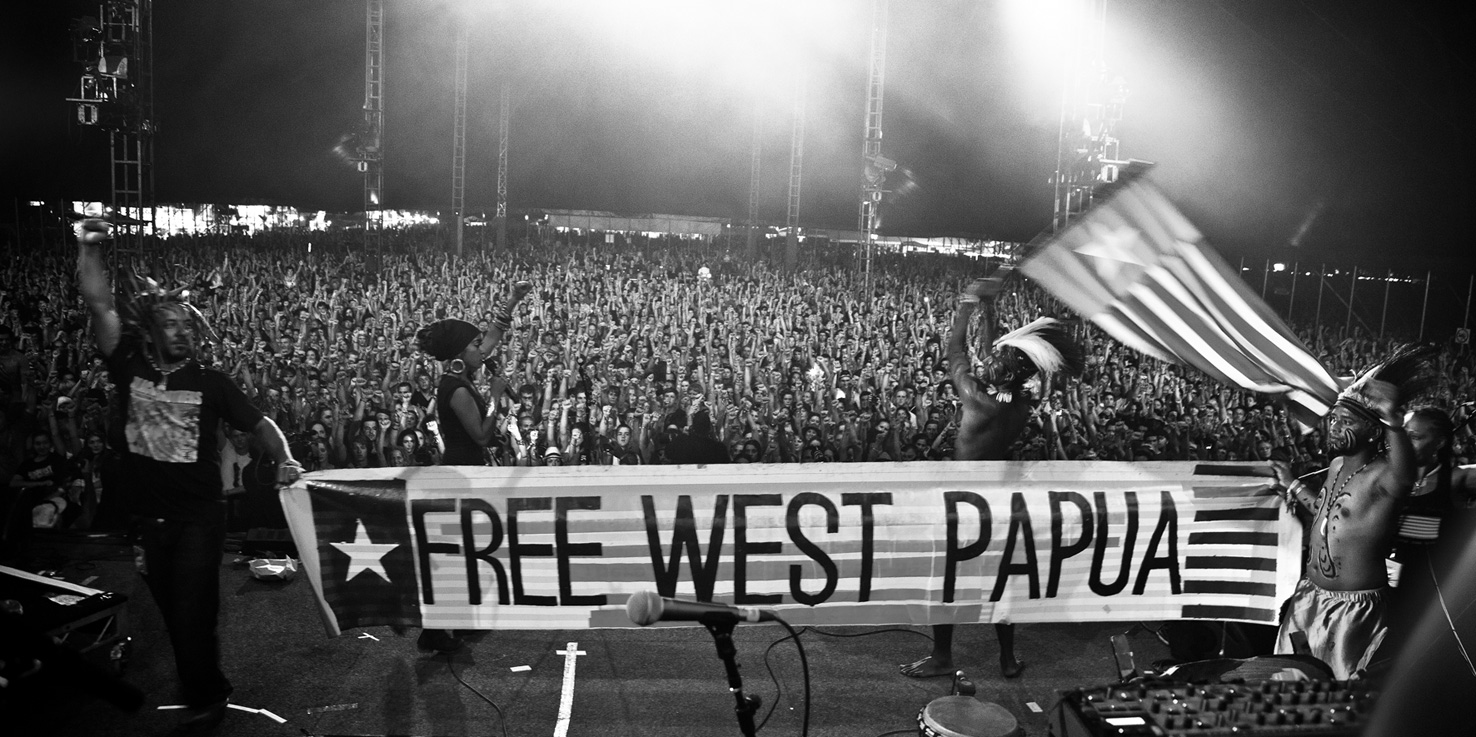
As momentum for the Free West Papua campaign continues to grow and gain attention throughout the international community, Australians continue to show mounting support for their fellow human beings and closest neighbours, West Papua. Another historic showing of undeniable support for human rights and justice in West Papua came at Blue King Brown‘s East Coast Blues and Roots Festival performance on Sunday 8th April, 2012 where thousands threw up their fists in a passionate display of solidarity and unanimity that the issues facing West Papua need to be promptly addressed by the Australian Government and the international community and that human rights is deserved to all people and we as nation have a responsibility to do whatever we can to ensure that is what’s happening.
It is through signing the petition and your sharing and reposting of images like this that we as a community can help expose the dark truths behind the oppression of West Papua and no longer allow these human rights abuses to be hidden in the darkness, our mutual knowledge on the issues is a light that has bravely begun to shine through, and it is only with your support that we will continue to see that light shine brighter and eventually, the unhindered Rize of The Morning Star for a FREE WEST PAPUA.

Morning Star flag flew for 5 hours in Serui

Unofficial Morning Star flag, used by supporte...
Image via Wikipedia
Bintang Papua,13 February 2012Serui: The Morning Star flag , Kejora, the flag of the separatists in Papua,  was held aloft for five hours in Serui, district of Yapen islands on Saturday, 11 February.

The local chief of police said that  this had been done by people who dont want peace and tranquillity  to prevail in Serui. He also called them ‘irresponsible elements’.

The police chief, Deniel P.Dwi Atmoko,  said that they were investigating the motives of those involved. ‘However, we can conclude that these people do not want peace to prevail and always engage in activities which are in violation of the law and one of things they do is to raise the kejora flag.’

He then went on to express his thanks to all those who had assisted the police and the army (TNI)  in pulling down the flag. ‘This proves that  the majority of people in Serui are very eager for peace. This is clear from the fact that the local people waited until the security forces had pulled the flag down.

He expressed the hope that these elements would not do such a thing again. ‘Stop doing things that clearly violate the law because this can only result in difficulties for the individuals themselves as well as for their families. We must work together to develop Serui in peace and tranquillity  so as to ensure that the activities being undertaken by the local government can be achieved.’

[Abridged in translation by TAPOL]

Identity Politics in Papua

Unofficial Morning Star flag, used by supporte...
Image via Wikipedia

JUBI, 27 January 2012

In the days before the special autonomy law for Papua (OTSUS), identity politics in Papua was focussed primarily on culture. It was his awareness of the richness of Papuan culture that encouraged Arnold Ap to set up his Mambesak group in the 1970s. [Not to mention the fact that he paid with his life for his activities.]

Brother Budi Hernawan, a human rights activist, said that the identity politics movement  had made some progress and was in the process of further development. ‘In fact,’ he said, ‘there are certain impacts of the inconsistency of the central government’s attitude towards the identity politics movement among the Papuans.’

He said that Papuan identity politics  emerged alongside the Indonesian identity politics movement  in the 1940s. But the way of defining Papuans referred to their tendency to being slender in build, dark skinned and with fuzzy curly hair as part of the Melanesian race; this led to the stagnation of this process.  At the core of the issue is the interaction between cultural and social issues, according to Brother Budi.

Cressida Hayes writes, in the 2007 Stanford Encyclopaedia of  Philosophy, that identity politics  has a far broader definition  and the theory has a far broader definition with regard to injustices that are encountered by people in certain social groups.

Rather than their being organised on the basis of ideology or party affiliation, identity politics is related to the group’s identity and of its not being marginalised  as a group as well as the question of belonging to the group in a much broader sense.

Demographically speaking, Papuans are no longer dominant in the land of Papua.  This has been reinforced by the role of capital  and limitations within the political sphere. While procedures are set in place to ensure that the head of region is an indigenous Papuan, no affirmative action has been taken by any legislative body to protect the interests of the indigenous Papuan people.

Apart from this, he said, Jakarta always bases its policies on economics and politics.The result is that there has been no comprehensive or ‘calm’ definition. ‘The word “calm”  is used here in the sense that the Dewan Adat Papua should be able to draft a definition of Papua-ness without being accused of being separatist or accused of subversion.’

Back in the days of President Abdurrachman Wahid,  the space being given to identity politics was broadening. Gus Dur, as he was affectionately known, granted permission for the Morning Star flag to be flown, which is regarded by Papuans as a cultural symbol, while at the same time stipulating that it should be held ten centimetres lower that the Red-and-White flag. But this has never been backed up by any government regulation.

West Papua- December 1 2011 – Breaking the Media Blackout

50 years ago on the 1st of December 1961, West Papuans flew their flag for the first time in preparation for their independence from the Dutch.

In 2011, despite ongoing repression, the Morning Star flag was once again flown across the country. The non-violent demonstrations and gatherings, as well as the military crackdown against them, were reported to the world via a network of citizen media journalists, breaking through the media blackout of West Papua.

This short wrap-up shows how the West Papuan people would not let outrageous threats of Indonesian state violence suppress their desire to declare their independence.

[vimeo http://vimeo.com/34163958]

Create a website or blog at WordPress.com

Up ↑