LP3BH report on the trial of five students in Manokwari

Report from LP3BH, the Merauke-based legal aid institute, regarding the charges against five Papuan students who are currently on trial for subversion, makar:First of all, the charges  against the five students, Alex Duwiri, Yance Sekeyab, John Raweyai, Penehas Serongon and Jhon Wilson Wader are not that they unfurled the 14-star flag but that they took part in a long march by students from the State University of Papua – UNIPA – which started at the university campus in Amban, Manokwari on 14 December and went to the Information and Communications Service of the district of Manokwari in Sanggeng, Manokwari.

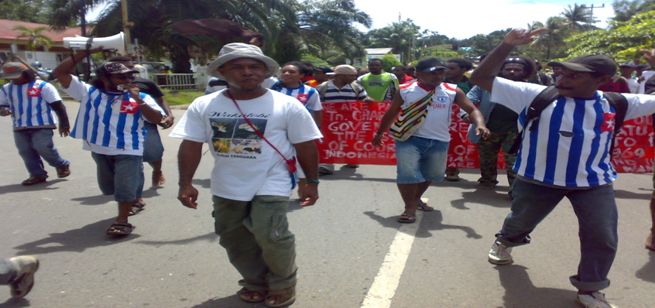
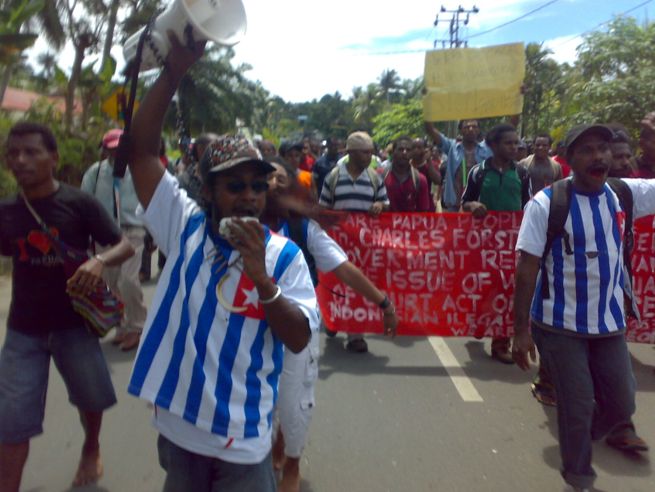
The five students were arrested  because their faces were identified in photographs taken by a member of the police force in Manokwari while they were taking part in a rally by about fifty students who were on a long march from Amban to show their support for the action to mark the 22nd anniversary of the Proclamation of the Independence of West Melanesia  on 14 December 2010.

Alex Duwiri was arrested somewhere near the the location of the action because his face had been identified in a photograph, while John Raweyai was arrested because he was the Master of Ceremonies of the action. John Wilson Wader was arrested while he was arranging the chairs that were being used during that ceremony, while Penehas Serongan and Yance Sekeyab were arrested outside the Women’s Institute which was about one kilometre from the rally as they were leaving the  event just before it had been broken up by the police. They had left slightly earlier because they wanted to get back to the university to attend a lecture there.

Then, what happened on 14 December 2010 was that Melkianus Bleskadit was taking part in an event to mark the 22nd anniversary of the Proclamation of the Republic of Melanesia that took place  near the premises of the Information and Communications Service  of the district of Manokwari in Sanggeng Manokwari.The event was attended by about one hundred Papuan civilians. Yance who was also there  had been asked to say a prayer and give a vote of thanks at the end of the ceremony.

Bleskadit got onto the platform to deliver his speech but all of a sudden, the crowd started yelling Papua, which they did three times, and Bleskadit pulled out a 14-star flag  and held it up in his hands, whereupon the Manokwari police who were present got onto the platform and arrested him.

Thirdly, the trial of Melkianus Bleskadit and Dance Yenu was held on the following day, Tuesday, 13 June at which  witnesses for the prosecution were heard, as well as some expert witnesses who had come from Makassar. One of the witnesses was an Indonesian language expert, another was an expert in criminal code and the third was an expert in governance law.

Fourthly, the five students are indeed facing the charge of makar based on Article 106 as well as Article 160 on incitement.

Finally, we have not heard anything about pressure being put on the media  regarding their coverage of this case in the Manokwari district court..

From Yan Christian Warinussy

This message was sent in response to a query received by LP3BP from Josef Benedict of Amnesty International.

AMNESTY INTERNATIONAL: Indonesia must end criminalization of peaceful political protests in Papua

Amnesty International calls today for the immediate and unconditional release of seven prisoners of conscience, arrested and charged merely for their involvement in a peaceful political protest and flag-raising.

Their case highlights the continued failure of the Indonesian government to distinguish between armed groups and peaceful political activists.

A group of activists including students took part in peaceful march on 14 December 2010 protesting against injustice and human rights violations by the Indonesian security forces against Papuans. The march ended at the Penerangan Sanggeng field in Manokwari where other political activists had gathered to commemorate the anniversary of the independence of “West. Melanesia”. These activists are part of a group that emerged in Papua in the mid-1980s advocating the independence of Papua as “West Melanesia”.

During the ceremony the “14 Star Flag”, a symbol of West Melanesian independence, was raised. The Manokwari Sub-district Public Order Police (Polres) immediately responded by dispersing the crowd and arresting five students: Jhon Wilson Wader, Penehas Serongon, Yance Sekenyap, Alex Duwiri and Jhon Raweyai. They also arrested Melki Bleskadit and Daniel Yenu, two other political activists at the demonstration.

For several months the activists were forced to sleep on a wet floor in their detention cell at the Manokwari sub-district police headquarters (Mapolres) and all seven activists contracted malaria and lost a significant amount of weight. Their health and conditions of detention have since improved.

All seven men have been charged with “rebellion” under Article 106 of the Indonesian Criminal Code which carries a maximum sentence of life imprisonment, and with “incitement” under Article 160.

The trial of five of the men, all university students, began on 6 June 2011.

The rights to freedom of expression, opinion and peaceful assembly are guaranteed under the International Covenant on Civil and Political Rights (ICCPR), to which Indonesia is a state party, as well as the Indonesian Constitution. While the Indonesian government has the duty and the right to maintain public order, it must ensure that any restrictions to freedoms of expression and peaceful assembly are no more than is permitted under
international human rights law.

Amnesty International calls on the Indonesian authorities to withdraw a 2007 government regulation that bans the display of regional flags which are used by separatist movements. Amnesty International believes that this regulation is contrary to the spirit of the 2001 Special Autonomy Law that granted Papuans the right to express their cultural identity.

Furthermore, the ban on waving these flags cannot be considered legitimate grounds for restricting freedoms of expression and association as set out in the ICCPR.

Amnesty International takes no position whatsoever on the political status of any province of Indonesia, including calls for independence. However the organization believes that the right to freedom of expression includes the right to peacefully advocate referendums, independence or any other political solutions that do not involve incitement to discrimination, hostility or violence.

Amnesty International has reported on dozens of arrests in recent years of political activists who have peacefully called for independence, particularly in areas where there has been a history of pro-independence movements such as Papua and Maluku.

Prisoner of conscience Filep Karma is serving a 15-year prison sentence for taking part in a peaceful ceremony in December 2004 in Abepura, Papua, where the prohibited pro-independence  “Morning Star” flag was raised.

Most recently, in August 2010, the police, including the Special Detachment-88 Unit (Densus-88), arbitrarily arrested 21 men in the province of Maluku for planning peaceful political activities. The police reportedly tortured or otherwise ill-treated 15 of them during their arrest, detention and interrogation in order to force them to confess.

All 21 were charged with “rebellion” and are serving prison sentences of between nine months and three years.

Link: http://www.amnesty.org/en/library/info/ASA21/012/2011/en

Thousands Walk for Peace in Manokwari without hindrance

by West Papua Media team

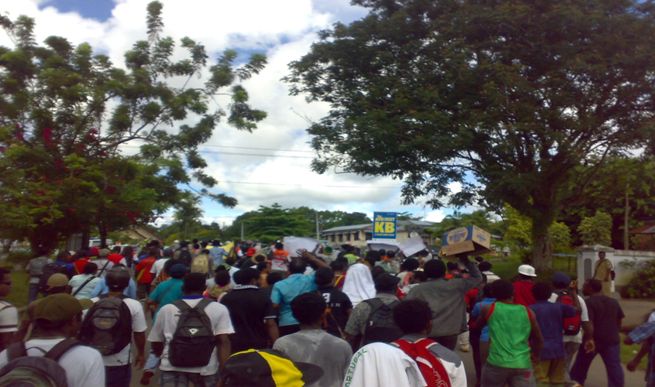
Manokwari, June 10, 2011:  Over 5000 people have gathered peacefully in Manokwari, West Papua, watched by about 200 security forces, to call for the release of political prisoners and detainees in Papua.  At time of publication (1530 West Papua Time), the gathering has paralysed Manokwari, according to organisers, but is unimpeded by security forces..

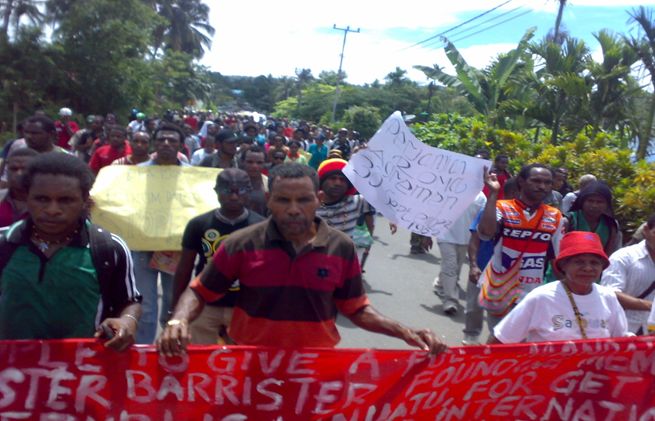
Organised by West Papua National Authority (WPNA), the rally began with a three mile march from Sanggeng soccer stadium to the government’s provincial office (DPRD) at Manokwari.  Thousands of Papuans were chanting “Thou Shalt Not Kill”, calling on the Indonesian government to end human rights abuses.

“Currently the situation in Manokwari is fine and is understood that there are military personal and POLRI present at the scene”, said Markus Yenu, Governor of Area 3, Manokwari.   Mr Yenu highlighted that 100 security personal in civilian clothing and 20 POLRI surrounded the civilians. “We have paralysed Manokwari, but our aspiration is for peaceful action”.

The rally dispersed peacefully with a closing prayer by Reverend Terryanus Yoku.   The majority of demonstrators were women and children.

Yohanna Wainggai, a housewife representing Melanesian Women in West Papua, said “I have to leave all my household duties and come down to this rally to speak on behalf of my children, who completed their studies but have no jobs provided after their studies”.

The organisers were pleased with the demonstration. Hans Sakorai, chairman of FNMPP (Front Nasional Mahasiswa Pemuda Pelajar Papua  or National Front for Papuan Youth and Students) stated “our peaceful rally has nearly 200 military personnel present, but no violence erupted”.

Jack Wainggai, spokesperson for the executive president of WPNA, demanded the “Indonesian authority to release all political prisoners,” and he calls out “for the international community such as Australia, USA and the UN to seriously consider the aspirations of West Papuans for self-determination”.

Related articles

WPNA Statement: WEST PAPUANS WALK FOR PEACE: “Thou Shalt Not Kill”

PRESS STATEMENT                                                        10 June 2011


WEST PAPUANS WALK FOR PEACE: “Thou Shalt Not Kill”

~ the value of trust as a noble door to the solution of Indonesia’s primary problem in West Papua ~


In the distinguished tradition of non-violence, West Papua National Authority’s rally in Manokwari on Friday 10 June begins with a three-mile jigjog—from the Sanggeng soccer stadium to the government’s provincial office—with five-to-ten thousand Papuans chanting ‘Thou Shalt Not Kill”.

The Authority’s rally position is the release of Papuan political prisoners. According to rally organizers, lawyer Abraham Wainarisi SH and security co-ordinator Matheus Maryen, these political prisoners are local leaders required by their village communities to negotiate their security with unprecedented levels of Indonesia military and intelligence agents.

The release of political prisoners was the first of five trust-building conditions Jacob Rumbiak placed on the table during his visit to Jakarta in February 2011. There has been no response to The Authority’s encouraging demands.

The other four conditions which The Authority believes are pre-conditional for creating trust between the two nations are:

  • The government’s guarantee of safe and secure conditions for a conference of Papuan leaders that would include those living in the jungle and others domiciled abroad
  • The government’s dismantling of regulations whereby Melanesian West Papuans living abroad and in exile needing to visit family and relatives are treated as ‘foreigners’
  • The government’s implementation of policy and regulations banning use of the word ‘separatist’ which enrages security forces bound by oath to defend the ‘territorial integrity’ of the republic.
  • The government to return all Military and Intelligence units in West Papua to Jakarta

Manokwari pro-Referendum rallies May 2: Photo Report

From Alfred Auparai (Executive Secretary) & Markus Yenu (Exec Governor), West Papua National Authority, Area II Domberai

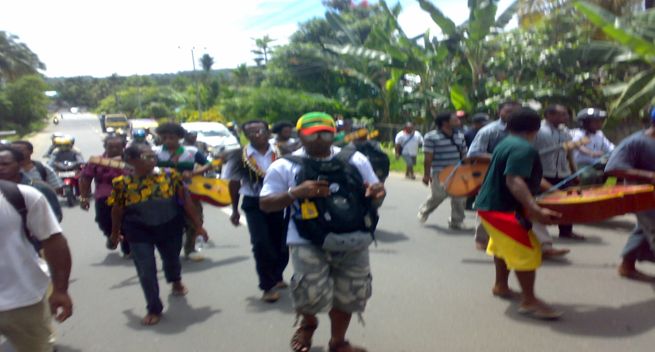
The masses came together from different directions and assembled at the rally point following the call for peaceful protest. The crowd that consisted of students and common people started to move towards the Banyan Tree at UNIPA Manokwari together with the protest Coordinator (Alex Nekemen) and speakers, amongst them Silas Ayemi (secretary area Bintuni WPNA),  Abraham Waynarisy (SH Chairman Solidaritas Pemuda Melanesia Papua Barat SPMPB) and KNPB. Political orations were held accompanied by slogans of Papua Merdeka along the way.

The crowd started at 10:30 with the long march around the city of Manokwari towards an open field, on the route the executive governor of the West Papua National Authority area 2 Domberei, Tuan Markus Yenu, gave political speeches. In front of the office of the State Attourney of the Republic of Indonesia Markus Yenu openly inquired about the detainees of the december 14th incident Melkianus Bleskadit, Rev. Dance Yenu together with 5 students from UNIPA Manokwari who are kept in detention already 4 months and their case is moved from table to table within the Indonesian police.

Manokwari, may 2nd 2011

Create a website or blog at WordPress.com

Up ↑