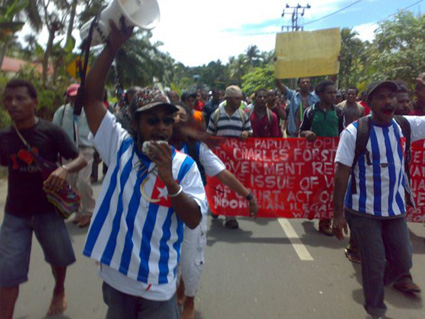
Yapen treason trial accused testify of torture in custody

from West Papua Media, with local sources

April 15, 2013

Defence witnesses have revealed the extensive and systemic use of casual torture and inhumane treatment by Indonesian police, whilst testifying at the Makar (treason) trial of two West Papuan peaceful political activists in Yapen District Court, Serui, on April 9.

IMG-20130409-00019
Yan Piet Maniamboi (defendant seated on Left) during cross-examination by Matius Matulesi, SH

The activists had been threatened with twenty years jail for organising a nonviolent march about media freedom in West Papua. The two men, Edison Kendi (38) and Yan Piet Maniamboi (36) were arrested for their involvement in organising peaceful demonstrations in Yapen on May 1, and August 9, 2012 for World Day of Indigenous Peoples,  and have been held in atrocious conditions in Serui prison and have been subjected to routine and regular torture since their arrest.
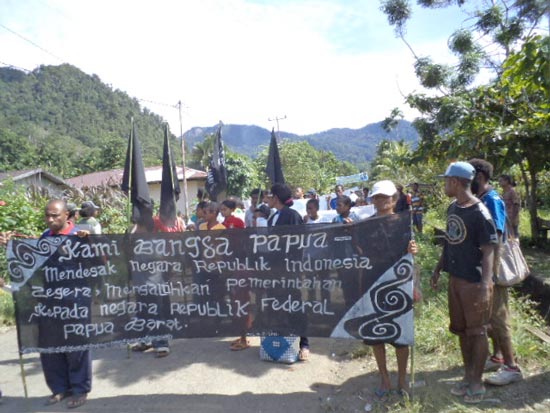
Banner at freedom of expression rally rejecting Indonesian rule in Papua on the International Day for Indigenous People. Photo via Alex Rayfield from West Papua Media stringers in Yapen.

The treason trial has been beset by procedural mistakes and the failure to appear of several police officers as prosecution witnesses.  Edison Kendi is the National Federated Republic of West Papua’s Governor of Saireri region.

According to independent observers present at the April 9 hearing, the four defence witnesses testified that they were beaten and tortured during detention and interrogation by Yapen police, and were forced to provide false information to stop the torture.  The presiding judge suspended the trial for five minutes to talk with witnesses as the BAP (Case Records) were in danger of being revoked by the judge, legally inadmissible as they were based on testimony extracted under torture.

One of the witnesses, named John, answered Prosecutor Matius Matulesi’s questions on the validity of the Case Records version of testimony, the prosecutor disagreed with John and called him “Swanggi” (Devil or Ghost).   Matulesi also began to threaten both the witnesses and defendants with hoax charges for testifying about their mistreatment.  Matulesi, a Christian native of Maluku, is known as a hard-liner and being “very inhumane in demanding punishment to the fullest extent on  native Papuans in Serui, according to human rights observers at the trial.

Edison Kendi had previously testified about the brutality inflicted on him and Maniamboi whilst being held at Yapen police station, and then after their transfer to Serui  prison on December 9, 2012 .  Kendi wrote in statement provided to observers:

“Since we were arrested we were tortured, kicked, pierced with wood, hit with wood, so we suffered extraordinary bruises and swellings, but (we were) never treated (for injuries) during our detention at the Yapen police station. Police did not allow us to be treated, for the  reason we are OPM (Free Papua Movement).”

Failure to provide medical attention for injuries whilst in custody is a grave human rights violation in and of itself, under the UN Standard Minimum Rules for the Treatment of Prisoners, and also the Convention against Torture and Other Cruel, Inhuman or Degrading Treatment or Punishment – obviously in addition to the torture suffered by the defendants.

IMG-20130409-00016
Defendants Yan Piet Maniamboi (fourth from left) and Edison Kendi (5th from right), with family, supporters and legal counsel, in court before the hearing. (photo: West Papua Media stringers / NFRPB)

Matius Matulesi has also come in for heavy criticism over his violations of basic prisoner rights to medical treatment in this case, for injuries sustained by the defendants whilst under torture by Yapen police.  According to Edison Kendi, “On December 19, 2012 I submitted an application to the clinic in the Prisons for medical treatment, but I was not allowed to go out (to the hospital) by the Attorney on behalf of Matius Matulesi, SH –  so we just keep quiet and bore the pain. I’ve been treated at the clinic LP / prisons but with no improvement. I was sick when swelling on both my legs because of torture when captured and examined at the police Yapen station. I have repeatedly applied for treatment outside of LP / prisons but it’s all just all in vain since the detention December 6, 2012 – January 21, 2013 is not permitted by the prosecutor Mathius Matulesi, SH”.

Matulesi also allegedly prevented Kendi from attending the funeral of his father, allowing him only two minutes with his father’s body before being taken back to prison, despite other Indonesian prisoners, including prisoners convicted of violent terrorism offences, routinely granted this basic right.

The trial was adjourned for the prosecutor to present two investigators from the police station at the next session to be confronted with the witnesses’ testimony.

West Papua Media

Interview With Bucthar Tabuni, Chairman of the West Papua National Parliament

(Apologies for the delay in posting due to significant funding shortfall and time over-commitments from WPM team)

(Translated by WPM Team for SuaraPapua.com)

Original article at SuaraPapua.com, March 23, 2013

https://i0.wp.com/suarapapua.com/wp-content/uploads/2013/03/vb.jpg
Chairman of the West Papua National Parliament, Bucthar Tabuni, and Chairman of the West Papua National Committee, Victor F Yeimo (Photo: Private)

PAPUA, Jayapura – recently,  suarapapua.com journalist Oktovianus Pogau, had the opportunity to interview with Bucthar Tabuni, the Chairman of the West Papua National Parliament (,).  In this interview Tabuni speaks about the criminalization of peaceful struggle of West Papua National Committee (KNPB), by the Police force in Papua.

Follow the interview below.

 What is the security forces attitude towards KNPB?


I see that the security force fears even more if KNPB exist in the Land of Papua. This is because of the mass and the base of KNPB is firmly rooted.  Indeed, during my leadership, the strength that we have built with the people is serious. So, at this time the security forces were escorting us to matters that did not enter our minds, and tried to destroy the struggle for peace that was pushed by us.

I hope this does not become an obstacle for KNPB to further progress and develop into the
 future.  If there’s any issue, then it should be coordinated with PNWP as the political body of the Papuan people. And we are ready to be responsible to the people, as well as to the 
KNPB board itself.

How’s the leadership of the new chief of Police (Kapolda), Tito Karnavian?


For Kapolda Papua at present, I think we just stay in an intensive communication, however 
my only regret is related to imprisonment of KNPB activists in Wamena Jayapura, Biak and Timika, that is being dragged on without a clear legal process.

I officially conveyed to the Chief of Police, I will still guarantee security throughout Papua when orders (are made) to release political prisoners, abolish the lists of wanted-persons 
(DPOs) of KNPB activists, and open a space for democracy, but also demands that have not been
 fulfilled.

I hope, all of these (demands) can be fulfilled soon. If it has not been answered, I
 will make a mention of the demands to the public and the police chief, but I’m (still) 
waiting for a response to the demands.

What was Kapolda’s Response?


His response was good, but not optimal. For example, legal issues with some KNPB members being detained should be settled with the Police, but his officers eventually put (a formal) submission to the Attorney General, 
so the legal process at court is protracted, and we are very disappointed for now.

The Papua issue needs communication. If it’s ignored, it will cause
 disappointment, and the violence will never disappear. If there is to be anything at all, then it should be 
communicated. Pak Kapolda responded well, but not optimal. And until now I’m still waiting.

KNPB accused of masterminding violence in Papua?


Officials still have a biased stigma towards the KNPB, starting from being considered as actors of
 violence, all the way to being the perpetrators of violence in Papua. I argue that, during my leadership, the peaceful campaign of the struggle by peaceful demonstrations have always 
been promoted.

KNPB are people’s media, so it would be inappropriate if we called masterminds of violence.  
KNPB also never ordered the people of Papua, nor a member of KNPB 
throughout Papua, to struggle with violent means.

Even if there is (violence), that cannot be generalised or all associated together. In the society, there are good people, some are evil, there are few that listen to advice, and some that are not willing to hear the advice, and it’s a normal thing, and it happens everywhere, including 
in KNPB today.

Although Kapolda asked us not to do violence, one needs to know that 
lots of those acts are carried out by TPN/OPM (Tentara Pembebasan Nasional or National Liberation Army).  And this is outside of civil society, but if its in town I would 
guarantee safety. I do not have the right to intervene on TPN/OPM actions.
  My civic leadership is in the town.  TPN/OPM field of operation is different from my field.

What is the condition of KNPB activists detained in Wamena, Timika and other places?


They all regret, because the legal process that is underway has not been proven 
as a legal case. If they obtain or store sharp tools, then almost everyone 
in Papua, including immigrants, also obtain (these tools) such as knives and other sharp instruments.

The cases of KNPB members in Wamena is seen (to be premeditated) that the authorities already have 
strategies to arrest them. Why do officers go check sharp instruments only at
 KNPB activists home, while many immigrants who also own and store those things 
that are mentioned?

The question is, those things are there, but what are they used for, who is harmed, how many victims? –  there are no legal facts. This is why I asked that Kapolda must release 
them, but he hasn’t reacted to my demands.

The detainees until now regret, because without fair (or truthful) evidence and legal facts, they still undergo jail terms.  A question from me, why didn’t the police force arrest knife-sellers or sharp instruments in the market?  Of course this is weird.

How’s the assistance from Counsel (legal assistance)?


I thank the council for their assistance in assisting the KNPB activists in various prisons in Papua, but there is no assistance given to the case that happened in Wamena.

I see that the counsel hesitates in giving their assistance; we are able to facilitate with fund and provide them with accommodation. However, it is acceptable if they are busy. I plead for the judge and the prosecutor to work in conjunction together and help me with all the decisions to hopefully free all of them.

According to the charges that were made, there are many political aspects in comparison with those of law. Hence, various approaches have to be done in order to silence the struggle of West Papuans, and that include punishing detainees. Police and Army forces (Polri & TNI) will always find gaps and use that to perform ongoing injustices to the struggle in Papua. Therefore, an exceptional consideration is needed.

KNPB is regarded as Highlanders?

I’m shocked when I heard that statement. KNPB originates from Papua and we have Regional Parliaments called Parlemen Rakyat Daerah (PRD) in Biak, Manokwari, Wamena and Merauke, and they are all representative of West Papua.

I believe that this opinion is from people that don’t understand what consolidation is. I can also say that that opinion comes from people that don’t do field work but just voicing their thoughts. We have been working together (around Papua) for six years.

Don’t look just at KNPB, but the important thing is to see the agenda we have been working on. Supposing that the agenda makes sense and  is rational, why don’t we gain the support from others? We are just normal human beings but if this agenda can grant West Papua an Independence, it has to be supported, especially by those who mock KNPB.

Message for KNPB Activists?

Suppose you are keeping sharp weapons in your homes, it’s wise to throw them away or to avoid or keep away from them. Let alone the outsiders to have them. It has been several days since the silence of KNPB, it doesn’t mean that KNPB withdraws and is scared of the coloniser.

The current situation is uncertain so that we choose to be silent and to be patient. Let’s stay calm and plan for our new strategy to rise again. Do not worry about the tactics sets by the enemy, we have to think and plan for other approaches.

Message for the People of West Papua?

Independence is not something that we can achieve in an instant. West Papuans, don’t get bored, don’t be lazy and don’t give up the fight. There is no struggle that does not bear an outcome, everything does. We just have to wait for right time.

Hence, I call out to every West Papuan to work together, to be committed in what we are doing to keep up the fight in order for West Papuan to be free from Indonesian Colonialism. By doing so, not only we keep the fighting spirit alive but we also honour all the sacrifices of the late Arnold Ap, Thomas Wainggai, Kelly Kwalik, Mako Tabuni, Victor Kogoya, Hubertus Mabel, and all West Papua Independence activists that were killed by the Indonesian Military.

(translated and edited by WPM)

Testimony of Markus Yenu of his arrest and interrogation

Manokwari, 7th March 2013

Markus Yenu was arrested at the side of the road in from of Daniel Sakwatorey’s house (former political prisoner in Papua, 2008) at Sanggeng Manokwari West Papua. The arrest was by Manokwari’s Criminal Police Unit at 11.32am West Papua time, on the order of Manokwari’s Criminal Police AKP. KRISTIAN SAWAKI. The Manokwari Criminal Police officers were driving a black Inova with the number plate DS.9977.

According to Markus Yenu’s evidence (he’s the Executive Governor of the West Papua National Authority District 2 Manokwari) after he was arrested and taken to the police station at Manokwari, he was immediately taken to an interrogation room and asked to give information about a peaceful demonstration on the 17th January 2013 during which the morning star flag was flown. There were various sized flags flown, and also biased political speeches from several leaders from the Free Papua movement who were inciting people to overthrow the legitimate government.

Markus Yenu also gave evidence that when he was in the interrogation room at the Manokwari Police Station he was visited by Kombes (Pol) Yakobus Marzuki former chief of police in 2008 and now Director of Papuan Police Intelligence. Marzuki told Yenu:

  • Comprehensive data from the Police indicated Markus Yenu was involved with provoking the acts of arson and destruction that three police officers faced on the 5th December 2012 following the shooting of Thimotius Ap.
  • In the near future police plan to meet with Kesbangpol to get rid of all organisations that don’t support the Ideology of a United Republic of Indonesia (NKRI)
  • Eight people are already dead, but police and TNI will be pursuing and removing any subversive groups both in the forest and the city.
  • Whereas for Markus Yenu there was an order from police headquarters to disable him.

According to Yenu, the Director of Papuan Police Intelligence said many other things indicating a threat to human rights and democracy activists in Papua.

Yenu said that, ‘After me, the police will arrest another six people who have been identified as suspects

1). Frans Kapisa,

2). Billy Auparay,

3). Ottow Rumaseb,

4). Jakobus Wanggai,

5). Eliazer Awom, and

6). Zeth Wambrauw


Source: WPNA Manokwari


Police question Papuan leader over peaceful demo ‘treason’

Written up Pacific Scoop from Social Media Reports by West Papua Media

March 6, 2013

Markus Yenu, Manokwari Governor of the West Papua National Authority (National Federated Republic of West Papua), was forced to appear at Manokwari Police Sector HQ  today (March 6) for questioning over makar (treason) charges relating to the organising of a peaceful mass demonstration almost two months ago.

The executive governor of the West Papua National Authority area 2, Markus Yenu, and the chairman of Solidaritas Pemuda Melanesia Papua Barat, Abraham Wainasiri,  lead a peaceful rally at Manokari on January 17. Image: WPM
The executive governor of the West Papua National Authority area 2, Markus Yenu, and the chairman of Solidaritas Pemuda Melanesia Papua Barat, Abraham Wainasiri, lead a peaceful rally at Manokwari on January 17. Image: WPM

Yenu has not yet been released, and no further information has yet been received about his status – whether he will be charged or released.

West Papua Media has contacted police in Manokwari without reply and the Papua Police Criminal Investigation chief in Jayapura – who claims to know nothing about Yenu’s whereabouts.

On January 17, a crowd of peaceful protesters calling for a referendum on the future of Indonesian-ruled West Papua assembled at a rally point in Manokwari.

The crowd – including students and workers – moved towards the Banyan Tree at UNIPA Manokwari together with the protest coordinator, Alex Nekemen, and speakers, among them Silas Ayemi, the area secretary of Bintuni WPNA),; Abraham Waynarisy (SH chairman Solidaritas Pemuda Melanesia Papua Barat SPMPB) and the pro-independence group KNPB.

Political speeches were made accompanied by slogans of “Papua Merdeka” (“Free Papua”) along the way.

The crowd marched around the city of Manokwari towards an open field.

In front of the office of the State Attorney of the Republic of Indonesia, Markus Yenu openly questioned bout the detainees after a an incident on December 14 – Melkianus Bleskadit, Rev. Dance Yenu and 5 students from UNIPA Manokwari who have been held by police for almost four months without charge.

Earlier story by West Papua Media


STATE VIOLENCE WHICH PARALYSES COMMUNITIES IS INTENSIFYING IN THE LAND OF PAPUA: Press Release by KINGMI Church and Papuan Alliance of Baptist Churches

PRESS RELEASE

LEADERSHIP WORKING FORUM OF PAPUAN CHURCHES

STATE VIOLENCE WHICH PARALYSES COMMUNITIES IS INTENSIFYING IN THE LAND OF PAPUA

As leaders of churches in the Land of Papua, we are deeply concerned about the state violence which is occurring in our  sacred motherland. This is clear proof of the fact that the government and the security forces  have failed to provide protection for the indigenous Papua people. These concerns of ours have already  been conveyed by our communities in the following statements:

(a)    The eleven recommendations made by the Consultation of the Papuan People’s Council (MRP) and the Indigenous Papuan Communities on 9-10 June 2010;

(b)   The Joint Communique of Church Leaders on 10 January 2011;

(c)    The Theological Declaration of Church Leaders  on 26 January 2011, and

(d)   The Prophetic Message by Papuan Church Leaders to the President of Indonesia on 16 December 2011, in Cikeas, Jakarta.

Similar concerns have been expressed by member countries of the United Nations (the USA, the United Kingdom, Switzerland, Canada, Norway, South Korea, Japan, France, Germany, Mexico, New Zealand, Australia Spain and Italy) on the occasion of the 23 May 2012 session  of the Human Rights Council (UPR) in Geneva, Switzerland.

Based on the above facts, we believe that the Indonesian Government and the security forces  are part of the problem of violence which has been created by the State, preserved by the state and allowed to continue in order to legitimise yet more acts of violence in the Land of Papua and to take advantage thereof in order to strengthen the security forces.

We regard these developments as a reflection of [Generative Politics] which was described in an article by Nugroho published by The Jakarta Post on 10 July, 2012. According to Nugroho, generative politics are political views and considerations which have paralysed and worsened the situation of Papuan communities and which have been pursued  in accordance with the policies  of the Indonesian Government for the past fifty years.

Herewith is a list of several incidents of violence that have systematically and structurally been perpetrated as a reflection of the generative politics mentioned above:

  1. On 2 March 2013, a priest named Yunus Gobay (male, 55 years old) was tortured and mal-treated and after being released, he paid ransom money to the police forces in the Police Command Post in the town of Enarotali, Paniai.
  2. The shooting incident in Sinak, District of Paniai, Tinginambut, Puncak Jaya on 21 February 2013 and the shooting incident  in Udaugi on the border of the District  of Delyai on 31 January 2013 when a number of civilians and members of the security forces were killed, which in our opinion happened  because of the neglect of the unlawful sale of weapons.
  3. On 15 February 2013, Dago Ronald Gobay (male, 30 years  old) was arrested  in Depepre, district of Jayapura by the police and while being interrogated was tortured in the office of police intelligence in Jayapura.
  4. The attempt by the government and the security forces to forcibly disband a religious ceremony which was being held on the 4th anniversary of National Committee of West Papua (KNPB) on 19 November, 2012 in the STAKIN ASSEMBLY HALL, Sentani, on which occasion the security forces were under the command of the Police Chief of Jayapura, AKBP Roycke Harry Langgie and the deputy of the District Head (Bupati) of the District of Jayapura, Robert Djoenso D, SH.
  5. The unlawful murder of Mako Musa Tabuni, first chairman of the NKPB on 14 July 2012 in Perumnas, Jayapura.
  6. The murder of TPN/OPM General  Kelly Kwalik by police from Densus 88 and a member of the Indonesian army (TNI) on 16 December 2009 in the town of Timika, and on the same day and month in 2012  another Papuan Hubertus Mabel was murdered  by police of Densus 88 in Kuruku, the town of Wamena.
  7. Ferdinand Pakage was tortured in Abepura Prison by Herbert Toam, a warder at Abepura Prison, on 22 September 2008, as a result of which he was permanently blinded in the right eye.
  8. The torture and murder of Yawan Wayeni on 13 August 2009 by the police chief in Serui, AKBP Imam Setiawan.
  9. Two incidents of gross violations of human rights  in Wasior in 2001 and in Wamena on 4 April  2003, the latter of which is related to the assault on an ammunitions dump; this incident has been investigated by Komnas HAM (National Commission of Human Rights), but the results of which have not been forwarded by the Attorney General to the Human Rights Court for a verdict.

These are just a few of the cases which are evidence of crimes which have been perpetrated by the Indonesian state and the security forces in a systematic, well-structured, widely-based  and prolonged way and which are reflective of the generative politics (paralysis, destructive, eliminating) which, according to Nugroho in his Jakarta Post article of  10 July 2012, have been perpetrated by the Unitary State of the Republic of Indonesia in the Land of Papua for the past fifty years, since 1961.

Bearing in mind all the very disturbing facts given above and the living experiences of the indigenous Papuan people, we church leaders in the Land of Papua, make the following recommendations:

Firstly, the Indonesian Government and the security forces should return to the original aspirations of this country by investigating and  putting an end to  the unlawful sale of weapons and ammunition which is happening in the Land of Papua.

Secondly, the Indonesian Government should speedily take cognisance of the prophetic messages from the Church, the eleven recommendations of the MRP on 9-10 June 2010 and the Appeal by members of the UN Human Rights Commission at its session  23 May 2012.

Thirdly, we believe that the Indonesian Government is responding in a very discriminatory way to the aspirations of the Papuan people for peaceful dialogue.  We therefore press the Indonesian Government to enter unconditionally into a dialogue based on the principle of equality between Indonesia and West Papua, with mediation by a neutral party, which is what happened in the dialogue between GAM (Gerakan Aceh Merdeka – the Aceh Liberation Movement) in Aceh.

Fourthly, the Indonesian Government should unconditionally release all political prisoners in Papua and should allow  a visit to Papua by the Special Rapporteur  of the United Nations, as well as by foreign journalists and human rights defenders. And it should forthwith end all its efforts to criminalise the political struggle of the Papuan people for self-determination.

Fifthly, the shooting to death of members of the TNI as well as civilians which occurred in the district of  Sinak, Puncak Jaya and in the district of Tingginambut, Puncak Jaya on 21 February 2013 should be regarded  as a separate incident. It was in no way connected to the election of the bupati (district chief) of the district of Puncak. This violent incident  is part and parcel of  state policy to build the necessary infrastructure for the TNI and Polri (the police) in the mountainous interior in order to establish the Puncak Jaya 1714 military command, to increase the budget for the security forces and  to criminalise the peaceful struggle of the Papuan people at the international level.

Sixthly, the Chief of Police in Papua, Inspector-General (pol) Drs M  Tito Karnavian, MA, has failed to investigate who it was who perpetrated acts of violence in the Land of Papua and has created the impression that he is allowing the illegal sale of weapons to go ahead. We urge the chief of police in Papua to implement the statement made by the chief of police, Inspector-General Bekto Suprapto in December 2010 that those who are responsible for the entry into West Papua of illegal weapons will be investigated.

Seventhly. we call on all Papuan communities and all components in society to study the laws in force regarding the TNI and Polri, in order to be able to control criminal actions as well as the policy of the Indonesian government and security forces  in the Land of Papua.

Port Numbay (Jayapura), 6 March 2013

Chairman of the Synod of KINGMI Church, Papua:

The Rev. Dr Benny Giay.

Chairman of the Executive Board of the Alliances of Baptist Churches in Papua:

Socratez Sofyan Yoman

End of translation by TAPOL


Create a website or blog at WordPress.com

Up ↑