ELSHAM: Reverting to the DOM era: Papua back to being a Zone of Military Operations

PRESS RELEASE FROM ELSHAM PAPUA

December 19, 2012

ELSHAM PAPUA
Lembaga Studi dan Advokasi Hak Asasi Manusia
(Institute for Human Ri ghts Study and Advocacy of Papua)

Reverting to the DOM era: Papua back to being a Zone of Military Operations

There was a significant increase in the intensity of the conflicts and violence in Papua between August 2011 and December 2012. ELSHAM Papua reported on several incidents that had resulted in serious casualties and although the growing severity of the incidents was disturbing, these did not prompt the Government to react.  These events include the overwhelming offensive called “Operasi Aman Matoa I 2011”, terror actions and shootings by unidentified perpetrators (OTK), cases of internal displacements,  as well as cases of extrajudicial killing of civilians by the police.

“Operasi Aman Matoa I 2011” is the designation for an armed crime prevention operation that was set up in the areas of Puncak Jaya and Paniai. This operation was under direct command  of the Chief of Police, and was run by the Operations Task Force (Satgas Ops) through police telegram letter No. STR/687/VIII/2011 dated 27 August 2011.

The Operations Task Force for Operasi Aman Matoa I 2011 was led by Drs. Leo Bona Lubis, the Commissioner of Police. During the execution of Operasi Aman Matoa I 2011 in the Paniai Regency, a number of grave human rights violations were perpetrated, which include:

(a) the taking of the lives of two civilians, Salmon Yogi (20) and Yustinus Agapa (30) who died as a direct result of the armed conflict,
(b) the inflicting of injuries to at least four civilians: Yulian Kudiai (22), Melkias Yeimo (35), Yohanis Yogi (25) and Paskalis Kudiai (21), who became victim as a result of the armed conflict,
(c) great material loss due to the armed conflict in Eduda District which includes 78 houses that were burnt by the Operations Task Force; educational activities at 8 elementary school (SD) and 2 Junior High School (SMP) that had to be halted; religious and worship services could no longer be ensured in eight Catholic churches, seven Kingmi churches and four GKII churches; hundreds of machetes, knives, saws, hammers, bows and arrows were confiscated;
(d) villagers no longer felt secure in their own homes and they fled. As many as 37 people perished while in displacement: 13 toddlers, 5 children, 17 adults and 2 elders;
(e) communities from the Districts of Komopa, Keneugida, Bibida, East Paniai and Kebo have endured material loss due to their displacement.  The villagers were forbidden from going to their gardens by the members of the Operations Task Force. As a result, this primary source of livelihood for the communities was left neglected and unattended. Prior to the evacuation, 1581 heads of livestock were forcibly slaughtered, including  as many as 478 pigs, 3 cows, 11 goats, 132 rabbits, 381 ducks, and 576 chickens. After returning to their homes and villages, the residents experienced severe food shortage. Members of the Operations Task Force had also damaged the fences built by the residents, as they used those as firewood.

Violent acts committed by the security forces, both the military and the police, are still common and they are in flagrant violation of a number of international humanitarian standards and principles. Some of the cases that we note are as follows:

a. The heavy-handed assault carried out by the police against Persipura fans at Mandala Stadium on 13 May 2012, which led to 18 people suffering from respiratory problems due to tear gas that had been fired indiscriminately and six others being detained arbitrarily.
b. The shooting of four people in Degeuwo by the police on 15 May 2012, by which one person was killed and the other three were seriously wounded.
c. The assault against civilians in Honai Lama Wamena on 6 June 2012, by members of the Indonesian army (TNI) Battalion 756 Wimane Sili, which resulted in one person dead and 14 others seriously injured.
d. The arbitrary arrest and torture by the police of 10 people in the town of Serui, as they were commemorating the International Day for Indigenous People on 9 August 2012.
e. The forced disbanding by the police of a KNPB-led demonstration that was about to start in front of the campus of the State University of Papua in Manokwari on 23 October  2012. A total of 15 people were detained by the police, nine of them were tortured, and 2 others suffered gunshot wounds.

Summary executions by the police of pro-democracy activists who are active within the West Papua National Committee (KNPB) continue to occur. The extrajudicial shooting of Mako Tabuni (34), First Chairman of the KNPB on 14 June 2012, is clear evidence of acts of police brutality against civilians. A similar killing occurred in Wamena on 16 December 2012, when the police shot dead Hubertus Mabel (30), militant KNPB Chairman for the Baliem region.

Other violent acts such as terror acts and shootings by unknown assailants increased, both in 2011 and 2012. From 5 July to 6 September 2011, there were 28 shooting incidents where 13 people were killed and at least 32 people were wounded. Meanwhile, throughout 2012, there were 45 attacks by unknown assailants, killing 34 people, injuring 35 people and causing severe trauma to 2 people.

One of the worrisome events that received very little attention from the Government was the crisis which lasted from July to November 2012 in the Keerom where villagers fled their homes as they no longer felt secure because of activities conducted by the security forces. A joint effort between ELSHAM Papua and the Keerom Catholic Church enabled the return to their homes of 38 internally displaced people (IDPs) who had fled into the jungle.

Various cases of violence and human rights violations that occurred in Papua totally escaped the attention of the central Government and that of local Papuans. Conditions such as these indicate that the status of Papua as an autonomous region has turned into a status of “Special Operations Region”, similar to what was experienced in the decades between 1970 and 2000 when Papua was designated as a Military Operations Area (DOM). Legal impunity for the perpetrators of the violence becomes flagrantly visible as the perpetrators of such violence are practically never brought to justice, nor do they receive fitting sentences.

Prohibiting international humanitarian organizations, international journalists and foreign researchers from accessing the Papuan region inevitably gives way to the increasing acts of violence by security forces in that region. Elite units, such as Anti-Terror Special Detachment 88, are conducting activities that are contrary to their mandate as they themselves are the ones creating terror against activists of the pro-democracy movement in Papua.

Bearing in mind the socio-political conditions faced by Papuans today, ELSHAM Papua is calling for:

1. the Indonesian Government, to open access to international humanitarian agencies, international journalists and foreign researchers to the region so they can freely visit and monitor the human rights situation in Papua;
2. the police of the Republic of Indonesia, to immediately reveal to the public the identity of those responsible for the numerous attacks and mysterious shootings that have occurred lately in Papua;
3. the Indonesian Government and groups opposing the Government, to choose dialogue as a way to end the conflict and the ongoing violence in Papua;
4. the military and the police, to uphold and respect the universal principles of human rights that have been ratified by the Government of the Republic of Indonesia.


KNPB: ‘When one is shot dead, a thousand will rise up!’

December 18, 2012
Bintang Papua
(see important editorial note below)

Jayapura: The fatal shooting of an activist of the KNPB, Hubertus Mabel, has been condemned by his family and by the KNPB – National Committee of West Papua – as unlawful. According to the law, if a person is deemed to be engaged in unlawful acts, he should be arrested and charged before a court of law but this did not happen in the case of Mabel and his colleague.

A spokesman for the KNPB, Wim Medlama, said that Hubertus had been immobilised by being shot in the legs. The security forces then pushed him into a police van where he was tortured and stabbed.

When he was arrested along with Natalis Alua, the two of them did nothing to resist arrest yet nevertheless they were shot.

‘We understand,’ said Medlama, ‘that Hubertus was severely beaten and stabbed in the chest. Natalis was also badly injured and is now being treated in hospital,’ said Medlama. He accused the security forces of acting without having any thought for the lives of their victims. ‘The security forces behaved like sadists and won’t even allow members of his family or his KNPB colleagues to see his body or demand an autopsy.’

Hubertus and his colleagues were not involved in the attack on Pirime Lanny Jaya. His activist colleagues believe that the police were feeling very frustrated and had opened fire on Hubertus and his colleague out of a sense of revenge for the deaths of three members of the police force who died during an attack on the Pirime police station.

‘The scenario was to convict Hubertus for showing resistance but this is simply not true.’ According to the law, a person should be taken into custody and brought before the court, not shot dead.’

‘When taking someone’s life, the police should be able produce powerful evidence before taking the law into their own hands like this,’ said Medlama.

If Hubertus did violate the law, he should be tried, not shot dead as happened to Mako Tabuni.

‘What the security forces are trying to do is to stamp out the issue of Papua Merdeka but the way they behave is having precisely the opposite effect, making Papuans more determined than ever to achieve an independent Papua.’

‘For every single Papuan who is murdered, a thousand Papuans will rise up and struggle for their freedom,’ said Medlama

‘They have accused us of being terrorists but we don’t have any bombs yet the allegations still persist. We have no idea what other tricks the security forces have up their sleeves in order to discredit us and the people of Papua, he said.

[Translated by TAPOL]

(West Papua Media Note: despite WPMs article yesterday on the fake journalism (allegedly done by a staff member with connections to Indonesian intelligence agencies) that made it through Bintang Papua’s editorial process, WPM can verify each and every statement made in this report is accurately reported, as we have received independent statements from the KNPB that verify this, and of course WPM broke the original story.  All our syndicated articles from Papuan media outlets must go through the same verification standards as our other sources, and we must take the time to point out that the majority of reporters at Bintang Papua are professional journalists and are not Indonesian intelligence agents.  We do believe there needs to be a tightening of their editorial process however to eliminate fake journalism – same as any media outlet.)


Densus 88 shoot and arrest KNPB leaders near Wamena as tensions rise

Hubertus Mabel  (Photo via Buktar Tabuni)
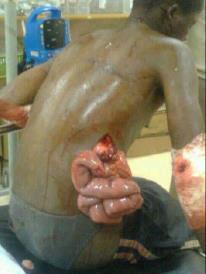
Shooting victim believed to be either Hubertus Mabel or Natalis Alua (CONFIRMED PHOTO; unconfirmed identity) in Wamena hospital, 16 Dec 2012. Both Victims died from their wounds by sunset, according to human right reports.  (Photo via Buktar Tabuni/KNPB)

compiled from reports of  Tabloid Jubi, Victor Mambor and West Papua Media stringers in Wamena

December 17, 2012

A West Papua National Committee (KNPB) activist has been killed, and a farmer has died from his wounds in hospital, after being shot by members of the Australian-trained anti-terror unit Detachment 88 outside Wamena on December 16, following raids that arrested at least six activists on Sunday morning, according to multiple sources.

KNPB activist Hubertus Mabel (aged 30) died shortly after being taken by police to Wamena hospital after the shooting at 1030am in the village in Milima (or Kugima) in Kurulu district outside Wamena.  Local farmer Natalis Alua (34) died in coma in hospital after being shot in the same incident, according to latest reports from human rights sources in Wamena.

According to journalist Victor Mambor, at this time Hubert was still alive and this was confirmed both by the police and Victor Yeimo (National KNPB Chairman).  “Police told me that Hubert was shot in the leg at 09.30 (morning). Hubert was taken to hospital by police and then died at the hospital because of loss of blood….  At 6 (afternoon), Hubert claimed by police died in hospital.”

Hubertus Mabel's body being prepared for burial, late December 16, 2012 (photo: KNPB/ West Papua Media)
Hubertus Mabel’s body being prepared for burial, late December 16, 2012 (photo: KNPB/ West Papua Media)

“Some peoples  in the Kugima Village, the place where Hubert was shot, told us police entered the village in full force. They brought two people who had been arrested before (Meky Kogoya and Wene Gombo) to the village to tell them where Hubert lived.”

Hubertus Mabel (Photo: KNPB)

At 9am, the same joint police/army and Densus 88 squad conducted a armed raid in the village of Kosi Hubi Holima, in Wamena.  KNPB Wamena Chairman Simion Daby was arrested with human rights activist Baroy Sambon, Meki Jikwa (Kogoya), John Huby, Pie Huby, Herae Huby, and Ima Mebel, allegedly at the house of Meky Kogoya, who was accused by police of being responsible for a bombing incident in Wamena.  They were all taken forcefully by police to Jayawijaya police headquarters.

It is believed that human rights worker Sambon was arrested as he was trying to alert international media to the situation, but this has not been verified.

The KNPB have repeatedly denied involvement in planning or carrying out acts of violence or bombings in Papua, a view supported by the Churches, human rights organisations and legal networks in Papua.  Police have yet to provide any credible evidence that shows their involvement, despite millions of dollars being provided to Densus 88 by Australia for forensic evidence analysis.

Alleged TPN retaliation questioned
There have been reports of an alleged West Papuan National Liberation Army (Tentara Pembebasan Nasional or TPN) retaliation against police over the shooting of Hubertus Mabel, but human rights workers have cast doubt on the involvement of TPN forces, instead accusing Indonesian security forces of acting up to continue to create a false scenario for conflict.
According to a report in Tabloid Jubi, the sound of gunfire could still be heard up to 11pm on 16 December in Wamena.
‘On 10.25pm, there was an exchange of fire between the TPN-OPM (the military wing of the OPM) and the TNI/Polri , Indonesian army and police, somewhere between Misi Market and  Sinakma, Yusodarso Road. The situation in Wamena was said to be tense and there were calls for help,’ according to a local report as quoted by Jubi.A local resident, Yason, confirmed reports of the sound of gunfire which was still continuing. It is alleged that this was in response to the shooting of Hubertus Mabel.  Another local resident named Vita told JUBI that the local police station had been burned down in response to the shooting of Hubertus Mabel. According to Vita, ‘Mabel and member of the KNPB was shot by the security forces as he was suspected of a bombing the Wamena, which led to the police station being burned down.’The local police chief later confirmed to JUBI that there had been an exchange of fire, but West Papua Media was unable to find any witnesses or evidence that any armed TPN unit was in the area.

However long time human rights worker Markus Haluk told West Papua Media that local  investigators had been visiting witnesses and have compiled a chronology that sits at odds with this account.  According to Haluk, at around 8pm local time, a number of drunk people set fire to one market stall at Pasar Misi/Bungsu.  Haluk also reported that at 11pm local time, police arrived on the scene with the Deputy Chief of Jayawijaya Police and opened fire with a barrage of shots, all from one side, with no clear target apart from civilians who had gathered.  Police then moved to the Dewan Adat Papua offices less than a kilometre from the scene, and set fire to them in retaliation, despite the burning market stalls having no connection to either the DAP leader or council staff.

Markus Haluk said that the “Alleged drunks burning kiosks in the market (is) scripted by the security forces to divert attention from the arrests and shootings of civilians and KNPB activists, and is a conscious Scenario consciously to burn the office and create psychological pressure against the leaders and members of the Papuan Customary Council Lani Pago Baliem Region.”

Local human rights workers believe this latest round of security force misbehaviour is due to the payment to the new Papua Police Chief Tito Karnavian (former Densus 88 commander) of Ten Billion Rupiah (approx US$1 million) from the Papuan Governors office, for the provision of “Phase 2”  security for the Papuan Gubernatorial Election campaign, which was also earmarked to maintain a peaceful environment in the lead-up to Christmas.

“Many parties are upset with these incidents,” said Haluk. “For catching, shooting in Wamena occurred on Sunday, when people were seeking to church to worship. While the arson of the DAP offices were do middle of the night, when the community was quiet for the night, ” he explained.

“On receipt of the funds, the Papua Police Chief conveyed the importance of maintaining the security and peace of Christmas and the election of Governor. Instead, he led police officers making arrests, shootings and arson of Balim Traditional Council offices,” an exasperated Haluk told West Papua Media.

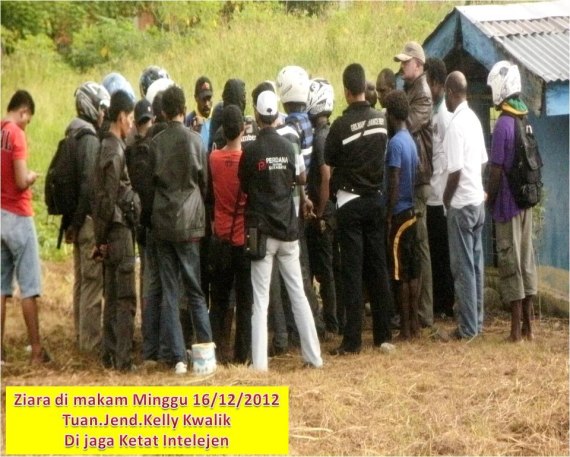
These arrests come amidst a major series of operations by Indonesian security forces across Papua on the anniversary of the Densus 88 assassination of legendary TPN guerrilla leader Kelly Kwalik on December 16, 2009.  Heavily armed Densus 88 personnel, including an unidentified Australian man, were seen to be guarding Kelly Kwalik’s tomb to prevent a memorial service from being held to commemorate the anniversary of Kwalik’s extrajudicial execution.

Papuan homage (16/12) to tomb of murdered OPM General Kelly Kwalik, blocked by heavily armed intelligence personnel (note Buleh Densus 88 advisor)
Papuan homage (16/12) to tomb of murdered OPM General Kelly Kwalik, blocked by heavily armed intelligence personnel (note Buleh Densus 88 advisor). (Photo courtesy Beni Pakage)

Also, in news from the Paniai, Brimob paramilitary police have reportedly shot and captured Yakobus Utii in Enarotoli on Sunday, alleging that he was a senior figure in Jhon Yogi’s TPN command.

West Papua Media

Lanny Jaya KNPB leader arrested and maltreated

4 December 2012 Local KNPB activist arrested and maltreated

KNPBNews

Another activist of the KNPB (National Committee of West Papua) has been arrested by Indonesian Police. This time, it was the secretary-general of the Lanny Jaya branch of the KNPB.Athys Wenda was arrested while sitting in the waiting room of Wamena Airport. He was arrested at 7am on 1 December.  He was seized by the police,  taken to the police station in Lanny Jaya and maltreated there.

Dules Wamimbo, the chairman of the KNPB in the district of Lanny Jaya, said that Athys was also badly mistreated while in a cell of the local police command in Jayawijaya.

In a short message, Dules said  that while being held by the Wamena police, Athys  ‘was beaten until he was black and blue all over.’

Athys had been trying to peacefully mediate a conflict among the people of Lanny Jaya.

Athys and several of his KNPB colleagues  are being closely watched by Densus88 (Detachment 88, the Australian, US, And UK funded elite counter-terror unit that is being used against peaceful political activists outside its funding mandate).  Dules said that when an armed conflict broke out between the TPN (the military wing of the OPM) and the Indonesian military, KNPB activists tried to mediate this conflict but they were treated as if they were the military.

Dules said: ‘ We very much hope that the police will stop arbitrarily arresting people without clear evidence.’

[Translated by TAPOL]


“Victor, we are ready to wreak havoc and clash with all of you” : Reflections by an unrepentant leader

by Victor Yeimo

Witness: Participant Analysis

December 3, 2012

Police Captain Kiki Kurnia: “We’re Ready To Clash.”

“Victor, we are ready to wreak havoc and clash with all of you.”

Those are the words spat out by police captain Kiki Kurnia, who yesterday (December 1) led hundreds of fully-armed police officers to put a stop to the Long March of students and the people. I was very sad to hear these words so righteously issued by the police, who present themselves as being on the side of safety. Do the police want safety, or do they not?Yeimo-ditangkap

When I was the leader of the Long March headed for Expo Waena on December 1 in Sentani, police backed by the Indonesian military had already closed off access to the people of West Papua who would pray. Since the late afternoon (30/11), Theys H. Eluay field, which is the field of (great significance and sacredness to) the West Papuan national struggle, had been controlled by the military and by the national police, although all the civil society organizations had long since said that their prayers and celebrations would take place there.

On November 19, police entered a prayer room in Aula STAKIN in Sentani and tried to stop me as I was giving a reception after prayers, and then yesterday on December 1 the people wanted to worship and eat at the Theys H. Eluay field but were prohibited, blockaded and arrested by the full force of the military. The question is, why did the military and the police force deliberately take control of the field and then shamelessly hold a traditional stone cooking event (a Indonesian-appropriated Papuan Custom) with a handful of residents who were offered money?

If the police are tasked with security, why exactly is that security so insecure when facing inhabitants who are conducting prayers peacefully? Is the Theys H. Eluay field, owned by the traditional people of West Papua, only permitted for use by the Indonesian military and the police force? If the law is just, why wasn’t police captain Kiki Kurnia charged with incitement to violence? As he himself clearly  (attempted) incited the mass action I led to commit violence on the streets in front of Dian Harapan Hospital yesterday.

If the police prohibit students from campaigning to put a stop to AIDS on West Papua’s Independence Day, why must it be prohibited? Do the police not want HIV/AIDS awareness campaigns to take place? Isn’t his proof that the police are ensuring and championing ethnic cleansing in West Papua? Why do the police prevent worship on West Papua’s Independence Day? Why do the police see more political and economic motivations than the goodwill and intentions of the people who want to interpret December 1, 2012 as World AIDS Day, the opening of Christmas festivities and the Independence Day of West Papua?

I lead my people safely and with restraint. I have personally guaranteed that I will be arrested or shot if there is a criminal act committed by people, but why in the safe Long March were we forcibly dispersed and captured like animals? Actually, who was it that committed the crime? Was it the people, or the police?

The police did not only incite the violence that happened, but yesterday (1/12) the police, through (Adjunct Senior Commissioner) Alfred Papare, publicly lied. Myself and the masses did not throw rocks at the police, however it was covered by several media sources that the police chief said we did so. In an era of openness such as this, why is there a need for mutual deceit when everybody saw yesterday that the police had no reason to blockade, arrest and attack people with tear gas? After I “escaped” from Abepura Sub-District Command, I had not received a call from the Jayapura Chief of Police, the aforementioned Alfred Papare, as stated by Wakapolda Papua, Paulus Waterpau, to Tabloid Jubi.

Better for the Police to become the Social Services

The idea of Papua’s Chief of Police, Tito Karnavian, to give out groceries and distribute help the mountain people of Papua in Jayapura and the Jayapura municipality makes me wonder a little. Has the police chief already switched functions from a chief of police who must preserve security, only to become the head of the Department of Social Services who must give social support to the people? Is this country unhealthy? Money for providing support to the people is redirected into the Police Department and the Police Department takes over the functions of the Department of Social Services.

For me, the efforts of the police department to muffle and destroy the basis of the Papua Independence conflict are obviously speculative, as well as inappropriate. Go ahead, if the police department and the Republic of Indonesia believe that our ideology can be bought off with money. Tens to hundreds of millions have been redirected to the Asrama Rusnawa Uncen, since becoming the basis for conflict, and the police are very hopeful that students will regard them as righteous people, as kind people. Well, again, it is better that the Police Institution in Jayapura be renamed as the Department of Social Security or the Department of Education, so that matters concerning the improvement of the Asrama Rusnawa Uncen and student welfare can just be taken over by the police.

Does Indonesia believe that money can silence the aspiration and ideology of independence for the people of West Papua? I am convinced the people of Papua that are given money and material aid from the police are only making use of them, because within the individual West Papuan person there is a flesh-and-blood desire for Papuan Independence, however difficult it is. So, go ahead, half-dead police and a waste of money to the people of Papua. Go ahead and pan the sympathy and dreams of the people who have hated the occupation of this land. Almost half a century practicing the policies of the Republic of Indonesia, and all models of development cannot turn the people of West Papua into people of Indonesia. Papua will rise and awaken by itself alone.

Idea of Separatists and Terrorists is a project of the TNI and Police 

There are no separatists and terrorists in West Papua; only those who demand the right to self-determination as legally protected under international law. The idea of separatists and terrorists is created by the state to disgrace the legal struggle of the West Papuan people, and created by the Indonesian military and the police with a view to expanding their territory, and their wealth. For the sake of money alone, the circumvention of the state apparatus and the deception of the state apparatus, alias “bullshitting a lot” (direct translation).

My organization, the National Committee of West Papua (KNPB), struggles in peace and does not want to create chaos that will strengthen the funds of the military and the police force. Consequently, the national police force does not like peaceful action, because in a situation that is safe and peaceful, the military and the police force will be poverty-stricken. Many security institutions in Indonesia have hundreds of troops that must be paid by the state. Moreover in Papua, there are now many civilian militias formed by the state; thousands have been recruited, and must be paid. All are created with the objective of “stripping bare” the security responsibility from the Indonesian government in West Papua that fall under the name of “eradicating separatists and terrorists.”

Forgive me; my group and I will not accept food from the military or the police, so there is no need to criminalise or drop that bomb on the National Committee of West Papua to stigmatise us, so that the project money can be maintained. These ways have become commonplace, and we are bored of them. The people are smart, and getting smarter: they have already been taught these ruses by the colonialists. Ways such as this will finally tarnish the image of the Republic of Indonesia in West Papua. So it is best not to try to painstakingly search for such an image. Oh, and yesterday in Guyana, Member of Parliament told Benny Wenda: “Oppression alone will burn the spirit of the independence struggle.”

Why not kill me, or imprison me? Why was I released? Oh, it is certainly not because I cheated. I will see this for what it truly is. There are demonstrations in the streets. Now that I have planted the seeds of resistance here and the invaders sow these seeds with their own actions. I must thank the colonialists for continuously teaching us to aspire to true humanity by means of rebellion.

Victor Yeimo wrote this article immediately upon his release from police custody on Monday December 3. 

Translated by West Papua Media volunteer translators

Create a website or blog at WordPress.com

Up ↑