REPORTS HAVE BEEN RECEIVED FROM WEST PAPUA COMMUNICATIONS TEAMS OF CURRENT ATTACK BY INDONESIAN SECURITY FORCES ON KNPB DEMO IN JAYAPURA
Breaking News: Jayapura Police have started to disperse thousands of KNPB protestors with water cannon and tear gas, major beatings by thousands of riot police, scores arrested. No CONFIRMED reports currently of live fire being used, however troops are heavily armed with live rounds. Developing Story. More to come – please spread widely.
THIS IS A MAJOR DEVELOPING STORY – PLEASE STAND BY FOR MORE INFO.
EARLIER:
Confirmed info from Reliable contacts in Jayapura: Sourced from a Papuan TNI member who is Papuan, and who is informing our stringers:
Protestors to start at 10 am Papua time – likelihood of violent action by security forces – stand by
1. TNI have readied 5000 personnel, tanks (Panzer APC/ASLAVS) and helicopters in Jayapura. All are on a state of alert.
2. Just heard from one of the protestors on site that said police are gathered in large numbers in Jayapura
“Apparently a lot of people ), have flown down to Jayapura from Wamena these last days to join there as too unpredictable how Indonesian security forces may retaliate in Wamena.”
Last night, major sweeps occurred in Waena to arrest any higlander potentially involved in KNPB demos today. At 10:43pm, hundreds of fully armed police complete with equipment and Panzer armoured personnel carriers, scores of Avanza cars, overran National Housing Authority dormitory complex III (Yakuhimo regency student accommodation). Massive sweeping, many arrests, beatings, unconfirmed numbers.
KNPB members rallying across Papua today held prayers last night, telling WPM “we are ready to be killed today”. 10am Papua time rally start, massive violence expected from security forces. “It felt like the night before battle where only one side has guns, said WPM’s stringer. Please monitor.
West Papuan independence organisation, the West Papua National Committee (known by its Indonesian acronym KNPB) continues to defy the Indonesian security after a series of arrests and attacks on the group in Wamena, Timika and Jayapura.
Speaking from a safe house KNPB Chairman, Viktor Yeimo told West Papua Media that the police were vigorously repressing the group’s right to freedom to organise and right to nonviolently express their political opinion.
“I am in hiding but I have to try and keep organizing. KNPB have plans for peaceful demonstrations in Sorong, Manokwari and Jayapura. The police won’t allow us to make a peaceful action but we will still have a peaceful action.”
Early on Friday morning officers from the Indonesian police and Australian and U.S aided counter-terrorist group Detachment 88 raided KNPB’s Timika headquarters. Four Papuans, Steven Itlay, Chairman of the Timika region, Romario Yatipai, vice-president of KNPB’s parallel parliamentary structure the West Papua National Parliament, Marten Kalolik, and Denias Tekege were arrested. Laptops and cameras were also seized. The arrests in Timika follow raids and arrests of ten activists in Wamena, raids on villages and an attack on a student dormitory in Jayapura last Tuesday. Some of those arrested are teenagers. Others like Simson, a student activist from Jayapura were beaten by the police to extract information.
Virtually the entire KNPB leadership has now gone underground. In addition to Viktor Yeimo, Fanny Kogoya, ex-member of the KNPB central committee who resigned from KNPB after being elected Director of the Papua Desk of Friends of the Earth Indonesia, and Simeon Dabi chairman of the Wamena branch of KNPB are all on the run. Their faces are pasted in the streets of Wamena and Jayapura under the ominous heading, “Daftar Pencarian Orang”, the list of wanted persons. In Fanny Kogoya’s case her only ‘crime’ is that she was a close friend of Mako Tabuni, the KNPB activist killed by Detachment 88 in June.
Indonesian police accuse KNPB of being behind a series of shootings and bombings in West Papua that have rocked the country in recent months. It is an allegation that Yeimo vigorously denies.
“All this evidence is planted so they can justify their attacks. We never had any plan or any program to make acts of terror. We are not a military movement. If we were a military movement we would be the TPN (West Papua National Army) but we are a civilian movement. The Indonesians fear our movement, they want to make a public opinion that we are terrorists so they can kill us.”
Yeimo pauses.
“But they won’t succeed” he tells me quietly. “Indonesia won’t success to stop our movements for the right. Indonesia cannot kill our spirit for freedom.”
Indonesian Special Forces officers have redoubled their efforts to hunt down non-violent womens’ and environmental rights activist Fanny Kogoya, after a failed attempt to capture her and Papuan student activists from the West Papua National Committee at a university dormitory on Tuesday night.
Fanny Kogoya was also elected the head of the Papua desk for the Indonesian branch of Friends of the Earth (WAHLI) on June 13, the day before her close friend Mako Tabuni, former KNPB leader,was extrajudicially executed by Detachment 88 troops in Jayapura.
Kogoya, also a women’s rights defender from the grassroots Papuan women’s network TIKI, has been been placed on a Papua wide wanted persons list (Daftar Pencarian Orang or DPO) by the Australian-trained and funded Detachment 88 anti-terror investigators. This is despite Kogoya having resigned from pro-independence activities, according to established credible sources in Jayapura. Kogoya is also accused by police of having knowledge of the whereabouts of activists from the pro-independence civil resistance group, West Papua National Committee (KNPB).
KNPB activists are in hiding after being ruthlessly hunted by security forces, in order to break the back of the civil resistance movement against Indonesian brutality in occupied West Papua. This harassment campaign has gained significant pace ahead of planned Papua-wide mobilisations against Indonesian colonial violence on October 23 – rallies widely expected to be subject to major Indonesian state violence.
The latest crackdown has seen brutal intelligence gathering techniques employed by security forces, including officers identified by witnesses as being from Detachment 88, arbitrarily targeting for beatings, kidnappings, arrests and torture on students and civilians from the highland tribes of Yakuhimo and Dani people – seen by many observers as the backbone of the KNPB effort to use civil power to defeat Indonesian state violence.
Confirmed reports from human rights activists in Jayapura have described heavily armed plain clothes officers – believed by witnesses to be members of either Kopassus or Detachment 88 – violently threatening highland students and civilians in a bid to hunt down members and associates of the KNPB.
Raids on student accommodation around Abepura and Jayapura have intensified ahead of a planned mass mobilisation across Papua on October 23rd by KNPB, which is calling for an end to these illustrated acts of Indonesian state violence – a move seen as makar (subversion) by the new Papua Police chief Tito Karnavian , the former head of the Australian- funded Detachment 88.
Attempts to contact Karnavian or his Papua Police spokespeople for comment for this article have been so far rebuffed and unsuccessful.
Additionally, witnesses and survivors have described a chronology of what is being described as a “fishing operation” by Indonesian intelligence officers. Attempts to capture Fanny Kogoya had been ongoing for several days, with police Avanzas permanently stationed outside houses and haunts of both Kogoya and her extended family and friends.
According to a detailed and disturbing testimony provided by Yakuhimo man and citizen media worker Simson Yohame to independent human rights monitors in Jayapura, the officers have heavily monitored highland students in the greater Jayapura area in a bid to isolate KNPB activists from their base.
Yohame, a friend of Kogoya, was himself kidnapped and tortured by suspected Detachment 88 officers on October 9 after accidentally leaving his motorbike helmet at a Javanese restaurant in Waena, near Abepura. He had been tailed for several days by intelligence officers, who suspected his friendship with Fanny would lead them to their quarry.
Upon leaving the restaurant, he was set upon by plain clothes police intelligence agents, whom he believed to be Detachment 88 officers. They bundled him in to the back of a black police Avanza car, whilst soldiers who were stationed outside the Yakuhimo regencies student dormitory at Waena stood guard. An intelligence officer from Makassar hit him repeatedly with a butt of a pistol, and other officers punched him systematically in the chest using a silat (traditional Javanese martial arts favoured by Kopassus) technique that can easily cause cardiac arrest.
He described being taken in a six car high speed convoy, initially to the back of an unknown facility close to the Jayapura police headquarters, before being subjected to psychological torture on a drive around the greater Jayapura area, and was hypnotized to disorientation. Yohame described the brutal interrogations where he was threatened with knives, swords and cocked and loaded firearms by Detachment 88, according to his testimony. Interrogators also subjected him to psyops by playing loud torture music and sound on headphones they held on his head, while they were sticking knives and pistols into his body.
Giving fascinating if chilling insight, Yohame has detailed the processes that Intel attempted to use to turn him to spy on his friend Fanny. He refused eventually, but not before documenting the techniques utilized.
After the torture, the Detachment 88 officers allegedly moved onto “Stage 3” as Yohame described it, a combination of the classic good cop / bad cop routine. “They (intel) began to ask me the core question: ‘Do you know Fanny Kogoya? This picture is FK, FK stay close to you. You do not deny it. If you deny we will kill you.’”
“I asked why are you looking for FK? Intel said to me that ‘because the cases of murder that Mako Tabuni was doing involved FK. FK participated in designing all events Mako and comrades were doing’. Yohame reported the police as saying.
The police continued: ‘FK loves the money Mako and his friends had over the years. FK is the girlfriend of Danny Wenda. Wenda is now the number 1 Papua Police DPO’,” the interrogators said.
The interrogators then changed tactics, offering a payment. “In addition, if you (SY) can inform on where FK is, we will pay you (SY) Rp 10 million for initial operations,”. They demanded the locations of Danny Wenda, the Chairman of KNPB, Victor Yeimo, Tinus Yohame, Buktar Tabuni, Victor Yeimo, Assa Asso, and also fellow Yakuhimo clansmen allegedly involved in KNPB, alternatively offering payment, and threatening to kill him if he denied knowledge of their whereabouts. Yohame was then trained in demonstration and civil resistance disruption and sabotage techniques, and fieldwork techniques employed by intelligence informants.
Yohame described how his tasking had traumatised him greatly, and he refused internally to carry out the actions. After his release having agreed to be an Indonesian agent, he was secretly informing Fanny Kogoya about the massive operation in effect to capture her and warning her to move outside the town to avoid arrest or disappearance.
Fanny Kogoya, who like other civil society activists on the DPO list is constantly moving from house to house, has so far eluded capture due to the diligence of the now underground non-violent independence movement in Papua.
—
For the whole night of October 12, a Cenderawasih University (UNCEN) dormitory in Waena was under siege by a large group of plain clothes armed and masked security forces, who surrounded the dormitories. During the night, the police overran the dormitories in their search for Fanny Kogoya, according to witnesses.
Three students who living at the UNCEN hostel – UL (32), IK (36), and PK (22) – said they had been beaten and terrorized by the police. “Police pry the door and entered. They say ‘we find the DPO who live here,'” the students explained in the human rights report. “They say the name of FK and Danny Wenda (DW).”
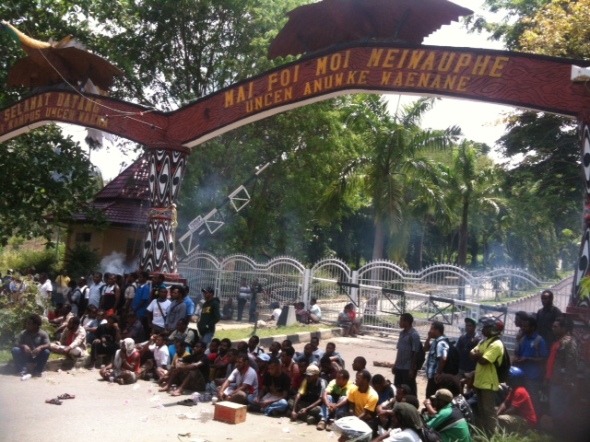
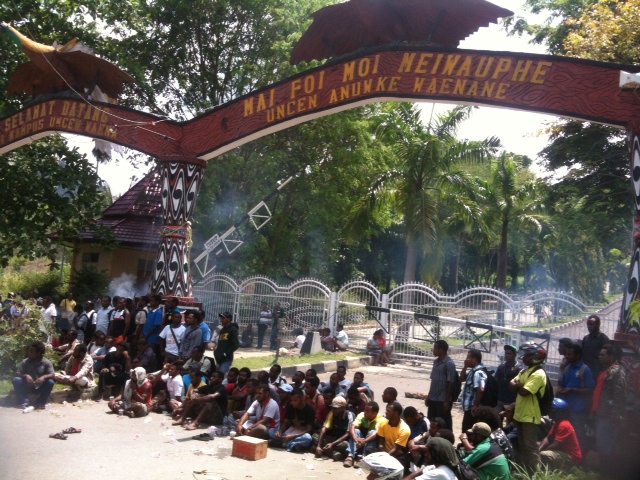
The Yakuhimo students at the dormitory were angered by the event, but held a peace blockade outside the gates of the Uncen campus in Waena, independent sources at the campus told West Papua Media. No reports were received of any forced dispersal, however tension is high and all West Papuan students are in fear that that they could be arrested or disappeared at any moment, according to human rights sources.
Yakuhimo students and supporters blockade outside Uncen Waena after the Detachment 88 raids, October 12 (West Papua Media)
These actions came after a campaign of arrests from late September of at least eight people in the highland town of Wamena after police targeted homes and offices of KNPB members, accusing them of involvement in bombings and terrorism, despite KNPB being committed to non-violent civil resistance tactics.
In a statement, UK based human rights group Tapol said that “The targeting of KNPB activists appears to have intensified after the killing of the KNPB leader Mako Tabuni, on 14 June 2012. Officers of Indonesia’s counter-terrorism unit, Special Detachment 88 (Densus 88), funded and trained by Australia, the US and the UK, are thought to have been involved in the killing of Mako Tabuni and the arrest of the KNPB members in Wamena.”
Tapol has called for Indonesian authorities to “end the campaign of terror, intimidation and violence against human rights defenders and political activists, particularly members of KNPB,” and to guarantee the safety of Fanny Kogoya, Viktor Yeimo, and others who have been targeted.
Tapol has also called on Jakarta to “end the deployment of Densus 88 to Papua, investigate all allegations of human rights violations by Densus 88 officers and other security forces personnel and bring those responsible to justice.”
Whilst tension remains high during the crackdown, KNPB activists have also warned their members not to be taken in by SMS messages that are being spread by intelligence personnel attempting to incite violence and horizontal conflict. Activists have circulated a list of mobile numbers that are responsible, and are urging all recipients to document any numbers that continue to spread these messages.
Many people have reported to West Papua Media of an upsurge in Special Forces activity, even around those who are not active on Papuan independence issues. There has been a significant increase on the presence of intelligence officers on the street. Selfius Bobii, the former Front Pepera leader serving out a three sentence at Abepura prison on a treason conviction for his role in the 3rd Papuan People’s Congress of October 2011, still maintains close and effective communications with a network of activists throughout Papua.
In an SMS sent to West Papua Media, Bobii described how the TNI “have stooped to making themselves out to be civilians, to carry out undercover operations in order muffle the independence aspirations.”
“Some are posing as Bakso (Beef offal noodles) Sellers on roadsides, some are posing as motorbike repair people and so on,” Bobii said.
Bobii described the following factual account: On 11 Oct at 2303 hours in Nabire, Yance Agapa was heading home and was given a lift by an ojek (motorbike taxi) rider to the front of the Indonesian Air Force Quarters in front of the ‘Glory’ internet cafe. When they arrived at Malompo he gave the driver Rp20000 (approx. AUD$2) who hurriedly put it into the pocket of the black jacket he was wearing. Then a pistol fell out of his jacket. Yance startled in fright to which the driver responded “Brother don’t be frightened because I’m from Ambon but my mother is from Sentani. I’ll tell you straight, I’m a member of DENSUS 88 sent from Central to get the government program happening. So let our people from the community know to be careful using hire motorbikes. ”
West Papua Media has independently verified this account.
KNPB activists, most living underground currently, have expressed significant fears for their safety and survival from the crackdown. Yohame begged in his testimony, “the condition of our current times is so dire, (we need) all my friends and the international support groups to be able to monitor our current situation. Virtually all KNPB activists are threatened at this time. “
It is unclear whether these intensified crackdown tactics will work on those close to DPO suspects to give up not just Fanny Kogoya, but other non-violent activists who are simply attempting to raise their universal human rights of self-determination and freedom of expression.
Certainly these hunting parties have confirmed one thing: that Australian trained counter-terrorism troops are without any doubt being used to suppress peaceful political activity, outside their legal mandate of counter-terrorism. This should be deeply concerning for Australia in its quest for advocating internationally the Rule of Law – and at the moment that it has just taken up a position on the UN Security Council it might prove to be an inconvenient turning of a blind eye.
ASIAN HUMAN RIGHTS COMMISSION – URGENT APPEALS PROGRAMME
Urgent Appeal Case: AHRC-UAC-185-2012
The Asian Human Rights Commission (AHRC) has received the information regarding the arbitrary arrest of five Papuan activists in Jayapura, Papua on 12 October 2012. The five activists were arrested on the allegation of involvement in importing or distributing explosive materials. The police did not have any evidence to arrest and detain them and they were later released. The police, however, copied several documents belonging to the activists related to their political movement.
CASE NARRATIVE:
According to the information we obtained from Yasons Sambom himself, he and his friends Denny Hisage, Anike Kogoya, Feliks Bahabol and Linus Bahabol were on their way to Nabire by the Lapobar ship when the police arrested them at around 9.20pm. They were initially put under the custody of the Sea Harbour Security Execution Unit (KP3 Laut) Jayapura before being moved to the Papua Regional Police Station at around 11-12pm for interrogation. The interrogation of some of the activists started at 1am on the next day and lasted until 4am whereas the remainder were questioned from 2.30am until 6am. It is not until 11 on 13 October 2012 that the five activists were released. None of the activists were given the opportunity to contact any legal counsel to accompany them during the questioning
The five activists were arrested for allegedly violating Article 187bis of the Penal Code concerning their alleged involvement in importing explosive materials to Indonesia territory. Several weeks before the arrest, two bombs were found at the secretariat of the West Papuan National Committee (Komite Nasional Papua Barat, KNPB) in Wamena and the police suspected Yasons along with his friends to be linked to it. The allegation, however, could not be proven and the police later released the activists after their 24 hours of arrest. According to the transcript of the police interview with the arrested persons, the police considered Yasons as the suspect of the bomb case in Wamena, Denny is merely a witness, whereas the status of the rest three is still unclear.
Yasons Sambom and Denny Hisage are well known for their activities in favour of Papuan independence, whereas the three other arrested people are university students. There is an allegation that their arrest was actually more likely to have been caused by their political activities instead of the suspicion that they were involved in the import of explosive materials. On the day of the arrest, the police seized several belongings of the activists which contained confidential and important information regarding their political activities. Those belongings include a laptop, four USB flash disks and one CD containing several documents – none are related to the import of illegal explosive materials which was the crime the activists were alleged to be involved in. Although the police returned all of these items to Denny Hisage and his friends, they managed to copy the documents before releasing the activists.
ADDITIONAL INFORMATION:
Prosecution, trial and punishment of activists in Papua are ongoing human rights issues taking place in the region. The use of articles concerning treason or treason-related activities (Article 106, 110 and 160) against the activists is typical that it has been a concern of several states involved in the UN Universal Periodic Review (UPR) on Indonesia last May. Leaders and members of pro-independence groups or those who are in favour of the independence movement had also been prosecuted with other criminal provisions which in many cases they had not breached. In the past, Yason himself was arrested twice. He was firstly arrested in 2009 due to his involvement in a peaceful protest asking the government to stop the violence and abuses in Papua. Later in May 2011 he was arrested without a clear charge and several documents on his political activities saved on his laptop were also copied by the police.
Victims of fabricated charges might seek compensation to the court once the legal proceedings against them prove they are not guilty. Yet the officers responsible for such abuse are unlikely to be criminally punished due to the absence of a law provision criminalising the fabrication of charges by law enforcement officials. The only specific prohibition on fabrication of charges is found in Article 6 letter (k) of Government Regulation No. 2 Year 2003 concerning the Discipline Rule for Members of Indonesian National Police whose one of articles sets out ‘in exercising their duties, the members of the Indonesian National Police are prohibited to manipulate cases’.
A complain to the Security and Profession Division (Propam), an internal oversight mechanism of the police, may be lodged by the victims yet the sanctions to be imposed will only be disciplinary. The similar government regulation sets out that any police officers who has manipulated a case may be sentenced to a maximum of 21 days of isolation which in some cases may be extended up to a further seven days.
The Criminal Procedure Code gives authority to the police to seize goods as well as to perform document checks. Goods to be seized and documents to be checked, however, have to be related to the crimes allegedly committed by the suspects. Article 39 of the Code sets out five general categories of seize-able goods: those which are products of a crime, used for a crime, used for halting the investigation of a crime, created specifically for a crime, and other goods that are directly related to the crime.
SUGGESTED ACTION:
Please write to the listed authorities below asking them to ensure investigation on the arbitrary arrest, seizure and fabrication of charges of the five Papuan activists to take place.
The AHRC is writing a separate letter to the UN Special Rapporteur on the promotion and protection of the right of opinion and expression as well as the UN Special Rapporteur on the rights to freedom of peaceful assembly and of association.
To support this appeal, please click here: SAMPLE LETTER:
Dear ___________, INDONESIA: Police arbitrarily arrested five Papuan activists and copied documents related to their political activities Name of victim: Denny Hisage (26 year old), Yasons Sambom (22 year old), Anike Kogoya (24 year old), Feliks Bahabol (23 year old), Linus Bahabol (23 year old) Names of alleged perpetrators: Papua Regional Police officers Date of incident: 12 October 2012 Place of incident: Jayapura, Papua
I am writing to voice my concern over the arbitrary arrest of five Papuan activists in Jayapura harbour on 12 October 2012. I was told that Yasons Sambom, Denny Hisage, Anike Kogoya, Feliks Bahabol and Linus Bahabol were on their way to Nabire by the Lapobar ship when the police arrested them on the allegation of their involvement in the import of explosive materials as prohibited under Article 187bis of the Indonesian Penal Code. The police suspected Yasons and his friends are somehow related to two bombs found at the secretariat of West Papua National Committee (Komite Nasional Papua Barat, KNPB) in Wamena last month. After being put under custody and questioned for 24 hours, Yasons Sambom and his friends were released by the police due to lack of evidence. There is a possibility, however, that the police have not changed Yasons’s status of suspect. The police seized several belongings of the activists which include a unit of laptop, four USB flash disks and one CD containing several documents.
This case has been my particular concern as I allege the politicisation of the criminal proceeding here. Yasons Sambom and Denny Hisage are well known in Papua, for their activities in favour of the independence of the region. As proved by the release of the five activists, the police did not actually have any evidence or basis to arrest them for illegal import of explosive materials. The police suspected them, mainly Yasons and Denny, to be responsible for the bombs found in Wamena due to their political activities. The political nuance in this case can also be concluded from the fact that the police did not seize any belongings related to the alleged crime but, instead, those related to Yasons Sambom and friends’ political activities.
I am concerned with the ongoing prosecution and punishment of individuals in Papua who are in favour of the independence of the region. I wish to emphasise that one’s political view is protected under the freedom of opinion and their activities to express such view is guaranteed by the notion of freedom of expression. Criminal proceeding against individuals for their dissenting opinion with the government is therefore unacceptable and in violation of those rights which are protected both in Indonesian 1945 Constitution as well as in the International Covenant on Civil and Political Rights to which Indonesia is a state party.
In this opportunity, I would also like to express my concern regarding the absence of law provision criminalising fabrication of charges by law enforcement officials in Indonesia. I am aware that a victim of arbitrary or false arrest, detention, prosecution or trial may initiate legal proceeding to district court to seek compensation. When the false arrest or detention was committed by the police, it is also possible for the victim to lodge a complaint to the internal oversight mechanism within the police, the Security and Profession Division. The punishment to be given to the police officers if they were convicted, however, is only those with disciplinary and not criminally nature. I therefore call you to make framing or fabrication of charges a crime falling under the jurisdiction of civilian courts.
In addition to the halt of prosecution and persecution towards Papuan activists as well as the criminalisation of charges, I request you to provide compensation to Denny Hisage, Yasons Sambom, Anike Kogoya, Feliks Bahabol and Linus Bahabol. Independent investigations towards the allegation of the fabrication of charges should also take place.
I look forward to your swift and positive response in this matter.
Yours sincerely,
—————- PLEASE SEND YOUR LETTERS TO:
1. Mr. Susilo Bambang Yudhoyono
President of Republic of Indonesia
Jl. Veteran No. 16
Jakarta Pusat
INDONESIA
Tel: +62 21 345 8595
Fax: +62 21 3483 4759
E-mail: presiden@ri.go.id
2. Ms. Harkristuti Harkrisnowo
General Director of Human Rights
Ministry of Law and Human Rights
Jl. HR Rasuna Said Kav. 6-7
Kuningan, Jakarta 12940
INDONESIA
Tel: +62 21 525 3006, 525 3889
Fax: +62 21 525 3095
3. Marzuki Alie
Speaker of the Indonesian House of Representatives
Gedung Nusantara III DPR RI
Jl. Jend. Gatot Subroto
Jakarta 10270
INDONESIA
Tel: +62 21 575 5048, 575 6041, 575 6059
Fax: +62 21 575 6379
E-mail: set_tu_ketua@dpr.go.id, baleg@dpr.go.id
4. Gen. Timur Pradopo
Chief of the Indonesian National Police
Jl. Trunojoyo No. 3
Kebayoran Baru, Jakarta Selatan 12110
INDONESIA
Tel: +62 21 384 8537, 726 0306
Fax: +62 21 7220 669
E-mail: info@polri.go.id
5. Insp. General Pol. Tito Karnavian
Chief of the Papua Regional Police
Jl. Dr. Samratulangi No. 8 Jayapura
INDONESIA
Tel: +62 967 531 014, 533 396
Fax: +62 967 533 763
6. Mr. Ifdhal Kasim
Chairman of the National Human Rights Commission
Jl. Latuharhary No. 4-B
Jakarta 10310
INDONESIA
Tel: +62 21 392 5227
Fax: +62 21 392 5227
E-mail: info@komnasham.go.id
Thank you.
Urgent Appeals Programme
Asian Human Rights Commission (ua@ahrc.asia)
Papuan political activists and human rights defenders are living in increasing fear as a result of an intensifying crackdown by Indonesian police, military and intelligence officers against activists, particularly members of the non-violent West Papua National Committee, KNPB. There are concerns that further acts of terror, intimidation, arrests, torture and extrajudicial killings against activists are imminent.
According to reports received by TAPOL, in the early hours of Tuesday 16 October Indonesian intelligence officers raided student dormitories at the University of Cenderawasih (UNCEN) in Waena, Jayapura in an unsuccessful attempt to arrest Fanny Kogoya, a member of the TIKI network of women human rights defenders, and other activists.
Last week, on 9 October, Simson Yohame, another activist was unlawfully detained and forced by intelligence officers to reveal the whereabouts of Fanny Kogoya and Viktor Yeimo, leader of the KNPB.
These incidents followed the arrests in late September of eight people in the highland town of Wamena after police targeted homes and offices of KNPB members.
The targeting of KNPB activists appears to have intensified after the killing of the KNPB leader Mako Tabuni, on 14 June 2012. Officers of Indonesia’s counter-terrorism unit, Special Detachment 88 (Densus 88), funded and trained by Australia, the US and the UK, are thought to have been involved in the killing of Mako Tabuni and the arrest of the KNPB members in Wamena.
Please call or write to the authorities urging them to:
End the campaign of terror, intimidation and violence against human rights defenders and political activists, particularly members of KNPB
Guarantee the safety of Fanny Kogoya, Viktor Yeimo, and others who have been targeted.
End the deployment of Densus 88 to Papua, investigate all allegations of human rights violations by Densus 88 officers and other security forces personnel and bring those responsible to justice.



 West Papua Media Alerts