(JG) 51 Tortured by Indonesian Security Forces in Papua Violence: Elsham

51 Tortured by Indonesian Security Forces in Papua Violence: Elsham
Farouk Arnaz & Ronna Nirmala | November 29, 2011

The National Police said on Monday that it handed out punishments to a total of 17 officers for last month’s deadly crackdown on the Third Papuan People’s Congress but refrained from firing or demoting any of their own.

Ethics tribunals were held for members of the Mobile Police (Brimob) and the Jayapura Police believed to have been responsible for the incident, according to a National Police spokesman, Insp. Gen. Saud Usman Nasution.

Two Brimob officers were reprimanded, while two low-ranking enlisted officers were sentenced to 14 days detainment in a special cell.

In Jayapura, the capital of Papua, the chief of police at the time of the violence, Adj. Sr. Comr. Imam Setiawan, and seven of his subordinates received reprimands, while five enlisted officers were sentenced to seven days of detainment.

“They failed to follow proper police procedures in carrying out their security duties,” Saud said of those punished. “[Their actions were] excessive.”

No officer, however, was dismissed from the force or demoted for a violent incident that left at least three congress participants dead.

Sau d said the none of the officers would be charged with murder or face any other criminal charges. Police investigators, he said, put the victims’ times of death after the officers had left the scene.

He said one of the congress participants, Daniel Kadepa, had died from a stab wound, while the other two victims, Max Saseyo and Jacob Samansabra, could not be autopsied because they had already been buried by their families.

Separately on Monday, the Institute for Human Rights Study and Advocacy (Elsham) and the Communion of Churches in Papua (PGGP) said at least 51 people had been tortured by members of the military and police during and after the congress.

Congress participants told the groups they had been beaten and kicked repeatedly by security forces both at the congress site and while being transported to police headquarters. Some participants said they were beaten at the police station.

There were also reports of verbal abuse, the groups said.

One person said a policeman hit him in the head with the butt of an assault rifle. Another said he was shot in the buttock and thigh.

Also, a nearby monastery was looted and vandalized by security forces, the groups said.

The Rev. Wellem Maury of the PGGP said the National Commission on Human Rights (Komnas HAM) needed to take over the case and form a fact-finding team to investigate allegations of human rights abuses, torture and excessive use of force.

“Komnas HAM must also announce its findings to the Coordinating Ministry for Politics, Legal and Security Affairs so there is an open and fair trial,” he said.

International human rights groups like Amnesty International and Human Rights Watch, he added, must also be given access to those still being detained for treason, particularly Forkorus Yaboisembut, who was named president of an independent Papuan republic at the congress.

In a report released on Nov. 4, Komnas HAM alleged that the crackdown violated a raft of basic human rights and called on police to conduct a thorough investigation. It also said the central government should accelerate a dialogue with the Papuan people and do more for development in the province

Amnesty: ‘Slap on the wrist’ for police violence in Papua is accountability failure

These written warnings are a slap on the wrist. They do not provide accountability for the deaths of three people, or for the use of excessive and unnecessary force against a peaceful gathering.

Sam Zarifi, Amnesty International’s Director for the Asia-Pacific
Wed, 23/11/2011


The fact that eight Indonesian police officers involved in a violent crackdown on a peaceful gathering that left three dead have only been given written warnings, is a failure of human rights accountability, Amnesty International said today.The warnings were given after an internal disciplinary hearing on 22 November found that the officers violated the police Disciplinary Code.On the afternoon of 19 October 2011, police and military units violently dispersed peaceful participants of the Third Papuan People’s Congress, a nationalist gathering being held in Abepura, Papua province.

The bodies of Demianus Daniel, Yakobus Samonsabara, and Max Asa Yeuw were later found near the Congress area.

“These written warnings are a slap on the wrist.  They do not provide accountability for the deaths of three people, nor for the use of excessive and unnecessary force against a peaceful gathering,” said Sam Zarifi, Amnesty International’s Asia-Pacific Director.

Some 300 participants were arbitrarily arrested and ill-treated at the end of the Congress. Most were released the following day but six have been charged and are currently awaiting trial.

Amnesty International has called on the authorities to act on the findings of the Indonesian National Human Rights Commission (Komnas HAM) that rights violations were committed by security forces, and to prosecute those responsible.

“Even though the Indonesian authorities have a responsibility to prosecute human rights violators, this is yet another example of how in Indonesia, human rights crimes committed by police officers never reach civilian courts, but are dealt with through inhouse disciplinary hearings,” said Sam Zarifi.

“Internal disciplinary procedures are for dealing with minor offences, not serious human rights violations.”

Amnesty International also urges the Indonesian authorities to set up an independent police complaints mechanism to deal with human rights violations by police officers.

Current bodies such as the National Police Commission or the National Human Rights Commission do not have the powers to deal effectively with complaints about police abuses, nor to provide reparations to victims.

A Komnas HAM investigation team found a range of human rights violations were allegedly committed by the Indonesian security forces on 19 October, including opening fire on the peaceful Papuan gathering and beating and kicking participants.

It was reported on 7 November that the President’s office had rejected the Komnas HAM findings, stating that the police were still handling the case.

On 22 November, an internal police disciplinary hearing in Jayapura, Papua found the former Jayapura Police Chief Iman Setiawan guilty of violating the Disciplinary Code for “his inability to co-ordinate police officers under his command”.

Seven police officers from Jayapura City were also found guilty of violating the code for not “protecting and servicing the community with the best of their ability” and “degrading the honour and dignity of the state and the police”. They were all each given a written warning.

The disciplinary hearings for the seven police officers were reportedly held behind closed doors.

——————–

JG: Officers Involved in Deadly Crackdown On Papuan Congress Slapped on Wrist

http://www.thejakartaglobe.com/home/officers-involved-in-deadly-crackdown-on-papuan-congress-slapped-on-wrist/480247

Banjir Ambarita | November 23, 2011

Jayapura. The former Jayapura Police chief and seven of his subordinates were handed a token written warning on Tuesday for their role in a brutal crackdown on a peaceful gathering that led to the deaths of at least three civilians.

At a disciplinary hearing at the Papua Police headquarters, Adj. Sr. Comr. Imam Setiawan was ruled to have committed a disciplinary infraction by not prioritizing the protection of civilians.

A parallel hearing at the Jayapura Police headquarters found the seven others guilty of a similar breach. All were issued a warning letter, despite earlier findings by the National Commission for Human Rights (Komnas HAM) that the crackdown on the pro-independence Papuan People’s Congress violated a raft of basic rights.

A day after the incident on Oct. 19, six congress participants were found dead in a field near the scene and just outside the local military headquarters.

Komnas HAM had ruled that at least three of the deaths could be attributed to excessive use of force by the security forces, although it stopped short of specifically fingering the police or the military.

In his defense, Imam said his men had acted out of fear of a repeat of the clash that occurred in March 2006 between protesters and security forces at Jayapura’s Cendrawasih University that left five police officers dead.

Sr. Comr. Deddy Woeryantono, the provincial police’s head of internal affairs, said the punishment meted out to the eight officers was the “heaviest in the police force.”

“If in the next six months after receiving a warning they commit another disciplinary breach, it’s possible that their punishment could be increased,” said Deddy, who presided over the disciplinary hearings.

He declined to say how the heaviest punishment available could be made any heavier.

The other officers disciplined included Comr. Junoto, the Jayapura Police’s operations head; Adj. Comr. Laurens, the head of intelligence; Adj. Comr. Frans, the head of riot personnel; and Adj. Comr. Ridho Purba, the chief of detectives. Adj. Comr. K.R. Sawaki and First Insp. I. Simanjuntak, the North Jayapura Police chief and deputy chief, and Comr. Arie Sirait, the Abepura Police chief, completed the list.

Tuesday’s decision echoes similar cursory punishment handed down to soldiers accused of gross rights abuses. In August, three soldiers accused of killing a Papuan man were given 15 months in jail for insubordination by a military tribunal.

In January, the military was criticized internationally for handing out sentences of between eight and 10 months to three soldiers who had tortured two Papuan men, in an act caught on video and posted to YouTube.

Longing for Merdeka by Melissa McLeary

‘Longing for Merdeka’ is about the desire of the people of West Papua to gain independence from Indonesia. The film focuses on Herman Wainggai who escaped to Australia with 42 Papuan refugees on a traditional canoe. Since settling in Australia he continues to campaign for the self-determination of his people.

[vimeo http://vimeo.com/32299332]

Thousands of West Papuans demand Referendum in Jayapura 14 Nov 2011

Several thousand West Papuan people took the streets in Jayapura on November 14 to  calling for a Referendum to demand their right of self determination.

This slideshow requires JavaScript.

In another show of mass civil resistance since the brutal crackdown by Indonesian security forces on the 3rd Papuan Peoples Congress,  the demonstration organised by the West Papua National Committee also called for the Government of Indonesia to take responsibility for its increased unjustified violence towards West Papuan people.

Indonesian police attempted to block the march, but protestors pushed through peacefully to continue to the offices of the DPRP, the provincial parliament building.

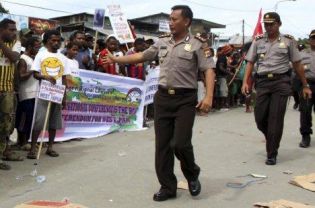
Demoted former Papuan Police chief Iman Setiawan attempts show of force (Reuters)

Protest organisers earlier expressed grave fears that security forces would attempt to repeat the violence on unarmed and peaceful protestors, but international monitoring and effective citizen media on the ground contributed to the restraint shown by security forces.

Participants rejected dialogue or talk with Jakarta until violence ended and maintained their position that a referendum was the only just pathway towards fulfilling Papuan rights.

“Give us the space for a referendum so that we can choose what we want.  We don’t want dialogue doing the bidding of UP4B, or other policy of Special Autonomy;  We don’t need money, we don’t need to be with  Indonesia, let us be free on our land,” said speakers, referring to the Special Development unit set up by Indonesian President Yudoyhono to dilute Papuan calls for independence.

[youtube http://www.youtube.com/watch?v=X4jVXagcUlM]

“The Papuan people have asked for an immediate referendum for self-determination. We reject any dialogue with Jakarta,” protest coordinator Mako Tabuni said.

“The referendum is non-negotiable.”

Mass Action Jayapura, 14 Nov 2011 (Af Wensi)

Create a website or blog at WordPress.com

Up ↑