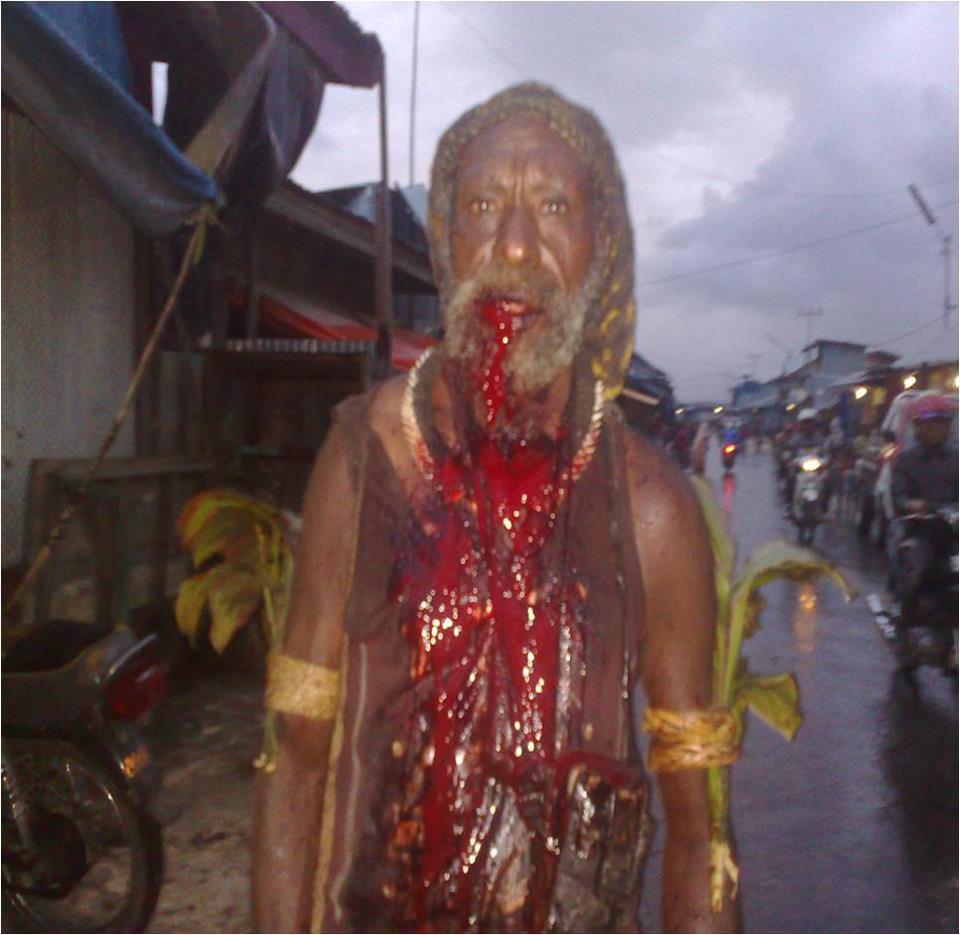
BRIMOB Paniai severely beat teacher Yulian Yeimo

November 28, 2011

(ENAROTALI, Paniai, West Papua)  In another display of arbitrary brutality against civilians, members from the increasingly notorious Indonesian paramilitary police unit Brimob last Thursday severely beat a local teacher without cause.

Yulianus Yeimo, 46, a teacher from Paniai was beaten  at 15:00 local time on 24 November by Brimob officers at Kogekotu / awabutu field in Enarotali, Paniai, Papua.   Police Officers fractured Yeimo’s nose and jaw from repeated blows with rifle butts.  The injuries caused by the Mobile Brigade officers caused severe bleeding, with his tongue almost severed by blows from the rifle butts.

West Papua Media has verified the photograph as genuine, and consistent with injuries reported.  Local sources have reported that Brimob and military officers are constantly raiding houses, taking away traditional hunting wepons and gardening tools such as axes, machetes and knives.  According to the same sources, this has made work and finding firewood for cooking impossible.  Many people have fled into the surrounding hills for shelter, fearful of continued arbtitrary violence from Indonesian security forces.

Combined operations throughout the Paniai district by Indonesian police and army since July have displaced several thousand local people, with many unable to find food or effective shelter in the mountains.

The district is subject to increasing tension, so please stay tuned to westpapuamedia.info for further updates.

Australia must act to protect human rights in Papua: Joint letter from HRLC and Human Rights Watch (28 Nov 2011)

The Australian Government should take a leadership role in promoting and protecting human rights in the troubled Indonesian province of West Papua say two leading human rights organizations in a Joint Letter to the Foreign Minister, the Hon Kevin Rudd MP.

Ahead of the 50th anniversary this Friday of the first raising of the West Papuan ‘Morning Star’ flag, the Human Rights Law Centre and Human Rights Watch have called on Minister Rudd to publically and unequivocally condemn the excessive use of force and suppression of peaceful protest and also deploy Australian embassy staff to Papua to monitor and observe anticipated events to mark the anniversary.

“Australia must unequivocally support the human rights of all persons to freedom of expression, association and assembly,” said Tom Clarke from the Human Rights Law Centre. “It is not in Australia’s strategic interest to have a festering human rights problem on our doorstep.”

“The default policy of successive Australian Governments has seemingly been to politely look the other way while human rights abuses occurred on our doorstep. This approach desperately needs rethinking. The problem of violence and repression in West Papua needs to be acknowledged and addressed,” Mr Clarke said.

The ‘Morning Star’ flag was first raised in 1961 when West Papua was moving towards independence with assistance from its colonial Dutch Government and the Australian Government. By this time, Papua already had its own government officials. However, in 1962 a chain of events eventually led to Indonesia taking control of Papua and well documented military violence and human rights abuses have plagued the province since. Today Papuans face imprisonment for simply raising the ‘Morning Star’ flag.

The letter urges Minister Rudd to call for a full and impartial investigation into recent use of force, including fatal force, by Indonesian police and military forces on a peaceful assembly on 19 October. The attacks on the Third Papuan People’s Congress resulted in at least three protesters being killed, at least 90 being injured and approximately 300 arrested.

“The West Papuan people do not enjoy the types of basic rights that we take for granted here in Australia. The right to meet to discuss ideas and express political beliefs are severely curtailed in West Papua. The international media is heavily restricted in travelling to Papua and reporting on events there. We are concerned that without international attention being focused on West Papua, human rights abuses are likely to continue,” Mr Clarke said.

The letter also requests that Minister Rudd urge the Indonesian Government to release all persons detained in Papua for the peaceful expression of their political views, including Filep Karma who the UN Working Group on Arbitrary Detention advises should be immediately released.

“Minister Rudd should follow US Secretary of State, Hilary Clinton’s lead and directly raise concerns with Indonesia about the violence and abuse of human rights in West Papua. If he has a ‘special relationship’ with Indonesia, now is the time to make the most of it and, as a friend, help Indonesia meet the commitments that it’s signed up to under the International Covenant on Civil and Political Rights,” Mr Clarke said.

The Human Rights Law Centre will be hosting a public seminar in Melbourne with Human Rights Watch’s Elaine Pearson looking at this and other human rights issues in Asia on Wednesday 7 December. Further details can be found online here.

For further comments from HRLC: contact Tom Clarke on tom.clarke@hrlc.org.au or 0422 545 763

For comments from HRW: contact Phil Robertson on RobertP@hrw.org or +66 85 060 8406

AAP: Exodus in Papua amid fears of crackdown

http://news.smh.com.au/breaking-news-world/exodus-in-papua-amid-fears-of-crackdown-20111127-1o10t.html

 Karlis Salna, AAP South-East Asia Correspondent

November 27, 2011 


AAP
Human rights groups have called for Australian monitors to be allowed into Papua amid reports people are fleeing parts of the Indonesian province due to fears of another violent crackdown on pro-independence rallies planned for next week.
In a joint letter to Foreign Minister Kevin Rudd, Human Rights Watch and the Melbourne-based Human Rights Law Centre have called for Australian embassy staff to be deployed to the restive Indonesian province to monitor events on December 1.
Large numbers of people are expected to gather in cities and other areas in Papua on Thursday for rallies to mark an unofficial independence day and the 50th anniversary of the first raising of the Morning Star flag.

The flag has been adopted by the separatist Free Papua Movement(OPM) and is regarded as a symbol of independence in the province which has been racked by a surge in violence over the past six months.

However, the Indonesian government considers the raising of the flag an act of treason.
At least three protesters were killed and another 90 people injured last month when Indonesian police and military stormed a pro-independence rally in Abepura after the raising of the Morning Star flag.
Video of the aftermath of the rally, broadcast on Australian television, also showed police beating unarmed protesters, including children.
As many as 300 people were arrested.
A spokesman for the pro-independence group, the National Committee for West Papua (KNPB), has told AAP that large numbers of people have begun leaving Jayapura and Manokwari in Papua, fearing a backlash from security forces at rallies planned for Thursday.
As Indonesia remains off limits to foreign journalists, the report could not be confirmed.
In the letter to Mr Rudd, Human Rights Watch and the Human Rights Law Centre raise concerns about the likelihood of a repeat of last month’s violence as well as the use of excessive force by the police and military.
The letter calls on Mr Rudd to urge the Indonesian government to allow full and free access of journalists to Papua and to deploy Australian embassy staff to monitor and observe events on December 1.
The human rights organisations say there should also be a full and impartial investigation into the deaths and injuries, and allegations of excessive use of force by the authorities, arising from the demonstration in Abepura on October 19.
But the letter also criticises the Australian Ambassador to Indonesia Greg Moriarty who had described the actions of the protesters at the rally as provocative.
“In our view, a clear and firm public statement on Australia’s position on human rights in the area is critical, especially since there is a real risk that Australian Ambassador Greg Moriarty’s recent reference to the actions of Papuan People’s Congress leaders as illegal, provocative and counterproductive may otherwise be interpreted as supporting a government crackdown on the congress,” the letter said.
Mr Moriarty, however, had also pointed to the response by Indonesian security forces as being disproportionate.
The letter to Mr Rudd also questions Australia’s funding and training of Indonesia’s elite anti-terrorism squad Densus 88, members of which were among the security forces present at the rally on October 19.
“Australia plays a critical leadership role on human rights in Asia and the Pacific and should take a principled and proactive stand on human rights with a key partner like Indonesia,” the two human rights organisations said.
Indonesia has been battling a long-running but low-level insurgency since its takeover of Papua in 1969.
However, the security situation has deteriorated in recent months with the province experiencing its worst violence in years.
Figures from Indonesia’s Commission for Missing Persons and Victims of Violence show at least 40 people have been killed as a result of the violence since the beginning of July.
© 2011 AAP

Amnesty: ‘Slap on the wrist’ for police violence in Papua is accountability failure

These written warnings are a slap on the wrist. They do not provide accountability for the deaths of three people, or for the use of excessive and unnecessary force against a peaceful gathering.

Sam Zarifi, Amnesty International’s Director for the Asia-Pacific
Wed, 23/11/2011


The fact that eight Indonesian police officers involved in a violent crackdown on a peaceful gathering that left three dead have only been given written warnings, is a failure of human rights accountability, Amnesty International said today.The warnings were given after an internal disciplinary hearing on 22 November found that the officers violated the police Disciplinary Code.On the afternoon of 19 October 2011, police and military units violently dispersed peaceful participants of the Third Papuan People’s Congress, a nationalist gathering being held in Abepura, Papua province.

The bodies of Demianus Daniel, Yakobus Samonsabara, and Max Asa Yeuw were later found near the Congress area.

“These written warnings are a slap on the wrist.  They do not provide accountability for the deaths of three people, nor for the use of excessive and unnecessary force against a peaceful gathering,” said Sam Zarifi, Amnesty International’s Asia-Pacific Director.

Some 300 participants were arbitrarily arrested and ill-treated at the end of the Congress. Most were released the following day but six have been charged and are currently awaiting trial.

Amnesty International has called on the authorities to act on the findings of the Indonesian National Human Rights Commission (Komnas HAM) that rights violations were committed by security forces, and to prosecute those responsible.

“Even though the Indonesian authorities have a responsibility to prosecute human rights violators, this is yet another example of how in Indonesia, human rights crimes committed by police officers never reach civilian courts, but are dealt with through inhouse disciplinary hearings,” said Sam Zarifi.

“Internal disciplinary procedures are for dealing with minor offences, not serious human rights violations.”

Amnesty International also urges the Indonesian authorities to set up an independent police complaints mechanism to deal with human rights violations by police officers.

Current bodies such as the National Police Commission or the National Human Rights Commission do not have the powers to deal effectively with complaints about police abuses, nor to provide reparations to victims.

A Komnas HAM investigation team found a range of human rights violations were allegedly committed by the Indonesian security forces on 19 October, including opening fire on the peaceful Papuan gathering and beating and kicking participants.

It was reported on 7 November that the President’s office had rejected the Komnas HAM findings, stating that the police were still handling the case.

On 22 November, an internal police disciplinary hearing in Jayapura, Papua found the former Jayapura Police Chief Iman Setiawan guilty of violating the Disciplinary Code for “his inability to co-ordinate police officers under his command”.

Seven police officers from Jayapura City were also found guilty of violating the code for not “protecting and servicing the community with the best of their ability” and “degrading the honour and dignity of the state and the police”. They were all each given a written warning.

The disciplinary hearings for the seven police officers were reportedly held behind closed doors.

——————–

JG: Officers Involved in Deadly Crackdown On Papuan Congress Slapped on Wrist

http://www.thejakartaglobe.com/home/officers-involved-in-deadly-crackdown-on-papuan-congress-slapped-on-wrist/480247

Banjir Ambarita | November 23, 2011

Jayapura. The former Jayapura Police chief and seven of his subordinates were handed a token written warning on Tuesday for their role in a brutal crackdown on a peaceful gathering that led to the deaths of at least three civilians.

At a disciplinary hearing at the Papua Police headquarters, Adj. Sr. Comr. Imam Setiawan was ruled to have committed a disciplinary infraction by not prioritizing the protection of civilians.

A parallel hearing at the Jayapura Police headquarters found the seven others guilty of a similar breach. All were issued a warning letter, despite earlier findings by the National Commission for Human Rights (Komnas HAM) that the crackdown on the pro-independence Papuan People’s Congress violated a raft of basic rights.

A day after the incident on Oct. 19, six congress participants were found dead in a field near the scene and just outside the local military headquarters.

Komnas HAM had ruled that at least three of the deaths could be attributed to excessive use of force by the security forces, although it stopped short of specifically fingering the police or the military.

In his defense, Imam said his men had acted out of fear of a repeat of the clash that occurred in March 2006 between protesters and security forces at Jayapura’s Cendrawasih University that left five police officers dead.

Sr. Comr. Deddy Woeryantono, the provincial police’s head of internal affairs, said the punishment meted out to the eight officers was the “heaviest in the police force.”

“If in the next six months after receiving a warning they commit another disciplinary breach, it’s possible that their punishment could be increased,” said Deddy, who presided over the disciplinary hearings.

He declined to say how the heaviest punishment available could be made any heavier.

The other officers disciplined included Comr. Junoto, the Jayapura Police’s operations head; Adj. Comr. Laurens, the head of intelligence; Adj. Comr. Frans, the head of riot personnel; and Adj. Comr. Ridho Purba, the chief of detectives. Adj. Comr. K.R. Sawaki and First Insp. I. Simanjuntak, the North Jayapura Police chief and deputy chief, and Comr. Arie Sirait, the Abepura Police chief, completed the list.

Tuesday’s decision echoes similar cursory punishment handed down to soldiers accused of gross rights abuses. In August, three soldiers accused of killing a Papuan man were given 15 months in jail for insubordination by a military tribunal.

In January, the military was criticized internationally for handing out sentences of between eight and 10 months to three soldiers who had tortured two Papuan men, in an act caught on video and posted to YouTube.

Create a website or blog at WordPress.com

Up ↑
