ELSHAM: Reverting to the DOM era: Papua back to being a Zone of Military Operations

PRESS RELEASE FROM ELSHAM PAPUA

December 19, 2012

ELSHAM PAPUA
Lembaga Studi dan Advokasi Hak Asasi Manusia
(Institute for Human Ri ghts Study and Advocacy of Papua)

Reverting to the DOM era: Papua back to being a Zone of Military Operations

There was a significant increase in the intensity of the conflicts and violence in Papua between August 2011 and December 2012. ELSHAM Papua reported on several incidents that had resulted in serious casualties and although the growing severity of the incidents was disturbing, these did not prompt the Government to react.  These events include the overwhelming offensive called “Operasi Aman Matoa I 2011”, terror actions and shootings by unidentified perpetrators (OTK), cases of internal displacements,  as well as cases of extrajudicial killing of civilians by the police.

“Operasi Aman Matoa I 2011” is the designation for an armed crime prevention operation that was set up in the areas of Puncak Jaya and Paniai. This operation was under direct command  of the Chief of Police, and was run by the Operations Task Force (Satgas Ops) through police telegram letter No. STR/687/VIII/2011 dated 27 August 2011.

The Operations Task Force for Operasi Aman Matoa I 2011 was led by Drs. Leo Bona Lubis, the Commissioner of Police. During the execution of Operasi Aman Matoa I 2011 in the Paniai Regency, a number of grave human rights violations were perpetrated, which include:

(a) the taking of the lives of two civilians, Salmon Yogi (20) and Yustinus Agapa (30) who died as a direct result of the armed conflict,
(b) the inflicting of injuries to at least four civilians: Yulian Kudiai (22), Melkias Yeimo (35), Yohanis Yogi (25) and Paskalis Kudiai (21), who became victim as a result of the armed conflict,
(c) great material loss due to the armed conflict in Eduda District which includes 78 houses that were burnt by the Operations Task Force; educational activities at 8 elementary school (SD) and 2 Junior High School (SMP) that had to be halted; religious and worship services could no longer be ensured in eight Catholic churches, seven Kingmi churches and four GKII churches; hundreds of machetes, knives, saws, hammers, bows and arrows were confiscated;
(d) villagers no longer felt secure in their own homes and they fled. As many as 37 people perished while in displacement: 13 toddlers, 5 children, 17 adults and 2 elders;
(e) communities from the Districts of Komopa, Keneugida, Bibida, East Paniai and Kebo have endured material loss due to their displacement.  The villagers were forbidden from going to their gardens by the members of the Operations Task Force. As a result, this primary source of livelihood for the communities was left neglected and unattended. Prior to the evacuation, 1581 heads of livestock were forcibly slaughtered, including  as many as 478 pigs, 3 cows, 11 goats, 132 rabbits, 381 ducks, and 576 chickens. After returning to their homes and villages, the residents experienced severe food shortage. Members of the Operations Task Force had also damaged the fences built by the residents, as they used those as firewood.

Violent acts committed by the security forces, both the military and the police, are still common and they are in flagrant violation of a number of international humanitarian standards and principles. Some of the cases that we note are as follows:

a. The heavy-handed assault carried out by the police against Persipura fans at Mandala Stadium on 13 May 2012, which led to 18 people suffering from respiratory problems due to tear gas that had been fired indiscriminately and six others being detained arbitrarily.
b. The shooting of four people in Degeuwo by the police on 15 May 2012, by which one person was killed and the other three were seriously wounded.
c. The assault against civilians in Honai Lama Wamena on 6 June 2012, by members of the Indonesian army (TNI) Battalion 756 Wimane Sili, which resulted in one person dead and 14 others seriously injured.
d. The arbitrary arrest and torture by the police of 10 people in the town of Serui, as they were commemorating the International Day for Indigenous People on 9 August 2012.
e. The forced disbanding by the police of a KNPB-led demonstration that was about to start in front of the campus of the State University of Papua in Manokwari on 23 October  2012. A total of 15 people were detained by the police, nine of them were tortured, and 2 others suffered gunshot wounds.

Summary executions by the police of pro-democracy activists who are active within the West Papua National Committee (KNPB) continue to occur. The extrajudicial shooting of Mako Tabuni (34), First Chairman of the KNPB on 14 June 2012, is clear evidence of acts of police brutality against civilians. A similar killing occurred in Wamena on 16 December 2012, when the police shot dead Hubertus Mabel (30), militant KNPB Chairman for the Baliem region.

Other violent acts such as terror acts and shootings by unknown assailants increased, both in 2011 and 2012. From 5 July to 6 September 2011, there were 28 shooting incidents where 13 people were killed and at least 32 people were wounded. Meanwhile, throughout 2012, there were 45 attacks by unknown assailants, killing 34 people, injuring 35 people and causing severe trauma to 2 people.

One of the worrisome events that received very little attention from the Government was the crisis which lasted from July to November 2012 in the Keerom where villagers fled their homes as they no longer felt secure because of activities conducted by the security forces. A joint effort between ELSHAM Papua and the Keerom Catholic Church enabled the return to their homes of 38 internally displaced people (IDPs) who had fled into the jungle.

Various cases of violence and human rights violations that occurred in Papua totally escaped the attention of the central Government and that of local Papuans. Conditions such as these indicate that the status of Papua as an autonomous region has turned into a status of “Special Operations Region”, similar to what was experienced in the decades between 1970 and 2000 when Papua was designated as a Military Operations Area (DOM). Legal impunity for the perpetrators of the violence becomes flagrantly visible as the perpetrators of such violence are practically never brought to justice, nor do they receive fitting sentences.

Prohibiting international humanitarian organizations, international journalists and foreign researchers from accessing the Papuan region inevitably gives way to the increasing acts of violence by security forces in that region. Elite units, such as Anti-Terror Special Detachment 88, are conducting activities that are contrary to their mandate as they themselves are the ones creating terror against activists of the pro-democracy movement in Papua.

Bearing in mind the socio-political conditions faced by Papuans today, ELSHAM Papua is calling for:

1. the Indonesian Government, to open access to international humanitarian agencies, international journalists and foreign researchers to the region so they can freely visit and monitor the human rights situation in Papua;
2. the police of the Republic of Indonesia, to immediately reveal to the public the identity of those responsible for the numerous attacks and mysterious shootings that have occurred lately in Papua;
3. the Indonesian Government and groups opposing the Government, to choose dialogue as a way to end the conflict and the ongoing violence in Papua;
4. the military and the police, to uphold and respect the universal principles of human rights that have been ratified by the Government of the Republic of Indonesia.


Manokwari Riots: Human rights investigation Report

Report of Human Rights Investigation by Monitoring Team from LP3PH (Institute for Research and Development of Legal Aid), Manokwari, as assembled from various local sources and members of the victim’s family.

December 6, 2012

Wednesday 5 December 2012, the weather was overcast without rain, seeming to restrain the usual busy activities of the local population, government and private company staff, white and blue collar workers, market traders, farmers, fishers, schoolkids and students, plus the security forces: army, police and intelligence.

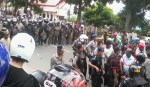
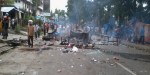
From early morning the atmosphere was tense: from about 07.00 to 09.oo [Papua time] groups of local people could be seen moving to blockade various major road intersections in Manokwari Town.  Primary official routes like Jl. Yos Sudarso, [near Sanggeng in front of the Bank Mandiri, Bank BRI and Bank Papua complex] as far as the three-way intersection on Jl. Merdeka & Jl. Gunung Salju [Makelew Fanindi complex] were blocked by mobs using wood, old tyres set on fire, tables, and tree branches, all thrown on the road. Various intersections of roads heading out to the residential areas of Fanindi beach [beside the Swissbel Hotel], Arkuki [beside the Bahagia store], Sanggeng market, and Jl. Serayu Sanggeng were blockaded by a populace brewing with anger.

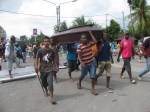
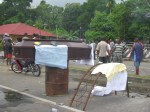
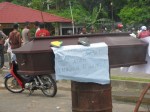
While the atmosphere in Manokwari has been tense there has never been any trouble between groups in civil society or between the local community and the security forces. Several witnesses said that ‘people are very emotional, they are making these protests because of the shooting of Timo Ap’. The police secretively shot and killed Timo Ap, and then took his body to his house in Wirsi, Manokwari.

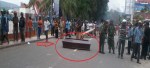
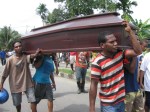
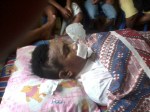
All Photos: LP3PH/West Papua Media

Chronology

A chronology of events has been put together as follows, from various civilian sources including the family of the victim Timotius Ap:

1)      More than 3 days ago the victim Timotius Ap, grandson of the late Timotius Ap, [former area head of Wirsi complex in West Manokwari], returned from Java to Manokwari: in Java he had been staying with family and working as a Marine;

2)      Timo Ap returned home to Manokwari with his wife Iwanggin;

3)     Timo was rarely present at the Wirsi house, he was mostly elsewhere due to being on the DPO [Wanted List], related to various cases that the Police accused him of;

4)     On Tuesday, 4 December 2012, as morning was turning to midday, Timo Ap was hanging out with his friends at Wirsi and wanting to eat areca nuts [?] but after eating them, his friends cannot account for his whereabouts;

5)     By the evening of 4 December, at around 09.00 Papuan time [21.00?] Timo was received and treated at the Dr Azhari Hospital [Navy Hospital] Manokwari;

6)     Around 10.00 [22.00?] Papuan time on 4 December, a friend of the family brought a message to Timo’s aunt Nelestin Ap, to ‘please come to the hospital to see Timo, whether he is still alive or already dead’. So then Timo’s aunt and other relatives hurried to the Navy Hospital but on the way they passed police and medical vehicles taking Timo’s corpse home to his grandmother’s house at Jl. Simponi Rindu, Wirsi, West Manokwari;

7)     On arriving at the house, there was only the victim’s grandmother, in her 70’s, living alone. She had no idea that her grandson’s body was being brought to her house. ‘The employees bringing in the corpse said nothing at all to the grandmother’, and then those employees just left the coffin there and went off;

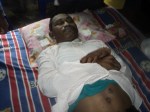
8)     After several minutes the aunt and several of the victim’s loved ones arrived, or came back from the hospital and cried hysterically upon seeing the body wearing only underpants and a clean T-shirt that he had been dressed in. His friends said that he had no other clothes apart from the clean T-shirt and underpants he had been dressed in. At the hospital he had been wrapped up in bandages around his chin and neck as though he were injured, but there appeared to be no injury to his neck, chin or head in general. His only wound was discovered to be on his stomach near the centre, where a surgical incision to remove the projectile [bullet] had been stitched up.

9)     By 11.30 the news had started to spread widely, that the victim Timo Ap had been shot dead by Police, and the local community began arriving to pay their respects and condolences.

10)  In the morning at about 06.00 [Papua time] various family members began blockading the route into Wirsi [Jl. Simponi Rindu]. Blockades then spread to various road junctions in Manokwari, while the local daily paper MEDIA PAPUA released in its Headline news that Timo Ap had been shot dead by the OPNAL [Professional Operations Team] of Polsek [Police sector] Manokwari town at Maripi beach, South Manokwari district at about 16.00 Papua time. This was due to his opposing the officers with an improvised pistol; he was killed with a shot to the head;

11)   From around 07.00 to 09.00, Papua time, the community closed off the main roads of Mankwari such as Jl. Yos Sudarso, Jl. Merdeka, the route to Sanggeng settlement, Jl. Siliwangi, Jl. Soedjarwo Condronegoro [?], Jl. Gunung Salju [heading to Ambun];

12)   At the same time, activities in Manokwari came to a complete standstill. The business centre, Hadi department store, Orchid Swalayan, the market, stalls and shops were closed en masse by their owners. Offices also shut their doors – the Manokwari Regency Government office of West Papua province, schools, banks: from early this morning until mid-morning as this report is written;

13)  At 10.00 Papua time, large groups began violent action, smashing shops along the length of Jl. Yos Sudarso and Jl. Merdeka as far as Jl. Siliwangi. Tens of buildings along the road suffered quite serious damage, and many cars and motorbikes were wrecked by the mob;

14)  Around 12.00, as the mob moved towards the town centre right in front of the West Papuan governor’s office, patrols of Brimob [mobile brigade], Dalmas Polres [area police] backed up with Indonesian Army forces were seen closing off the intersection that the crowd wanted to pass;

15)  A local man, Demianus Waney held a megaphone in front of the security forces, asking the crowd to disperse and go home…. ‘I say go home’… said Demianus Waney….. but hearing those words, the crowd became more worked up. In the process of their demonstrations against Demianus Waney, a number of buildings, restaurants owned by transmigrants around the harbour and PT Pelni [national shipping line] became targets of their anger;

16)  The police, Brimob and TNI [Indonesian army] started to rush forward but were stopped by an attempt at negotiation by a priest, who said he had been the victim’s priest [i.e. Timo Ap who had been shot and killed]. However at the same time Demianus Waney said that every avenue had been tried already, inviting the armed forces to action;

17)  The security forces then moved forward to break up the crowd. The police, Brimob and soldiers using trucks, paddy-wagons and Barracuda vehicles moved rapidly to take over the main road that had been controlled by the mob;

18)  Around 13.00, Papua time, the situation had become calm and back to normal.

Lanny Jaya KNPB leader arrested and maltreated

4 December 2012 Local KNPB activist arrested and maltreated

KNPBNews

Another activist of the KNPB (National Committee of West Papua) has been arrested by Indonesian Police. This time, it was the secretary-general of the Lanny Jaya branch of the KNPB.Athys Wenda was arrested while sitting in the waiting room of Wamena Airport. He was arrested at 7am on 1 December.  He was seized by the police,  taken to the police station in Lanny Jaya and maltreated there.

Dules Wamimbo, the chairman of the KNPB in the district of Lanny Jaya, said that Athys was also badly mistreated while in a cell of the local police command in Jayawijaya.

In a short message, Dules said  that while being held by the Wamena police, Athys  ‘was beaten until he was black and blue all over.’

Athys had been trying to peacefully mediate a conflict among the people of Lanny Jaya.

Athys and several of his KNPB colleagues  are being closely watched by Densus88 (Detachment 88, the Australian, US, And UK funded elite counter-terror unit that is being used against peaceful political activists outside its funding mandate).  Dules said that when an armed conflict broke out between the TPN (the military wing of the OPM) and the Indonesian military, KNPB activists tried to mediate this conflict but they were treated as if they were the military.

Dules said: ‘ We very much hope that the police will stop arbitrarily arresting people without clear evidence.’

[Translated by TAPOL]


Police shooting of escaped political prisoner sparks Manokwari riots

Tabloid Jubi

December 5, 2012

Condition of Manokwari town tense

The town of Manokwari in West Papua is in uproar (On Wedenesday, December 5). It is reported that crowds have run amok and have been carrying out acts of arson.

A (WPM edit: source believe to be police officer) source for tabloidjubi.com in Manokwari states the riot was triggered as the result of the shooting by police officers  of a DPO (Detainee on the political Daftar Pencarian Orang or Wanted persons list)) by the initials TA, who escaped from Prison. on Tuesday.https://i0.wp.com/tabloidjubi.com/wp-content/uploads/2012/12/Manokwari.-ist.jpg

(West Papua Media has confirmed with independent sources in Manokwari that the dead political detainee was named Timotius Napirem Ap – a relative of executed West Papuan songman and nationalist Arnold Ap).

“So last night (Tuesday 4/12) police members chased a DPO prisoner of the initials TA. (police) Members fired warning shots, however the person in question (the escapee)  resisted because he carried a homemade weapon, “ reported the source of Tabloidjubi.com, Wednesday 5/12/12.

According to the source, because the prisoner’s resistance endangered the police, they were forced to shoot him. “However I don’t know precisely where he was shot. But after he was shot he was able to run to the Manokwari District General Hospital (RSUD)’’ he explained.

However he continued,  it appears that because of loss of blood, the prisoner’s life could not be saved. “Even though he was taken to the RSUD, his life could not be saved. This was what triggered the anger of a number of the people. They then lit fires at various points in the town of Manokwari, including the Prison Guard Post perhaps which is in the centre of Manokwari was burned . Up to this moment the situation in Manokwari remains tense,” explained  the  (police) source to Tabloidjubi.com.

Another Tabloidjubi.com source  in Manokwari mentioned that the prisoner had been shot in the feet, neck and back, by the police officers. The prisoner died and was taken secretly by security offers to the morgue in Wirsi last night, 4/12 around 12.00 pm WIT. (West Indonesian time).

“The prisoner was shot in the coastal area of Maripi by the police, without committing any crime. The police chased this person because he escaped using a motor cycle. But because of the chase the police and  intelligence cordoned off and encircled Timotius Ap, which resulted in the prisoner being shot’’ said the Tabloidjubi.com source via his mobile phone.

Meanwhile the Public Relations Officer for the Police District of Papua AKBP I Gede Sumerta Jaya, said that his office was still waiting  for information from Manokwari. “I have not yet received field data. I too am still waiting for data. Shortly, if there is accurate data then I can provide information.” I Gede briefly responded.  (Jubi/Arjuna)

Solidarity organisation calls on police not to use violence on 1 December

Bintang Papua,
26 November 2012Jayapura: Alius Asso, the deputy chairman of SHDRP,  the Papuan Civil Society Organisation for Solidarity, Law and Human Rights, has urged the police to use persuasive methods on 1 December when demonstrations will take place to mark the anniversary of 1 December.

Asso said that on that day, there will be actions by indigenous groups in seven regions that claim to be part of the Federated Republic of West Papua  in Mamta, Saireri, Bomberay, Domberay, Me Pago, Ha Amin and several other places, which will take the form of prayer meetings or flag ceremonies.

However, Asso said that it was not possible for him to tell groups not to wave the Morning Star flag  ‘because they have every right to do so’.

He said that it was up to the security force to act in a professional way during these coming events. Demonstrations on 1 December have become a regular annual feature for Papuan people to  commemorate this historic day and this has been going on for many years.

‘The police should act wisely and professionally. They should avoid repressive actions. If they fail to do so, there will be many victims among the Papuan people . In Sentani, it is likely that  the event will take place at the grave of [the assassinated Papuan leader] Theys Eluay with prayers being said.’ But Asso said  he was not sure what would happen in Jayapura.

The chief of police for Papua, Inspector-General Tito Karnavian has said that the army (TNI) and the police will be out guarding the areas because this is an integral part of their duties.. But Asso said that they should not resort to the use of violence. ‘If the demonstrators only intend to say prayers, why should this be banned by the security forces?’

He went on to say that the spirit of democracy is developing and people are expressing their aspirations in peaceful ways, but if the State goes on silencing democracy, it will be responsible for closing down the space for democracy and there will be yet more injustices and human right abuses.

‘Everyone agrees about the need for security and moreover there is a law in force which guarantees protection for the citizens. And this is quite clear in the first article of the 1945 constitution.’

[Translated by TAPOL]


Create a website or blog at WordPress.com

Up ↑