http://www.etan.org/issues/wpapua/2011/1103wpap.htm
This is the 83rd in a series of monthly reports that focus on developments affecting Papuans. This series is produced by the non-profit West Papua Advocacy Team (WPAT) drawing on media accounts, other NGO assessments, and analysis and reporting from sources within West Papua. This report is co-published with the East Timor and Indonesia Action Network (ETAN). Back issues are posted online at http://etan.org/issues/wpapua/default.htm Questions regarding this report can be addressed to Edmund McWilliams at edmcw@msn.com. If you wish to receive the report via e-mail, send a note to etan@etan.org.
Summary:
Newly obtained video footage reveals Indonesian security forces, including U.S. and Australian-backed Detachment 88 personnel, brutality in operations in West Papua’s Central Highlands. Indonesian NGOs and prominent Papuans have faulted President Yudhoyono’s newly announced approach to dialogue with Papuans with criticism of Jakarta’s failure to end human rights violations and impunity by security forces as a basis for dialogue. Papuans criticized Jakarta’s selection of a limited range of Papuans as dialogue partners and have urged a role for international mediators. A prominent West African leader has announced support for West Papua’s self-determination. The chair of the Papuan Peoples Council (DAP) denounced the Indonesian government’s policy of transmigration. The Asian Legal Resource Center has appealed to the UN Human Rights Council to address continued security force abuse of human rights in West Papua. A Papuan political prisoner who is gong blind as a result of an attack by a prison warder needs urgent care. A report from within West Papua details land grabs by the Indonesian military and “developers” which have targeted Papuans in the Sorong area. Hamish McDonald considers Papuans’ struggle for self-determination in the light of recent similar successful examples within the international community.
Contents:
New Video Footage Reveals Indonesian Military Brutality
Video footage released in early February reveals previously unseen Indonesian military brutality against Papuan civilians in Kapeso in 2009. The footage was released by West Papua Media and can be viewed here: http://www.youtube.com/watch?v=VD0eFA4scTo
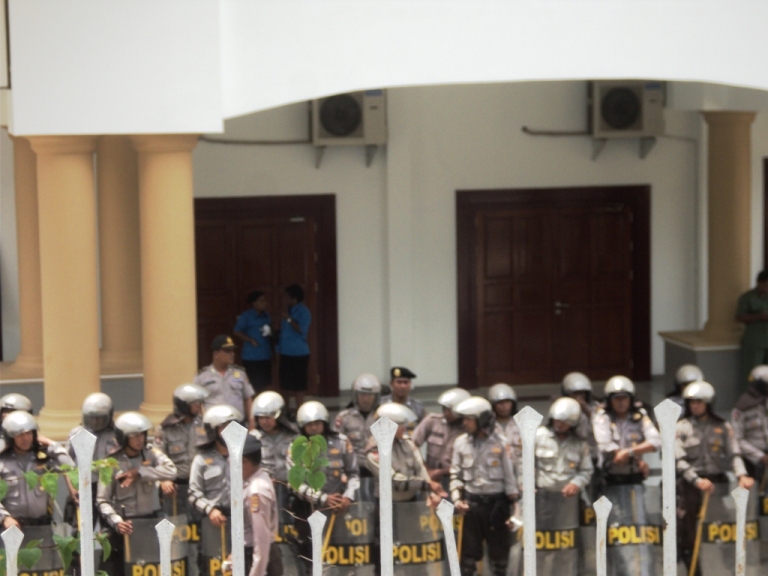
The video shows the late May 2009 raid on the Kapeso airstrip in the village of Kampung Bagusa in Mamberamo regency by troops from Indonesia’s elite police counter-terrorism unit Detachment 88 as well as other security personnel from BRIMOB and other units. Detachment 88 was created at behest of the U.S. government and receives significant U.S. and Australian Government funding and training assistance.
The footage, filmed by a Detachment 88 officer on his mobile phone, shows the immediate aftermath of a raid to retake the airfield which had been occupied for several weeks by a small armed group and a large number of villagers. The bodies of at least five dead are visible on the ground and sporadic gunfire is clearly heard. It appears that the footage was taken well after the killing took place. Footage depicting security personnel taking cover behind desks appears to have been staged to suggest the conflict was continuing.
Disturbing scenes at the end of the footage appear to show two Papuan children tied up and being forced at gunpoint to crawl along the floor by the Indonesian military. The footage continues to show them in apparent pain while the soldiers taunt them. In another scene troops are shown firing at civilians cowering in adjacent brush.
Indonesian authorities have not investigated events surrounding the Kapeso occupation and shooting of civilians by security forces.
West Papua media commented that such footage of brutal Indonesian security force actions, amounting to ‘trophy footage,’ is rampant among troops operating in the region.
For all media enquiries please contact Nick Chesterfield at West Papua Media on wpmedia_admin@riseup.net or +61409268978
In September 2010, East Timor and Indonesia Action Network (ETAN) and West Papua Advocacy Team (WPAT) called for suspension of U.S. aid to Detachment 88 “pending review of charges leveled against the unit for systemic human rights violations, including use of torture.”
Government’s “Dialogue” Approach with Papuans Faulted
The “Alliance for Papua” on February 25 issued a press statement that critiqued a government plan for dialogue with Papuans. The statement called on the government to better synchronize its plans for the dialogue with the reality of politics in Papua. (See below for composition of this NGO alliance.)
The initial government approach calls for two presidential assistants to engage in dialogue with Papuans who would be represented by the Papuan branch of the National Human Rights Commission (Komnas HAM), the Papuan People’s Council (MRP), and the churches. The two presidential assistants are Bambang Darmono and Farid Husein.
The Alliance for Papua urged that the government to create appropriate conditions for dialogue by undertaking to “consistently protect and comply with the basic rights of the Papua people by ensuring that there is no repetition of violations of Papuan human rights.” The alliance also urged that the government review the presence of the TNI security forces and the undercover security operations “that continue to occur.”
According to the alliance, the government also should not proceed with the election of members of the MRP (Majelis Rakyat Papua, Papuan People’s Council). The MRP is an institution that was mandated by Papua’s special autonomy law (OTSUS). The vast majority of the Papuan people have declared that OTSUS has failed “because it has not taken sides with, given protection to, empowered and fulfilled the basic rights of the indigenous Papuan people.”
The alliance points out that the government has nevertheless pressed ahead with the election of a second-term MRP in 15 districts of Papua. The second-term MRP is due to be sworn into office soon. The alliance objects to proceeding with the seating of the MRP because the election of MRP members “has not been transparent and has failed to comply with the [mandated] electoral stages.” The alliance also contends that the counting of the votes has been deeply fraudulent.
The alliance argues that seating the fraudulently elected MRP members “will only reinforce the Papuan people’s sense of disappointment towards a government that lacks any understanding and has shown no respect for local Papuan feelings.”
For his part, the outgoing chairperson of the MRP, Forkorus Yoboisembut criticized the government approach to dialogue by arguing that those Papuan groups that the government has announced as dialogue partners are not representative of the people because they don’t fully understand the Papuan problem. He contended that the government approach to dialogue would amount to the government talking to itself ” because they are all within the same system, and this would solve nothing.” He urged instead that the dialogue be with DAP (Dewan Adat Papua, Papuan Traditional Council) , the Papuan resistance (OPM), the Papuan parliament, and other Papuan groups.
Separately, the executive director of LP3BH,Yan Christian Warinussy said a neutral party should mediate the Jakarta-Papua talks, He suggested an international group such as the Henri Dunant Centre or a foreign country with experience in handling conflict resolution, including Aceh.
WPAT Note: The Alliance for Papua in Jakarta was set up as an expression of solidarity with humanitarianism, in support of fellow human beings in their struggle for justice and truth. The Alliance includes KontraS, ANBTI, IKOHI, Imparsial, Foker LSM Papua, Setara Institute, HRWG, Komnas Perempuan, FNMPP, IPPMAUS, Forum Papua Kalimantan, PGI, Walhi, JIRA, LBH Pers.
West African Leader Supports Papuan Self Determination
WestPan, Canada’s West Papua Action Network, reports that the President of Senegal Abdoulaye Wade has become the first African leader to publicly back West Papua’s bid for self determination, stating that “West Papua is now an issue for all black Africans.”
His comments came in late January during a conference in Senegal’s capital Dakar, attended by Benny Wenda, a West Papuan activist who was granted political asylum by the British Government in 2003. Benny Wenda addressed the audience, telling them about the situation in his homeland. Following his address Wenda presented the President with a Papuan headdress, and was warmly embraced by him. The President then addressed the audience, urging all African nations to take attention to the West Papua issue and do whatever they can to help.
In 1969, when Indonesia, with the backing of the United States, sought UN approval for its annexation of West Papua through the fraudulent “Act of Free Choice,” it encountered significant resistance in West Africa where the memories of colonialism were still strong.
Papuan People’s Council Condemns Transmigration as Harmful to Local People
Responding to a report that the government plans to send more transmigrants to Papua, the chair of Dewan Adat Papua (Papuan People’s Council) Forkorus Yoboisembut https://lists.riseup.net/www/arc/reg.westpapua/2011-02/msg00051.html asserted that continuation of transmigration would transform the Papuan people into a minority in their own lands and trigger conflicts. “‘As the representative of the adat (traditional) people in Papua, I reject the transmigration program which fails to safeguard the position of the local people,” he said.
Forkorus’s statement came after media reports that the central government has allocated Rp 600 billion to pay for the transmigration of people from Indonesia to a number of so-called “under-populated” places in the Indonesian archipelago, including Papua. https://lists.riseup.net/www/arc/reg.westpapua/2011-02/msg00068.html
“I hope the central government will consider this matter carefully because the transmigration program to Papua has already resulted in the marginalization of the indigenous people in the context of (so-called) development work,” Forkorus stated.
Forkorus said that the location of transmigrants in many places in Papua has made it difficult for the local communities to preserve their own culture and lifestyles. Development of more luxurious migrant lifestyles, he explained, intensifies the marginalization of the local people.
In addition, because the government has lavished attention on the transmigrants, feelings of envy emerge.
Forkorus also noted that Papuans’ marginalization in their own homeland is evidenced by the cat that vast majority of those now running the economy are non-Papuans. Forkorus added that Papuans are not yet able to compete with the newcomers in economic affairs.
(WPAT Comment: Papuans rank at the bottom in Indonesia in terms of central government provision of health care, education services and employment creation. In the province of West Kalimantan, decades of central government driven “transmigration” has transformed the indigenous Dayak into a minority in their homeland and led to conflicts, particularly with Madurese transmigrants, along the lines of Forkorus’s concerns. The policy, abandoned during the Suharto dictatorship due to international condemnation, has been resumed under the Yudhoyono administration despite criticism that it is tantamount to ethnic cleansing.)
Human Rights Council Hears Urgent Appeal Regarding Human Rights Abuse in West Papua
On February 22, the Human Rights Council heard an urgent plea from the Asian Legal Resource Center (ALRC) regarding worsening human rights abuse in West Papua and the impunity accorded perpetrators of that abuse. The statement said in part:
- The Asian Legal Resource Centre (ALRC) is seriously concerned by ongoing, widespread human rights violations and violent acts being committed by the Indonesian security forces in the Papuan highlands in Indonesia. Impunity typically accompanies even the most serious abuses, as shown by the lack of effective remedies in a case of severe torture that the ALRC has documented recently. Despite institutional reforms in Indonesia, effective accountability for human rights violations in Papua is lacking, resulting in impunity that then engenders further atrocities.
- Impunity and the sense of injustice that it engenders in society are having a strong impact on social stability and cohesion in Papua. Repression, discrimination and human rights violations by the Indonesian security forces are adding to tensions. Papuans reportedly feel like second-class citizens in Indonesia, even within Papua itself, and face discrimination, poverty and injustice as a result. The military arbitrarily suspect Papuans of being linked with rebel groups and stigmatize them, subjecting them to abuse.
The ALRC statement recounts two of the more flagrant examples of abuse and impunity where military personnel were videoed beating and torturing Papuan civilians (see West Papua Report December 2010). Those prosecuted for this received minimal sentences. The ALRC statement comments:
- The government of Indonesia continues to deny the widespread use of violence by the Indonesian military in Papua, and alleges that these violations are rare and isolated, individual cases. However, the ALRC continues to receive further cases of violence against indigenous Papuans, including killings by the police and military, arbitrary arrests, the burning of houses and killing of livestock, which point to a widespread pattern of the use of violence, as well as a policy of intimidation by the Indonesian military.
-
The statement underscores the inadequacy of the Indonesian military and civilian court systems for addressing the continuing abuses:
- Human rights violations and other crimes committed against civilians by members of the military are still only tried by military courts, which lack independence, transparency, a comprehensive penal code incorporating human rights norms, and a system of punishments that are proportional to the severity of the crimes committed. A military tribunal is not able to hold perpetrators of torture accountable in line with international law standards. Such tribunals cannot invoke any military regulations that prohibit the use of torture. Therefore, perpetrators cannot be tried for committing torture and no remedies can therefore be provided to victims.
- Furthermore, the country’s penal code does not include torture as a crime. This means that members of the police that commit torture remain immune from criminal prosecution. Indonesia is therefore failing to comply with its obligations under the Convention Against Torture. Indonesia ratified the Convention against Torture in 1998, but the use of torture is still widespread and systematic…
The ALRC urgently calls for remedial action by the Indonesian government:
- Jakarta must ensure that the security forces halt the use of excessive force and violence-based strategies in dealing with security-related issues in Papua. Allegations of human rights violations must be investigated and any lacuna in legislation and due process must be addressed. For example, torture must be criminalized in line with Indonesia’s international obligations under the Convention Against Torture. Military personnel who are alleged to be responsible for human rights violations against civilians must be tried in civilian courts.
The ALRC also recommended that the Indonesian government undertake steps to reduce tensions and address outstanding injustice:
- …the ALRC urges the Indonesian government to heed the call for dialogue made by the Papuan indigenous community and avoid a
- further deterioration of the conflict in Papua. Finally, the ALRC calls on the Indonesian government to release all Papuan political prisoners,
- in order to show its commitment to a new path towards peace, security and human rights in Papua.
The ALRC underscored the role and responsibility of the international community in addressing the ongoing abuses and impunity:
- The ALRC invites the Special Rapporteur on the independence of judges and lawyers to recommend institutional reforms to the government of Indonesia to ensure that members of the military are held accountable by independent courts that uphold human rights and constitutional values and ensure that these are made available to legislators in Indonesia.
- The ALRC also requests that the Special Rapporteur on torture and other cruel, inhuman or degrading treatment or punishment follow up with the Indonesian government to ensure the full implementation of the recommendations made to Indonesia during the UPR review regarding the review of the penal code and the full criminalisation of torture.
Note: The Asian Legal Resource Centre is an independent regional non-governmental organization holding general consultative status with the Economic and Social Council of the United Nations. It is the sister organization of the Asian Human Rights Commission. The Hong Kong-based group seeks to strengthen and encourage positive action on legal and human rights issues at the local and national levels throughout Asia.
Journalist Organization Chief Calls for Reporting on Human Rights in West Papua
The chair of the the Papua chapter Alliance of Independent Journalists (AJI) speaking in Jayapura, urged the press in Papua to regularly monitor cases of human rights violations in Papua, according to a report published in February 11 JUBI and translated by TAPOL.
AJI’s Victor Mambor emphasized the importance of the media reporting the human rights situation in Papua saying this can help reduce acts of repression against the civilian population.
He added that many reports about human rights in Papua were only available from NGOs active in the field, and these were frequently quoted in reports that appear in the media. He stressed the importance in ensuring that these reports are accurate and credible. Journalists should provide the appropriate references to make it easier for others to investigate the violations that occur.
WPAT Comment: Reporting on human rights violations in West Papua, particularly in instances where the TNI or police were involved, pose risks for journalists. Manokwari area reporter Ardiansyah Matra was murdered in July 2010 following his investigative reporting regarding police and military coercion targeting civilians in the development of the MIFEE plantation project in Manokwari. AJI has been active in following up on this case. Government restrictions placed on foreign journalists and NGO personnel impede their access to West Papua and reporting on human rights in the region.
Papuan Political Prisoner Denied Adequate Medical Treatment
New concerns have been raised about the inadequate medical treatment afforded Papuan prisoners of conscience Ferdinand Pakage. He is going blind following a beating by prison authorities in 2010.
Peneas Lokbere, chair of SKPHP HAM Papua (Solidarity for the Victims of Human Rights Violations in Papua), told JUBI that his organization is continuing to press for medical treatment for Ferdinand Pakage. “We will continue to fight for treatment after he was struck in the eye by an official of the Abepura Prison. This caused his eye to bleed and he is now not able to see any more with this eye” said Lokbere.
SKPHP is working with Pakage’s family to press the prison authorities to speed up medical attention to his condition. Lokbere explained that his organization has been demanding treatment for Pakage since last year, when they sought permission for him to go to Jakarta where treatment is available. However, according to Lokbere, Prison Director Liberti Sitinjak refused permission for any transfer of Pakage out of West Papua. Lokbere noted that in 2010, Pakage was told by a doctor at the West Papua General Hospital in Dok II say that he needed to have an operation in Jakarta. The doctor said that his eye was badly damaged and that even if he does get medication in Jakarta, he will continue to be blind.
Pakage was assaulted by prison warders Alberth Toam, Victor Apono and Gustaf Rumaikewi while in detention in Abepura. Toam struck the blow that injured Pakage’s eye. None of the warders has been held responsible for this assault. Pakage is now held in custody with common criminals, including those convicted of violent crimes.
Military and Military-Backed “Developers” Seize Papuan Lands
A Sorong-area leader has illegally transferred Papuan tribal lands to the Indonesian military (TNI) and to non-Papuans. The transferred land is vitally important, affording resources that are key to Papuan survival. Victims include Papuans belonging to various clans and tribes including the Osok, Mambringofok Idik and Fadan peoples in Klamono and Semugu and Kalaibin among others. The TNI has employed terror and intimidation targeting local Papuans to enforce the land transfers. The land sites are located along the Sorong to Klamono road at kilometer markers 16, 38 and 49 in the western end of the territory.
The military and non-Papuan developers will exploit the land for military base construction and oil palm plantation development. Specifically, local District Chief (Regent) Stefanus Malak provided land to the navy at km 16 and to the army at Km 38 to build a bases (the latter land belongs to the Semugu clan). Land was also transferred to the TNI, without tribal consent, at Km 49. This site will be used by the TNI to develop a palm oil plantation.
Seizure of land by the TNI, especially through use of force, violates various international obligations undertaken by Indonesia including the UN Declaration on the Rights of Indigenous People Article 30:
- “1. Military activities shall not take place in the lands or territories of indigenous peoples, unless justified by a relevant public interest or otherwise freely agreed to or requested by the indigenous peoples concerned.
- “2. States shall undertake effective consultations with the indigenous peoples concerned, through appropriate procedures and in particular through their representative institutions, prior to using their lands or territories for military activities.”
Analysis Considers Papuan Self-Determination Struggle in Context of Similar Recent Successful Efforts
The Sydney Morning Herald on February 26 published an analysis comparing Papua’s struggle for self-determination with some recent anti-colonial struggles. “A Worm Inside the New Indonesia” by veteran journalist Hamish McDonald draws on the experiences of south Sudan and Kosovo, two emerging nation states as potential models for West Papua. McDonald, former Foreign Editor of the Herald with extensive experience in Indonesia, concludes that these developments have had the effect of rendering “respect for the territorial integrity of states and post-colonial boundaries somewhat tattered.”
Indonesia has long insisted that the international community affirmatively express public recognition of its “territorial integrity” in the context of West Papua. Similarly, Indonesia once demanded international recognition of its territorial integrity to include its annexation of East Timor, though with less success.
McDonald cites Akihisa Matsuno of Osaka University as suggesting that between Kosovo and southern Sudan, the later would appear to offer a more applicable precedent for West Papua. Sudan became independent in 1956 from British rule, but has been in civil war most of the time since. A 2005 peace agreement finally conceded a referendum on independence by the south. This suggests to Matsuno that a lack of integration between territories ruled by the same colonial power can justify a separate state. McDonald writes that ”this means that colonial boundaries are not as absolute as usually assumed.”
There is a broad international consensus that the 1969 Indonesian annexation of West Papua was in violation of its UN mandate to administer the territory and entailed a transparently fraudulent referendum, the “Act of Free Choice.” McDonald writes that Richard Chauvel, an Indonesia scholar at Melbourne’s Victoria University, described West Papua as Indonesia’s ”Achilles’ heel” and the conference. Chauvel argued that, notwithstanding Indonesia’s democratic progress since the fall of the Suharto dictatorship, West Papua remains “Indonesia’s last and most intractable regional conflict.” As such, Chauvel contends, ”Papua has become a battleground between a ‘new’ and an ‘old’ Indonesia. The ‘old’ Indonesia considers that its soldiers torturing fellow Indonesians in a most barbaric manner is an ‘incident’. The ‘new’ Indonesia aspires to the ideals of its founders in working towards becoming a progressive, outward-looking, cosmopolitan, multi-ethnic and multi-faith society.”
McDonald concludes that, as demonstrated by the ongoing developments in the Middle East, “the new media make it harder and harder to draw a veil over suppression. In the Indonesia that is opening up, the exception of West Papua will become more glaring.”
Back issues of West Papua Report




 West Papua Media Alerts