Front Pepera PB: “Stop the Joint Indonesian Military/Police Operation against civilians in Dogiyai Regency”

Press Release Report

WEST PAPUAN PEOPLE’S UNITED STRUGGLE FRONT – NATIONAL EXECUTIVE

(EKNAS FRONT PEPERA PB)

Secretariate: Padang Bulan II – Abepura – Jayapura – Papua

=============================================================================

“Together for the History of the Star of the East”

Press Release

“Stop the Joint Indonesian Military/Police Operation against civilians in Dogiyai Regency”

On Wednesday April 13, 2011 at 2:30 PM local time, a bloody incident took place in Moanemani (capital of Dogiyai Rgency). This incident started with a protest by civilians objecting to the behavior of the local Police chief along with police officers in Moanemani, who seized toggle (gambling) money from local people.  According to the information obtained from trusted sources, the toggle site is owned by the Police chief and some police officers.  Police officers trust some local people to manage the gambling site.  Yesterday around midday, some local people were playing toggle near Moanemani market; at the time, a few police officers approached them and along with the Police chief, took away all of the toggle money that was in a plastic bag.  The toggle seller did not accept this behavior and went to face the Police chief, but one civilian named Domin Auwe (25 yrs) was shot dead in front of the local Moanemani police station; another civilian named Otin Yobe (23 yrs) was shot in the chest, with the bullet piercing the body beneath the armpit; and Amon Pigai (23 yrs) was shot in the waist and the chest.

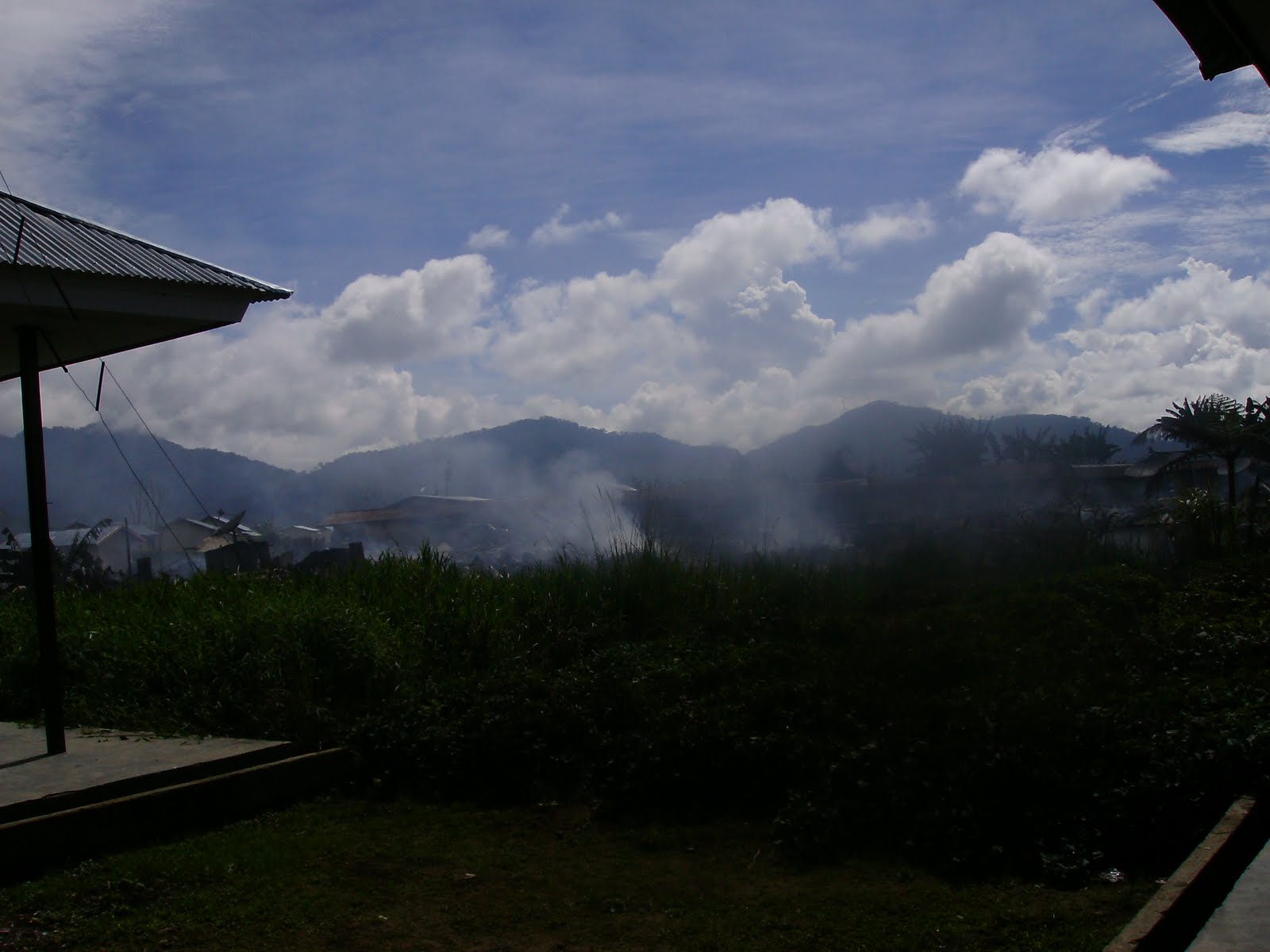
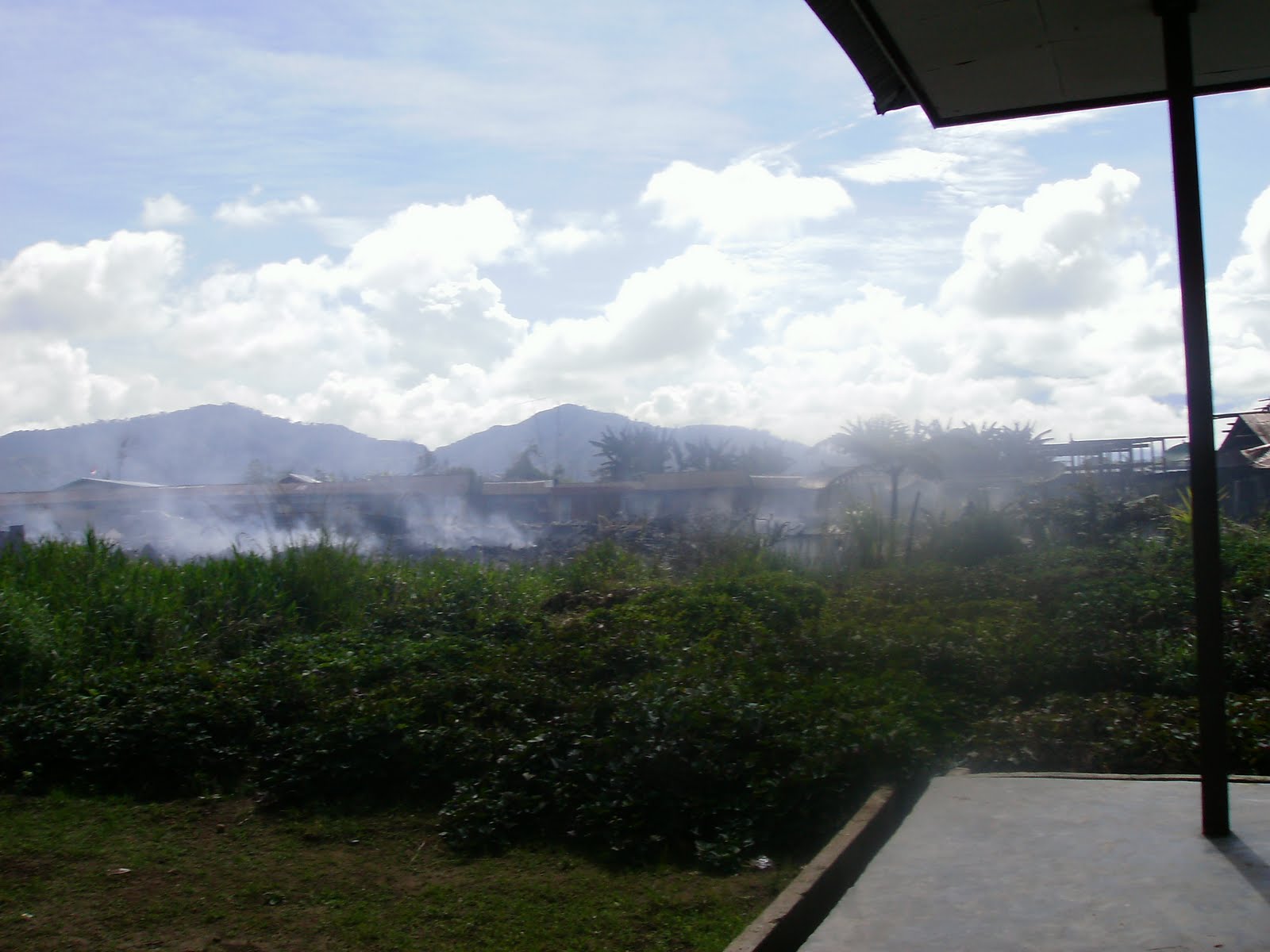
Local people did not accept this brutal action.  Some local people burned down part of the local Moanemani Police station and burned some shops owned by Police officers.  A joint Military/Police unit was then deployed, attacking locals’ homes in Moanemani and environs.  According to information we have gathered so far, four civilians’ homes were burned by the joint Military/Police operation; locals were terrorized, intimidated, beaten and shot; locals’ herds and gardens were destroyed.

During the night, at midnight local time, two of the civilians who were shot during the day, Amon Pigai and Otin Yobe, were brought to the Nabire hospital for treatment; both are in critical condition.  Meanwhile, the joint Military/Police units were brought to Moanemani from nearby locations including Nabire so as to expand the local operation.  Transmigrant (Indonesian) populations were evacuated to Nabire and the surrounding region.

On April 14 2011 at 8 AM local time, a local person named Aloisuis Waine (35 yrs) was shot dead by a joint Military/Police arbitrary sweeping operation in Iikebo – Moanemani, Dogiyai Regency.

Moanemani, the capital of Dogiyai Regency, is in a state of violent terror.  Most local inhabitants have already escaped to nearby villages for safety; meanwhile those remaining are staying in their homes, while some are even hiding in bushes and forest.  To respond to this bloody tragedy, we firmly demand that:

1.      The arbitrary sweepings by Military and Police against civlians in Moanemani (capital of Dogiyai Regency) and surrounding area cease immediately;

2.      Papua Police Chief and Regional Mlitary Commander for XVII Cenderawasih command immediately accept responsibility for the shooting deaths of two civilian (Domin Auwe and Aloisius Waine) as well as the two other shooting victims (Amon Pigai dan Otin Yobe) who remain in critical condition at Nabire Hospital, and also other victims of shootings and beatings carried out during sweepings.;

3.      Local Police chief and Military Commander as well as soldiers and Police officers in Moanemani who have arbitrarily brutalized local people immediately be disciplined sternly (fired from their positions with Military or Police) and brought to justice and sanctioned in accordance with the level of brutality they have enacted;

4.      Papua Police Chief immediately ban gambling and specifically Toggle in Papua;

5.      Governor of Papua Province and Dogiyai Regency Government accept responsibility over the loss suffered by local people, including the burning of shops by locals as well as the burning of homes by the Military and Police, in addition to other damages;

6.      Papua Province Legislature immediately form a Humanitarian Team to advocate around the tragedy that has gripped the people of Moanemani, Dogyiai Regency;

7.      National Human Rights Commission immediately advocate for the victims of the bloody Moanemani tragedy.

That is our press release that we express with all sincerity in the hopes of follow-up action by all relevant actors.

Demikian siaran pers ini kami buat dengan sesungguhnya untuk ditindak-lanjuti oleh pihak-pihak terkait.

Jayapura, Thursday, April 14 2011

“Unity Without Limits, Struggle Until Victory”

SELPIUS BOBII

(Public Head, WPPUSF (Front PEPERA PB))

4 Residents Shot Dead By Indonesian Police in Dogiay, West Papua

by Victor Yeimo, KNPB

[Dogiay, West Papua] – 4 residents, namely Dominikus Auwe, Pinsen Tigi, Alwisius Waine, and Matias Iyai from Dogiay (near Paniai, West Papua ) have been shot dead by Indonesian Police on 13 April 2011 at 3.00 AM.  During this operation, some others residents were injured.

According to local witnesses, this incident began when police wanted to disperse some people who were playing a gambling game.   These people were immediately attacked by the police, without giving any warning to the victims.

Until now, several houses (in DOgiyagi) have been burned down by police. About 2,000 residents fled to the forests because of last night, there are 7 companies of police were brought in from Nabire last nigh at 3.00 AM.

(WPMA NOTE: these are preliminary figures based on witness reports.  WPMA has no way of independently verifying these numbers at present, but given the severity of the operation the numbers would be accurate.  1 Company of Police would be approximately 100-150 men, depending on the unit)

Local people claim that AKP (Inspector) Marji Marpaun is immediately responsible for this incident.

MORE INFORMATION AS IT COMES TO HAND.

Photos by ALIANSI-MAHASISWA-PAPUA(AMP) 

http://myspecialdocumentaries.blogspot.com/  (tested, legitimate link)
=============

Victor F. Yeimo,
International Spokesperson for the West Papua National Committee [KNPB]
“Tidak ada kemenangan revolusioner tanpa teori revolusioner”


Papuan people’s coalition refuses to recognise new MRP

JUBI, 13 April 2011

The coalition of Papuan People United for Justice, KRPBK has declared that it refuses to recognise the new MRP.

Spokesman of the coalition Selpius Bobii, said that inauguration of the new MRP was a sign of lack of respect for the chairman of the former MRP who has just passed away.

‘This inauguration is an insult to and abuse of the struggle of the
indigenous Papuan people which was waged by the first MRP.’ he said.

The coalition issued a press release one day ago calling on all 73
members of the new MRP to resign from the body.

The inauguration of the new MRP took place on 12 April and was sworn in by the Minister of the Interior, Gamawan Fauzi and was attended by the governor of Papua Bas Suebu, the governor of West Papua, Octovianus Atururi and the heads of various districts in West Papua

Benny Giay shocked by death of Agus Alua, calls for MRP inauguration to be postponed

JUBI, 9 Apil, 2011

The chairman of the Synod of the KINGMI Church Papua, Dr Benny Giay said that the sudden death of Agus Alue Alua has come as a great shock not only to his family but to all West Papuans.

Agus Alua, the rector of the Theology College of Philosophy and
Theology, was a member of the last Majelis Rakyat Papua and his death occurred just as the second MRP was about to be sworn in, against the background of much controversy. [It is known too that although Agua Alua had been proposed as a member of the new MRP, his name was excluded under pressure from the government.]

‘Because the Indonesian government saw Agus Alua as a threat, they were not happy about him being a member of the new MPR. In the midst of all this, he died which has shocked us all,’ said Dr Giay.

He said that Agus Alua’s views were known to be opposed by the
government who regarded him as a separatist, which is why they did not want him to be chosen as a member of the new MRP.

Asked about what may have led to his death, Giay said he had frequently come under pressure from many sides, sometimes through messages on his cell phone or through direct terror threats.

All this is very likely to have been because of the decision adopted by the MRP at a meeting in 2010 when they adopted eleven recommendations, one of which called for a referendum in Papua about the status of Papua.

He said that the death of Agus should be seen as a crime against the basic rights of the Papuan people and aganst their rejection of special autonomy.

Dr Giay said that despite his death, the government was going ahead
with the inuguration of the new MRP although many were calling for this to be postponed, at the very least until after the period of mourning for the loss of Agus Alua.

He also called for all those who have been appointed to the new MRP to boycott the inauguration. He was hoping in particular that all 40
members from the Central Highlands would boycott the inauguration, out of respect for Agus Alua who was also from the Central Highlands.

Agus Alue Alua: A life of dedication to the Papuan People

Obituary of Agus Alue Alua
A life of dedication to the Papuan People 

Agus Alue Alua was born on 13 September 1962.  He studied at the Catholic secondary school Dok V, Jayapura and later worked as a teacher, then spent three years studying at the Catholic University in Leuven, Belgium.

From 1997, he took part in discussions within Catholic circles about the need to wage a struggle for the rights of the Papuan people, always stressing the importance of eschewing violence and pursuing the path of peace.

During the reformasi era that followed in the wake of the downfall of Suharto, he made good use of the newly-found freedoms to discuss such issues as development and the basic rights of the people of West Papua. Under discussion at the time were two alternatives for West Papua, autonomy or independence from Indonesia.

Agus Alua was one of several Papuan intellectuals to be appointed to the Committee of 100 which held important talks with President B.J. Habibie on 25 February 1999.  According to a colleague, he impressed everyone as he spoke with conviction and dignity: ‘We want our freedom,’ he said. ‘We want to organise our own homeland.’

The meeting ended inconclusively. The Papuans were advised to go away and consider their situation but the talks were never resumed. He was one of the first Papuans following that aborted encounter with Habibie to spread the idea about the need for dialog with Indonesia.

Catholic church leaders made good use of the more conducive political atmosphere to discuss the role of the church in Papua’s political struggle. While Bishop Leo Laba Ladjar OFM who was then the Bishop of the Jayapura Diocese, was hesitant about siding with the Papuan people, Agus who was a lecturer at the STFT -Fajar Timur (the High School of Philosophy and Theology) at the time challenged these thoughts, warning that if the Church failed to side with the Papuan people, he and others would set up a Papuan Catholic Church.

At the historic Second Papua Congress in June 2000, Agus Alua was elected deputy secretary-general of the Central Council of the newly-created PDP, the Papuan Presidium Council, one of two Papuans from the Central Highlands, along with Tom Beanal, and two from the coastal regions, one of whom was Theys Hijo Eluay, who became chairman of the PDP. Theys was assassinated in November 2001 by members of the army’s elite force, Kopassus. As a member of the PDP Central Council, Agus Alua played a key role in drafting documents that gave voice to the need to struggle for the Papuan people’s aspirations.

He later became the Rector of STFT-Fajar Timor, where he had previously been a student, as well as Director of the Catholic Senior Seminary. He also wrote and published several books about the culture of the Dani people and about a whole range of Papuan political issues.

However, the Papuan spring ended in 2002 when Kopassus agents infiltrated the PDP leadership and set about destroying the movement from within. Some of its leaders withdrew, several died under mysterious circumstances, while others gave up the struggle and threw in their lot with Indonesia. Agus remained true to the Papuan struggle, using all means possible at home and abroad, frequently visiting countries in the Pacific and Europe to win support for the Papuan people.

When the Special Autonomy Law, OTSUS, was enacted in October 2001, a special council composed solely of Papuans, the Majelis Rakyat Papua, the Papuan People’s Council, was set up which he recognised as an institution of crucial importance in the fight for Papuan aspirations. He became its first chairman with the support of Bishop Leo Ladjar, a position he held for the first five-year term of the Council till shortly before his death.

He fought strenuously throughout his term to expose the malicious strategies of the central government which sought to undermine OTSUS. From the start, the central government had been half-hearted about OTSUS and had even delayed its establishment for several years, fearing that it might become a springboard for Papuan political aspirations One of the moves from the central government to undermine the unity of the Papuan people was the decision to split West Papua into two provinces which Agus Alua vehemently opposed. He continually worked hard to counter the government’s attempts to create divisions and conflicts among the Papuan people.

After the creation of the two provinces, he insisted that there should be a single MPR and whenever Jakarta pushed for policies to undermine OTSUS, he strenuously resisted, along with his close colleagues Frans Wospakriek, former rector of Cendrawasih University, and Hanna Hikoyobi who was deputy secretary-general of the MRP.

Among the many central government decisions he opposed was Presidential Decree No 77 which banned the use of Papuan symbols such as the Morning Star flag, the mambruk bird and the Papuan song, Hai Tanahku Papua, insisting that these were legitimate cultural symbols provided for within the terms of OTSUS. Another of his decisions was to make it obligatory for all positions of leadership in the Papuan provinces and regions to be held by indigenous Papuans.

Before ending his term as chairman of the first MRP, Agus oversaw the adoption of eleven recommendations. These recommendations included a declaration that OTSUS had been a failure and should be returned to Jakarta, that there should be an internationally-mediated dialogue, facilitated by a neutral third party, and that a referendum should be held on the question of Papuan sovereignty. These eleven recommendations comprehensively set forth the basic demands of the Papuan people and continue to inspire the Papuan struggle to this day.

Agus Alua was always steadfast in his support for Papuan efforts to make Special Autonomy a reality against constant obfuscations from central government, and continually used his outstanding intellectual abilities to promote Papaun interests and aspirations.

At the time of his tragic death, the second-term MRP was due to be inaugurated amid disputes about its membership, with Jakarta rejecting the appointment of Agus Alu and Hanna Hikoyobi. According to sources in Jayapura, these two had been elected as members of the new body, against the wishes of central government. The appointment of the second-term MRP is still in dispute; some of his colleagues believe that the pressures and intimidation he experienced at the time plunged him into deep depression, leading to his untimely death on 7 April. On that day, he was found lying on the floor at home and was rushed to hospital but was dead on arrival.

He is survived by his wife Cornelia Pekey and his three children, Liberta Claudia Alua, Liberto Claudia Alua and Hilerti Alua.

Carmel Budiardjo [with help from Octovianus Mote]

Create a website or blog at WordPress.com

Up ↑