Tragic Bloodshed in Waghete, Papua – Suspected Serious Human Rights Violations

Analysis/ Opinion

by Selpius Bobii

Abepura Prison,  27 September 2013

Ever since West Papua was annexed into the Republic of Indonesia on 1 May 1963, it has been nothing other than a land smeared with blood, and at every moment the blood of Papuans has been shed by continuous killings.   On 23 September 2013 there was yet again bloodshed with a tragic incident in Waghete, Tigi district, in Deiyai Regency of the Central Highlands.  The incident started from ‘sweeping’ (house to house searches) carried out by joint armed forces of BRIMOB (an Indonesian National Police special operations unit), and a special unit of the Indonesian Military (TNI) unit 753, the Paniai District Police and local police from the Sub-District Units of Tigi and the Paniai Koramil.  The following article looks in detail at the background to why this incident occurred and at the impact of the incident on the local community.

When asked why the joint armed forces were carrying out sweepings in the area in the first instance, the High Commissioner for Police in the District of Paniai responded that they were making the area safe for civilians from the practices of gambling, drunkenness and the carrying of sharp objects (www.tempo.co/read/news/2013/09/23/058515978). However the facts clearly indicate that the sweepings were being carried out not to make the area safe for civilians against the said vices of drunkenness and gambling, but rather to:

  1. Confiscate any sharp instruments including all types of smaller knives, large machete like knives, axes and bows and arrows
  2. Confiscate shovels
  3. Confiscate mobile phone memory cards with photos of those active in the Papuan Freedom Movement
  4. Confiscate traditional woven dillybags (nukens) with patterns of the Morning Star flag, and to
  5. Target community members with dreadlocks and long beards.

Of course the very items that the armed forces confiscated during the sweeping – small knives, larger machete type knives, axes and shovels – are those used by the community for maintaining their gardens which is their source of food.  As in the Deiyai regency most civilians are farmers who farm the mountain slopes. The forces even confiscated any traditional darts, which are something which by customary beliefs cannot be separated from the life of the Mee Tribe as they are symbolic and special to that tribe. That they would even consider confiscating the peoples carrying bags and mobile phone memory cards with Papuan photos is a shameful reflection of the police and military, as those are symbols of Papua that are widely available and have been published in many books, media and other publicly available forms.
The TNI and police are well aware the people need those tools in particular to survive and they well know those items are widely accessible, so the question begs why did they really intentionally undertake operations to confiscate these items?

The targeting of civilians with dreadlocks and long beards –  based on the false perception of the police and military that anyone of that appearance is a member of the TPN /OPM – is also a shameful reflection of the thinking of the armed forces, as long beards and dreadlocks are an age-old tradition of Papuans.  The Indonesian police and military should understand and respect something of the cultural and social ways of the people of Papua such that they don’t recklessly carry out arbitrary actions which can lead to the sacrifice of innocent civilians’ lives. Reckless and improper actions which  also destroy the image of the police and Indonesian army in the public eye. Throughout the many years of Indonesia’s presence in Papua police, TNI and National Intelligence (BIN) have always assumed that Papuans with dreadlocks and long beards are all TPN OPM members. Whenever met with people with those physical characteristics the armed forces always act with improper and cruel actions intended to make life hard for those individuals. This is absolutely unreasonable! We could just as much say that every Papuan who longs for liberation from the cruel oppression of Indonesia could be called OPM!  When is Indonesia going to wake up to the reality that that no action whatsoever of the Indonesian military and police against the people of Papua will ever be able to destroy the Mambruk (Papuan) ideology in their hearts; that their cruel actions will never be able to stifle the political aspirations embodied by the Papuan movement for freedom.  Reckless,  cruel and improper actions by the armed forces such as occurred at Waghete must stop!  The forces instead need to adopt persuasive approaches (with dialogue and non-violent means)  in facing up to civilians in all circumstances and not use repressive measures such as has been evidenced at Waghete.

The events that led to the killing and wounding of civilians that day in Waghete started with the above stated sweepings which were being conducted in a manner that was far too excessive and abusive.  A particular activist present at the time (who cannot be named for safety reasons ) told the armed forces at the time that the community didn’t accept their excessive sweeping actions, but to no effect. They testified that before the shootings on 21 September 2013 the joint armed forces had carried out sweepings and detained 15 Papuans who had dreadlocks and long beards. Then on 23 September 2013 the forces returned to the same location where those persons had been arrested and carried out sweepings yet again with excessive abusive behaviour.

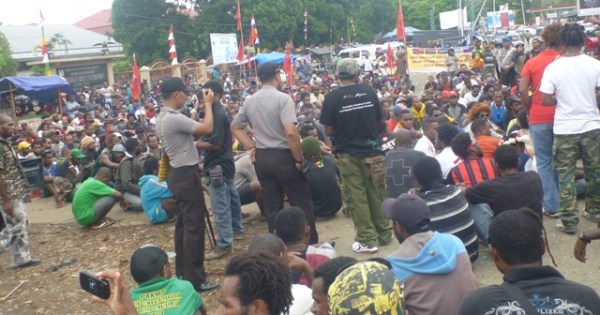
It was the second aggressive sweeping according to the witness that was just too much, and some in the community couldn’t keep silent.  He testified that it was not the adults who voiced the community’s protest but rather high-school and upper secondary school students together with a number of other youth. The armed forces had also confiscated some of the young peoples’ phone memory cards then according to the witness the young people protested in particular after seeing two Papuan mothers on their way to  their gardens having their gardening shovels confiscated then an adult male’s koteka (penis sheath) being checked by forces.  The witness stated: “The protest came from the school children and no adults were involved.  Then the police responded to their protest with excessive violence. The Head of the Paniai District Police a number of times shouted out a command to those under his command to shoot the children.  I was there at the time and saw myself the Head of the District Police together with police officers under his command, chasing and shooting at the school children with their weapons. That day I also heard there were 4 civilians detained.”

The Police spokesperson claimed that the disturbance occurred due to provocation by a group of supporters of a particular failed candidate in the local government elections. However another activist at Waghete (who also cannot be named for security reasons) testified that “the tragedy at Waghete was entirely due to the actions of the joint Indonesian police and military forces and cannot be said to be connected in any way to a problem of the local elections.”

This accusation by the police was just a strategy to try and  turn criticism back towards the local civilian population.

The facts are clear that it was the military and police that provoked the civilians into carrying out some type of protest in response to their excessively abusive treatment of the people  during the sweeping and their arbitrary arrest and detention of a number of community members. The forces then met the young people’s opposition with extremely excessive violence including shooting, killing, arbitrary arrest, and torture of civilians. If there had not been excessively abusive sweeping by the joint armed forces in the first instance then of course there would never have been opposition from the young people. Secondly if the response from the civilians had not been dealt with so repressively by the police and military then of course there would also not have been victims of  shooting, torture, intimidation and arbitrary arrest. In summary it was precisely the excessively abusive sweepings by the military and police that triggered the reaction from the civilians; It was precisely the repressive reaction from the armed forces to the civilians’ opposition which caused the tragic killing and serious shooting injuries of civilians in Waghete.

In considering whether there is any element of truth in the police’s accusation that civilians attacked them with rocks, or pieces of timber or arrows, a human rights activist Yohanes Mote who was present at the time of the shooting stated to the magazine Selangkah, “At the moment the incident occurred I was there. The community didn’t take up arrows. We were really disappointed that they were checking the penis sheaths of the men (traditional clothing of males). As there’s nothing inside penis sheaths but male genitals is there. We asked them why if they wanted to carry out sweeping because of gambling and drinking (alcohol), had they not stopped the drinking and gambling.  The gambling and drinking had been allowed to continue by the police so that through that we Papuans could be killed and shot like this.”, (www.majalahselangkah.com/content/penembakan-pelajar-di-deiyai-aktivis-ham-minta-kapolri-copot-pelaku-dan-evaluasi-polisi-di-papua).

Another activist who also can’t be named for security reasons testified “The students didn’t attack the armed forces with arrows. I only saw two or three students throw rocks in the direction of the armed forces but the rocks didn’t even hit them. Rather the police and military brutally shot those children. The one that shot Alpius Mote was an aide of the Paniai Head of Police. Alpius died on the spot as the bullet went right through his right side and came out his back. He didn’t die whilst being taken to the Paniai hospital (as the police claimed). Whilst regarding Alex Mote (another victim), the bullet entered the right side of his chest. After Alpius was shot dead the police gathered up all the bullet cartridges. I couldn’t take a photo at that moment as it would have been impossible.”

From the explanations of these two activists who were present at the time of the sweepings and shooting, it is clearly evident that the accusation of the police that the community attacked them was merely words to try and justify their own repressive actions of wounding and killing unarmed civilians. It is most ironic that the Papuan Provincial Police spokesperson also tried to legally justify the police and TNI’s actions, stated that the shooting by their forces was in line with their procedures since the citizens were becoming increasingly anarchist. He tried to justify the shootings on the basis that if the forces hadn’t fired then the situation would have escalated (www.news.viva.co.id/news/read/446352-bentrok-aparat-dan-warga-di-papua–1-tewas).

Returning to the initial action of the forces – being the sweeping – one must ask the question why were the police and TNI carrying sweepings out in such an excessively abusive manner in the first place. From the facts provided by witnesses as stated above, it would seem that the sweeping was intentionally carried out in such a way so as to give rise to some type of conflict in Waghete. The sweeping was not intended to make the community safe from vices of drinking and gambling as the police claimed, but rather to give rise to a conflict that would enable the armed forces to do away with those in the community with long dreadlocks and beards who were considered by the forces to be OPM/TPN members. The sweepings also provided an opportunity for them to confiscate any items that were symbolic of the freedom struggle. It was an intentional act carried out to make people terrified and to torture, kill and injure innocent civilians at that location.

Witnesses testified that on 21 September around 15 people with dreg locks and long beards were violently arrested and detained at the Paniai District Police Command headquarters. Then on 23 September one student was shot dead and another shot in the chest. An English teacher from the local Deiyai upper secondary school Yance Pekey who voiced opposition to the treatment by the armed forces, was also inhumanely ‘dealt with’ at his office. It is understood he was also detained together with the other 3 civilians at the Paniai District Police Station. From data available to date it is understood that the total of civilians detained over these few days was 19. To the date of writing their names have not been made available by the police and neither has access been allowed  to visit any of them. (For the preliminary report to this incident  see: www.westpapuamedia.info/2013/09/27/preliminary-report-into-waghete-deaths-and-sweepings/).

From the above stated detail the Writer concludes that the tragic events from 21 – 23 September 2013 in Waghete involved a number of serious human rights violations. Violations which commenced with the excessively abusive sweeping and harassment by the military and police; followed by the arbitrary arrests, torture,, shooting dead and wounding of citizens and the general terrorising of the local community in Waghete. The actions of the police and military cannot be justified with any reason whatsoever! The tragic killing and wounding of unarmed civilians that occurred fall within the category of serious human rights violations and the culprits must face legal processes and be held responsible (1).

Footnotes

 1)To that end the Writer puts forward the following recommendations to those parties involved:

i) That the TNI and Police in the land of Papua must cease carrying out excessive sweepings and terrorising/ intimidating the people, must cease all torture and other brutal treatment of civilians, all shootings, killings and arbitrary arrests.

ii) That the culprits of the acts at Waghete must be brought to justice in the human rights court or general court to hold them responsible for their actions.

iii) That the Head of the Indonesian Police is strongly urged to immediately remove from office the Head of Police in the Sub-District of Tigi, The Head of the District Police in Paniai and Head of the Papuan Provincial Police. As all three persons have acted irresponsibly and are not capable of ensuring the safety of citizens.

iv) That the Head of the Paniai District Police immediately and unconditionally release all citizens (believed to be 19 in number) who are being arbitrarily detained at the Paniai District Police Station.

v) That the Investigation Team appointed by the Papuan Legislative Council (DPRP) on 25 September 2013 to look into the tragedy in Waghete,  immediately be sent to the location of the events  to commence investigations.

vi) That the Indonesian Republic National Human Rights Commission (Komnas HAM RI) immediately form an adhoc team to follow up the early findings that will be reported by the independent DPRP Investigation Team.

vii) That all parties and in particular the local government, leaders of the church and  traditional customary leaders in that region, act immediately to restore security and order in Deiyai.

viii) To all those who are concerned and who work in the field of humanitarianism, your help is requested at this immediate time in advocacy, monitoring and publishing of information regarding this case and in organising assistance for those civilians who have been detained at the cells of the Paniai District Police Station.

ix) The excessively abusive sweepings, the terrorising and intimidation, the torture, shootings, killings and arbitrary arrests of indigenous Papuans by both the Indonesian military and police in the land of Papua will never bring an end to the problems in Papua. The Indonesian Government needs to instead enter into dialogue / unconditional negotiations with the nation of Papua facilitated by a neutral third party and held in a neutral location in order to find a dignified solution to the problems in Papua.

Selpius Bobii is the General Chairperson of Front PEPERA & a Papuan Freedom Political Detainee in  Abepura Prison, Jayapura


What should be the role of the Australian government as a member of the UN Security Council ?

Opinion / Analysis
By Herman Wainggai
September 11, 2013

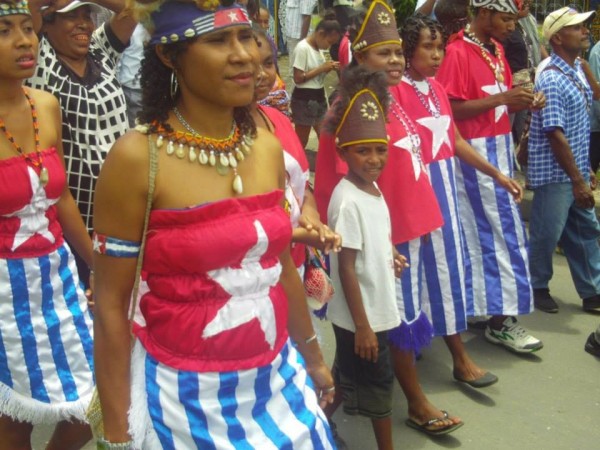
Papuan women wearing the banned Morning Star flag as clothing at Manokwari demo to welcome Flotilla (Photo: West Papua Media stringers)

Knowing  the history of the Indonesian state’s Army and Police invasion of West Papua there is no surprise in the fresh news of increased Indonesian military troops to the region, who are growing rapidly on this Melanesian ground like fertile mushrooms.

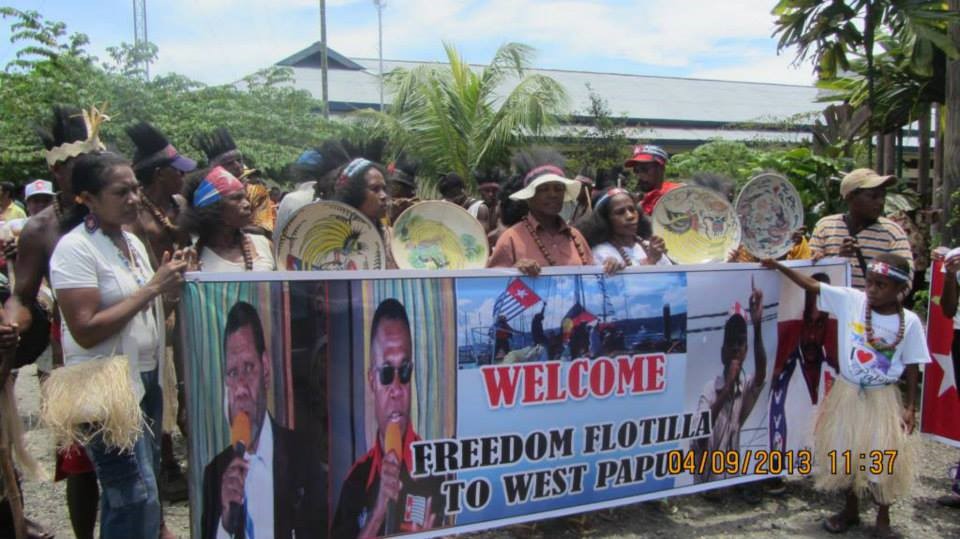
The Freedom Flotilla sailboat is currently on its voyage from Australian waters to the land of West Papua , and it has been confirmed that it is due to arrive within the next few days. Throughout the land of West Papua citizens and activists have been holding a number of peaceful demonstrations as a signal to welcome this boat. Thousands of West Papuans have bravely taken to the streets, high in enthusiasm and taking with them a variety of traditional instruments used in West Papua – ukuleles , guitars , drums , flute drums. They are also wearing traditional dress, and along with raising banners of the Freedom Flotilla sailboat, they are also displaying the national symbols of West Papua – the Morning Star flag.

This represents a challenge to and hope for the Indonesian government, that it ‘opens up’; that Jakarta demonstrates that it possesses genuine democratic maturity to negotiate peacefully with the political leaders of West Papua.  The people of West Papua, moreover, sincerely look forward to the newly elected Australian Federal government, especially in its new role as one of the member states of the UN Security Council, to act as a  mediator and by standards of international law help resolve the long running political conflict between the Indonesian government and the people of West Papua.

Demonstration welcoming Freedom Flotilla, Sorong (photo: supplied from Herman Wainggai, NFRPB)

Our hope is that the precise opposite does not happen – that the Australian Government merely lets the Indonesian government continue to unilaterally kill the political, human rights and democracy activists of West Papua. This has been their lot for over 50 years – arrests, kidnapping, detention, shooting, killing, raping, long imprisonments.

The people of West Papua also hope that the Australian government will not forget this tiny Freedom Flotilla who will be facing the storm of the Indonesian military whose numbers have been newly swelled in the border area. Whatever happens, Australia needs to be assured that the people of West Papua will maintain their struggle to govern themselves, and will fight for that freedom by non-violent means.

The Freedom Flotilla to West Papua logo

The history of Indonesian brutality in West Papua over decades must be stopped by the international community, which includes Australia in its significant roles in the UN and  the Asia-Pacific region.  The data has been clearly documented from year to year – how long must West Papuans continue to be slaughtered like animals? The question is very pertinent then – what will be Australia’s role, and the USA and the United Nations – in regards to West Papua?  This land of the Mambruk – the beautiful Crowned Pigeon and symbol of Papua – which we love, shall we close our eyes and stop our ears to the injustices?

In the same way that attention is currently being given to the political situation in Syria, so must attention be given to the little Freedom Flotilla, and to the suffering people of West Papua, who have struggled for freedom and justice under the brutal regime of the military of the Indonesian state

Leading Indonesian NGO Condemns the continued use of Treason Charges against Papuans

by ALDP (Alliance  for Democracy in Papua)

Opinion/Statement

September  6, 2013

68 YEARS SINCE INDONESIA BECAME INDEPENDENT, TREASON [MAKAR] IS STILL BEING USED AGAINST PAPUANS.

The  Indonesian people recently celebrated the 68th anniversary of their independence on 17 August 2013.   What lessons can we draw from this anniversary in order to resolve problems faced by our people who experience so many problems in various parts of the country,  especially in regions where there is conflict such as Aceh and Papua?

Especially with regard to Papua, it is not acceptable for the articles about treason  to be used any more.   This is because for a country that is now based on democratic principles, it clearly violates these principles.  Furthermore, the law on treason which is still included in Indonesia’s Criminal Code is no longer used in the country where it originated [The Netherlands].  The continued use of these articles will only widen the gap between Papua and Indonesia and lead to acts of violence because of  feelings of revenge about history, or may cause friction between different groups of people.

These articles on treason are always held ready for use against activists or anyone who demands justice and the right to express their views in public, in accordance  with the right to freedom of expression.

The treason articles were first included in the Criminal Code in the 19th century. The Dutch Minister of Justice adamantly refused a move to include an article on treason which could be applicable to anyone.  He said:  ‘These articles should be enacted to meet the needs of a colonial territory and should not be applicable to  European countries.’

The articles on treason were adopted by the Dutch colonial government and were based on Article 124 of the British Indian Penal Code.  In 1915. The Indian Supreme Court and the East Punjab High Court declared that they were invalid because they contradicted the Indian Constitution which upheld the principle of freedom of expression.  In The Netherlands, these articles were regarded as being undemocratic.   However, the Dutch East Indies government made use of the articles in their colonial territories.

In this day and age, several decades after Indonesia declared its independence, these articles should no longer be applicable to citizens of the country, including Papuans, bearing in mind that Papua is not a colony of Indonesia. {Eds – This statement does not reflect WPM’s position}

In judicial terms, treason is a unilateral act against the authorities, for the purpose of ensuring that part of its territory falls into enemy hands or should be ceded in order to become part of another state.

The crime of treason  is regulated under Articles 104 to 129 of the Criminal Code – KUHP.  Treason is also classified as a crime against the president and vice-president [the head of state and/or the head of a rival state], against the legitimate government or against government agencies, being involved in espionage on behalf of the enemy, resistance to government officials, rebellion and other activities that are directed against state interests.  Treason is also committed against the government (the head of state and his/her deputy) for the main purpose being to render an individual incapable of governing, to annihilate the country’s independence, to overthrow the government, to change the system of governance by unlawful means, to undermine state sovereignty by  separating part of the country on behalf of another country, or to create an independent state.

The crimes of spreading hatred or incitement are dealt with in Articles  154, 155 and 156 of the Criminal Code. These articles state that ‘public statements which express feelings of hostility or are offensive to the government’ are regarded as crimes as well as public statements which support such sentiments. These articles are punishable for up seven years.

During the era of the late President Soeharto, these articles were frequently used to restrict freedom of expression. They were also used against political opponents, critics, students and human rights defenders in order to silence them. The people in power used these articles like rubber, something which can be pulled in any direction as a way of restricting the right to freedom of expression.

Nowadays, in {after} the era of ‘reformasi’, the articles are frequently used to bring charges against pro-democracy activists.  In Papua. They are used in every way possible against pro-democracy activists on occasions when it has not been possible to charge them for involvement in treasonous activities.

In a report published by Human Rights Watch (HRW) in 2007, ‘Protest and the Punishment of Political Prisoners in Papua’ , Indonesia was mentioned as one of the countries where exceptions and restrictions apply that are in conflict with the basic principle of freedom of opinion. HRW drew attention to the many cases of people being arrested and imprisoned simply because they took part in peaceful protest or for peacefully raising flags. This is in violation of international law on basic human rights.  Indonesian courts frequently apply the law on ‘spreading hatred’ or ‘incitement’  towards people who are exercising their right to freedom of expression. These clauses also violate the spirit of the Indonesian Constitution which was adopted when the country became independent in 1945.

There is a tendency in Papua for a court, having been unable to prove that treason was committed, to use the crime of incitement. The articles about treason  were used when Indonesia was a Dutch colony to charge individuals or groups of people with rebellion. But these days, ‘the articles on treason are used against the civilian population when they publicly express their aspirations,’ said Harry Maturbongs, the former co-ordinator of KontraS.

A lawyer in Papua, Gustaf Kawer, said that the tendency of courts and prosecutors to use the charge of incitement when they are unable to prove that treason has been committed, is a sign that the court is apprehensive and wants to avoid the possibility of people who have been charged making counter-charges against the state, where the case against them had not be proven.

It is often the case that pro-peace Papuan activists who are brought before the courts are charged on several counts for a variety of misdemeanours.  In the trial of Buchtar Tabuni in 2010, he was charged under five articles.  Article 106 and Article 110, as well as Article 160, Article 212 and Article 218, for treason, for incitement and for disobeying an order by an official.  Another group of people were sentenced and convicted for treason. Forkorus Yaboisembut and his colleagues were arrested by the police for organising the Third Papuan People’s Congress on 19 October, 2011.  [After formally declaring the establishment of an independent Federated State of Papua] ‘President’ Forkorus, along with his Prime Minister Edison G. Waromi, were arrested with others who were involved in organising the Congress, Dominikus Surabut, Agus M. Sananay Kraar and Selfius Bobii. They were charged by a team of prosecutors headed by Yulius D.

Even today In 2013, the treason article continues to be used. A group of men were recently charged. They are Klemens Kodimko (71 years old), Obeth Kamesrar (68 years old), Antonius Saruf (62 years old), Obaja Kamesrar (52 years old), Yordan Magablo (42 years old), Hengki Mangamis (39 years ) and Isak Klebin (52 years old) . They were charged at the first hearing of their trial in a court in Sorong on Monday, 19 August 2013.

A spokesman for the police in Papua, I Gede Sumerta Jaya, said that the men were charged with treason because they are leaders of the OPM (Organisasi Papua Merdeka) or of radical groups that are active planning or speaking out in favour of resistance to the legitimate government.

Earlier this year, on 30 April, hundreds of people gathered at a posko  [a small construction] which they had  just set up. They sang together as they gathered there on 30 April to make preparations to celebrate 1 May on the following day.  While they were singing, shooting was heard aimed in the direction of the posko. The shots came from some people aboard an avanza vehicle with darkened windows, accompanied by a police patrol vehicle.

[Translated by TAPOL]

Mixed success for Papuan Cultural parades despite pre-emptive arrests across Papua

Special Wrap-up report by West Papua Media, with local sources.

(Apologies for delay in posting as WPM was chasing hi-res photo essays from outlying regions.  This will be a separate item as soon as we get hold of them.)

August 26, 2013

Scores of non-violent activists from the West Papua National Committee (KNPB) were arrested across Papua over the last two weeks, when Indonesian Police carried out pre-emptive sweeps ahead of a day of mobilisation on August 15, a day intended to celebrate Papuan cultural identity and demand rights to free expression be respected.

Organisers across Papua claimed varying degrees of success in holding the cultural parades, hailing the assertion of Papuan cultural identity in the face of a “deliberate campaign of cultural suppression by the Indonesian colonial security forces” as a “moral victory that would show that West Papuan people are not going to die quietly,”  according to sources who spoke with West Papua Media (WPM).

The parades were organised by West Papuan activists on the anniversary of the contentious New York Agreement – that began the process of Indonesian colonisation of Papua – to demonstrate against ongoing the threats to the survival of Papuan culture.  The parades  were also celebrating the opening of the new Free West Papua Campaign office in The Hague in The Netherlands under the coordination of Oridek Ap (the exiled son of executed West Papuan musician and cultural hero Arnold Ap).

Despite Police being widely reported by Indonesian colonial media stating they would allow the parades to go ahead, activists and stringers for WPM reported from across the country of waves of arrests – or detentions as described by Indonesian security forces – and intimidation that prevented several of the parades from occurring.

Nevertheless, the events went ahead in Jayapura, Wamena and Biak, with  much smaller gatherings unconfirmed across the rest of the country.

Papuans villagers  arrested and searched, detained in Aula Fakfak Police for interrogation (photo: Alex Tethool / Jubi / Fakfak)
Papuans villagers arrested and searched, detained in Aula Fakfak Police for interrogation (photo: Alex Tethool / Jubi / Fakfak)

In the west coast town of FakFak, police arrested several dozen people on August 13, according to reports from Tabloid Jubi, and human rights sources.   Jubi reported that officers intercepted two trucks carrying dozens of villagers as they were preparing to attend the Cultural Parade on the 15th.  Police commandeered the trucks to  the police headquarters in Fakfak, detaining and interrogating the villagers – including large numbers of women and children –  in the Police Hall.  Police refused to explain their actions to Papuan media, according to local observers.  Unconfirmed reports from Fakfak say the majority of villagers were released, but the date of their release, or the ability for them to continue their participation in the cultural parades is still unknown.

Jayapura

In Jayapura, KNPB Chairman Agus Kosai was arrested by Police as he and other KNPB members attempted to move a sound system from his village near Sentani (about 12km outside Jayapura) to the gravesite of slain independence hero Theys Eluay in Waena.  KNPB treasurer Toni Kobak and National Spokesperson Wim Medlama were also arrested with 13 other KNPB members.  Police interrogated them but later released them, ordering them home after seizing their banners and equipment.

Refusing to be intimidated, the released KNPB members then ignored the Police directive, made new rally materials and proceeded with the planned Cultural Parades regardless in Jayapura.

This slideshow requires JavaScript.

Thousands of local people turned out in Jayapura to showcase Papua’s vibrant indigenous cultural diversity, reflecting and representing Papuan cultures from every corner of the country.   The day itself had been planned as a deeply symbolic act of cultural resistance through survival, drawing on the actions of slain ethnomusicologist Arnold Ap in a nonviolent assertion of Papuan sovereignty resisting  Indonesian colonisation and control of Papuan lives.

Indonesian Police surveille activists during the Papuan Cultural Parade, August 15, 2013
Indonesian Police surveille activists during the Papuan Cultural Parade, Jayapura, August 15, 2013 (Photo: West Papua Media / YS)

Illustrating this attempt at control, many acts of cultural expression such as banned dances, banned songs, and banned displays of cultural heritage were actively monitored by heavily armed Indonesian Police, however the sheer number of participants prevented further arrests.

Coordinator of the Peace Demonstration Warpo Sampari Wetipo, told the crowd from a stage mounted atop a Kijang car, “we in KNPB are standing with the people of Papua, despite the Indonesian military’s terror by prohibiting any peaceful demonstration and action, we do continue to fight without fear, to demand the right of self-determination for us, the people of West Papua.”

Buchtar Tabuni, West Papua Parliament Chairman, and revolving door political prisoner currently between arrests, reminded the crowd that they were gathered to “Declare to the world that the people of Papua are demanding the recognition of their right of self-determination with fairness and dignity.”  By demonstrating their cultural resistance, Tabuni said that West Papuan people were asserting their identity “as a community of the Melanesian family, that Papuans are not part of the people of Indonesia or Malay.”

Reports from the Jayapura rally suggested that police were initially prepared to utilise force against the participants after they defied the order to go home.  Significant military hardware was deployed, with security forces surrounding the thousands of people gathered at Theys’ gravesite with Armoured personnel carriers, water cannon, tear gas trucks and several Barracuda armoured assault vehicles.

According to reports filed to WPM, activists had prepared unspecified “unique” methods of non-violent de-arresting techniques should the need arise, though it is unclear whether the Indonesian security forces were prepared to respect the nonviolence of the day.

The rally had been tightly safeguarded by KNPB members, who kept the participants separated from security forces and plain clothes special forces personnel with a simple rope line, thus preventing any agents provocateur from provoking police to create a scenario of violence.  in Papua.   Buchtar Tabuni told the crowd at the end of the rally, “the security forces to help secure us, and also I just want to explain that from yesterday until last night we kept guard patrol, to keep track of things that we do not want to happen and also it helps security deposit until the day’s activities, ”

In Wamena, KNPB activists reported that police and members of the Indonesian army were also being proactive in prevention of the parades, with banner seizures and an active show of force.  According to local sources, almost the entire KODIM 756 Wim Ane Sili (lit. “House of the Sound of War” in Dani language) Battalion (up to 1000 soldiers) surround the protest field at Sinapuk,

This massive “show force” was responsible for thousands of people being forced to stay away from the Cultural gathering, according to KNPB Wamena spokesperson Mr Mabel.  The gathering was peaceful but was only attended by several hundred people.

In Biak, local members of the KNPB organised a smaller demonstration passing the site of the infamous Biak Massacre, which recently commemorated its 15th anniversary on July 6.  Hundreds of people marched from the old market and Terminal Pasar Darfuar ending up at a traditional meeting house (pendopo adat Sorido), to support the opening of The Hague Free West Papua office.  Apollos Sroyer, Biak KNPB Chairman, told WPM’s correspondent “The parade was also planned as an expression of welcome to the arrival of messengers from the Melanesian Spearhead Groups (MSG) in the near future to West Papua.”

Sroyer also expressed “gratitude to those MSG members who have expressed their support of the right of self-determination of the people of West Papua,” without mentioning the official rejection of the bid for Observer Status for West Papua by the MSG, widely seen as a betrayal of Melanesian solidarity by many across the Pacific.

WestPapuaMedia, with local sources

Mayora’s Latest Trick: Threatened with OPM stigma, Village Leaders Intimidated into Signing Document

by AwasMIFEE

August 7, 2013

Kampung Yowid, like other villages in Tubang and Ilwayab districts, has taken a determined and united stance against plantation companies, which have recently been moving in to the area. But now indigenous leaders in Kampung Yowid have been intimidated into signing a document from PT Mayora, one of Indonesia’s leading food brands, which is trying to take over their land for a sugar cane plantation. The people were accused of being OPM separatists by the police mobile brigade members the company employs as guards, who also accused them of storing weapons in their indigenous meeting house (adat house). Knowing that villagers were scared and thinking they might have to run to the forest, some community leaders felt they had no option but to sign the document. The contents of the document are unknown – villagers were never given a copy. Now, as before, the community states its clear opposition to Mayora’s plantation plan.

Merauke, like the rest of West Papua, is a militarized zone bearing the scars of fifty years of conflict. Now, as plantation companies continue to push their way in, it is not the first time that companies have been accused of using the ‘separatist’ stigma as a way to threaten indigenous people to give up their ancestral land.  The people are quite reasonably afraid – they know that  elsewhere security forces have unleashed violent repression countless times after labelling people as separatists.

This kind of link between military might and corporate ambition also has a clear parallel in Suharto’s New Order regime: plantation companies seized huge swathes of peasant farmers’ land in Sumatra in the 1970s and 1980s, threatening to kill people as communists if they resisted. Many communities are still trying to reclaim this land through land occupations and other forms of resistance.

The elders of Kampung Yowid who were forced to sign have now testified on video of how they were the victims of Mayora’s manipulation. Below, the Woyu Maklew sub-ethnic group Intellectual Forum and JPIC-MSC have also provided further background information on what happened.

(ends)

Video: Statement from the Woyu Maklew Sub-ethnic group Intellectual Forum (subtitled video available at https://awasmifee.potager.org/?p=472%5D

Merauke, Friday (2 August 2013), the Woyu Maklew Sub-ethnic group Intellectual Forum wishes to make clear that PT Mayora has violated the rights of the Marind Woyu Maklew indigenous people. The traditional (adat) chief and village head were forced to sign a document which PT Mayora presented to them, after the village was threatened with the stigma of being considered OPM members. A few villagers which supported the company were used to terrorise the others into accepting PT Mayora’s
prescence in Yowid, Dokib, Wamal, Bibikem, Woboyu, Wanam and Dodalim villages.

According to Ambrosius Laku Kaize, Kampung Yowid’s adat chief, he was forced to sign after pressure from PT Mayora’s staff. “I was forced to sign, because the villagers of Kampung Yowid had been accused of being OPM members”, he said. Mr Kaize went on to explain how he, the administrative village head and the head of the Geb-Zami clan had all been similarly intimidated after PT Mayora made clear that the people of Kampung Yowid would be considered OPM if they didn’t sign the company’s letter.

The Woyu Maklew Sub-ethnic group Intellectual Forum’s monitoring has revealed that Marind people in the affected villages ( Yowid, Dokib, Wamal, Dodalim, Woboyu, Bibikem, Wanam and Uliuli) have not received reliable and truthful information about any policy for investment on their ancestral lands in general, and about PT Mayora’s presence in particular. This is an indication that the investment process is already violating the Marind indigenous people’s right to receive information without compulsion and before investment activities commence. Aside from that, Marind people from the Woyu Maklew sub-ethnic group have already made clear that they oppose all investment on their ancestral land, because they do not have the skills required to get work with companies.

PT Mayora has already brought insecurity into the lives of local people, by going around villages in the area escorted by fully-armed Brimob from Merauke Police Station, and now by inciting individuals from the villages, the company has also created an unsafe situation by sowing fear.
Further Background Information

On 21st May 2013, PT Mayora and PT Astra’s management met with Marind customary landowners in the Swiss-Bel Hotel on Jalan Raya Mandala in Merauke city. In this meeting, the people, through the Woyu Maklew Sub-ethnic group Intellectual Forum, expressed their opposition to the two companies. The reasons for this can be read in the forum’s letter here: https://awasmifee.potager.org/?p=352

Villagers from Woboyu, Bibikem, Dadalim, Yowid, Wambi, Wanam, Wamal and Dokib villages have all made their opinion clear. In March and April this year each village has erected markers as a way to use customary law to prohibit the companies’ presence, also putting up signs with messages like “Oppose the  companies, because we don’t have much land, and because we want to defend the Marind culture and our children and grandchildren’s future”.

While most of the people have maintained their strong stance against Mayora and Astra, two villagers from Yowid who had been won over by the company, together with one of PT Mayora’s Brimob guards and the company’s staff, got hold of a leaflet about human rights in Papua. The leaflet had been put together by the Merauke branch of the West Papua National Committee (KNPB) and was a summary of news from the mass media about the human rights situation. The deputy adat chief admitted that it was him who had distributed the leaflet so that people could read about the human rights situation. After all, they have the right to know.

However he was shocked to see how PT Mayora reacted towards the community after seeing this leaflet. As the adat chief explains in the video, PT Mayora started claiming that villagers were OPM separatists. The company also reportedly claimed that the adat house was used for storing weapons or OPM equipment.

During their monitoring from the last part of July to 4th August, JPIC MSC Indonesia and the Woyu Maklew Sub-ethnic group Intellectual Forum found that the people of Yowid had been severely frightened as a result of Mayora’s accusations that they were OPM separatists. There was a plan for the women and children to seek refuge in the forest. On 27th July, a meeting was held in the adat house (the local name is Sawiya) to discuss the fear they were living under. In that meeting village leaders told of how they had been forced to sign the document. Others didn’t sign, but their signatures were forged by the pro-Mayora villagers.

They never received a copy of the document they signed, and this made the community even more nervous. They were concerned that word would spread amongst neighbouring villages that they had given away their land to the company. All villages in the area had agreed some time ago that no-one should sell their land, and anyone who betrayed that agreement would be sure to face harsh repercussions.

On 27th July 2013, villagers wrote a letter to the Merauke Regency leader, Papuan Provincial Investment Board and Indonesian National Land Agency explaining that Kampung Yowid continues to oppose PT Mayora.

Photo shows the community in Yowid making their opposition to
plantations clear earlier this year (Photo: AwasMIFEE)

.

-Mayora’s brands include Kopiko coffee and sweets, Energen cereal drinks, Torabika coffee, Bengbeng chocolate wafers and Slai O’lai biscuits. They are mostly sold in Indonesia, but selected lines are exported to around 50 countries worldwide.

Create a website or blog at WordPress.com

Up ↑