
West Papua: Ignored Struggle Set To Explode On Our Doorstep
Scoop.co.nz
Ignored Struggle Set To Explode On Our Doorstep
By Nick Chesterfield of WestPapuaMedia.Info (In Wellington)

While the world’s media is obsessing with manufactured crisis after crisis, a seriously under-reported and potentially explosive situation on our doorstep has largely failed to take the notice of both media and government. The willful ignorance of events in West Papua, the atrocious behaviour of the Indonesian military and the rise of effective and determined civil resistance is building to a situation that may slap Pacific countries hard in the face during 2011.
West Papua is a colony. After surviving almost 48 years of entrenched brutal treatment at the hands of the Indonesian security apparatus (and ignored by complicit powers ) West Papua civil resistance is consolidating. Innovative new tactics for self-determination are emerging daily as West Papuan people create dynamic space for discussion and action on how to end the state violence on their land.
And now after Jakarta has stubbornly refused to reform the actions of its brutal security forces, and even to simply listen to legitimate grievances, a momentum is developing that will see sustained mass civil disobedience resume after the rains end in early 2011. This will again create a direct challenge to end a colonial occupation from Indonesia that has delivered little benefit and much pain to West Papuan people for nearly five decades.
And just as occurred in East Timor in 1999, the moves towards independence have sparked crackdown by the Indonesian military against non-violent acts of peaceful resistance. Military and police action is intensifying across West Papua, including the arrest of Indonesian legal observers sent in by Jakarta-based civil society.

(Click Here To Download .flv file – full uncut version)

Major arrests have been occurring against people for simply showing the banned Morning Star flag, and political prisoners are being herded around different keepers like cattle. Since West Papuan people commemorated their sacred Independence Day on December 1, there have been daily abuses against Papuan people in Jayapura, Wamena, Tingginambut, Bolakme, Manokwari, Sorong and many more unreported cases.
By taking inspiration and adapting lessons from other successful national liberation struggles, the Papuan people’s strategy is simple and moving forward: through civil disobedience and international action, the aim is to make the cost of occupation unaffordable for Indonesia, and for the enablers of colonial occupation.
****************
An Issue About To Attract A Spotlight
Several factors could propel the issue of Papua front and centre of Pacific affairs in the next 12 months:
- the desire of ordinary Papuans for deep and comprehensive change, and their organisation, education, and consolidation of the civil resistance movement to achieve that aim;
- the combined push by Indonesian, international and Papuan civil society to expose potentially embarrassing evidence of Indonesian crimes against humanity.
- the likelihood of the Indonesian security policy turning rogue in cracking down on all civilians presenting opposition to Jakarta’s plunder of Papua and Papuans.
Already peaceful acts of civil resistance are being met with disproportionate brutality. Three people were shot dead in Nafri on December 1, and in Manokwari, local independence activists are continuing to be abducted by Kopassus, the notorious special forces unit blamed for decades of abuse.
And given the well-known history of brutal behaviour by an unreformed Indonesian military drunk on impunity, there is every likelihood that an enhanced and co-ordinated civil resistance will generate enormous anger from the least civilised elements of the Indonesian state.
Such events have the potential to draw in all Pacific countries whether they like it or not, and will make the violence in East Timor look like a minor skirmish. The opportunity to avoid bloodshed that may engulf wider Melanesia depends on the choices and actions Australia and NZ make in the coming months. The prospect of another East Timor has serious ramifications for the whole Pacific region.
Impunity is the core of the problems in Papua. With an international community too cowardly and/or complicit to hold the Indonesian state and security forces to account, the culture of the TNI [Indonesian Armed Forces] is completely unchallenged. Abuses continue to mount, mass suffering, criminality and mafia behaviour occurs, terrorism and environmental destruction continue – and all the while the Australian Government refuses to stop training these thugs and killers.
Even the US has not actually implemented the resumption of training and support yet, but Australia has never suspended it. With the Indonesian military still only receiving about 20% of its funding from the state, mafia business rackets are the motivation for all their actions. These are the thugs Australia pays to protect its own corporate interests, such as the Rio Tinto owned Freeport mine, the largest gold/copper mine on Earth.

Tough Questions for Pacific Governments
The question both Australia and NZ people must ask their governments, is how much responsibility do we bear for training torturers and abusers and financially enabling the organised criminal apparatus they work for? The people of Papua are understandably saddened by our enabling of the people that make their lives hell every day. Is this how we wish to be seen?
Refusing to actively condemn these behaviours threatens basic human security in our region where it is most vulnerable. And with the manufactured furore in Australia over the relative trickle of refugees from war zones (of our making) how is Australia going to cope with tens of thousands of Papuans fleeing for their lives from coming extreme violence in West Papua?
As a former refugee protection worker and one of the few people involved in assisting a boatload of 43 refugees to land in Cape York, Australia in January 2006, I am well placed to assess the likelihood of any influx.
After several boats attempted the very short Torres Strait crossing, the Australian government asked me in panicked tones: “how many more are you bringing?”. My response now is the same as then: “that depends entirely on how many people need to flee the killings of the Indonesian murder machine”.

It should not take a rocket scientist to see that if there are threats to people’s safety or the ability to live free from climate threats (posed by massive and rapacious land use changes) then people are going to flee to those immediate places to seek protection from slaughter. This course of action is a basic human right, which under the 1951 Refugee Convention both Australia and NZ are treaty bound to honour.
All these “push factors” are as present in West Papua as they are in Afghanistan, Iran or Iraq. In the Pacific, the destination for fleeing West Papuans is obvious. However for the last 45 years, the obvious and logical is something which has been missing from most Pacific Governments’ attitude to Papua.
Political leadership across the Asia-Pacific theatre must wake up to the fact that civil society inside Papua is sick of excuses for looking the other way while a slow motion genocide is inflicted on their people.
With conservative estimates of 200,000 people murdered under occupation, and a demographic discrepancy of 526,000 people unaccounted for, Papuans are acting now for their very survival.
The question that those fighting for survival often ask is: “why are Pacific peoples forgetting their ancestors?”

West Papua’s Resistence Has Evolved Into A Cohesive Whole
For the past decade international media coverage of West Papua has been sporadic, with occasional breakthroughs of stories too terrible to ignore. As such, a stereotype has been entrenched in Western minds of a low level guerrilla insurgency that has little popular support, a view based mainly on bad journalism.
The traditional western understanding of Papuan resistance to Indonesian violence is a romantic notion based on the image of traditional semi naked highland warriors armed with spears and clunky old rifles. However, this Guerrillas in the Mist cliché of armed struggle (whilst still a key part of resistance identity), represents only a tiny element of the total campaign for long term change in Papua, and simply put, does not involve the majority of civil society.
Today’s mass Papuan movement is mainly urban, educated, innovative, nonviolence based, and embracing significantly the power of citizen and social media as a key plank of civil resistance strategy.
Not waiting for the rest of the world to come to the rescue, many sectors of Papuan society spontaneously and independently began a dramatic take-up of social media technology, something which has exponentially increased since 2008. Blogs, social networking and online media outlets are being utilized all over the country, encouraged by the emergence of a generation who came into adulthood after the Papuan Spring of 1999-2000.
Like all Melanesian peoples, this generation deeply respects the experience, counsel, lessons and traditional Law of those elders who have held resistance throughout the occupation, but they are refusing to be held back by its understandably sapped energy. To ensure this does not spark intergenerational conflict (which can easily be exploited by the Indonesian colonial forces) many of the most respected elders across civil society are handing over to the younger activists and leaders as they recognise the new dynamism that is emerging, while providing the guidance that is so critical to maintain indigenous Melanesian identity.
Indonesian civil society must also challenge their state’s behaviour in Papua: are they going to allow their reputation to be trashed even further by a military hell bent on exploitation and mafia fear tactics at any cost, or are they going to do something about it?

Myth Busting (1): Territorial integrity is not immutable
Before East Timor become independent (very suddenly in 1999) the very idea that Indonesia would allow East Timor to leave was unthinkable. Then circumstances changed.
For the same reason the current AUS-NZ (and nearly unanimous global) policy stance of “supporting Indonesia’s territorial integrity” is not even close to a factor in determining what kind of reality will hit the Pacific in early 2011.
Papuan’s have little hope that deals done with the corporate enablers of occupation will deliver any kind of liberation, nor are they unrealistic about their prospects through organised civil/social resistance.
The traditional Great Power game does not factor in the desire of peoples surviving genocide and resisting annihilation. However we are no longer playing that game.
The commercial elites’ (of all the world) obsession with boardroom deals, and keeping happy those who have already profited massively off occupation, just has no bearing with the reality of a switched on, educated, and determined civil resistance.
Historically speaking sustained widespread civil resistance is almost universally the main catalyst for lasting change, a point that has been demonstrated consistently across the world since the fall of the Berlin Wall and more recently across many parts of the former Russian sphere.
Similarly many in the older generation in West Papua have lived under Jakarta’s colonial behaviour and believe that change is unlikely in the extreme.
However the younger generation in West Papua brooks little quarter to Cold War era “Great Power” mindsets amongst their opponents (and even some international friends) that do not think that small independent countries have the capacity to determine their own future.
They are adamant that they will not let a far off bunch of elites determine their future ever again – and notwithstanding the risks are prepared to seek what they want.
National boundaries that are made by drawing lines on with no respect for local geographies or ethnic boundaries, are not countries that ever last. West Papua is an example of one of the most ridiculous arbitrary colonial delineations in history, with a line drawn straight down 141 degrees, declaring one side is Asia and the other the Pacific. Tell that to the cassowaries, kangaroos and birds of paradise and see if they listen.
Whilst it has to be acknowledged that for East Timor, international resource deals did assist in securing the pathway toward Indonesia’s withdrawal (not to mention internal turmoil), many actors in Papuan civil society are very well aware that independence alone is not a guarantee to genuine independence.
One only has to look at the massive forces faced by the former resistance heroes of East Timor’s independence struggle to see that when the resource companies hold the power, the conditions for justice are never met.
In fact the decision by East Timor’s elite to give away any chance of accountability for the most heinous crimes in Indonesia – outside those committed in Papua – was heavily lobbied for by the Government of Australia. Australia in turn was lobbied by large resource corporations who wanted a suitable “business as usual” investment environment.
Business as usual in the case of West Papua, as evidenced by the operations of Rio Tinto’s Freeport , is shorthand for utilising Indonesian security forces to carry out massive human rights abuses.
And so without any international insistence that human rights improvements be enforced against Indonesian State, military, and business interests operating in Papua (and genuine, measurable reform of the military) another East Timor is looking ever more likely in Papua.

TNI Military Tactics In West Papua In 2010 Nearly Identical To East Timor 1999
Many of the strategies that the TNI are utilising in Papua are almost identical to their behaviour in East Timor in the build up to the militia riots and massacre of 1999.
Now as then the strategies are:
- to treat every person in Papua as a military enemy until they submit to military rule;
- to wipe out any hint of resistance through a massive campaign of random terror, abductions, torture, rape and pillage;
- to exploit all possible resources to enrich individual military/militia commander’s business empires;
- to aggressively expand into areas not previously exploited;
- to conduct punitive sweeps of massive disproportionate force through any area that may harbour sympathies to independence or dialogue;
- to decisively put down any act of organised rebellion (whether nonviolent or otherwise) with extreme force.
And the identical use of militia proxies to conduct terror operations.
There is only one result that will come of such strategies. Eventually, the people’s desire for survival outweighs their fear of reprisal, and they kick back hard. Harder than the cassowary. And the violence will escalate.
Myth Busting (2): West Papua is a Colony, Indonesia is Colonialist
So what does this crisis mean for Indonesia? Internally?
For starters Indonesia must face the fact that despite its powerful anti-colonial birth, it is still a colonialist country. It has become everything it fought against.
After fighting so hard for Indonesia Merdeka (Indonesia in Liberation/Freedom), now it refuses to even to countenance the idea of Papua Merdeka. Why is freedom valid for one people and not the other?
In recent years Jakarta successfully bribed the Vanuatu government of Edward Natepei to not list the Papua on the agenda at the UN Decolonisation Committee, but this alone does not make West Papua not a colony.
Jakarta’s chairmanship of the committee is up for expiry soon, so there is potential for change. West Papua is still one of the last colonies on Earth, yet the UN look the other way. Is it too difficult to understand why West Papuan people have zero faith in UN institutions like this?
What Happens Next To A Mafia Run West Papua?
The argument put forward by those foreign powers seemingly under Jakarta’s control is that for Indonesia securing the status quo over West Papua is of paramount interest: Keeping Jakarta happy trumps all concern over human rights, the future of our region’s forests and climate, and the future of human security.
Simply put however, no it does not.
In fact, Indonesia’s failure to stand up against it’s internally unaccountable rogue military mafia will just enhance the likelihood of a brutal and unholy alliance forming between rapacious, expansionist and brutal regimes hell bent on lifting whatever can be carried away in West Papua – and after that anywhere else in Indonesia, SEA and the Pacific that the criminals can get their hands on.
And these alliances have the potential to make 500 years of European gangster colonialism and indigenous genocide look positively humanitarian by comparison.
Already both China and Russia have been offering significant help to Indonesia, and the ever masterly shadow puppeteer Indonesia is playing everyone against everyone else in the Great Power game. Meanwhile those who would be most expected to be keeping an eye on their neighbour – Australia – are experiencing an advanced case of self-inflicted blindness.
Since the ratification of the Lombok Treaty in Australia in February 2008 (it was signed in 2006), giving succour or support to West Papua “separatism” has been outlawed. And oddly this seems to include the simple act of reporting on activities of West Papua political groups.
Official Australian government monitoring of the situation in West Papua is non-existent unless forced, and Canberra refuses to allow either formal or informal contact between it and Australian citizens (such as myself and WestPapuaMedia.Info), or West Papuans, who have data and current monitoring information and resources inside West Papua.
Publicly both Australia and New Zealand continually parrot the Indonesian designed mantra that, “we must respect Indonesia’s territorial integrity”. But this is just long winded description for doing nothing.
Meanwhile West Papuans will not wait for permission from Australia to seek justice, nor respect a diplomatic need to keep the Indonesians happy. Indonesia is in their country, Indonesia is killing their people, Indonesia is destroying Papua’s ancient forests and threatening the very essence of Papuan survival. Papua wants to be free, and neither Australia nor anyone will stand in the way of a people who want to be free.
And thankfully – even if Australia is officially seeing and hearing no evil – media and human rights workers who care about West Papua have many backdoor methods to ensure that the situation enters the official record.
Instability in Neighbouring Papua New Guinea
Adding to the current geopolitical powderkeg in West Papua is the imminent collapse of the Sir Michael Somare kleptocracy in Papua Niugini (Papua New Guninea – the half of Papua that is in the Pacific) which will likely create a security vacuum that Indonesia is well placed to take advantage of.
Whilst currently Sir Michael Somare has, “stepped aside pending a formal inquiry in to official misconduct and corruption”, many in PNG are now pushing for complete investigations into his alleged corrupt activities, and in particular the reach of his involvement with Indonesian military figures.
These inquiries will necessarily delve into his alleged entwinement with Indonesian military businesses which have expanded extensively across the border into PNG, and involve among other things illegal logging, illegal mining, human trafficking, prostitution, and other alleged activities including PNG government involvement in human rights abuses by Indonesian personnel in both PNG and West Papua.
And once Somare’s activities are more publicly examined, we will most probably see profound change in the political dynamic of grassroots sympathy for the plight of West Papuans inside PNG.
Support for direct actions against Indonesian owned business interests inside PNG would then raise the spectre of TNI sending in security forces (in uniform) across the border (or putting uniforms on the very large number of TNI already in PNG) to defend those interests.
In theory this would be an action which should automatically activate Article 4 of the ANZUS Treaty (“an attack on one is an attack on all”) due to the curious unfinished constitutional arrangements Australia imposed on PNG upon independence in 1975.
Having personally conducted extensive investigations in the border areas of PNG and West Papua, the fear of repeated cross-border abuses still paralyses refugees, local villagers, and officials in the border region.
A quick flyover on Google Earth will show just how extensively Indonesian military run illegal logging and oil palm operations have encroached deep into PNG territory, with little attempt or capacity by PNG authorities to combat it. With less than 300 soldiers on the PNG side of a 750 km long border, and almost 40,000 TNI on the other, it is a matter of when, not if, the Indonesian military attempt to formalise their control over the area.
The Problem Of Impunity And The Military State
Indonesia regularly trumpets to the world that it is a vastly different place to that under Suharto. However, there is little evidence of change on the ground in Papua. Every week sees yet another atrocity or threat to a nonviolent activist, journalist, priest, or politically inactive civilian. Today’s victim is tomorrow’s activist.
In November, secret files sourced from the Indonesian special forces, Kopassus, were released by veteran journalist Allan Nairn . They showed the existence of military orders and planning that treats human rights workers, priests and representatives of Papuan civil society and the no-violent movement as military enemies (again shades of East Timor).
Granted there is a remote possibility that the Indonesian state will rein in its uncontrollable and rogue military; i.e. that it will hold all its human rights abusers to genuine account. But to base foreign policy on this remote possibility is deeply dangerous.
And bearing in mind the recent news (via Wikileaks) that Kopassus was making direct demands of the Obama administration (seeking a resumption of military training) in advance of the President’s recent visit to Indonesia – it is hard to believe that they are about to be reigned in.
Every week the international community sees more evidence of torture and atrocity being aired, yet still they sit on their hands. What is indicative is that nowhere in the exposure of the TNI and BRIMOB (Indonesian Police’s Mobile Brigade) misdeeds is there any evidence of comprehension by Jakarta that the actions of their agents are wrong and unacceptable for a nation-state that purports to be a modern democracy.
This is doubly troubling in that this clearly demonstrates the effect of impunity on the psyche of the modern Indonesian soldier. As they burn villages and torture civilians too many clearly quite sincerely believe that they are protecting the unity of Indonesia.
The current reality is that nobody in civilian administrations in Jakarta has had the guts to ever challenge the non-stop murderous rampage that has been the reign of the TNI in West Papua.
Occupation Must End – Directing The Anger
And so Papuans are angry. They are angry at the continuation of regular and unpunished human rights abuses in every corner of their land by the Indonesian state. Papuan people are angry at the tactics of state terror meted out daily for no reason other than to cause fear of the occupier.
They are angry and tired of being treated like stone-age people by an occupier that shows no evidence of even an understanding of civilised behaviour. They are sick of not having the ability to live unfettered in their own land, without it and its resources being stolen by colonial invaders. They are sick of their rivers being poisoned, their ancient forests being destroyed by marauders. They are sick of living as the poorest people in one of the richest lands on Earth.
West Papuan people have a right to be angry, and quite frankly, they also have a right to focus their anger on the greedy consumers in the West that are causing the destruction of their land.
But as 2010 draws to a close though the people on the ground in West Papua are not being bound by that anger – they are transforming it.
As a people that have known nothing but war and violence from brutal occupier for generations, Peace means a lot to the people of West Papua. And it is a peace that they know must be fought for, but not through violence.
New strategies are building on an increased commitment to a nonviolence, and the movement for justice in Papua is coalescing rapidly into a genuine mass movement for self-determination.
The Rise Of Peaceful Civil Resistance To Indonesian Rule
The rise of co-ordinated civil resistance to Indonesian rule has deep roots within the nonviolent struggle dating back to the late 1980s, but has only recently taken on mass character since the June 2010 mass mobilisations that occurred almost spontaneously across Papua. (See also…. Jason MacLeod’s “West Papua: from Morning Star to Mourning” at Werewolf.co.nz)
Last year, sectors of the Papuan civil society working for self-determination came together to form the West Papua National Consensus, to identify a clear pathway to getting the issue of West Papua to the negotiating table in Jakarta.
Whilst eventually agreeing that dialogue could only happen with the involvement of an independent third party mediator, Consensus agreed that the first step that needed to occur was a scientific evaluation and testing of all the conditions in Papua that Indonesia used to claim legitimacy.
Chief amongst these is the policy of Special Autonomy (Otsus), which was designed to give Papuans a greater voice in their economic and social affairs, and hand back the benefits of the exploitation of resources from the land to its people. Special Autonomy was granted to West Papua in the aftermath of events in East Timor by then President Abdurrahman Wahid.
Over the decade across wider Papuan society, differences of strategy had emerged between more vocal Pro-Otsus Papuans, and the majority of Papuan society who sought to establish a framework for the pathway toward a genuine act of self determination.

Then the rarely listened to and oft sidelined Majelis Rakyat Papua (MRP – or Papuan People’s Assembly) joined with the Papuan Consensus to conduct a Papua wide consultative process to evaluate the implementation of Otsus.
Across many months of consultations, the story they heard was the same all over West Papua: i.e. there was no material, social or justice benefit that flowed to Papuan people under the provisions of Otsus they were being implemented by the organised criminal elements in the TNI and BRIMOB.
To enable Papuans’ voices to be heard, these actors across Papuan Society joined with the largest indigenous Church in Papua, the Kingmi Church, and more conservative forces and NGOs who could not be politically aligned, to form ForDem, the Democratic Forum for Papuan People’s Resistance.

ForDem is consequently representative of a genuine national West Papuan majority consensus. (See also…. Jason MacLeod’s “West Papua: from Morning Star to Mourning” at Werewolf.co.nz)
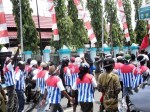
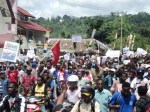
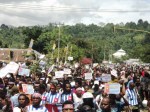
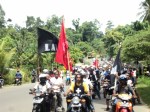
Under ForDem all walks of Civil Society mobilised in unprecedented numbers in 2010 to formally send back Otsus to Jakarta. Massive rallies were held notably on June 18, and then on July 8-9 when mass rallies converged on the Papuan Parliament (DPRP).
Almost 60,000 demonstrators demanded that Jakarta institute immediate dialogue with West Papua civil society over all the conditions in Papua, rejected Otsus, and demanded Jakarta respect the right to self-determination by allowing a referendum to take place (as allowed by President Habibie in East Timor in 99).

Notably this final element in Consensus’ list of demands came after many stops and starts, and after much self-serving and sabotage from actors within exile groups. Putting aside years of acrimony, member organisations of the West Papua National Consensus and West Papua National Coalition for Liberation agreed to work together to achieve a referendum to determine the West Papua’s future.
This Papuan demand for a Referendum to determine the province’s future is not a pie in the sky demand. It comes from a deep seated understanding that this is the best solution to put to rest all claims of legitimacy of either party.
Indonesia currently refuses it, but once again that does not change the reality: that democratic choice is the only basis for peace, not military occupation against a permanently resistant population.
A Swarm Movement Takes Wing
It is important to understand that no one faction or sector in West Papua can claim dominance or leadership of this mass movement. This is not Congress in India and there is no single Gandhi figure. Rather, this is a movement with thousand’s of Gandhis.
And while there is consensus there is not necessarily agreement, but civil resistance is putting this aside to allow many different streams of action.
Many people in West Papua even belong to organisations in opposition to their own position, mainly due to the fact that many younger activists see organisational membership as a tool for continuance of struggle through dialogue and action.
In a unique Papuan twist it is this (undefinable aims) factor that has created the conditions for unity, a unity that allows for internal dissent, and vigorous discussion between groups whilst still working together for common goals.
A perfect example of this is an organisation such as the West Papua National Committee (KNPB), a forum for creating space discussion and organising of nonviolent direct actions. Whilst certainly not the only sector providing this coordinating role (other notable players include activists from both West Papua National Authority, and student organisations ) KNPB has played a leading role, and is bringing together arguing groups on the street to get them to commit to common goals. At a higher level, this forum has been mirrored by the Consensus itself.
This has enabled a situation where the civil movement refuses to be based around a single leadership group, and instead features multitudes of groups and tribes all acting autonomously and independently (where everyone knows their role and works their hardest) but which is nevertheless unified under its collective goals.
This is the epitome of a political swarm movement enabling collective problem solving, providing populations under repression with both the flexibility and robustness needed for survival, but without requiring any centralised leadership or task allocation (and the targets these would create).
As a people close to nature, the natural environment routinely provides (at least subconsciously) political inspiration in Papua. And so working as a swarm is one of the most effective natural strategies for action on our planet, utilised by a majority of life on our Earth.
Such a swarm structure can occasionally present difficulties for those who cannot think outside traditional top-down strategies for national change. Rather than being shut out of dialogue by the game playing of unaccountable elites, this type of structure encourages a longer lasting peace by enabling all actors to have their voices heard.
It is also a natural strategy to employ in a nation where it is for the most part illegal to congregate in groups.

Not Noticed Abroad – Nor Back In Java
The international community is not the only sector that suffers from a complete failure to comprehend the magnitude and development of the Papua body politic.
Jakarta also fails to pay the attention it should to Papua for a variety of reasons, none the least being an entrenched colonial mindset that still clings to a seemingly racist belief that Papuans are unable to manage their own affairs.
To maintain this illusion Jakarta has deliberately sought out the most corrupt local officials, and -together with a mafia military that resists even Presidential orders to stop illegal business – creates military business fiefdoms in local regency who blame Papuans for stealing resources that are being actually being siphoned off by Javanese military elites!
When Papuan institutions examine these rorts – as was the case in June with the MPR’s examination of the failure of Special Autonomy which discovered widespread stealing of development funds from the Indonesian Treasury, Jakarta just refuses to listen.
Now even those Papuans who thought their best chances of moving forward lay with Jakarta are now disillusioned with the lessons that this process revealed. This is shown in the support of ForDem from a number of members of the Papuan Parliament who are the theoretical guardians of Otsus (Special Autonomy).
Jihadist/militia threats
With the rise of a co-ordinated body like ForDem, there is a serious danger now that leading figures will be assassinated, as Kopassus did to Chief Theys Eluay in 2000.
If this occurs, it is pretty much guaranteed that West Papuan people will react with anger. And thus the TNI will, as they always do, seek to provoke significant and widespread violence, including through the utilisation of militias in order to justify any crackdown.
Just like with East Timor and other trouble spots violated by Indonesian state violence, security forces maintain a close and unhealthy working relationship with both nationalist militias like Besar Merah Putih, Islamic nationalist militias like Laskar Jihad, and elements of banned terror networks. This is nothing new: since Indonesia’s founding the doctrine of Pertahanan Rakyat Semesta (Total People’s Defence) has seen civilians mobilised into militias to defend national unity.
These same militias are the ones that took over East Timor in the aftermath of the independence referendum in 1999.
In West Papua, TNI commanders have held several joint meeting with militia and known jihadist figures to recruit fighters against the ‘military threat’ of separatism. Regular and widely reported meetings have been held between security force commanders in Jayapura, Manokwari, Nabire and Wamena, militia commanders from BMP, LJ and Pemuda Pancasila, and the rectors of the universities in each city.
These have occurred in the lead-up to massive mobilisations by civil society, where state forces and their proxies have been exhorted to use all “necessary” measures to prevent demonstrations of separatism. Thankfully to-date the militias have been comprehensively out-numbered by the civil mobilisations and have retreated rather than attacked marchers.
Additionally, anecdotal evidence is continuing to emerge from Papua of the program of Islamisation and mosque building (especially around the Bird’s Head Peninsula in the north west of Papua) with foreign Wahhabist funding enabled through organisation such as Muhummadiyah, the largest mass Islamic organisation in the world. The Muhummadiyah is generally utilised as a vehicle for Indonesian elite political ambitions, especially currently under the stewardship of Amien Rais.
There are two distinct trends in active Islamism as it relates to Papua.
One is the groups advocating violent Jihad to protect Islam, groups that are significantly close to senior figures in the Indonesian military.
The other is of course the “moderate I’syalom” movement, epitomised by indigenous Papuan Muslim groups, Nahdlatul Ulama (Formerly led by the late President Abdurrahman Wahid – who was removed from office by Kopassus after his peacebuilding efforts with Papua in 2000), and organisations such as the Islamic Student’s Association.
This tendency is bucking the trend of misunderstandings leading to violence and working directly to counter the militaristic nationalism pushed by the TNI proxies through ecumenical dialogue and volunteer aid projects
Lasting Security For The Pacific and SEA?
If the democratic nations of South East Asia and the Pacific were genuine about lasting security, it would understand that we have about 200 million natural allies in Indonesia and 2 million in West Papua.
And if we help the people of Indonesia and Papua get the military Hanuman monkey off its back, then they will stand with us, like they always have.
But if we let the military run around with its hard drinking Jihadist thugs, instead we will see havoc and intensifying violence, staining us all with the blood of innocents. The international community has got to wake up to the fact that terrorists is uniform are still terrorists and that criminals who command prisons are still criminals.
Indeed if we allow those who perpetrate fear and violence to force a population to change its policies then we succumb to the very definition of terrorism (US Penal Code).
Even the former Indonesian President, the late Abdurrahman Wahid, described the military as an out of control terror network. Wahid was quoted extensively describing the “fear that senior officers (of the TNI) are involved heavily in terror networks.”
Text (SMS) Terror In West Papua
In late October, a series of SMS text messages were widely distributed purporting to be from the head of the Laskar Jihad network, an Islamic Nationalist militia that has been heavily documented working closely with Indonesian military in Maluku, Poso and Aceh.
The texts said that the Christians were threatening the Islamic character of the Land of Papua and that 16 million rupiah would be paid to anyone that brought in the head of a “slain Nazarene”.
It was very clear that this SMS text campaign originated from military intelligence, as it showed very clear correlations to their prior dark work in Maluku prior to the religious war at the turn of the 21st century.
West Papua Media was also sent these SMS’s in attempt to utilise us to spread panic, but working together with many key actors in civil society and faith communities (both Muslim and Christian) and human rights workers, we organised a response that showed that as these “fear and panic” provokasi campaigns were utilised increasingly, every campaign would be countered with equally effective ecumenical peace-building and emergency interfaith dialogue mechanisms.
People on the ground in Papua, both trans-migrant Indonesians and indigenous Papuans, may be living in fear of the next type of military terror, but they are not stupid. This augers well for the failure of “organic” militia violence, however this also the reason why so many newcomers are still being brought into West Papua enmasse on Pelni ships almost daily.
Black Ops Such As The Recent Shootings Of Indonesian Transmigrants
Since the end of November, several incidents have been recorded of Indonesian transmigrants being randomly shot in the areas of Jayapura, Abepura and Sentani, usually whilst on motorbikes in outlying areas.
There is still only sparse information as to the culprits, which is surprising given the amount of police involvement in the case. However there is a wide belief amongst locals that this is not the work of Papuan forces (as this is a new tactic unsupported by the mass movement). Rather many believe this bears striking similarities to years of “ninja” attacks on Papuans on motorbikes in the northern border region during 2005-06, widely believed to be the work of Javanese terror squads (aka Kopassus).
Responses (1): Speaking Up To Evil
Evil is such an overused and polarising word, but it is the only adequate word that describes the Jakarta generals. They have no concern for human life, they are unreformable, they are completely unaccountable, and are like vultures feasting on carrion.
The international community needs to stop being cowardly and tell Jakarta that if it wants to take its place amongst the civilised nations of the world, then it has to start acting like it. It must be made clear to Jakarta that the behaviour of its security forces as state policy is completely uncivilised and unacceptable.
It is about time the international community faced up to facts – the only way to trust the Indonesian military is stop giving them arms, training, legitimacy, and to put each one of the criminals among them in the dock under Nuremburg principles.

Shooting victim Melkias Agapa – shot dead by BRIMOB in Nabire in June 2009


Melkias Agapa’s body is presented to the riot police
Responses (2): Safeguarding Community Security
Sectors of West Papuan Civil Society have taken extraordinary measures to provide safe space for peaceful free expression, a right which Jakarta seems unable to comprehend in Papua.
The Papua Customary Council (Dewan Adat Papua or DAP), a leading member of Consensus, formed the Guardians of the Land of Papua (Petapa) in July, after a series of violent incidents carried out by security forces and transmigrant militia members. They have had been providing a visible peacekeeping security presence for mobilisations on peaceful demonstrations, which though allowed under Indonesian law are almost always dispersed with force by security forces.
Whilst they have been trained in physical self defence, a significant part of Petapa’s training has been on non-violent conflict resolution. Petapa are not mandated by DAP to be anything but a defensive security guard.
This did not stop the police Mobile Brigade (BRIMOB) from shooting dead Amos Wetipo and Frans Lokobal whilst trying to seek shelter from indiscriminate police shooting at the DAP Balim Lapago office about 1 km from the police station.
Petapa will be providing security for almost all mobilisations right across Papua in the future. However it is unlikely the Indonesian state will allow any community security in opposition to the police and their actions will create another potential trigger for violence across Papua.

Responses (3): Free Media = Free People
Due to the ongoing ban by Indonesia for international media and humanitarian organisations having access to Papua, allegations of abuse are notoriously difficult to verify.
In a joint conference with then Australian Foreign Minister Stephen Smith, the former Indonesian Foreign Minister, Hasan Wirajuda, famousely said “just because we do not allow foreign media to come to Papua, does not mean that we are hiding anything”. Actually, yes it does.
However while this ban remains in place, only the most dedicated journalists make the effort to go in undercover.
West Papua Media has been proud to facilitate undercover trips into occupied territory to meet with many West Papuan people prepare to tell their own story. This is getting more difficult by the day so local people are working for a solution.
Live images, video and online activism have the potential to create tremendous momentum in the awareness of the situation inside Papua, and have certainly already created much international action.
By creating their own media, and their own narrative, Papuan people are reclaiming self-determination denied for so long.
Very occasionally West Papua does get in the news, but only through the co-ordination between committed journalists and human rights workers working together.
The network I work with, West Papua Media (WestPapuaMedia.Info), was started to provide a professional service to international media interested in covering the issue of West Papua.
In particular we seek to cover the moves of the Papuan people to end human rights abuses, the efforts to hold the Indonesian security forces to account for their systematic human rights abuses, and to bring these unreported Papuan issues to the front page.
We have been taking a leading role in the hard work n raising the profile of West Papua this year, with significant joint investigations that have broken several major stories this year, and we have gained deep trust from the people of Papua in reporting their stories.
West Papuan citizen media played a key role in alerting the world to deeply heinous cases of abuse.
One was the sourcing, verification and release of deeply shocking leaked videos of Indonesian military brutality filmed by Kostrad (Strategic Reserve) troops from Battalion 753 torturing two West Papuan farmers, Tunaliwor Kiwo and Telengga Gire, burning Kiwo’s penis with a flaming stick.

Tunaliwor Kiwo
(Click Here To Download .flv file – full uncut version)

Tunaliwor Kiwo’s Torture
The other was footage of Indonesian BRIMOB police taunting a former political prisoner Yawan Wayeni, whom they had allegedly disembowelled moments before after he argued with them.
Both these videos showed the power of citizen media in activating international human rights networks to effectively raise the issue of Papua.
There are many more videos in preparation for release.
After the release of the torture videos (Click Here To Download .flv file – full uncut version), West Papua Media was the first of five organisations subjected to a massive, organised Distributed Denial of Service cyber-attack (DDOS), which investigating agencies have classified as an act of cyber-terrorism.
Since then we have had to spend a great deal of time and money to make our systems resistant to further acts of aggression. However, these attacks only increased our resolve to keep working harder to expose Indonesian abuses in Papua.
Media Exposure Works On July 9 2010
Some of our real time work has assisted directly in the prevention of mass acts of violence by the Indonesian security forces, such as our coverage and media advocacy fixing of the July 8-9 occupation of the regional Parliament House.
With less than ten minutes before the deadline for dispersal of the 2 day rally of over 45,000 people, the Indonesian security forces were forced to back down after a BBC report aired, organised by West Papua Media Alerts, which brought international attention the explosively dangerous situation.
Extensive international diplomacy occurred in that 15 minutes, and together with the extreme discipline of the mass protest, forced Indonesian security to back down and enabled the protestors to peaceably leave the scene of the protest.
The Australian government- pressured by negative media reports via the Fairfax and ABC in Australia – have been forced to take some limited action on the issue in recent weeks.
Australian Foreign Minister Kevin Rudd this week was set to raise with Indonesian Foreign Minister Marty Natalagewa the issue of prosecuting TNI officers suspected of torture of Tunaliwor Kiwo.
And to give some wider credit, Australian PM Julia Gillard was also seen showing concern and displeasure at President Susilo Bambang Yudhoyono over the lack of progress in holding military to account for the crimes.
More importantly, Gillard has spoken forcefully about the lack of transparency at the trials, and the fact that the Indonesian prosecutors turned the apparent accountability exercise into a red herring.
Instead of a real trial a stacked military court tried different perpetrators for a different violation; abuse much milder than the Kiwo torture.
The military judge lectured the defendant’s not on the criminality of the abuse they had committed, but on the shame they had brought on the TNI by shooting the torture on video and not destroying the evidence! (Click Here To Download .flv file – full uncut version)
This incident neatly captures why the Indonesian military cannot be trusted to reform themselves from the inside.
As an easier and clearer step towards a solution, if the international community is serious about stopping brutality, it will help develop the capacity of the West Papuan media to tell the story of what is going on, and press Jakarta hard to allow international media access.

Responses (4): The Role Of The Pacific & New Zealand
Countries in the Pacific, especially New Zealand, can and should push hard for measurable cessation of human security violations by the Indonesian state and all its proxies.
New Zealand has many forums in which to achieve this, and could play a very constructive and peace-building role just as they did in Bougainville and East Timor.
There is a strong role for New Zealand to play in direct bilateral talks, through ASEAN, APEC and even by becoming involved in the existing EU/Norway/Indonesia annual Human Rights dialogue.
And should the West Papuan ForDem movement achieve its goal of direct dialogue with Jakarta, the movement wants an external third party present at those talks – New Zealand could be that party (even it seems very unlikely at this point in time).
Most importantly it is critical that during this year’s Pacific Island Forum to be held in New Zealand, that it utilises this unique opportunity to highlight the epicentre of Human Rights abuse and Environmental degradation in the region.
Whether NZ decides to do the right thing and help to stop genocide, or not, is certainly NZ’s choice.
However if NZ doesn’t stand up to its responsibilities it risks being seen in the same light as the Australian Government which has been turning a blind eye while its corporate giants pad their annual profit reports with the plundered resources of a vulnerable and defenceless neighbouring indigenous nation.
Whatever country decides to take the initiative will be seen as a country that is a leader in what the planet needs the most: countries prepared to act for principle and decency, to help broker peace.
As we approach the resumption of mass-civil action in West Papua a bloodbath can likely only be avoided if the international community immediately stops sitting on its hands and pulls its head out of the sand.
Pacific countries must start to act now to make it clear that not only the world is watching, but it will be taking action. Without a concerted stand to resist Indonesian state violence, the situation will spiral out of control. There are significant economic tactics, which may hurt collaborators of human rights abuse, but at the end of the day, are Pacific countries more comfortable with subsiding genocide and ecocide, or helping to prevent the annihilation of a people?

*************
Nick Chesterfield is the founding editor of West Papua Media , and is a human rights journalist with extensive experience of the Papua issue, and has conducted many field investigations in the West Papuan region since 1999. He has been involved in refugee protection, advocacy, as a human rights and citizen media worker and trainer. Since 1999, Chesterfield has been intimately involved with the Papua issue, after several years with the Indonesian pro-democracy, and East Timor freedom movements. Initially involved as an activist, and noticed by those who do not wish for the Papua activists to distribute their news, Chesterfield’s first journeys there necessarily saw him underground on mission. He collected abuse data, worked to build local capacity for doing so independently, and to assist in the escape of hunted non-violent activists to safer places.
Together with citizen media and human rights workers from inside Papua, Chesterfield helped set up West Papua Media in 2008, to counter the wilful lack of coverage by the international media.













 West Papua Media Alerts