This is the 96th in a series of monthly reports that focus on developments affecting Papuans. This series is produced by the non-profit West Papua Advocacy Team (WPAT) drawing on media accounts, other NGO assessments, and analysis and reporting from sources within West Papua. This report is co-published with the East Timor and Indonesia Action Network (ETAN). Back issues are posted online at http://www.etan.org/issues/wpapua/default.htm Questions regarding this report can be addressed to Edmund McWilliams at edmcw@msn.com. If you wish to receive the report via e-mail, send a note to etan@etan.org.
Summary:
An Indonesian court has sentenced five senior Papuans to three years imprisonment following their conviction on “treason” charges. They fell victim to the same undemocratic law employed against more than 90 Papuans and Malukans for their peaceful dissent in recent years. The five were charged for their central role in the October 16-19, 2011 “Third Papuan National Congress,” a peaceful assertion of Papuans’ right to self-determination that came under brutal assault by Indonesian security forces. In a statement, WPAT calls for an end to that law which was developed during Dutch colonial times, was employed by the dictator Suharto, and now has no place in a democratic Indonesia. Thousands of Papuans took to the streets in West Papua and elsewhere on the occasion of the visit to Indonesia of UN Secretary General Ban Ki-Moon. The largely peaceful demonstrations called for a special referendum to at last allow Papuans a genuine act of self-determination. More than 90 international organizations have called on the U.S. Congress to block sale of Apache helicopters. They would significantly expand the capacity of Indonesian security forces to conduct “sweep operations” that have devastated rural Papuan villagers. A recent book and a commentary by a Papuan legislator have underscored the Indonesian governments persistent failure to bring essential services to rural Papuans. WPAT observes that for many rural Papuans the face of the Indonesian government is not that of a teacher, doctor or nurse but rather, that of a solider, policeman or intelligence agent.
Contents:
Papuan Leaders Sentenced to Three Years Imprisonment; Security Force Thugs Evade Justice
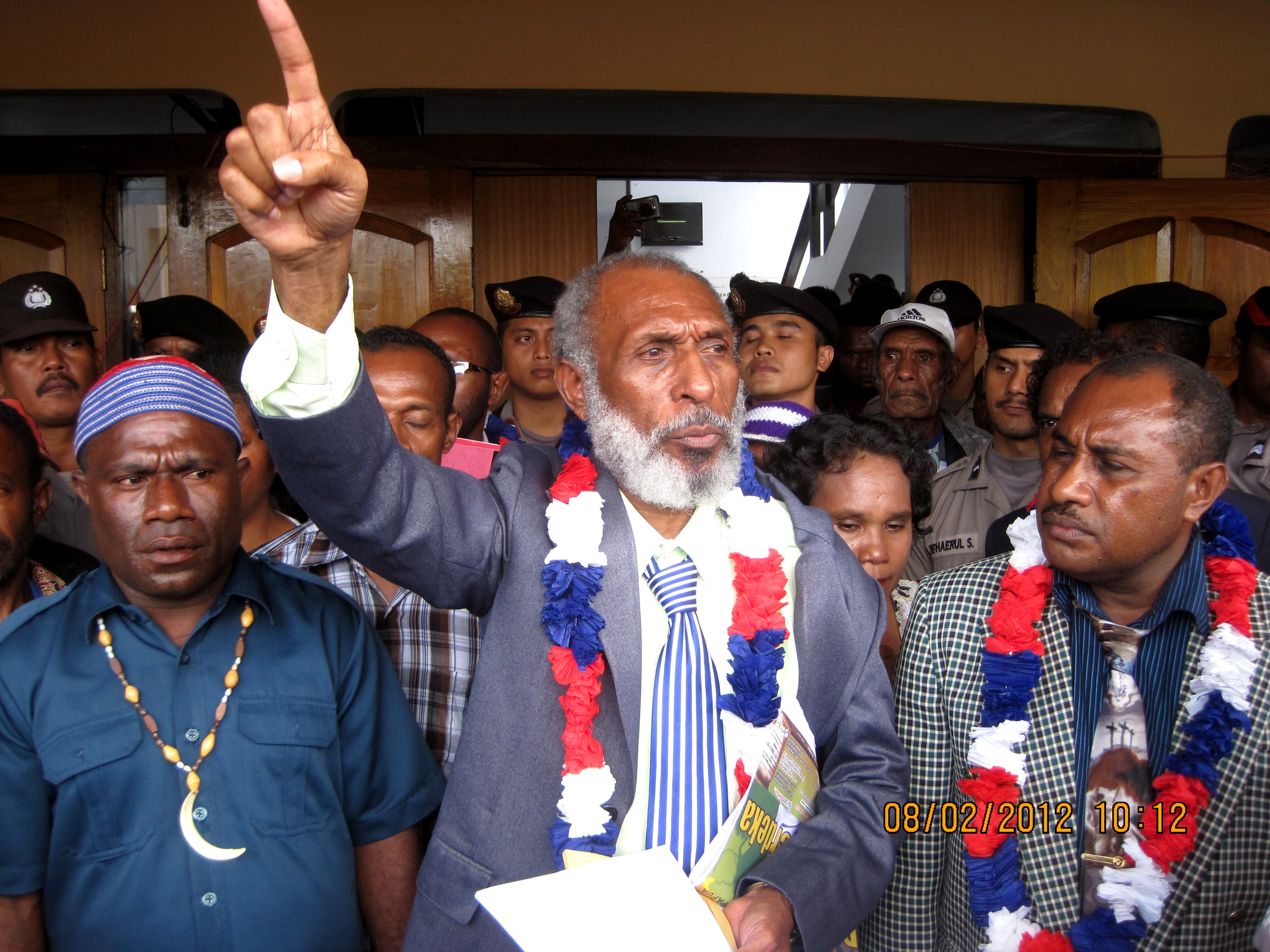
On March 16, an Indonesian court convicted five prominent Papuans of “treason” and handed down sentences of three years imprisonment for each of them. The charges, based on the infamous Article 106 of the Indonesian Criminal Code (see WPAT Comment below), derived from the Papuans involvement in the October 16-19, 2011 “Third Papuan National Congress” (See West Papua Report, November 2011). The victims of this travesty of justice were Forkorus Yaboisembut, Edison Waromi, Selfius Bobii, Agus Kraar, and Dominikus Sorabut.
The October 2011 congress drew 5000 Papuans representing all districts in West Papua. At the conclusion of this peaceful three day meeting, participants declared independence for West Papua and elected Forkorus Yaboisembut, who heads the Papuan Tribal Assembly, as their President. The congress elected Edison Waromi as Prime Minister.
The real crimes during the three day gathering were committed by the security forces, including the U.S. organized and funded Detachment 88, which along with other state security elements, that attacked the gathering shortly after it concluded. As participants were preparing to leave the open air venue, the police opened fire from their armored personnel carriers. At least three people were killed in cold blood. Participants were rounded up, beaten, kicked, and forced to crawl into the middle of the field. Some 90 sustained injuries and 300 people were arbitrarily detained.
Despite demands from Papuan, Indonesian and international organizations that the security personnel who were perpetrators of this violence be brought to trial the Indonesian government, as usual, refused to hold these elements responsible. Only 17 Indonesian police personnel received “administrative sanctions” in internal disciplinary hearings.
The trial of the five Papuans and the failure to hold security force personnel accountable for their attack has drawn protests from international non-governmental organizations. The U.S. government, however, has not reacted to these miscarriages of justice.
In one of the stronger commentaries on the travesty, Amnesty International called on Indonesian authorities to “immediately and unconditionally release” the five. Amnesty said the court decision “significantly eroded Indonesia’s respect for freedom of expression and peaceful assembly.” Amnesty International considers all five men to be prisoners of conscience, part of a group of more than 90 political activists in the provinces of Papua and Maluku “who have been imprisoned solely for their peaceful political activities.”
For its part Human Rights Watch, in addition to condemning the trial of the five and failure to address the violence against civilians perpetrated by security forces, also raised serious due process concerns. HRW cited the defense team as telling the court that police questioned their clients in the first 24 hours of arrest without their lawyers present. According to the defense team, “the men were beaten by police while in custody. Police allegedly kicked Yaboisembut in the chest and beat his head with a rifle butt. Sorabut testified that the police beat him on his head with a pistol and struck his body repeatedly with an M-16 assault rifle. Kraar said he was hit by police twice on the head with a pistol,” Human Rights Watch wrote.
Indonesia Continues to Resort to Undemocratic Means to Repress Peaceful Dissent
WPAT Statement: Indonesia continues to prosecute and punish Papuans for the peaceful exercise of their internationally recognized rights to free expression and of assembly, rights protected under international law including Article 1 of the International Covenant on Civil and Political Rights and Article 1 of the International Covenant on Social, Economic and Cultural Rights. Indonesia is party to both of these treaties and is similarly obligated to protect free expression and the right of peaceful assembly under terms of the Universal Declaration on Human Rights.
Indonesia’s own constitution (see Article 28(e) and 28(f)) protects free expression and the right of peaceful assembly. Article 28(e) states, “Every person shall have the right to the freedom of association and expression of opinion.” Article 28(f) provides for the individual “right to communicate and obtain information for the development of his/her personal life and his/her social environment, and shall have the right to seek, acquire, possess, keep, process, and convey information by using all available channels.”
The government, however, uses Articles 106 (for makar, treason), 110 (conspiracy) and 160 (incitement) of the Indonesian Criminal Code to repress peaceful free expression and assembly.
Since 2008, at least 82 Papuans have been charged under some or all of these provisions with sentences ranging from ten months to six years imprisonment. The vast majority of those charged and convicted were engaged in peaceful actions such as the raising of the Papuan “morning star” flag, a symbol that resonates as a powerful symbol of identity for many Papuans. In 1999. the UN Working Group on Arbitrary Detention declared the detention of such flag raisers was “arbitrary.”
These arbitrary restrictions originate from Indonesia’s colonial period and were used extensively by the Suharto dictatorship to repress dissent. These undemocratic provisions served not only to punish peaceful protest, but also as a powerful tool of intimidation.
Most recently, the Indonesian criminal justice system used Article 106 to target Papuans who played prominent roles in the October 16-19, 2011 “Third Papuan National Congress.” (see above) The assembly was attacked by security forces who killed at least three participants, beat scores more. and arbitrarily detained several hundred. While the Indonesian Government has prosecuted the leaders of this peaceful gathering, the government has failed to bring to justice those security forces who attacked the Congress participants.
Papuans Mark the Visit of UNSG to Stage Massive Demonstrations
Thousands of peaceful civilians demonstrated in the streets of cities and towns throughout West Papua in March in conjunction with the March 20 visit to Indonesia by UN Secretary General Ban Ki-Moon. An estimated 5000 demonstrators in the capitol, Jayapura (Port Numbay), effectively brought normal activity in that hub to a halt.
The rallies, organized by the West Papua National Committee, were largely peaceful. In a departure from usual practice some demonstrators attacked journalists covering the marches. Victor Mambor, chair of the Alliance of Independent Journalists in Jayapura, said that the presence of the TNI or police in civilian clothing near the journalists led to the journalists being regarded as “tools.” Mambor explained, “It is because there were so many security forces near the journalists who were covering the event that the journalists were thought to be collaborating with the security forces. We have to understand the situation in Papua which means that if someone realizes that there are security forces in our midst, we should not allow them any space.”
For their part, imprisoned political leaders Forkorus Yaboisembut and Edison Waromi called on the UN and others to push for the rights of West Papuans, including the right to self-determination and control over the territory’s mineral resources. West Papua was a Dutch colony until 1962 when control was handed over to the UN ahead of a planned vote on self-determination.
Groups Urge US Congress to Block Sale of U.S. Attack Helicopters to Indonesian Military
The West Papua Advocacy Team (WPAT) and the East Timor and Indonesia Action Network (ETAN) organized a statement urging the U.S. government and Congress not to sell AH-64 Apache helicopters to the Indonesian military (TNI).
More than 90 human rights, religious, indigenous rights, disarmament and other organizations worldwide write that “Providing these helicopters would pose a direct threat to Papuan civilians, who have been the target of deadly TNI assaults for many years”
The groups believe that the helicopters will inevitably be used to augment the Indonesian security forces ongoing campaign against Papuans in rural areas. That campaign has led to the destruction of Papuan villages, the coerced displacement of thousands of Papuan civilians, and the deaths of many, either as a direct result of security force attacks or due to prolonged displacement into inhospitable jungles and forests.
The text of the petition follows:
- As organizations concerned about human rights in Indonesia and West Papua, we are writing to urge the U.S. government and Congress not to allow the sale of AH-64 Apache attack helicopters to the Indonesian military (TNI). Providing these helicopters would pose a direct threat to Papuan civilians, who have been the target of deadly TNI assaults for many years.
- The sale of this weapons system to the TNI — notwithstanding its long record of disregard for civilian casualties, corruption, human rights violations and impunity in East Timor, Aceh and elsewhere — would only increase the suffering of the Papuan population.
- Indonesia’s Deputy Minister of Defense Sjafrie Sjamsoeddin told the Antara news agency, that Indonesia intends to buy eight AH-64 Apache helicopter from the United States.
- The heavily-armed AH-64 is a highly lethal weapon which can be used to escalate conflict within Indonesia and in West Papua. These aircraft will substantially augment the TNI’s capacity to prosecute its “sweep operations” in West Papua and thereby, almost certainly lead to increased suffering among the civilian populations long victimized by such operations.
- TNI “sweep operations,” including several now underway in the Central Highlands region of West Papua, involve attacks on villages. Homes are destroyed, along with churches and public buildings. These assaults, purportedly to eliminate the poorly armed Papuan armed resistance, force innocent villagers from their homes. Papuan civilians either flee the attacks to neighboring villages or into the surrounding forests where many die or face starvation, cut off from access to their gardens, shelter, and medical care.
The AH-64is designed for air to ground attack. It can operate day or night and is armed with high caliber chain guns . It is also equipped to fire missiles.Congress must be notified of major weapons sales. We urge Congress to oppose the sale of these helicopters.Vital Services Not Available to Many Rural Papuans
The daily JUBI reported on a new book by Cipry Jehan. The Papuan Paradox, describes “systematic discrimination” targeting Papuans in Keerom District. At a seminar convened by the Catholic Church in Keerom Jehan described “structural social injustice.” He said that the Indonesian government has focused development efforts in the area of Arso and Skamto, areas populated largely by non-Papuan immigrants and transmigrants. Papuan majority areas such as Waris and Towe do not receive such development assistance, he explained.
Jehan added that discrimination against Papuans extends to education. As evidence he cited the reality of inequality in educational services provided from nursery school level right up to secondary school level. In Keerom district, he said, nursery schools are spread right across the districts whereas in the Papuan majority districts of Waris and Towe Hitam there are no educational facilities at all. He concluded that “The government is much more consistent about sending troops to this area than sending teachers and doctors.”
On March 26, JUBI, reported that Kenius Kogoya, a member of the Papuan legislative assembly (DPRP), expressed regret that Indonesian state teachers and health personnel seldom venture out to rural Papuan populations.
Despite explicit and implicit obligations undertaken by the Indonesian government, particularly under the rubric of “special autonomy,” Papuans living in rural areas have long suffered from a dearth of public services.
Kenius elaborated that there was widespread neglect by Indonesian officials who are supposed to check on whether government teachers and health workers in the interior turn up for work. The DPRP member stated that this is a problem that exists in almost all the districts of Papua.
WPAT Comment: For West Papuans, especially those living in rural areas, the face of the Indonesian government is not that of a teacher or a nurse or a doctor. It is the face of a soldier, a militarized police officer (Brimob), or an intelligence agent. Vital services provided in relative abundance to non-Papuans are simply not available for Papuans who continue to languish in poverty and to endure health conditions that are among the worst in the Southeast Asian region. It is precisely such disparity that have led many close observers to describe Indonesia’s policy toward Papuans as genocidal.
But it would be wrong to portray Indonesia’s policy as simply one of malign neglect. Indonesian security forces have long played the role of brutal enforcer as Indonesian, U.S. and other international corporations seize Papuan land and resources, aping the vilest practices of colonial powers of the past century. Transmigration policies conceived and employed during the era of the dictator Suharto are again in place, supported by Government “development” policies, as seen above, that greatly advantage the migrant over the deliberately marginalized Papuan.
Back issues of West Papua Report
http://etan.org/issues/wpapua/2012/1204wpap.htm




 West Papua Media Alerts