The Indonesian State is responsible for the shooting of three civilians in Dogiyai

Press Release

The Indonesian State is responsible for the shooting of three civilians in Dogiyai


(JAKARTA, Friday, May 13th 2011) – The Anti-Militaristic Papuan Students’ Coalition urges the Head of the National Police to immediately dismiss the Heads of Papua provincial police, Nabire regency police and Moanemani district police after the shooting of three civilians that occurred in Moanemani district, Dogiyai regency, Papua.

This was stated by Frans Tomoki from the Anti-Militaristic Papuan Students’ Coalition during a press conference at the KontraS office, Jln. Borobudur No. 14, on Friday, May 13th.

According to Frans, shooting incidents have been occurring for nearly one month but haven’t been clarified yet. He also criticized the brutal behavior of  the police officers who shot at civilians without warning.

“There must be a warning before shooting, but the police directly opened fire without thinking of the possible consequences.  This  can be categorized as a serious human rights violation.”

According to Agus Okama Kosay, human rights violation have been going on in Papua since the territory was forcefully merged into Indonesia. “From 1961 on there have been human rights violation and tensions keep rising.”

In the Reformasi era, all the more since the implementation of the Special Autonomy Law, human rights violations should have decreased. But this eventually didn’t materialize. As compared to the Ancient and New Order eras, the Special Autonomy era is even worse.

“Why do Papuan people think that the Special Autonomy is a total failure?  Because human rights violations keep occurring  and the central government never tried to solve this problem,” Agus explained.

The Anti-Militaristic Papuan Students’ Coalition also urges the international community to lobby the Indonesian government to take responsibility  for the frequent serious human rights violations in Papua, including the shooting incident in Dogiyai regency.

Images of shooting sites, Dogiyai (IMages courtesy of witnesses on ground)

“The international community must lobby the Indonesian government to  thoroughly investigate several human rights violations in Papua,” Agus added.

The shooting of three civilians by police officers took place on April 13th, 2011, around 1.30 pm. It began as police officers raided a togel [illegal lottery] kiosk in Moanemani market housing complex. They seized the money belonging to the togel vendor who was just known as an agent working in fact for police members.

A group of people refused this and followed the police car to the district police station. The upset police officers shot at three civilians and wounded two others, directly in front of the district police station. Dominikus Auwe (24), Otniel Yobe (26) and Agus Pigay (24) died, while two of their friends were critically wounded.

As a consequence, local people were angered and torched the Moanemani district police station as well as several kiosks belonging to migrants from other islands, including the illegal lottery kiosk operated under the names  of First Brigadiers I Made Sudarsa and Eka. Papua provincial police sent two Brimob [Mobile Brigade] platoons to secure the area in Dogiyai and investigate the involvement of police officers but to date,  no further clarification was provided. (**)

Medical personnel arrested in Jayapura for ‘inciting strike’

Bintang Papua, 15 March 2011

[Abridged in translation into English]

Eight nurses and midwives have been arrested in Jayapura for their
involvement in a strike that resulting in a halt to services at the
general hospital in Jayapura. They face charges of inciting their
colleagues to take part in a strike.

[See earlier reports about the strike of medical personnel who were
protesting against the failure of the authorities to pay incentives that
had been promised more than a year ago.]

The eight persons are being held by the criminal investigation unit of
the Papuan police command. The police claim that there is sufficient
proof that the persons had acted in violation of the law, forcing others
to engage in acts of violence and citing a number of articles in
Indonesia’s criminal code. Media attempts to contact the police for
confirmation of the arrest were unsuccessful.

According to Anum Siregar, one of the lawyers acting for the eight, a
group of fifty personnel from the security forces had gone to the homes of two of the persons and told them that they must report to police headquarters in Papua. The two women, Leni Ebe and Popi Mauri, then contacted the lawyer to inform her of what had happened. The two women then reported to the police as requested, in the company of the lawyer.

The two had earlier received notification from the police that they
would be summoned as witnesses in connection with the strike action of the hospital personnel.

According to Anum Siregar, after being questioned for several hours by
the police as witnesses, the police changed tack and indicated that they were being held as suspects. Soon after, the police took the six others into custody.

According to Bintang Papua, the eight detainees have been subjected to prolonged interrogations while other personnel from the hospital have rallied in support of their colleagues. Anum Siregar accused the police of acting in violation of the rule of law, saying that the medical
personnel were only acting in defence of their legitimate rights. She
also said that the action by the police would have a negative effect on the provision of services for patients at the general hospital.

‘The impact will not be felt by officials in the province because they
never go to the local hospital for treatment on occasions when they fall ill but fly to Jakarta or overseas for treatment.’

She also said that the arrests had led to expressions of solidarity from
members of the medical profession throughout the Land of Papua in
protest against the actions of the police.

Papua New Guinea Raises Concerns Over Arms Smuggling At Indonesian Border

Media Information:

(Note: West Papua Media and illegal arms smuggling investigators have long raised this issue with the PNG and Australian governments, however, evidence collected from the ground has implicated INdonesian military sources, not West Papuan opposition sources. The reporting in this piece is disingenuous and misleading by lumping this together with Operation Sunset Merona, implying that West Papuan refugees were involved in weapons smuggling. This has never been the case. Widespread research has documented a pathway of Indonesian military officers exchanging weapons for Marijuana with Raskol gangs from the PNG highlands, and with Indonesian officials in PNG openly flooding the country with small arms via illegal logging networks. Please contact West Papua Media for more background).

BBC Monitoring Asia Pacific
February 21, 2011

Papua New Guinea Raises Concerns Over Arms Smuggling At Indonesian Border

Text of report by Papua New Guinea newspaper The National website on 21
February

[Article by Isaac Nicholas: ‘Weapons smuggling a concern’]

Western law enforcement authorities have raised concerns about arms
smuggling into the province from Australia and Indonesia, saying it is
a threat to national security.

Provincial Police Commander Peter Philip said his men had confiscated
arms ranging from high-powered semi-automatic weapons to small arms
and shotguns.

He also raised concerns that Operation Sunset Merona refugees had been flown into East Arwin refugee camp without consultations with
provincial authorities, adding that the flight of more than 50 refugees by the PNGDF Casa aircraft into Kiunga was causing further strain on the limited resources in the province.

Philip said the frequency of illegal gun smuggling was higher than
what was happening up at the West Sepik border.

Ningerum Prison acting Commander Wini Nemo also raised similar
concerns that the extra people on the ground would also put pressure
on the jail holding capacity of 30 inmates, adding that the jail was
already over-crowded.

Similar sentiments were conveyed to Correctional Services Minister
Tony Aimo during a visit to the North Fly township of Kiunga last
week.

Provincial Magistrate Patrick Monouluk said arms smuggling was a
concern for authorities which lacked the capacity to police the vast
border province.

Last week, Monouluk sentenced a man to 18 months imprisonment for
smuggling arms and ammunition. Simon Somo Harquart from Mapos Village, Buang, in Morobe, was arrested by police when he attempted to move three firearms from Saibai Island in the Torres Strait into Daru.
Acting on a tip-off, police confiscated a .22 squibman rifle, 303
rifle, self-loading rifle and more than 150 rounds of ammunition.
Monouluk found him guilty and after sentencing, Harquart was
transferred to Bomana Jail outside Port Moresby.

Aimo admitted that arms smuggling and free movement of people across
the border of Indonesia and Australia was a major security concern and
he would raise the issue through reporting to the National Executive
Council to extend the operations from West Sepik to Western.

“We are sitting on a time bomb. There is exchange of guns and drugs
along this Western border which Waigani does not know about,” Aimo
said.

“It is very fragile and a threat to our national security.”

Source: The National website, Port Moresby, in English 21 Feb 11

Police urged to say who shot Miron Wetipo

JUBI: 17 February 2011

A lawyer in Jayapura, Gustaf Kawer, has called on the police to be transparent and explain what happened to Miron Wetipo, who was being held in the Abepura Prison. He was shot dead by the police/TNI and Densus 88 during a sweeping operation and searches being undertaken by BTN Puskopad (an army unit).

‘The police must be transparent and explain publicly what happened to Miron Wetipo. All the more so since Miron was not the person who was behind the shooting in Nafri. The police should tell his family and the general public what happened,’ said Gustaf Kawer. He also said that it was important for the name of the peron responsible for the shooting to be made public so as not to cast suspicion on the whole of the police force.

‘They must have the courage to say who it was in the security forces who shot Wetipo. They cannot ignore this case because it involves a violation of human rights that must be resolved,’ he said.

Miron Wetipo was shot dead by forces of the police/TNI and Densus 88 while they were on sweeping operations and were searching the home in the location of BTN, Puskopad, in the district of Abepura, Jayapura, Papua. He was also thought to be a leader of the OPM and was involved in the shooting that occurred inNafri Kampung on Sunday, 27 November 2010.

[The article includes a photo of a poster saying: ‘Who is it who murdered Miron Wetipo’.

VIDEO: More Indonesian brutality against Civilians in Kapeso, 2009

WARNING: This video contains disturbing images of extreme brutality and will be disturbing to most viewers.  Please complain to the Indonesian security forces if you do not wish to see this.

Indonesian military brutality and torture of West Papuan civilians is revealed in a video released today exclusively by West Papua Media.

The footage shows troops from Indonesia’s elite counter-terrorism unit Detachment 88, who receive Australian and US military training, engaged in a raid in late May 2009 on the Papuan village of Kampung Bagusa, at Kapeso airstrip in Mamberamo regency.

The footage, filmed by a Detachment 88 officer on his mobile phone, shows the immediate aftermath of the raid. The bodies of at least five dead villagers are visible on the ground and there is sporadic gunfire clearly heard.

The incident occurred at the end of a month long occupation of the remote airstrip by an local religious group, and was transformed into a demonstration of widespread pro-independence sentiment by an off-shoot of the TPN or National Liberation Army. Local military and police commanders sent troops to clear the airstrip, including the elite Detachment 88 force. Negotiations between local people and security forces broke down in confused circumstances, and security forces attacked all present. The aftermath of this operation is depicted in the video.

The footage shows Detachment 88 troops urgently taking cover behind desks in a pendopo (traditional ceremonial shelter) whilst under alleged attack. Curiously, whilst troops are allegedly being shot at by unknown shooters off camera, the solider continues to narrate calmly and film proceedings whilst he is standing up, exposed to alleged fire. This does raise the possibility that the entire proceedings are staged for the benefit of the camera.

Disturbing scenes at the end of the footage appear to show two Papuan children tied up and being forced at gunpoint to crawl along the floor by the Indonesian military. The footage continues to show them in apparent pain while the soldiers taunt them.

To date, no satisfactory transparent investigation has occurred of the events surrounding the Kapeso occupation and subsequent shooting of civilians by security forces. West Papua is routinely closed by the Indonesian government to International Media and Human Rights Observers.

Regardless of the circumstances of alleged armed provocations, Indonesian security forces are again displaying excessive force to civilians and non-combatants and in particular to children. Indonesia has ratified the Convention on the Rights of the Child, but has so far refused to ratify the Convention’s Optional Protocol on the involvement of children in armed conflict.

The footage is sure to raise further questions about the activities of the Indonesian military in West Papua, as well the involvement of the Australian military in training and arming those seen in this footage. The video was passed to West Papua Media via a member of the Indonesian security forces who stated that the circulation of this form of ‘trophy footage’ is rampant amongst troops operating in the region.

PLEASE NOTE:  There is a translation error in the subtitles in this footage which is quite critical.  At approximately 00:54 (seconds), where soldiers are pursuing West Papuan people, the dialogue is incorrect.

From a correspondent:
“”jangan dibunuh” is translated as “don’t get killed” but should be “don’t kill them”. It’s common to issue orders in passive register like that. It is followed by “diborgol” ie “handcuff them”. It’s a big difference, since it is suggestive of how often extra-judicial killings do take place – the soldiers on scene have to be reminded to NOT kill the prisoners. “

The video can be viewed at the following link: http://www.youtube.com/watch?v=VD0eFA4scTo
or watching below:

For all media enquiries please contact Nick Chesterfield at West Papua Media on wpmedia_admin@riseup.net or +61409268978

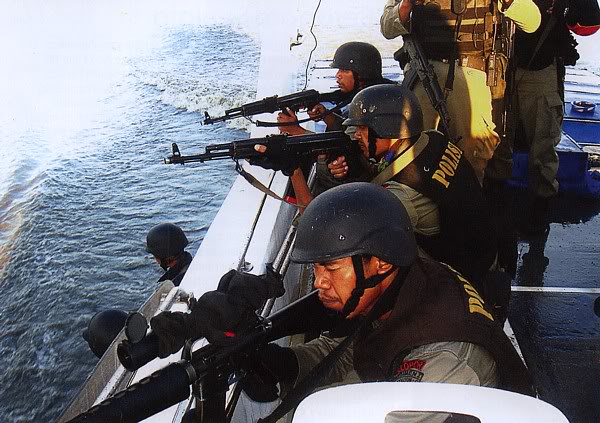
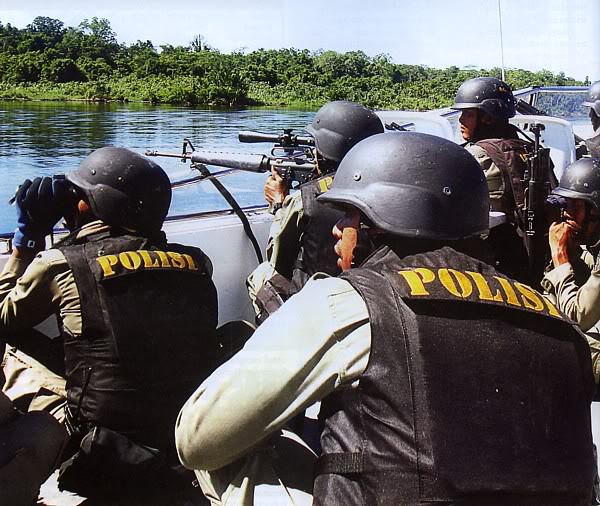
An Indonesian BRIMOB source today (Feb 9) sent West Papua Media these images of personnel from the Pelopor taskforce depicted in the footage above on their way via speedboat to conduct the operation to retake the airfield.  The individual officer in the foreground of the upper image has been identified as the cameraman and narrator of the footage.

West Papua Media apologises for the low-quality of the footage due to it being filmed on mobile phone in low resolution

A higher quality version of the footage is available to media upon application under strict conditions; unfortunately YouTube automatically loses quality during upload.  Please contact West Papua Media for arrangements

Create a website or blog at WordPress.com

Up ↑