ELSHAM finds evidence of 749 acts of violence in Papua


JUBI
15 August 2012
Jayapura: ELSHAM, – the Institute for the Study and Advocacy of Human Rights in Papua – found evidence of 749 acts of violence that befell the people living in Papua. Most of these acts of violence occurred during arbitrary arrests and detentions.This is reported in the recently launched book, Masa Lalu dan Tak Lalu – The Past and Never Past – which was published by ELSHAM and the International Centre for Transitional Justice.

During its investigations, the researchers examined 108 testimonies about human rights violations . They spoke to 76 people in Biak, 12 people in Manokwari, ten people in Paniai and ten people in Sorong. The period covered was from the mid 1960s (prior to the Act of Free Choice in 1969) up to the period of ‘reformasi’ (following the downfall of Suharto).

Their researchers spent three months out in the field, studying testimonies and obtained information about 749 cases.

Of the 749 cases, 312 were violations against males and 56 violations against women. The details were obtained from101 victims who were  interviewed. One hundred and one victims  had suffered violations together with a group of people or with more than one person. The types of violence were arbitrary arrests and detentions, 234 cases,  military operations against the civilian population including operations to forcibly evict people 181 cases, and torture and ill-treatment, 97 cases.

There were also 86 cases of deaths as the result of extreme torture,  threats 53 cases, assaults 28 cases, the seizure or destruction of  people’s belongings, gardens or livestock  22 cases, orders to report 26 cases, attacks and searches of people’s homes 4 cases, lack of access to food or medication 4 cases, forcible removals, preventing people from finding work 4 cases, forcible removals 3 cases, lack of access to food or medications, denial of access to families 2 cases, trials without lawyers,  2 cases, preventing people from travelling  2 cases. Finally, there was prevention of access to education. A total in all of 749 cases.

Other points included in the report  were that during the first period, from 1960 till 1969, several witnesses spoke of this period being marked by armed clashes  between the Indonesian army and troops of the OPM  (Papuan Freedom Organisaation)  which were frequently followed up by military attacks aimed directly at  the civilian population and arbitrary arrests and acts of torture, and the arrest of  people regarded as being against integration with Indonesia.

During the second period, from 1969 to 1998,  the focus was on destroying the remnants of the OPM, who were still involved in guerilla actions in the forests, People living in the towns as well as in the villages  were kept under tight guard and were required to obtain permits from the army if they wanted to travel anywhere. Peoeple who had once been arrested  were often re-arrested  for no apparent reason.

In the third perid following ‘reformasi’ after the fall of Suharto, there were many pressures for changes to be made in the situation in Papua. However, civil actions by  students and political groups of people calling for independence  were dealt with by acts of violence.

[Translated by TAPOL]


Indigenous Papuans Arrested for the Celebrating the UN International Day of the World’s Indigenous Peoples.

by West Papua Media team

9 August 2012

UPDATED: 2300 West Papua Time

On the International Day of the Indigenous Peoples, Papuan people took to the streets to celebrate their continued survival as indigenous people, and called for an end to the Indonesian government’s occupation of their land.  Demonstrations took place in Manokwari, Serui, Baliem, Jayapura and various other locations around West Papua.

Although the United Nations declaration of 2012 as the year of ‘Indigenous Media, Empowering Indigenous Voices’ communicated a sense of optimism to First Nations people around the world, indigenous Papuans continue to experience a media blackout and silencing of indigenous voices by the Indonesian military. Despite the repression of Papuan voices this report demonstrates that local indigenous media activists continue to find ways to circumvent Indonesian government censorship and control of the press.

According to local sources a few days prior to the International Day of Indigenous Peoples, the head of Police in Yapen Island, Roycke Harry Langie, officially issued a letter rejecting a request for Papuans to celebrate the International Day of the World’s Indigenous People’s in Serui. In defiance of the Police refusal indigenous Papuan leaders in Serui proceeded to organise their planned celebration.

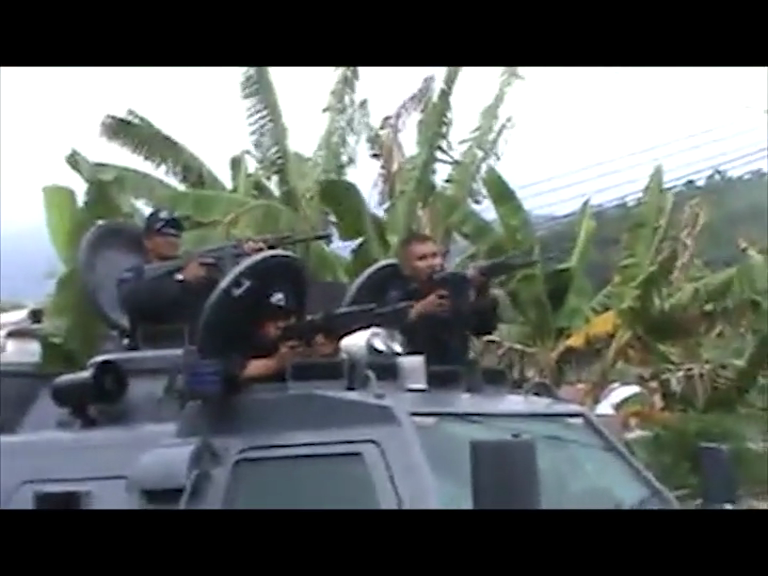
At around 9:00am (West Papua local time) on August 9, 2012 the combined forces of Brimob (Police Mobile Brigade), Densus 88 and TNI (Indonesian Army) blocked off access to Mantembu District and destroyed several houses.

Local stringers sent SMS messages to West Papua Media that at Anotaurei junction in Mantembu district, peaceful demonstrators were confronted with shots fired into the air by the police. A local source reported that sixteen shots were fired – six to the air and ten at human targets. The shoting generated fear and panic amongst the people and forced many, including local villagers to seek refuge in the nearby jungle.

At midday Australian time, West Papua Media team rang the Head of Police, Roycke Harry Langie but the call was redirected to an interrogation squad spokesperson (Reskrim), Mr Waluyo, who denied that any shots were fired and stated that no arrests had been made.

Despite police claims West Papua Media continued to get reports from several people in Serui who confirmed that eleven people had been arrested including a seven months pregnant woman, Ratna Semboari, who is a Member of State Council of Yapen of the Federated Republic of West Papua, an Indonesian-banned independence organisation. A witness told West Papua Media by phone conversation that Ms Semboari was pushed forcefully into BRIMOB truck and fell very hard on her belly.

Sopina (Yosina) Pangkurei, the wife of Daud Abon, governor of Saireri of the Federated Republic of West Papua was also arrested, despite also being  8 months pregnant.  Activists told West Papua Media that she stood in agony as she watched the security forces destroy her house. Local stringers report that police took a printer, a laptop and four banners declaring that ‘The indigenous Papuans also support indigenous people’s birthday.’

Other people arrested in Serui are:

  • Edison Kendi – Deputy governor of Saireri of the Federated Republic of West Papua
  • Sopia Kayani – Member  of State Parliament of Federated Republic of West Papua
  • Yosina Pangkurey, wife of Daud Abon.
  • Hendrikus Warmetan – State secretary of Saireri of Federated Republic of West Papua
  • Ruben Bonai – Member of  State Parliament Federated Republic of West Papua
  • Yan Piet Maniambo – Member of State Parliament of Federated Republic of West Papua
  • Matius J Pedai – Head of Regency of Mamberamu under Federated Republic of West Papua
  • Bram Wainarisi – a local activist
  • Elia Karma
  • Arnelda Kayane
  • John Paririe
  • Daniel Kandipi – a local activist
  • Beni Yobi – a local activist

At time of writing, Kayani, Waremtan, Wainarisi and Maniambo had been released from arrest.

After the release of the arrested women,  Mrs. Yossi Pangkurey (28 yrs) told another West Papua Media stringer that after they were arrested by a joint military-police apparatus in the village of Anatourei, they were immediately taken to the Police HQ of Yapen island.  Police officers immediately separated the men and women, with all the women in one room to undergo interrogation.  Male police officers, who claimed to the detainees that they were acting  on the orders of chief of Yapen police Roycke Harry Langie,  forced all the arrested women to strip and conduct the interview semi-naked, dressed only in their underwear under assumption of imminent sexual assault, according to the women.

In Manokwari, the celebration was held in front of the Papuan Tribe Council office with up to twelve Morning Star flags flying high in defiance of laws banning the West Papuan national flag. Many other people held smaller flags. Local stringers report that a thousands paraded around Manokwari town. Heavily armed Security forces attempted intimidation on the protest, and confiscated the Morning Star flags but people proceed to continue the march peacefully.

This slideshow requires JavaScript.

Slideshow: Images from the demonstration in Manokwari, August 9, 2012 (Photos: West Papua Media stringers)

Meanwhile, in Jayapura, the Baliem Valley and other locations across Papua, celebrations were carried out under strict police supervision.  In Jayapura the police prevented Papuan protesters from marching.  However, protesters proceeded to the Council of Papuan Customary Chiefs to continue the celebration.

In the central highlands celebrations were also held at the Council of Papuan Customary Chiefs despite provocation by police, who according to local stringers surrounded the event in full combat gear.  A Lani highland chief told West Papua Media by SMS that “the reason the police tried to stop the demonstrations was that they were held by ‘unregistered’ groups.”

What this means,” he continued, “is that the Indonesian Government does not respect human rights and universal freedoms.”

Statement from the International Parliamentarians for West Papua on the Escalating Violence in West Papua

West Papua flag
West Papua flag (Photo credit: lussqueittt)

P.O. Box 656, Oxford, OX3 3AP England, U.K.Date: : July 22nd 2012

Statement from the International Parliamentarians for West Papua on the Escalating Violence in West Papua

To: Mr. Susilo Bambang Yudhoyono, President, Republic of Indonesia
Mr. Andi Matalatta, Minister of Justice and Human Rights, Republic of Indonesia
Mr. Hendarman Supandji, Attorney General, Republic of Indonesia
Gen. Bambang Hendarso Danuri, Chief of National Police, Republic of Indonesia

As members of the International Parliamentarians for West Papua, we voice our concerns over the escalating violence in West Papua, especially in Wamena and Jayapura.
We are saddened by the recent murder of West Papuan independence leader Mako Tabuni and we express our sincerest condolences to his family and friends. We call on you to conduct a thorough investigation into Mako Tabuni’s death.

We are also concerned by the recent re-imprisonment of Buchtar Tabuni and his colleagues, Jufri Wandikbo and Assa Alua, and the continued imprisonment of Filep Karma, an Amnesty International recognized prisoner of conscience, who was sentenced to 15 years in prison for raising the Morning Star flag at a peaceful protest.  We ask you to release and to drop all charges against these detainees and others who have been held for peacefully expressing views. We also request your help in assuring that Mr. Tabuni and his colleague be released immediately from custody, as we have further concerns that he may be at risk of torture and other ill-treatment.

We call on you to allow foreign journalists and humanitarian organizations entry into West Papua in order to provide a comprehensive report of the human rights situation there.

As the International Parliamentarians for West Papua, we support the indigenous people’s of West Papua’s call to a genuine act of self-determination, a right which was not recognized in the 1969 Act of Free Choice. We are therefore deeply troubled by your government’s suppression of political activity in West Papua. We urge you and your government to end the violence in West Papua, by listening to West Papuans call to self-determination, rather than attempting to silence them.

Signed,

Andrew Smith, MP (United Kingdom)
Caroline Lucas, MP for Brighton Pavilion House of Commons (United Kingdom)
Lord Richard Harries (United Kingdom)
Dr. Russel Norman, MP (New Zealand)
Jamie Hepburn, MSP (Cumbernauld and Kilsyth, Scotland)
Catherine Delahunty, MP (New Zealand)
Bill Kidd, MSP (Glasgow Anniesland, Scotland)
Hon. Ralph Regenvanu, MP (Port Vila, Vanuatu)
Cllr Alex Sobe (Leeds City Council)
Eugenie Sage, MP (Aotearoa)
Cate Faehrmann, MLC Green MP (Australia)

Is Australia funding Indonesian Death Squads? Densus 88 in West Papua

Statement by the West Papua Project, Centre for Peace and Conflict Studies, University of Sydney, 16th July, 2012

Questions are being asked about the role that the partly Australian funded
and trained elite Indonesian police squad, Densus (Detachment) 88, has
played during the recent violence in West Papua. Set up in the wake of the
Bali terrorist bombings, Densus 88’s mandate was to tackle the rise of
domestic terrorism in Indonesia. Australian support might have been
motivated by revenge as well: 88 Australians were killed in the Bali attack.
While acclaimed for capturing or killing known and suspected terrorists,
Densus 88 also gained a reputation for extreme violence: many suspects being
killed rather than arrested. Now reports are suggesting that Densus 88 is
operating in West Papua, possibly clandestinely, and has been responsible
for the assassination-like killing of Papuan political activist, Mako
Tabuni, on June 14.

Detachment 88 troops firing live rounds at civilians during the brutal crackdown on the Third Papuan People’s Congress, October 19, 2011 (West Papua Media video still)

While Indonesian National Police spokesman, Saud Usman Nasution, has denied
Densus 88 is operating in West Papua he has left the door open for their
involvement, saying in the Jakarta Globe on June 27, “Densus will be
deployed if terrorism occurred there.” However other reports, for instance
from Kontras Papua, a local human rights organization, state that Densus 88
is already operating in West Papua “carrying out undercover activities”
(Cenderwasih Pos, June 23). Kontras Papua believes that Densus 88 was
involved in the Tabuni killing – where the victim is reported to have been
standing in the street eating betel nut when three unmarked cars pulled up
nearby. With no provocation a person emerged from one car and shot the
victim dead.

Police report that the victim had tried to snatch a weapon from the
plainclothes police involved and was killed in the resulting fracas. Police
also claim that Mako Tabuni was wanted for a series of shootings that had
occurred in Jayapura over the previous few weeks: a claim that seems
unlikely given his role as Deputy Director of KNPB (the West Papua National
Committee), which is a non-violent political organization. Tabuni had also
been publicly calling for an independent investigation into the recent
shootings of which he was accused. Nonetheless, any charges should have been
heard in court and given due legal process, now impossible with Tabuni’s
death. Other reports of Densus 88 activities in West Papua have come from
respected Papuan leaders. Reliable sources observed Densus 88 police arrest
KNPB member, Zakeus Hupla, in the lobby of the Dhanny Hotel, Entrop,
Jayapura, on the morning of June 23. Other reports indicate further arrests
of KNPB members by Densus 88 and their subsequent torture. According to
family members, no arrest warrants were issued by Indonesian police for
these arrests, and the Jayapura police deny that the KNPB members are in
their custody. Indeed it is unclear if these men have been arrested,
abducted or ‘disappeared.’

These events are of genuine interest and concern to Australia because
Australian taxpayers’ money is spent training and maintaining Densus 88.
This organization has a legitimate role to play in countering the rise of
terrorism, but it should act strictly within its organisational mandate. If
Australian taxpayers are indeed partially funding a clandestine force
involved in killings, abduction and torture of Papuan activists an
unacceptable situation has developed. These events and allegations must be
comprehensively investigated and all funding for Densus 88 frozen until
either the allegations have been disproved or the individual police officers
guilty of crimes arrested and tried in an open court. We call on the
Australian government to immediately halt the funding of Densus 88, to
investigate the claims of its misconduct, and to apologise to the Papuan
people if they are proven to be true.

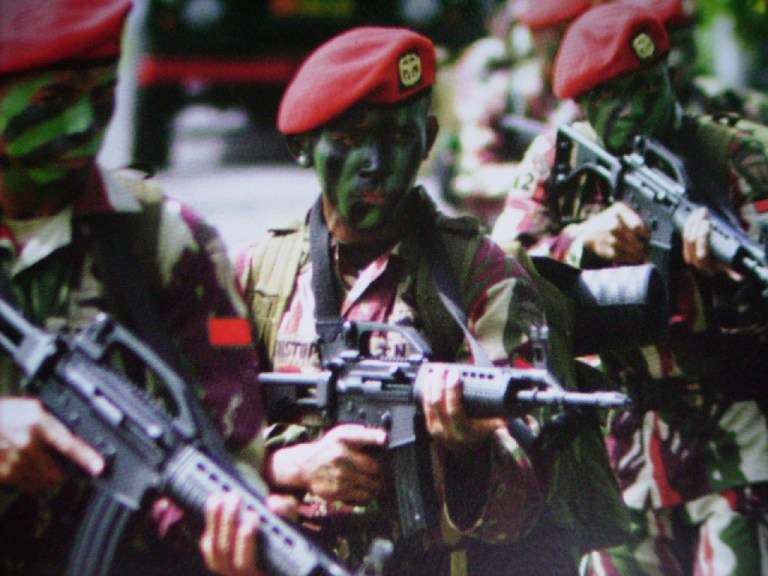
Kopassus claims to be pursuing ‘persuasive’ approach

The “persuasive” approach used by Kopassus
Bintang Papua, 4 July 2012
The commander of Kopassus, the elite strike force of the Indonesian army, Major-General Wisnu Bawa Tenaya declared during a joint training investigation with  China’s People’s Liberation Army in Shandong, China, that his men will continue to pursue the persuasive approach in its handling of the security disturbances in West Papua.He was quoted as saying: ‘We cannot the kind of actions that we would like to take but must act cautiously because in addition to security problems, other issues in West Papua need to be attended to, such as the welfare of the people.’

He also said that Kopassus forces plan to conduct expeditions in various parts of in West Papua to investigate the what is going on there and what it is that the people there actually want.’

Earlier on,  a representative of Kontras,  Indria Fernida, the chairperson of the Synod of the Kingmi Church, Revd Benny Giay and the secretary of the Working Group of NGOs in Papua, Septer Manufandu made it clear the military approach is still being prioritized in West Papua.

Moreover, the welfare approach that has for so long been proclaimed by the authorities was far from being pursued to any meaningful extent or in any way to the satisfaction of the aspirations of the Papuan people.

[Abridged in translation by TAPOL]

Create a website or blog at WordPress.com

Up ↑