Papuan cultural parade blockaded then broken up by Jayapura Police

From KNPB and West Papua Media sources in Jayapura

February 20, 2014

https://westpapuamedia.info/wp-content/uploads/2014/02/565e1-dscf2364.jpg
Traditional Cultural Action, Jayapura, 17 February 2014

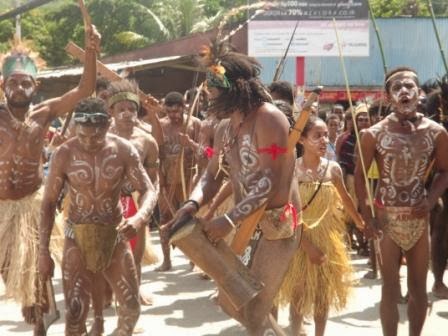
A cultural parade organised by university students in Jayapura was blockaded and then dispersed with force by Indonesian police on February 17, after Indonesian police refused to recognise West Papuan cultural expression.

The demonstration of culture, music, art and dance from across Papua’s indigenous tribes, in which several hundred students in two groups marched wearing traditional Papuan dress, was to highlight the demand of “Save the Papuan Culture”.  The manifestation was organised by the Youth Coalition for the Rise of Students (Koalisi Pemuda mahasiswa bangkit or KPMB) and the Cenderawasih University’s (Uncen) Student Executive Body (Badan Eksekutif Mahasiswa or BEM).

This slideshow requires JavaScript.

Speakers, songs and dances were performed from 8-10am local time in two locations, outside the Uncen Waena Housing Complex (Perumnas III) and in front of the post office in the town of Abepura, and at 10am, the Perumnas III mass began to march and dance their way to Abepura.

However Police blockaded the mass action once the crowd reached the Waena traffic lights.  Despite having previously notified police of their intention to hold the parade, field coordinators of the action were forced to negotiate with the police, pointing to the KPMB’s intention to hold a peaceful action that day in the form of Papuan cultural art.

However, in an outburst witnessed by a West Papua Media stringer, the Deputy Commander of the Jayapura District Police, the notorious hardliner Kiki Kurnia refused to let the gathering continue, warning the crowd that he would not tolerate “introducing some culture from an unknown place”.  “There is no such culture such as that in Indonesia,” Kurnia asserted, dismissing over 45,000 years of Papuan language, culture and art.

Kurnia then prohibited the students from displaying any form of Papuan culture, and further stated that the crowd “was prohibited from carrying out any action of any form whatsoever as the Governor had prohibited all forms of actions,”. according to independent sources and verified by WPM.  Just after 10am local time, ordered several platoons of heavily armed police to blockade and disperse the cultural gathering.  Several injuries were reported but unconfirmed.

After being forcefully dispersed,  a much larger mass returned and gathered in front of UNCEN’s main entrance, lighting a bonfire on the road in response.  According to witnesses, this crowd was spread out as far as Perumnas III in Waena, a distance of several kilometres.

According to the cultural event organisers, the crowd outside UNCEN was angrily voicing their objections to the continued silencing of the democratic space throughout all of Papua by the Police, with speakers expressing outrage at the betrayal of the culture of Papua.

“That the police had been obstructing the mass action stating ‘Where are you bringing this culture from? We don’t have any culture like that in Indonesia’ angered us all, as it is seen as a denial of the Papuan culture,” an organiser told West Papua National Committee (KNPB) media workers.

Members of the gathering clearly spoke out that if the police continued to betray and deny Papuan culture in such a way, that Papuans would mount an even larger scale action asserting the Papuan culture, and that they would boycott the 2014 presidential election, according to reports from the KNPB.  The action Coordinator Beny Wetipo then called upon the Papuan community and all parties to save the Papuan culture from being replaced by a foreign culture that was threatening the existence of the Papuan race.

Karnavian: 11 prominent security cases in West Papua for 2013

From Victor Mambor at  Tabloid Jubi

December 1, 2014

Head of Papua Police, Inspector General of Police Tito Karnavian (Jubi)

Jayapura, 1/1 (Jubi) – Head of Papua Police, Inspector General of Police Tito Karnavian said, during the year 2013, there were eleven prominent cases related to Security and Public Order.

“There were eleven prominent cases during the Year 2013. Such as attacks carried by unidentified peoples, fifteen cases, and assault in the area of ​​PT Freeport Indonesia, eleven cases,“ said Tito Karnavian to reporters on Tuesday (31/12) night.

The eleven prominent cases are :
1. Tribal warfare, 3 cases;
2. Shooting in the area of ​​PT. Freeport Indonesia, 11 cases;
3. Mass attacks against members of the police, 6 cases;
4. Attacks by Armed Civilian/The National Liberation Army of Free West Papua Movement, 15 cases;
5. Deprivation against foreigners, 1 case;
6. Plane crash, 0 cases;
7. Protests against Special Autonomy Law, 3 cases;
8. Possession of illegal weapons , 4 cases;
9. Shootings by police, 3 cases;
10. Anarchist demo, 3 cases;
11. Raising of the Morning Star, 5 cases.

In addition, Papua Police had eleven operation carried out in the year 2013.
Eleven of these operations include Operation Mantap Praja II,  Operasi Mantap Praja III, Operasi Sahabar Matoa, Operasi Simpatik Matoa, Operasi Dian, Operasi Patuh Matoa, Operasi Zebra Matoa, Operasi Lilin Matoa dan Operasi Aman Matoa III.

“To eradicate corruption, from ten activities with 122 existing cases in police report, the State suffered a loss of Rp. 58,166,994,730, – but money returned to the state was Rp. 15,066,951,566, – , ” said Tito Karnavian.

Papua Police have predict public order and security situation (Sitkamtibmas) for 2014 will still be dominated by mass demonstrations relating to the Legislative and Presidential Elections. (Jubi/Aprila Wayar/Victor Mambor)

BRINGING AN END TO THE CONFLICT IN PAPUA THROUGH JAKARTA-PAPUA DIALOGUE

Opinion / Analysis

By: Selpius Bobii

December 31, 2013

Peace is critical to the continuation of life for human beings, though we find it hard to achieve in even our everyday lives. West Papuan Nehemia Yarinap stated that “Christ Jesus came to bring peace to the earth, however the characteristics of humans are such that they sometimes fail to reach peace and truth due to acting in the interests of political economics, oppressing other nations of peoples in the name of peace. At this time in the modern world, there are  powerful nations oppressing and usurping the rights of other nations.” Yarinap’s points to the annexation of the sovereign independence of the nation of Papua into the Republic of Indonesia, commenting “ to realise peace and justice in Papua so many have sacrificed themselves and continue to sacrifice their lives just as Jesus Christ sacrificed himself to bring peace to humans on this earth….. Christmas reminds all people about peace and speaks to us that those characteristics that oppress other nations must change.”(1)

The dynasty of tyranny of Indonesia is now firmly established in Papua. In all areas of life  the Indonesian State has firmly established those pillars that ensure the continuation of Indonesia’s oppression, even in religion. Indonesia has to that end consistently brought  pressure to bear on those key Papuan figures in the churches who have continued to speak openly about the realities of discrimination, marginalisation, injustices and humanitarian atrocities that are occurring against the indigenous people of Papua. There have been accusations made that those such church persons too are themselves involved directly in the politics of Papua. Accusations that are particularly of recent times aimed at weakening the case for dialogue between Jakarta and Papua which has been encouraged by particular church figures.  If the Church also becomes a pillar of support for this dynasty of oppression by Indonesia, then the church itself will in so doing lose both its very foundation as well as its direction.  In that instance the church would be torn from its very roots and mission as handed down by Jesus Christ, being to save the world.  The church in Papua  must stand strong as a beacon of hope to the people and not become a partner of the State of Indonesia in the colonial domination of the indigenous people of Papua.

The Papuan Writer Usman Yogobi stated that “ The countenance of the Church in the land of Papua is such  that it has become  a partner for the Indonesian Government, with some reverends, bishops, pastors, pilgrims and monks supporting the colonial domination of the land of Papua. ‘Papua the Zone of Peace’ as declared in 2002 has never been realised, with the reality being quite the opposite – Papua has become a region of humanitarian disaster!

The term ‘Zone of Peace’ which arose from leaders of the different religions in Papua in 2002, has even been adopted recently by the Indonesian Military Commander in Papua (XVII) and the Head of Papuan Provincial Police. They have used the term in speech, letters or on banners, whilst in practice the Indonesian military and police have continued to carry out acts of violence and human atrocities against the indigenous people of Papua” stated Yogobi. The Church in Papua needs to learn and better understand its mission as handed down by Christ Jesus, being to bring salvation to the world. The salvation of souls is not just a matter of becoming oriented with the hereafter, but rather it’s about saving lives on this earth.

The law of the church prohibits representatives of the church being practically involved in politics, however at the same time it’s important to understand that the very teachings of the churches stress the importance of the church being involved in a real way in the life of the people. There is no such thing as evangelisation without social involvement; no such thing as mission without the struggle for justice. The church has a moral responsibility to be socially involved and to fight for justice and for respect of the dignity of humanity.

Dialogue between Jakarta and Papua which is being urged by the Peace Network of Papua – coordinated by the Catholic Priest Neles Kebadabi Tebay (Pr) – is a part of the involvement of the church in the upholding of justice and the respect of humanity dignity. If the church only speaks of justice and criticises human rights violations but does nothing to point to a way to bring an end to the conflict in Papua, then the human rights violations in Papua will continue without ceasing. Rather the church needs to itself open a way or point to a way forward.  Dialogue between Jakarta and Papua is a way of enabling such discussion as required to deal with  the many problems so as to find a dignified solution to the Papuan issue.

So let’s work together to lead the way to bringing about dialogue between Jakarta and Papua to find a solution that upholds the dignity of all.  Indeed there are more than one way to bring about an end to the problems in Papua and it is important that other approaches being made are also continued such as the legal approach and the United Nations decolonisation approach.  And as we struggle let’s always remember that the Struggle of Papua does not use violence or physical force but rather our means are always peaceful. As wherever violence is used there are inevitably human victims lost and indeed Indonesia has and continues to kill Papuans by a range of violent means. Over this more than 50 years endless innocent victims have been killed as a result of Indonesia’s actions in Papua. There’s been enough killing by Indonesia. Let’s bring an end to this cruel colonial domination using strictly peaceful means.

Indonesia and Papua really need to be enlivened to bring this about and its important we leave any narrow thinking paradigms. As the consequence of such is but to extend this conflict and more fallen victims, which are not small in number. Let’s take this never-ending conflict between Papua and Indonesia to the table and carry out unconditional peaceful dialogue as between two equal parties, facilitated by a neutral third party and in a third and neutral location. The international community including the USA has previously expressed its support for the path of dialogue between Jakarta and Papua; and it is the Writer’s conviction that all those who seriously uphold the values of the human rights, democracy, truth, justice, honesty and peace will also support a peaceful and dignified approach to finding a solution to bring an end to the problems in Papua. So let’s all work together to make dialogue between Jakarta and Papua a reality!

The Indonesian President Susilo Bambang Yudhoyono  has numerous times stated in speeches that the problems of Papua will be brought to an end in a peaceful and dignified way. Also is recalled the words of the Head of the Council of Presidential Advisors Dr Hasibuan in January 2013, that the President had promised to arrange dialogue between Jakarta and Papua during the year 2013. However that promise has not yet been fulfilled.  A ‘promise’ is as something that is owed and must be paid and President SBY needs to fulfil that promise. It is dearly hoped that before President SBY’s term as president comes to a close on 20 October 2014 that this very extended conflict between Indonesia and Papua can be brought to an end through peaceful and dignified means and that it might become the hope of all parties to make that a reality.

Footnote

  1. 1.        The Bible of the Christian Religion  talks about the ‘Garden of Eden’ that radiated the glory of God and where there was peace and prosperity.  Where there were no wild beasts but rather all creatures lived together in peace. Then it is written, that peace was destroyed by the wrong of the first humans and therein began anarchy on the earth. Humans in all places seek after that peace which the Bible speaks of. Yet we see in the world that powerful humans prey on those weaker than themselves. The rich get richer and the misery of the poor becomes greater.

Selpius Bobii is the  General Chairperson of Front PEPERA & is a Papuan Freedom Political Detainee in Abepura Prison, Jayapura


Leading Indonesian NGO Condemns the continued use of Treason Charges against Papuans

by ALDP (Alliance  for Democracy in Papua)

Opinion/Statement

September  6, 2013

68 YEARS SINCE INDONESIA BECAME INDEPENDENT, TREASON [MAKAR] IS STILL BEING USED AGAINST PAPUANS.

The  Indonesian people recently celebrated the 68th anniversary of their independence on 17 August 2013.   What lessons can we draw from this anniversary in order to resolve problems faced by our people who experience so many problems in various parts of the country,  especially in regions where there is conflict such as Aceh and Papua?

Especially with regard to Papua, it is not acceptable for the articles about treason  to be used any more.   This is because for a country that is now based on democratic principles, it clearly violates these principles.  Furthermore, the law on treason which is still included in Indonesia’s Criminal Code is no longer used in the country where it originated [The Netherlands].  The continued use of these articles will only widen the gap between Papua and Indonesia and lead to acts of violence because of  feelings of revenge about history, or may cause friction between different groups of people.

These articles on treason are always held ready for use against activists or anyone who demands justice and the right to express their views in public, in accordance  with the right to freedom of expression.

The treason articles were first included in the Criminal Code in the 19th century. The Dutch Minister of Justice adamantly refused a move to include an article on treason which could be applicable to anyone.  He said:  ‘These articles should be enacted to meet the needs of a colonial territory and should not be applicable to  European countries.’

The articles on treason were adopted by the Dutch colonial government and were based on Article 124 of the British Indian Penal Code.  In 1915. The Indian Supreme Court and the East Punjab High Court declared that they were invalid because they contradicted the Indian Constitution which upheld the principle of freedom of expression.  In The Netherlands, these articles were regarded as being undemocratic.   However, the Dutch East Indies government made use of the articles in their colonial territories.

In this day and age, several decades after Indonesia declared its independence, these articles should no longer be applicable to citizens of the country, including Papuans, bearing in mind that Papua is not a colony of Indonesia. {Eds – This statement does not reflect WPM’s position}

In judicial terms, treason is a unilateral act against the authorities, for the purpose of ensuring that part of its territory falls into enemy hands or should be ceded in order to become part of another state.

The crime of treason  is regulated under Articles 104 to 129 of the Criminal Code – KUHP.  Treason is also classified as a crime against the president and vice-president [the head of state and/or the head of a rival state], against the legitimate government or against government agencies, being involved in espionage on behalf of the enemy, resistance to government officials, rebellion and other activities that are directed against state interests.  Treason is also committed against the government (the head of state and his/her deputy) for the main purpose being to render an individual incapable of governing, to annihilate the country’s independence, to overthrow the government, to change the system of governance by unlawful means, to undermine state sovereignty by  separating part of the country on behalf of another country, or to create an independent state.

The crimes of spreading hatred or incitement are dealt with in Articles  154, 155 and 156 of the Criminal Code. These articles state that ‘public statements which express feelings of hostility or are offensive to the government’ are regarded as crimes as well as public statements which support such sentiments. These articles are punishable for up seven years.

During the era of the late President Soeharto, these articles were frequently used to restrict freedom of expression. They were also used against political opponents, critics, students and human rights defenders in order to silence them. The people in power used these articles like rubber, something which can be pulled in any direction as a way of restricting the right to freedom of expression.

Nowadays, in {after} the era of ‘reformasi’, the articles are frequently used to bring charges against pro-democracy activists.  In Papua. They are used in every way possible against pro-democracy activists on occasions when it has not been possible to charge them for involvement in treasonous activities.

In a report published by Human Rights Watch (HRW) in 2007, ‘Protest and the Punishment of Political Prisoners in Papua’ , Indonesia was mentioned as one of the countries where exceptions and restrictions apply that are in conflict with the basic principle of freedom of opinion. HRW drew attention to the many cases of people being arrested and imprisoned simply because they took part in peaceful protest or for peacefully raising flags. This is in violation of international law on basic human rights.  Indonesian courts frequently apply the law on ‘spreading hatred’ or ‘incitement’  towards people who are exercising their right to freedom of expression. These clauses also violate the spirit of the Indonesian Constitution which was adopted when the country became independent in 1945.

There is a tendency in Papua for a court, having been unable to prove that treason was committed, to use the crime of incitement. The articles about treason  were used when Indonesia was a Dutch colony to charge individuals or groups of people with rebellion. But these days, ‘the articles on treason are used against the civilian population when they publicly express their aspirations,’ said Harry Maturbongs, the former co-ordinator of KontraS.

A lawyer in Papua, Gustaf Kawer, said that the tendency of courts and prosecutors to use the charge of incitement when they are unable to prove that treason has been committed, is a sign that the court is apprehensive and wants to avoid the possibility of people who have been charged making counter-charges against the state, where the case against them had not be proven.

It is often the case that pro-peace Papuan activists who are brought before the courts are charged on several counts for a variety of misdemeanours.  In the trial of Buchtar Tabuni in 2010, he was charged under five articles.  Article 106 and Article 110, as well as Article 160, Article 212 and Article 218, for treason, for incitement and for disobeying an order by an official.  Another group of people were sentenced and convicted for treason. Forkorus Yaboisembut and his colleagues were arrested by the police for organising the Third Papuan People’s Congress on 19 October, 2011.  [After formally declaring the establishment of an independent Federated State of Papua] ‘President’ Forkorus, along with his Prime Minister Edison G. Waromi, were arrested with others who were involved in organising the Congress, Dominikus Surabut, Agus M. Sananay Kraar and Selfius Bobii. They were charged by a team of prosecutors headed by Yulius D.

Even today In 2013, the treason article continues to be used. A group of men were recently charged. They are Klemens Kodimko (71 years old), Obeth Kamesrar (68 years old), Antonius Saruf (62 years old), Obaja Kamesrar (52 years old), Yordan Magablo (42 years old), Hengki Mangamis (39 years ) and Isak Klebin (52 years old) . They were charged at the first hearing of their trial in a court in Sorong on Monday, 19 August 2013.

A spokesman for the police in Papua, I Gede Sumerta Jaya, said that the men were charged with treason because they are leaders of the OPM (Organisasi Papua Merdeka) or of radical groups that are active planning or speaking out in favour of resistance to the legitimate government.

Earlier this year, on 30 April, hundreds of people gathered at a posko  [a small construction] which they had  just set up. They sang together as they gathered there on 30 April to make preparations to celebrate 1 May on the following day.  While they were singing, shooting was heard aimed in the direction of the posko. The shots came from some people aboard an avanza vehicle with darkened windows, accompanied by a police patrol vehicle.

[Translated by TAPOL]

Timika Six plead for international intervention after sentence passed despite unproven case

by West Papua Media, with Oktovianus Pogau at SuaraPapua.com

April 18, 2013

Six West Papua National Committee (KNPB) activists from Timika were each sentenced to one year in prison on Tuesday by judges from the Assembly District Court in a trial deemed as opaque and farcical by observers.  Sentenced on charges of carrying dangerous weapons and makar (treason/subversion), defence lawyers insisted that the six non-violent activists had no case proven against them and will immediately be lodging an appeal.

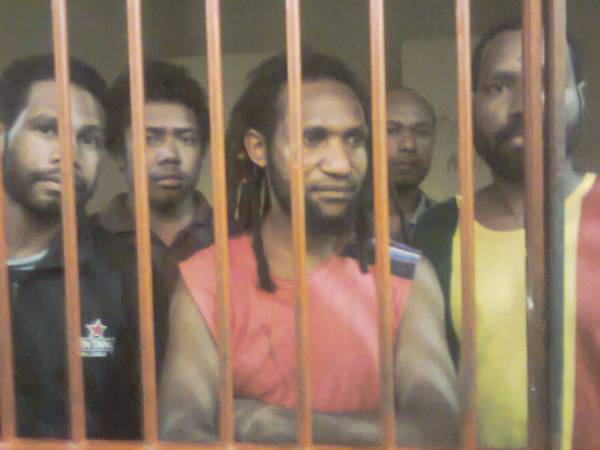
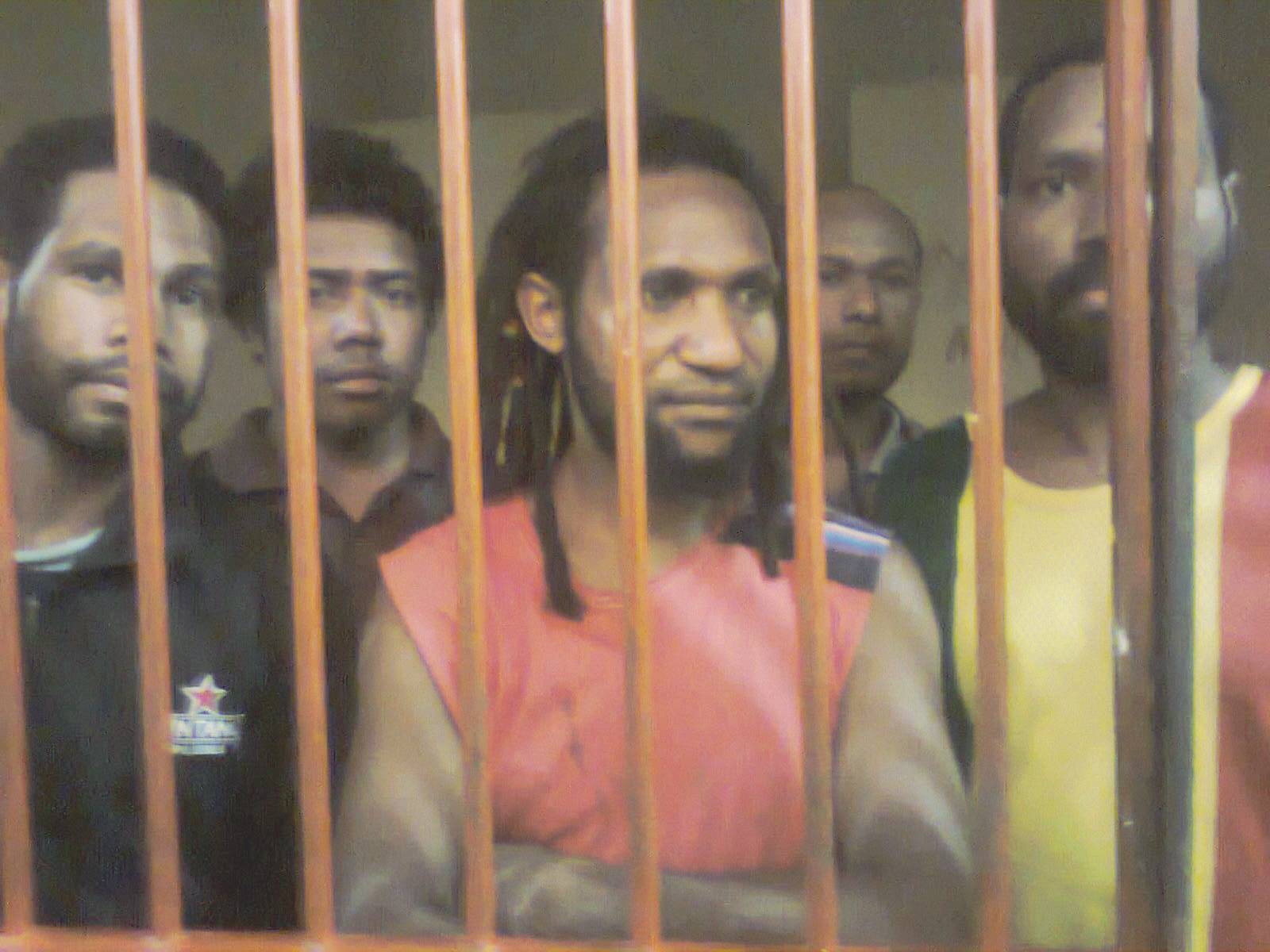
The KNPB Timika 6 back in their cells, photo taken April 17, after trial hearing. From L-R, (photo KNPB/ West Papua Media)
The KNPB Timika 6 back in their cells, photo taken April 17, after trial hearing. (photo KNPB/ West Papua Media)

The six, Romario Yatipai, Steven Itlay, Yakonias Womsiwor, Paulus Marsyom, Alfred Marsyom and Yanto Awerkion, were arrested on October 24, 2012, amidst a spate of high publicity arrests of KNPB activists by the Australian-funded counter-terror unit Detachment 88.  The then-incoming Papua Police Chief, former Detachment 88 chief Tito Karnavian,  exploited the brutal arrests to increase justification for use of Detachment 88 against political activists at a time when OTK (unknown persons, now known as Orang Terlatih Khusus or Specially Trained Persons) killings were spiralling out of control across Papua.

Despite Jakarta pinning the blame for the killings on non-violent activists from the

KNPB Timika Activist  Romario Yatipai
KNPB Timika Activist Romario Yatipai

KNPB, no credible evidence had been able to prove KNPB responsibility despite highly politicised and farcical trial processes.  Most independent observers have linked responsibility for OTK incidents in Papua squarely in the hands of agents of the Indonesian special forces.

In SMS and email communications to West Papua Media from the prison before and after the trial, KNPB activist and detainee spokesman Romario Yatipai said that the assertions made by police were “Simply lies”.

534937_10152766823260010_1179983606_n
“We are KNPB activist in Timika, West Papua. Indonesia Police jailed us with no reason.” – Romario Yatipai

“Indonesian police say that KNPB activist are criminals, terrorists, Makar (treason), separatist and so on,” Yatipai explained.

“Actually, KNPB activists in Timika always make peaceful demonstrations with all West Papuans.    We always make peaceful demonstrations to demand Referendum, as the best solution for West Papua,” he said.

Central to the police case was that the accused were allegedly carrying explosives to be used against Indonesian police posts and military targets, yet no evidence was furnished that could prove that the accused possessed explosives before t

Despite the Australian Federal Police providing Detachment 88 with state-of-the-art explosives and ballistic forensic testing capability to secure counter-terror convictions, none of this equipment or personnel were deployed in Papua for any of the OTK  trials, and no forensic proof was available at the Timika 6 trials that could have linked any of the defendants to use of explosives.

The trial heard wild accusations from prosecutors and police, but defence lawyers led by Gustaf Kawer, objected and expressed surprise when Yanto Awerkion (19) was sentenced.

As to who had ownership of explosives, Kawer explained to Suara Papua, none of the witnesses saw the defendant carrying explosives, but officials forced the defendant to claim possession of explosives.

“Since the moment of the defendant’s arrest along with five colleagues, there were absolutely no explosives he possessed … Yet when he reached the Mimika police station, the officers brought explosives and used it as evidence, and compelled the accused to confess  having an explosive. It’s very strange,” Kawer told Suara Papua.   “Our legal counsel will conduct a plea on April 23, 2013. The sixth defendant must be released immediately because of  not proven guilty, ”

Kawer also objected to the sentencing of the other defendants under makar provisions, saying the judges decision “did not correlate with the examination of the facts.”

“For the first case, it’s not proven that the five defendants were in the possession of sharp weapons.  And concerning the  treason related article, also during the course of investigation (there was) not any reference to it, but nevertheless the judge decided one year in prison by saying treason  that was proven – so we will appeal, ” Kawer told suarapapua. com.

After the defendants returned to the prison cells that have been their home since October 2012, they made a video appeal on their mobile phones, calling on the international community to do more to ensure that Indonesia ceases its persecution of peaceful political activists.

“We hope (the) International community, Amnesty International, IPWP, ILWP support us and pressure Indonesia government, Indonesia Police in Papua and Timika,” Yatipai told West Papua Media.  “West Papua activists, and all West Papuans need UN Observers,  UN Humanitarian workers, and International Journalists now in Papua.”

“Please support us with prayer and monitoring for us” said Yatipai.

westpapuamedia

Create a website or blog at WordPress.com

Up ↑