Australian Greens: Government fails to cut ties with torture unit

Australian Greens

Government fails to cut ties with torture unit

Media Release | Spokesperson Scott Ludlam

Wednesday 8th December 2010, 4:46pm

The Australian Greens have criticised the Government for failing to take action in response to allegations an Indonesian unit supported by Australian authorities has used torture against peaceful protestors.

On November 4 this year Greens legal affairs spokesperson, Senator Scott Ludlam, called on the Government to stop funding Detachment 88, an Indonesian “counter-terrorism’ unit that has been linked to a series of human rights abuses.

“Demonstrators arrested in Ambon, in Maluku, unveiled their independence flag at an event at which the Indonesian president was present – this had nothing to do with terrorism whatsoever. They were subsequently jailed and many of them tortured and hospitalised,” Senator Ludlam said. “70 political activists in Maluku have been imprisoned since 2007.”

The Department of Foreign Affairs and Trade reported this week that the total Australian Federal Police financial support for counter-terrorism initiatives in South East Asia in the 2009/10 was $16.3 million. DFAT said while the AFP is not directly involved in Detachment 88 operational activities, the AFP’s support to the Indonesian National Police includes that unit.

Senator Ludlam said that while Australian officials provide support to Detachment 88, it is not enough to leave investigations of the unit’s conduct in the hands of the Indonesian authorities.

“We are told the AFP does not have the power to investigate what Detachment 88 has done, but it does have the power to stop funding and supporting the unit,” he said. “The United States introduced a ban on training or assisting Detachment 88 members in Maluku in 2008 after the allegations of torture first emerged in 2007, but our Government has not issued a similar ban, which is much-needed.”

Detachment 88’s major facility at the Jakarta Centre for Law Enforcement Co-operation was established in 2004 with almost $40 million of Australian funding. According to its website, most of the counter-terrorism seminars at the Centre are run by the AFP, and it is a major beneficiary of $16.3 million in annual funding allocated to the AFP to combat terrorism in south-east Asia.

http://scott-ludlam.greensmps.org.au/content/media-release/government-fails-cut-ties-torture-unit

Indonesia: Respect Rights of Papuan Prisoners Filep Karma and Buchtar Tabuni

Indonesia: Respect Rights of Papuan Prisoners Filep Karma and Buchtar Tabuni

The East Timor and Indonesia Action Network (ETAN) and the West Papua Advocacy Team (WPAT) urge the Indonesian Government to respect the rights of and end the persecution of internationally recognized prisoners of conscience Filep Karma and Buchtar Tabuni who were transferred from Abepura Prison to Jayapura Police Headquarters on December 3.

ETAN and WPAT also urge the U.S. government to use its considerable influence with the Indonesian government and police, deriving in part from its extensive assistance to and training of the police, to ensure that persecution of these prisoners of conscience ceases.

The transfer of Karma, Tabuni and several other prisoners to the police headquarters followed a riot at the prison which in turn was prompted by the killing of one of five prisoners who had escaped the previous day. The authorities are accusing the two activists of inciting the riot. However, reliable reports says that Karma and Tabuni had sought to calm the situation at the prison.

Karma is serving a 15-year sentence for raising a Papuan flag in 2004, while Buchtar Tabuni is serving a three-year sentence after supporting the launch of International Parliamentarians for West Papua in October 2008.

Since their transfer to the police headquarters Karma and Tabuni reportedly have had very limited contact with their families and no contact with legal counsel. Karma has launched a hunger strike in support of his demand for proper treatment for himself, Tabuni and the other transferred prisoners, including access to adequate food or drink.

ETAN and WPAT note that Article 10 of the International Covenant on Civil and Political Rights requires that “All  persons who are deprived of their freedom must be treated humanely and with respect for their dignity as human beings.”  ETAN and WPAT also note that under Indonesian regulations Karma and Tabuni are entitled to correspond with and receive visits from their families, legal counsel and others.

ETAN and WPAT are also deeply concerned that the Indonesian authorities may seek to pursue charges against Karma and Tabuni related to the prison riot. Such a course would be particularly ironic insofar as the Indonesian authorities have failed to prosecute the security force personnel who were recorded torturing two Papuans in May 2010.

Observers in West Papua are concerned that the authorities may transfer Karma and Tabuni to the infamous Nusakembangan prison in Java, where violent criminals are incarcerated. As nonviolent prisoners of conscience, Karma and Tabuni would be at risk. Such a transfer would also make it much more difficult for their families and counsel to monitor their welfare. ETAN and WPAT strongly urge that Karma and Tabuni not be transferred out of West Papua.

Contact: Ed McWilliams – 401-568-5845
John M. Miller (ETAN) -917-690-4391

see also West Papua Report

Bintang Papua: Rejection of OTSUS intensifies DPRP should convene plenary session

[All items abridged in translation]

Bintang Papua, 1 November 2010

Rejection of OTSUS intensifies
DPRP should convene plenary session

The rejection of OTSUS, the Special Autonomy Law of 2001,  has intensified  with a demonstration outside the office of the regional legislative assembly, the DPRP calling for it to convene a plenary session to discuss  the eleven recommendations adopted recently by the MRP which included the rejection of OTSUS.

‘We declare that the OTSUS law adopted in 2001 has resulted in no significant  improvements in the living conditions of the Papuan people, and we state that OTSUS has failed.’

The chairman of Pepera PB, Selpius Bobii said that OTSUS provided for a system that sides with the Papuan people, and which protects and empowers them. But in the nine years since the enactment of the law, not a single special regulation as required under the law has been adopted. There have been inconsistencies between the attitude and the actions of the central government.

The chairman of the Customary Youth  of Papua, Wilson Uruway, presented a joint statement to the deputy chairman of the DPRP who was urged to make a statement in response. He said that all the aspirations of the people submitted to the assembly had been discussed. Those concerning the central government would be quickly forwarded to the government in the same way that the eleven recommendations of the MRP has been forwarded.

The joint statement was supported by a large number of groups and NGOs.

Hardly any of the OTSUS funds  has not been used in ways that would assist and help indigenous Papuans but had been misdirected as ‘fictive funds’. The central government was accused of thwarting the MRP at all levels of its activities, as a result of which it has be incapable of struggling for the rights of the Papuan people.

Among the indicators of the problem was the tardiness in adopting special regulations – Perdasi and Perdadus – regarding management of the administration and  for economic development. Dualism between provincial and districts administrations has occurred in their adoption of different regulations

Before demonstrating in front of the DPRP, the crowd gathered at Expo Waena, where they waited for a group from Sentani Customary Council to join them.

One speaker called on the government  to speak out against acts of intimidation, threats and killings of Papuans perpetrated by the TNI/Army and the Police.

A group led by the chairman of DAP Forkorus Yaboisembu arrived at the DPRP travelling on several trucks.

The demonstration was surrounded by two special Brimob units and members of the local police. Nevertheless, the action proceeded peacefully

—————————

Historic Papua day commemorated

Bintang Papua, 19 November 2010

19 November 1969  is a historic day for the Papuan people, a day regarded as been sacred by many sections of the people struggling for independence. On this day in 2010,  groups gathered to recall the historic event when the  Papuan issue was discussed in the US Congress, although it did not clearly stated that the US Congress fully supports Papuan sovereignty.

At a gathering held to socialise the events at the US Congress, Wilson Waimbo Uruwaya  announced that they would hold a peaceful demonstration calling for the peaceful solution of Papua’s status which was discussed by the UN General Assembly in 1969.

Wilson said that all elements of the Papuan struggle were united in their determination to socialise the results of the US Congress on which occasion, a discussion took place about crimes against humanity and the need to seek a solution to the difficult problems that were being faced by the Papuan people to the present day.

The discussions in the US Congress which had occurred for the first time have taken the Papuan people a step forward in their history of struggle.

Brimob should act professionally and be loved by the people

Bintang Papua, 15 November 2010

Abridged in translation

Brimob should act professionally and be loved by the people
The commander of the Brimob unit in Papua has called on his men to avoid acts of violence in resolving problems that may arise. Speaking on the occasion of Brimob’s 65th anniversary, Police Commissioner Prasetyo said: ‘We need to be firm but without using violence. We may feel angry but we should not act in a spirit of anger.,’ he said.

Saying that these words were aimed at members of the force in Papua, he acknowledged that this would involve a process, over time. ‘It’s not something that is easy to do, like turning your hand upside-down and could take quite a long time.’

He said that the changes must start from the top. ‘We must set an example. We should not behave arrogantly towards the people but behave as leaders towards their subordinates, and stop beating up people.’

Measures were also being taken to reinforce the number of personnel and improve their equipment to ensure that they preserve security in those places where their presence is needed, without bringing in extra forces from elsewhere.

He referred to statements made recently by a number of Papuan leaders concerning the TNI (armed forces) and the police that had been reported in the media about the use of violence towards Papuans. He said that in principle, the presence of Brimob in these places was legitimate.’If any of our members behave incorrectly, then they should face sanctions,’ he said.

The national chief of police spoke abut the history of Brimob which was established in November 1946 as a special police force that had been active during the Japanese occupation of Indonesia. In 1961, Brimob was highly praised by President Suharto.

He said that the occurrence of many disturbances within the community meant that the presence of Brimob was necessary. It was, he said. a unit that was trained to handle all high-intensity disturbances of security.

[Comment: Brimob is a special unit of the Indonesian police force, Polri. Some years ago, it was decided that the Indonesian army, the TNI should take a back seat in West Papua and it would left to the police force to be in charge of maintaining ‘security’ in Papua. Members of the regular police force are frequently condemned in many parts of Indonesia for using violence against ordinary members of the public and for corruption. But as far as we know, it is only in Papua that Brimob has been brought in and deployed on a permanent basis.

As readers will know, several serious cases of the use of torture against Papuans have been condemned after being widely circulated on the internet, and several officers were last week tried before a military court and given very light sentences for these terrible crimes. Reports of these incidents have not identified which police units were involved but it is likely that the personnel involved were members of Brimob. TAPOL]

Powerful images from Manokwari show mass opposition to Indonesian occupation of West Papua

westpapuamedia.info

November 9, 2010

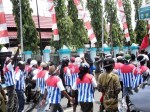
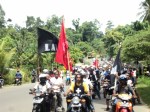
Manokwari, West Papua:  Powerful images have emerged from mass actions calling for  US President Barak Obama to stop assisting Indonesian state violence, and to seek a lasting peaceful solution to West Papuan people’s suffering.

West Papua National solidarity for Obama (SONABPO) called the peaceful demonstration held on November 8 in Manokwari, to coincide with the visit to Indonesia of Obama.  After two separate protest marches combined, the crowd grew to at least 6200 people.  Despite fears of unrestrained Indonesian security forces in attendance, events were largely peaceful, with the large crowd outside Sanggeng stadium listening to hours of speeches demanding both Indonesia and the US to take responsibility for their role in the systemic brutality of the Indonesian colonial occupation.

(more below)


The demonstration was also in support of the Washington Solution conference on West Papua starting on the 9th November

The main demands of the rally were:1.    The USA must review their 1962 New York Agreement that transferred West Papua to Indonesia.

2.    President Obama and US Congress must review how US assistance to Indonesian military can be leveraged to solve human right abuses in West Papua.

3.    Indonesian government as a political body that is the cause of problems in West Papua,  must open themselves to solve the problems in West Papua.

4.    We West Papuan Melanesians strongly reject the failed Special Autonomy (package imposed by Indonesia) and call for referendum

5.    We West Papuan Melanesians,  support the Washington Solution (self determination) to be held on the 9th of November 2010 in Washington DC USA.

6.    We West Papuan Melanesians demand for the referendum to be conducted in West Papua for democracy and justice.

7. United Nations – Nations (UN) must soon send a team / International Observer Force to West Papua.8. We West Papuan Melanesians are asking for International community to support West Papua Transitional Government to meet Indonesian Government.

After they expressed their political views, representatives from the DPRD promised to continue working according to Papuan aspirations but conceded the were hobbled by being an instrument of  Jakarta.

The rallies dispersed by themselves peacefully.

Create a website or blog at WordPress.com

Up ↑