SKPHP plans to commemorate the 28th anniversary of the death of Arnold Ap
Jayapura: The chairperson of Solidaritas Korban Pelanggaran HAM Papua (SKPHP)- Solidarity for Papuan Victims of Human Rights Violations, Lokbere Peneas has announced that they will be commemorating the 28th anniversary of the death of Arnold Clemens Ap, the Papuan human rights leader who is thought to have been murdered by the Indonesian Government.
‘We wish to inform the general public in the city of Jayapura and its environs that SKPHP will commemorate the 28th anniversary of the death of Arnold Clemens Ap who is believed to have been murdered by the Indonesian government. During the anniversary we will organise a number of actions, ‘ Peneas. told JUBI.
He said that the agenda of the anniversary would include campaigning as well as the performance of Mambesak music in various places in Jayapura and throughout the district of Sentani. Prayers will be said at the grave of Arnold Ap and there will be a press conference, as well as speeches being delivered in front of the UNCEN (Cenderawasih University) Museum.
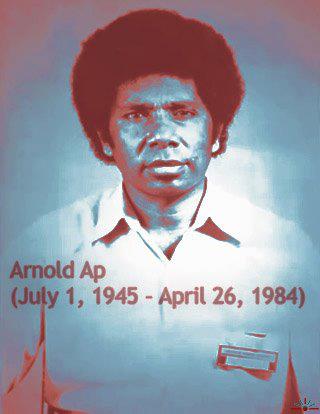
Arnold Ap (1 July 1945 – 26 April 1964) was a Papuan leader, a cultural worker, anthropologist and musician. Arnold Ap was the leader of the Mambesak group and Curator of the Museum of the Cenderawasih University . He also performed Papuan music during weekly programmes on the radio.
In November 1983, Ap was arrested by a Kopasus unit, imprisoned and tortured. He died from a shot in the chest in the month of April. The security forces said at the time that he had made an attempt to escape, but it is clear that he was executed by Kopassus.
To this day, Arnold Ap and his Mambesak music are very popular throughout West Papua and his creations are regarded as symbols of Papuan identity.
Surrendering their lives to God, they remain calm when they face trouble
It was during the week of Christ’s sufferings that Forkorus Yaboisembut was found guilty of treason and sentenced to three years imprisonment. His wife, Beata Yaboisembut was at his side throughout the trial. Dressed in dark brown trousers and a blouse, she sat in the courtroom, calmly following the proceedings. She accepted the result with a feeling of relief.
‘Bapak was always telling us to keep calm. We should not feel troubled and feel grateful that our children are already grown up and can understand what is going on. And please remember that this is the week of suffering and we must all think about the sufferings of our Lord.
Lord Jesus suffered much more than this for our sins. And you must be willing to accept my sentence, said Forkorus’. As a mother and as his wife, she expressed her belief in him.
She first met her husband when they were studying together at the Taruna Bakhti Waene College. They were among the first generation of students at the college and graduated in 1975.After graduating, they were both sent to isolated places in West Papua. Mama Beata was sent to Wamena and Forkorus was sent to Sarmi. In 1976, they decided to get married in Jayapura and after getting married, they each returned to their jobs. Mama Beata was given a job at the Oksibil YPPK primary school and worked there for three years. She was then sent to Sobron, after the kampung where she was working was attacked.
After her husband became active in the Papuan Customary Council (DAP), Mama Beata saw this as a huge responsibility that was to be borne by him.’Bapak is an Ondoafi, part of our tradition and enjoying the trust of the people. He is greatly respected and loved by the people, just like us, his wife and our children.’
He was the third of six siblings. His two brothers are not with him in Sobron. Forkorus also has two younger brothers and a sister who all live in Nabire.
After being elected as the Chairman of DAP, Beata realised that he no longer belonged just to her but belonged to all the Papuan people. ‘This is why Bapak has always told his children to stand on their own feet.’
As his wife, she realised that his election as the chairman of DAP would have many consequences for herself and for their children which is why he has always stressed the importance of their living their own lives independently.
Fortunately, only two of their children are still studying at Cenderawasih University while their oldest daughter is an expert in civil technology, and the sons have completed their studies in architecture. ‘The youngest is now at sixth grade while his older brother should have graduated last month on 15 March. But never mind, as Bapak is now on trial, his needs are our priority.’ Her daughter’s husband has to rely on the wage he earns as a teacher. As for her own husband, he has not been earning anything since last year.
‘I was not there to see Bapak when he was arrested because I had just returned from Sobron.’ She was preparing food for the [Third Papuan People’s] Congress but before anyone could start eating, the security forces destroyed everything that they had prepared.
When she and the other women heard gunshots and saw tear gas bombs exploding, they ran to the mountains around the Zakeus Field. ‘People can be arrested at any time and I was told never to get worried. On that day,’ she said ‘I tried to keep calm and to find my way home to Bapak so that I could be together with him at all of the court hearings while keeping calm.’
‘Forkorus has always told our children to focus on their education and not to follow him on his chosen path. But the children are always deeply concerned about what is happening to him and they always accompany me when I visit him in prison. I know that they readily accept what is happening to their father. Maybe this is the path chosen by our Lord for this country of ours,’ she said.
During the trial, Bapak stayed overnight at the lodgings of their daughter who lives in Waena. It is a small room, 3 x 4 meters, where the three of them slept. Their home in the kampung is being looked after by Mama. The youngest daughter frequently goes back and forth to visit their grandmother. Because their home in Sobron is 80 kilometres from Abepura, Mama decided to stay with her daughter so that it would be easier for her to visit her husband.
She said that during the time she has been attending the court hearings, neither she nor the children have experienced any terror or intimidation. ‘And Bapak is always telling us to keep calm.’
She visits her husband three times a week, on Monday, Wednesday and Saturday. ‘We are only given 15 minutes to sit together, side by side.
That is quite enough for me,’ she says, ‘because I know that the Lord is there with him.’
She is still busy teaching grade 1 and 2 children at the primary school in Sobron. When she visits her husband, she takes him food and clean clothes. ‘As he is not alone in the prison, I always take food for the other prisoners as well.’
She says that her husband is not fussy about the food she brings, as long as she cooks it. She takes him porridge, vegetables and fish and on special occasions, she cooks him some meat. Ever since he has been in prison, Forkorus has never asked her to bring anything. ‘In fact, when I meet him, he always has a present for me, as well as giving me his dirty clothes to be washed,’ she said, with a laugh.
She can also visit him on Sundays but only to take part in a service together. She is not allowed to take anything except a Bible. They have services twice a day, once in the morning at 8am for the Protestants and once in the evening for the Catholics.
Mama always arrives at 7am to say prayers together with her husband.
Sometimes he asks her to stay for another prayer, after her visit to him has ended. so that she too can receive the body and blood of the Lord, Jesus Christ during the Holy Eucharist as she has continued to be a Catholic.
Mama Beata is the third of six brothers and sisters from Kampung Yuruf Keerom where the majority of the people are Catholics. In December, she will be 59 years old. Because of unsatisfactory conditions in the kampung, the people have been forced to move frequently. Only one of her sisters is still living in Yuruf while one of her brothers died in Vanimo. The two other brothers are living in Vanimo.
‘Prayer is the source of our strength. Everything we achieve, all our happiness and sadness are part of our lives and my family leaves everything to the one who gives life, to the Lord God Creator of all,’ she said, when she was asked what her future plans for her family were.
This is the first in a series of articles by Suara Perempuan Papua commissioned by TAPOL on the impact of the Papua conflict on women
CONFIRMED REPORT FROM CREDIBLE SOURCES ON THE GROUND
FROM CREDIBLE WEST PAPUA MEDIA STRINGERS
(INDONESIAN MILTARY) TNI TROOPS HAVE OPENED FIRE ON CONGRESS AT 1530 JAYAPURA TIME
LIVE FIRE IS BEING USED ON PEACEFUL GATHERING. REPORTS OF CASUALTIES BUT NO CONFIRMATION OF NUMBERS. PETAPA PEACEKEEPERS HAVE BEEN SHOT, REPORTS OF MANY DEAD. WOMEN TENDING TO SHOT PETAPA SECURITY ALSO SHOT BY INDONESIAN MILITARY.
FORKORUS YABOISEMBUT ALSO ARRESTED FOR SUBVERSION/MAKAR.
TEXTS MESSAGES FROM DELEGATES STATE “WE HAVE ALREADY BEEN ARRESTED”
Confirmation that Edison Waromi has been arrested.
1400 JAYAPURA : Indonesian troops and police have amassed outside the Third Papuan Peoples‘ Congress in a show of force that credible sources arereporting is to forcibly break up a peaceful gathering of thousands of Papuans in Taboria oval (Zaccheus Field), Abepura, Jayapura, the capital of West Papua.
The Third Papuan People’s Congress is being held for the second time since Indonesia’s invasion in 1963. Papuan delegates openly discussed their rights to self-determination and the pathways to a referendum on the future of West Papua. Forkorus Yaboisembut, the chair of the Papuan Customary Council was quoted in Papuan media sources as saying that the Congress is “part of the struggle of indigenous Papuans to enforce their fundamental rights.” He argued that Papuans are not seeking to undermine or destroy Indonesia. however “we strive to uphold our fundamental rights, including political rights, including the right to independence as a nation…. And whatever be produced, the Government of Indonesia should able to appreciate it.”
This slideshow requires JavaScript.
Photos and video sent live from Petapa Community security forces and West Papua Media stringers are showing a massive buildup of military hardware surrounding the conference venue, where up to 20,000 people have been gathering since October 16 to determine their pathway to self-determination. Occupying Indonesian military forces have made regular public pronouncements in recent days that they will not allow any gathering to threaten the unity of the Republic of Indonesia, and peaceful discussion is of this is also banned.
The congress is still continuing. According to witnesses the military presence is strong and fully armed with automatic weapons. Army Panser armed personnel carriers and Police Barracudas are present but they appear not to have made moves to physically break-up the gathering. However, the presence of the security forces seems to have deterred some from attending.
[vimeo http://vimeo.com/30776329]
[vimeo http://vimeo.com/30776103]
[vimeo http://vimeo.com/30775444]
Sources at Congress from Church, West Papua National Authority, Dewan Adat Papua and West Papuan National Cmmittee representatives that they are all prepared to stay and continue to meet until finished. Not sure when that will be. They are in the process of discussing a transitional / parallel government structure.
Delegates of the conference have sent out a series of urgent messages to the international community demanding that act immediately to stop a brutal Indonesian military action that is set to forcibly breakup the historic gathering.
Markus Haluk, the leader of a Papuan youth organization, sent a plea via text message, saying that it’s an “emergency situation.” He wrote, “In some moments possibly we will be massacred and there will be a bloodbath.” Haluk asked international supporters to tell the Kapolda (Head of Police) and the Pangdam (Military Commander for Papua Erfi Triassunu) in Jayapura to retrieve their troops.
Text messages sent to the military commanders from international supporters demand “The world is watching the 3rd Papuan National Congress. Remove troops and police now. Let West Papuans exercise their human right to gather and discuss their future without violence”.
The Australian Greens have also expressed deep concern. “The Congress is a peaceful event, and the Papuan people have a right to assemble and discuss their future,” said Greens West Papua spokesperson, Senator Richard Di Natale, from the Australian Parliament today. “To meet without threat of violence is a fundamental human right that all citizens enjoy.”
Senator Di Natale has also been in contact with the Indonesia Embassy in Canberra today to convey the concern.
“No level of violence is acceptable at a peaceful gathering,” added Senator Di Natale. “The authorities will have to answer to the world for any bloodshed that occurs.”
Papuan activists who declined to be identified have requested that international supporters telephone the chiefs of Police and the Army (Kapolda – +62 811 950376 and Pangdam TNI +62 811136522) to tell them to withdraw their forces immediately
Special Report By West Papua Media editorial and field teams
October 19, 2011
(Jayapura) Scenes of jubilation and free expression have erupted in Jayapura, West Papua as over 20,000 delegates took part in the historic Third Papuan People’s Congress. Thunderous cries of “Papua Merdeka!” filled the streets as tens of thousands of people marched towards the Congress venue Taboria oval (Zaccheus Field) in Abepura, after the Indonesian government prevented the Congress from being held at the Cenderawasih University. Despite threats by Indonesian security forces to derail the Congress, held for only the second time since Indonesia’s invasion in 1963, Papuan delegates openly discussed their rights to self-determination and the pathways to referendum on the future of West Papua.
The Third West Papuan People’s Congress was called by the West Papua National Committee and supported by the majority of civil society and political groups across West Papua, including the Papuan Customary Council (DAP) and the West Papua National Authority (WPNA), with the exception of some elements of the armed wing, the TPN/OPM.
Over 5000 people had already gathered from 8 am at the Taboria oval, with the numbers continuing to grow steadily throughout the day. Organisers were hoping for up to 40,000 attendees from across Papua, and at least 20,000 were present by Monday afternoon.
This slideshow requires JavaScript.
Approximately 5000 people from Yapen, Waropen, Mamberamo, Manokwari, Sorong, and Jayapura conducted a “long march” rally from Yawa dormitory in Abepura towards the Taboria oval. This march was under the responsibility of WPNA and security was provided by over a thousand Petapa community security personnel, although over 500 police were following behind the march in trucks.
Amid tight security due to the threat of violence from Indonesian military and police apparatus, 100 guests were allowed to attend the opening of the Congress which followed with a traditional mumu or feast. 14 pigs were killed with several Paramount customary Chiefs present, as the Sampari dance group performed the traditional dances. The Sampari dance group was infamously persecuted by the Indonesian military as “separatists” after an emotional performance at the Second Papuan Peoples’ Congress in 2000 that depicted the Biak Massacre of 1998. They also danced with the sacred Morning Star flag, banned by Indonesia, which was officially raised around 2pm. Sampari dancers presented the Papuan Collective Leadership, comprising Forkorus Yaboisembut, Eliezer Awom, Septinus Paiki, and the Reverend Edison Waromi of the WPNA, with a traditional Tifa drum, on which he beat a rhythm to officially open the Congress.
The initial stages of Congress featured speakers from across Papuan civil society speaking on the need to take strong action to end impunity for human rights abuses and to implement the pathways to self-determination.
The Chairman of the Baptist Church in Papua, Sofyan Yoman, was one of the opening speakers on behalf of Papuan Council of Churches who spoke about crimes against humanity being committed daily against the Papuan people. He called upon those present to help in “challenging all the Churches to speak up for human rights for West Papuan people”. “These churches who are living in fear should and must speak out about the atrocities and ongoing injustice in Papua,” Yoman said.
Other speakers from across Papuan civil society and customary leaders spoke of the will of the Papuan people being a step closer to realisation through the holding of the Congress, but a long road was still ahead of Papuan to gain freedom or Merdeka.
The Chairman of the DAP, Forkorus Yaboisembut, was elected on the first day as the Chairman for the Congress. As reported in Indonesian news outlet Kompas, Yaboisembut explained Congress is “part of the struggle of indigenous Papuans to enforce their fundamental rights.” He argued that Papuans are not seeking to undermine or destroy Indonesia. however “we strive to uphold our fundamental rights, including political rights, including the right to independence as a nation.” According to Yaboisembut, the Collective Leadership Committee has no particular agenda. “The people who will proceed in the congress. And whatever be produced, the Government of Indonesia should able to appreciate it.”
West Papua Media stringers report that preliminary recommendations had been made by both the organising committee and speakers of the makeup of mandated office holders for a new Congress 3 Presidium, that would officially speak for West Papua’s independence movement. In a surprising display of common purpose, delegate have initially endorsed the consideration of office bearers, though no binding decisions have been made. Frans Kapisa of WPNA, had recommended that Forkorus Yaboisembut, the Chairman the Papuan Customary Council – be elected as the inaugural President of the Democratic Republic of West Papua.
Participants at Congress have indicated that the deliberations could extend until Friday or beyond, and that any political, logistical, timetable, and office-bearing positions arrived at currently are far from finalised.
Security Force intimidation
Despite the jubilation and ability to engage in open and peaceful free expression at Congress, sources report that Indonesian security forces are continuing to gear up for an imminent potential assault or dispersal on the Congress participants. Bintang Papua reported that the announced presence of the Indonesian Coordinating Minister for Political and Security Affairs Djoko Suyanto at the Congress would not be attending, despite the promise by Indonesian President Susilo Bambang Yudhoyono that he would attend to represent Indonesia.
However the Papuan-based Indonesian police commander Bigman Tobing has stated that his forces will not be there to cause unrest, merely to protect the proceeding of the Congress. “The joint forces have to obey in order not to cause Unrest in the community,” he said. Local newspapers in Jayapura reported that security forces were preparing 2,200 personnel with armour, “not to frighten the people but to ensure calm’. Unconfirmed reports state that all police leave has been cancelled around the greater Jayapura area.
Over 3000 Petapa Community Security Guards have been trained and deployed to provide security for the Congress, with duties of surveillance, detection of intelligence agents, and keeping a physical buffer zone between Papuans and Indonesians to minimise any potential for contact. The proactive but peaceful work of the Petapa force is believed to be stymying any legitimacy of the Indonesian security forces to action, a strategy which according to sources inside Petapa has caused simultaneous frustration and admiration from security forces with apparent lines of communication open between senior police as part of the Papuan security strategy. Petapa personnel are greatly outnumbering the deployed Indonesian security forces, though any direct confrontation would probably see Indonesian weapons being used, a scenario that Petapa have trained for.
On Tuesday afternoon, credible local stringers for West Papua Media reported that several hundred fully armed Indonesian police and military took up offensive positions outside the offices of the DPRD. Five Indonesian Army Pansers with .50 calibre machineguns, one company of soldiers from the TNI and 1 SSK (Strategic Company – 150) of Brimob paramilitary police reportedly in full combat gear made manouevres to attempt tho dissolve the gathering. Based on observation by local human rights sources and troop dispositions provided to West Papua Media, surrounding the Congress were 13 Ranger trucks, 24 Army troop transports, 20 Brimob trucks, water cannon, 3 police buses, 2 mobile prisons, Military police/ Provost units (to ensure military discipline), 6 Army Pansers and 4 Police Barracuda Armoured Personnel Carriers, all containing fully armed troops. Approximately 2200 Indonesian security forces were surrounding Congress in a display that participants believed were deliberately designed to intimidate. Security forces also conducted several high profile convoys of armour and hardware throughout the proceedings of Congress, and conducted very visible drills throughout the day and night.
West Papua Media’s stringers have reported that there is a understanding amongst delegates that brutal action from Indonesian security forces seems inevitable, but that the intimidation is not going to stop them from discussing the options for their future. At time of writing a credible source stated that the Joint TNI/Polri security force plan to occupy the field on the morning of October 19, though this has not been fully decided. It is likely that any plan for taking over the field will lead to conflict and bloodshed.




 West Papua Media Alerts