Rio Tinto has cosy ties with the Indonesian military, who have a long history of human rights abuses.
|
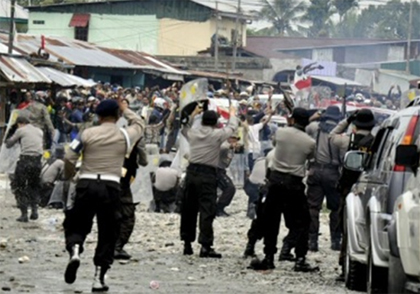
| Freeport’s James Moffett has said ‘there is no alternative’ to the company’s reliance on the Indonesian military [EPA] |
|
Investing in conflict-affected and high-risk areas is a growing concern for responsible businesses and investors. Companies based in developed countries often operate in lesser-developed foreign markets, where governance standards are lax, corruption is high and business practices are poor.
These pieces focus on one specific Anglo-Australian company and their American partner that jointly operate a mine in West Papua, one of the poorest provinces of Indonesia. The risks for the company include the potential to contribute to environmental and social damage in a foreign market. The risks for investors include financing a company that does not get its risk management right.
This is the third chapter of a four-part essay that examines how the Norwegian Pension Fund came to blacklist the mining giant Rio Tinto. The first part can be found here, and the second part can be found here.
In February 1995, Anglo-Australian mining giant Rio Tinto announced three deals that secured access into Grasberg, a massive gold and copper mine in the Indonesian province of West Papua.
First, Rio Tinto agreed to invest $500m of new capital in Arizona-based mining corporation Freeport for a 12 per cent stake in the US business. Second, Rio Tinto agreed to finance a $184m expansion of the Grasberg mine. In return, it received 40 per cent of post-1995 production revenue that exceeded certain output targets and, from 2021, a 40 per cent stake in all production. Finally, Rio Tinto would receive 40 per cent of all production from new excavations elsewhere within West Papua.
Rio Tinto was effectively doing business with Indonesian dictator Suharto, too.
In response, Freeport told shareholders that Rio Tinto would “contribute substantial operating and management expertise” through proportional representation on the board – as well as on various Grasberg operating and technical committees, from which the “policies established by the [board] will be implemented and operation will be conducted”.
Speaking of the “exceptional potential” of the deal, Rio Tinto’s then chief executive, Robert Wilson, agreed that“given [Rio Tinto’s] experience in other major open-pit copper ore bodies such as Bingham Canyon, Palabora and Escondida, we anticipate considerable mutual benefit”.
Rio Tinto obviously liked how Freeport-Indonesia did business, especially at Grasberg.
US government: Grasberg contravenes the Foreign Assistance Act
By October 1995, an independent US government agency had cancelled Freeport’s international political risk insurance. The insurer, the Overseas Private Investment Corporation (OPIC), specifically cited the Grasberg mine operation as contravening the Foreign Assistance Act of 1961, which required that “overseas investment projects do not pose unreasonable or major environmental hazards or cause the degradation of tropical forests”. Freeport was the first policyholder to be terminated by the OPIC for ethical violations, despite President Suharto and Freeport director Henry Kissinger heavily lobbying the US government to reinstate the policy. Following OPIC’s decision, the company did not disclose the environmental performance of the mine again until 2003 – it no longer had to.
For a brief time in 2000 and 2001, a particularly sympathetic Indonesian environment minister, Sonny Keraf, pursued numerous avenues to impose penalties and fines on Grasberg, including an unsuccessful attempt to invoke the criminal section of the 1997 Environmental Law to cease Freeport-Indonesia’s riverine method of tailings disposal, by which the corporation fed the mine’s waste product into nearby rivers. Under pressure for his pursuit of the part-Indonesian-owned Freeport, Keraf was replaced following the 2001 election.
As Suharto’s reign came to an end, an increasing number of West Papuans also began to campaign against the environmental and social impact of Grasberg. Papuan leaders brought the matter before the US Federal District Court in April 1996 and before the Subcommittee on International Operations and Human Rights of the US House of Representatives in May 1999. Many more attempts, including one to address shareholders at Rio Tinto’s 1998 annual general meeting in London, were foiled by Indonesian authorities.
Building on restrictions introduced in 1991, the US government banned arms transfers to Indonesia for widespread human rights violations in East Timor in 1999. Consequently, Freeport’s payments to the Indonesian military and security forces were more closely scrutinised. The Wall Street Journal found that, between 1991 and 1997, Freeport guaranteed more than $500m in loans so that Suharto’s family and allies could purchase a stake in the mine – a great portion of which was written off by Freeport in 2003.
An outspoken Australian academic, Lesley McCulloch, also found that the 1996 Timika riots adjacent to the Grasberg mine led to a spike in monetary demands by the Indonesian military, resulting in the funding of a $35m army base. Freeport and Rio Tinto refused to disclose details of the payments.
A history of violence
Then in August 2002, two US teachers and an Indonesian employee of Freeport-Indonesia were murdered at the Grasberg mine complex. Following one rebel’s admission that he was a business partner of the Indonesian military, several New York City pension (superannuation) funds formally requested that Freeport disclose the nature of its Indonesian “security” payments. The shareholders were concerned that such payments violated the Foreign Corrupt Practices Act.
Although Freeport was not required to put the proposal to shareholders, the company did begin to disclose its security-related payments. Filings with the US Securities and Exchange Commission since 2001 have confirmed annual payments reaching an average $5m each year for government-provided security of the Grasberg complex and its staff – and fluctuating annual costs reaching $12m for unarmed, in-house security costs. A spokesman for the company later told the Jakarta Post that these payments had been taking place since the 1970s.
Sporadic accounts began to surface – in the Sydney Morning Herald, Jakarta Post, and New York Times – quoting internal sources that confirmed that the Indonesian had masterminded the killings to extort monies from the Grasberg operators. “Not surprisingly, the Indonesian military has exonerated itself,” US Congressmen Joel Hefley and Tom Tancredo said in June 2003. “American investigative teams, including the FBI, have not been able to complete their investigations mainly due to the Indonesian military’s refusal to co-operate and tampering of evidence.”
Freeport remained steadfastly opposed to later demands by New York City pension fund investors to cease all payments to the Indonesians until they complied with official US investigations into the August 2002 murders. At the 2004 annual general meeting, president and chief executive Richard Adkerson advised shareholders: “The management and Board believe that the stockholder proposal mischaracterises the company’s relationships with Indonesian security institutions and suggests actions that would undermine the company’s relationship with the Indonesian government and the security of the company’s operations.”
Despite the ongoing human rights and corruption concerns in West Papua – including a report by the World Bank and a letter by US senators to then UN Secretary General Kofi Annan calling for the appointment of a special representative to Indonesia – after a vote by shareholders, the resolution was not passed.
On March 23, 2004, Rio Tinto announced it had sold its 11.9 per cent shareholding in Freeport. Rio Tinto made a $518m profit. Citing no environmental or social reasons, Rio Tinto’s then-chief executive Leigh Clifford reassured shareholders that “the sale of [Freeport] does not affect the terms of the joint venture nor the management of the Grasberg mine” and that through “our significant direct interest in Grasberg, we will continue to benefit from our relationship with Freeport”.
Rio Tinto remained committed to the mining of Grasberg and would continue overseeing its management through various operating and technical committees.
Sensational claims that illegal payments to individual soldiers, units, and policemen had been routinely made to secure the Grasberg complex and its staff came to light in 2005. A report by Global Witness revealed that an additional $10m had been paid directly to individual military and police commanders between 1998 and 2004. This included $247,000 between May 2001 and March 2003 to General Mahidin Simbolon, former head of the 1999 East Timor massacre, and monthly payments throughout 2003 to the police Mobile Brigade – a group cited by the US State Department as having “continued to commit numerous serious human rights violations, including extrajudicial killings, torture, rape, and arbitrary detention”.
With the US arms trade embargo still in place, Rio Tinto had reassured the market that payments to the Indonesian military were “legally required and legitimate” only months before the news broke. Now Rio Tinto and Freeport-Indonesia came under even greater public pressure. At Rio Tinto’s next shareholder meeting, after several West Papuans refugees made statements to the board on Grasberg, shareholder activist Stephen Mayne suggested that “the most appropriate thing for Rio Tinto to do would be to exit”. After confirming that Rio Tinto’s contractual obligations would permit such a move, then-chairman Sir Rod Eddington informed shareholders that they “make a considerable effort to ensure that the best that Rio Tinto can offer to Freeport in the management of that venture is available to them”.
An Indonesian ministerial decree in 2007 demanded that the security of “vital national objects” – such as Grasberg – be handed over to the police within six months. Evidence obtained by world news service AFP suggests this is not happening. In a filing to the US Securities and Exchange Commission, Freeport disclosed additional direct payments of “less than” $1.6m in 2008 to 1,850 soldiers, despite the fact that 447 policemen make up the official number of personnel responsible for security at the Grasberg complex.
Unrepentant
The company’s 2008 Sustainable Development report confirms that Freeport-Indonesia makes contributions to “security institutions (including both police and military)”. Alarmingly, according to Amnesty International, as recently as 2008 there have been fundamental human rights violations such as the “torture, excessive use of force and unlawful killings by police and security forces” – reports that have subsequently been confirmed by the UN Special Representative of the Secretary General on Human Rights Defenders and the United Nations Committee against Torture.
“There is no alternative to our reliance on the Indonesian military and police,” Freeport chairman James Moffett said to the New York Times in 2005. “The need for this security, the support provided for such security, and the procedures governing such support, as well as decisions regarding our relationships with the Indonesian government and its security institutions, are ordinary business activities.”
Part 4 to follow next week.
This is an extract of a chapter from the book, Evolutions in Sustainable Investing: Strategies, Funds and Thought Leadership, to be published by Wiley in December 2011.
NAJ Taylor is a PhD candidate in the School of Political Science and International Studies at the University of Queensland, and casual lecturer in the Faculty of Law and Management at La Trobe University.
Follow NAJ Taylor on Twitter: @najtaylordotcom




 West Papua Media Alerts