New Matilda: Australia’s Money Helps Kill, Intimidate And Torture

from our good friends at

New Matilda.com

NM INVESTIGATES

23 Mar 2012

Our Money Helps Kill, Intimidate And Torture

By Marni Cordell

Bob Carr and Stephen Smith

Australia plays a key role in training and funding elite Indonesian counter-terror unit Detachment 88 – but wants to distance itself from the unit’s violent reputation, reports Marni Cordell

Bob Carr and Stephen Smith with

their Indonesian counterparts.

There’s been a terror threat in Jakarta. A group of hardliners claim they intend to bomb the city’s transport system, just days before the UK prime minister is scheduled to arrive for a state visit. Indonesia’s counter terror agencies scramble to respond to the critical incident as the population goes into lockdown.

I’m sitting in the Control Room at the Jakarta Centre for Law Enforcement Co-operation (JCLEC) alongside international police trainers Bob Milton and David Gray.

On the screens in front of us, Indonesian police are acting out roles in this imagined terrorism scenario — and Milton and Gray are the puppet-masters.

Inside the JCLEC Control Room. Photo: Marni Cordell

“Basically the scenario develops into a more and more complicated problem,” explains Milton, a former Metropolitan Police commander from the UK.

“We try to make it as real as possible. We’ll have things such as pictures, audio, taped phone conversations, anything that we can try and get the information to them in a more interesting way.”

“We then challenge the students and ask for quite a lot of detail about how they are going to respond, and how they are going to deal with it.”

Fake terror scenarios like this one are a regular part of the immersive training that goes on at the Australian-funded police training centre.

JCLEC was set up in 2004 as a result of a bilateral agreement between Indonesia and Australia to strengthen Indonesia’s counter-terror effort in the wake of the Bali Bombings.

I visited the centre last week as part of an investigation into Australia’s funding and training of Indonesia’s crack anti-terror squad, Detachment 88 — the unit responsible for capturing or killing most of Indonesia’s terrorism kingpins since the 2002 Bali attack.

Detachment 88 employs a controversial brand of policing in which suspects are shot dead rather than arrested — like a soldier would shoot an enemy combatant. The high profile counter-terror raid in Bali last Sunday, in which five suspected terrorists were killed and the police were hailed internationally as heroes, was just the latest in a long line of lethal operations.

The unit is funded and trained by Australia and while the Australian Government might not endorse their paramilitary-style tactics, it’s been willing to turn a blind eye because Detachment 88 has been extremely effective at disrupting Indonesia’s extensive terror network.

JCLEC itself is deep within the grounds of the Indonesian National Police Academy, in the city of Semarang in Central Java. When I arrive at the centre I’m met by AFP federal agent Brian Thomson, a friendly, middle-aged cop from Canberra who is nine months into a two-year stint here. I’m the first Australian journalist he has hosted in that time.

JCLEC is touted as an international police training centre but in fact its students are over 90 per cent Indonesian — 9 per cent of whom are Detachment 88. The centre hosts trainers from Indonesia and across the globe, predominantly from Australia, Europe, and the UK.

Students undertake computer-based training courses – this one tests their knowledge of the difference between intelligence and information. Photo: Marni Cordell

Its core funding for more than 130 staff on six hectares of well maintained grounds comes directly from the Australian Federal Police’s own budget.

The self-contained centre — complete with student accommodation, lap pool and gym — couldn’t stand in greater contrast to stories that abound in Jakarta about Detachment 88’s operations.

JCLEC’s shtick is about “learning and understanding through shared experience” — and teaching best practice terror investigation techniques and proper use of the judicial process. Detachment 88, an elite and highly skilled unit with unique powers of surveillance in Indonesia, seems to operate above the law.

As I reported earlier this month, there is growing evidence to suggest what was once solely a counter-terror unit is now moving into counter-separatist operations. Activists in West Papua claim the squad is being deployed to hunt down civilians aligned with the independence movement in a growing campaign of intimidation.

According to Eric Sonindemi, a participant in last October’s Third Papuan People’s Congress, says Detachment 88 personnel were involved in the deadly attack on Congress in which six people were killed and many others wounded.

“Most of the security forces were in plain clothes, but they weren’t really concealing their weapons — they were sort of showing off,” Sonindemi told me when I met with him in Jakarta. “Detachment 88 was there,” he said, explaining that he “saw their equipment and riot shields”.

“Hundreds of people were detained [by police] that night and many of them were beaten in detention,” Sonindemi said. “I spoke to one person who had a gash in his head, a broken nose and bruises on his face. He had been beaten with the butt of a rifle by a policeman.”

“He was subsequently released and never charged with any crime.”

So exactly how closely does Australia work with the deadly unit?

According to a Jakarta-based security analyst who asked not to be named, “There was a big push after the first Bali Bombing, to the point where Detachment 88 actually had Australians with them on [counter-terror] operations.”

“It’s been a long time since that’s happened,” the analyst continued. “The AFP says that sometimes Detachment 88 doesn’t even share information with them any longer. There’s a real pride in doing things themselves now without relying on the Australians.”

But a diplomatic source in Jakarta confirmed that the relationship remains extremely close — and that the AFP continues to work with the Indonesian National Police, of which Detachment 88 is a part, at head office in Jakarta.

Australian Federal Police agent Brian Thomson at JCLEC, with an Indonesian colleague. Photo: Marni Cordell

Details on our financial support for the unit are harder to come by. The Australian government committed $36.8 million over the first four years of JCLEC. Now Thomson tells me the Australia’s support for JCLEC comes out of the AFP budget, which continues to provide “roughly the same amount” of funding to the centre. We also assist the unit directly — although just what that assistance entails is a closely guarded secret.

“I’ve pursued that question through senate estimates, through questions on notice, I’ve had DFAT briefings, and I can’t get any clarity about the role of Australian support of the Indonesian military and police and specifically whether our contribution benefits Detachment 88,” Greens senator and spokesperson on West Papua Richard Di Natale told NM.

“And it’s very clear that Detachment 88 has been involved in some of the violence that has occurred in the region.”

Details from the Indonesian side are just as shady.

Although some of Detachment 88’s terror raids have been simulcast on television in Indonesia, scratch below the surface and it’s difficult to get any real detail on the unit, says Usman Hamid, advisor to the International Center for Transitional Justice.

“The accountability of Detachment 88 is very low,” Hamid tells me when I meet him in a hotel lobby in Jakarta where he is meeting with other experts to prepare a response to the draft national security bill.

“Detachment 88 has special allocation of the budget and international funding — which has never been explained to the Indonesian public clearly, or even to the parliament for that matter.”

“We hear vague amounts but it’s not under the state budget.”

“It should be accounted appropriately,” Hamid told NM. “To the Indonesian parliament, to the Indonesian public, and of course to the Australian parliament and public … to make sure that the budget Australia gave is really being used for the right purpose.”

As Brian Thomson walks me through the official JCLEC Power Point presentation, I ask how Australia can be sure that the training taught at the centre is also being “used for the right purpose” — how do we know it isn’t being used to crack down on civilian dissent?

He’s silent for some time before asking me to repeat the question, and then ultimately refusing to answer it — handballing to his Indonesian counterpart, Dwi Priyatno, who refers me to the Indonesian law on terrorism, and back to the public affairs branch of the Indonesian police.

I also ask specifically about separatism in Indonesia and whether techniques to quash independence movements are ever discussed at the Australian-funded centre. Thomson again gets nervous.

“I can’t really answer that because my job here as an executive director is to be involved in running the centre, so what’s actually discussed in the classroom, I can’t give full [details],” he says.

“Although separatism…

“Yeah…

“No…

“Not separatism.

“When you say separatism, in what regard are you referring to it?”

Back in Australia my inquiries about Detachment 88’s operations in Papua and their move toward policing separatism have been met with an almost uniform response. Here’s what I received from the AFP head office in Canberra: Australia has no mandate to tell the Indonesian Police how to run their business. And yes, we will continue to provide “capacity building assistance”.

Meanwhile, Eric Sonindemi says he remains traumatised by the police and military attack on the Third Papuan People’s Congress. He clearly remembers the sound of gunfire, he tells me, and now jumps when he hears loud noises. He is sure he is being monitored by the police. “I’ve been threatened by the police before,” he says, “but this is the first time I’ve feared for my life.”

Other Papuans I met in Jakarta told similar stories — of constant surveillance by the security forces, phone tapping and intimidation. They told me that fear is part of their daily lives.

Australian officials may well seek to disclaim any responsibility for the behaviour of the Indonesian police and particularly from the activities of Detachment 88. Given the close relationship between the AFP and the unit, however, it’s hard not to conclude that Australia is directly contributing to this climate of oppression.

This is the second article in an NM investigation of Detachment 88 and Australia’s role in the Indonesian counter-terror effort. Read the first article here.

West Papua: Senator Richard Di Natale questions Foreign Minister Carr

Video of Question Time in the Australian Senate on Tuesday March 20, 2012, where Senator Di Natale questioned Foreign Minister Carr about his meeting with the Indonesian Foreign Minister.

He asked Senator Carr whether he had raised West Papua in this meeting, and if not, when the Government planned to do so.

The video includes Senator Carr’s response.

[youtube http://youtu.be/v-MD9ak3ORg]

Federal parliament yesterday (Australia)

http://parlinfo.aph.gov.au/parlInfo/search/display/display.w3p;query=Id%3A%22chamber%2Fhansards%2Febe16d5f-1452-4285-9104-171295b6d0c4%2F0029%22

THE SENATE
PROOF
QUESTIONS WITHOUT NOTICE
West Papua
QUESTION
Tuesday, 20 March 2012
BY AUTHORITY OF THE SENATE

PDF: http://parlinfo.aph.gov.au/parlInfo/genpdf/chamber/hansards/ebe16d5f-1452-4285-9104-171295b6d0c4/0029/hansard_frag.pdf;fileType=application%2Fpdf


Senator DI NATALE (Victoria) (14:52): Mr President, my question is to the Minister for Foreign Affairs, Senator Bob Carr. Minister, last week you met with your counterpart from Indonesia.

Honourable senators interjecting—

The PRESIDENT: Order!

Senator Bob Brown: I rise on a point of order. As you know, it is impossible to hear Senator Di Natale up this end of the chamber. I am sure that the minister cannot hear the question, so he will not be able to answer.

The PRESIDENT: Senator Brown, that is a valid point of order. I had called for order. I had called, in particular, two members of the Senate to order so that Senator Di Natale can be heard.

Senator DI NATALE: I might begin again. My question is for the Minister for Foreign Affairs, Senator Bob Carr. Minister, last week you met with your counterpart from Indonesia, Marty Natalegawa, and the defence ministers of both nations. Can you inform the Senate as to whether the issue of West Papua was raised as part of those discussions? If not, when do you plan to raise the issue of West Papua with the Indonesian government?

Senator BOB CARR (New South Wales—Minister for Foreign Affairs) (14:53): Mr President, it was raised. First of all it was raised by me, when I assured the Indonesian foreign minister that Australia—both sides of Australian politics—fully recognised Indonesian sovereignty over the Papuan provinces. I reminded him that that was recognised in the Lombok treaty, signed by the Howard government with Indonesia in 2006. I underlined that I understood the case that all the governments of the world recognise Indonesian sovereignty. It would be a reckless Australian indeed who wanted to associate himself with a small separatist group which threatens the territorial integrity of Indonesia and that would produce a reaction among Indonesians towards this country. It would be reckless indeed.

I can say this: the Indonesian foreign minister nominated to me the responsiveness of the Indonesian government to oft-expressed Australian concerns about human rights in Papua. Before I could raise the subject, as I was fully intending to, the Indonesian foreign minister nominated that they have a clear responsibility to see that their sovereignty is upheld in respect of human rights standards. I was impressed by that. It reflects the fact that the previous Australian governments—I know it is the case with this Labor government and I assume it is the case with a coalition government—have raised these concerns with Indonesians, and it reflects the fact that Indonesians have listened.

I again would warn any member of the Senate against foolishly talking up references to separatism in respect of the Papuan provinces. That is reckless and it is not in Australia’s interests.

Senator DI NATALE (Victoria) (14:55): Mr President, I ask a supplementary question. It does relate to the Lombok treaty and I need to remind the foreign minister—I understand he is new in his role—that the Joint Standing Committee on Treaties report of 6 December made a bipartisan recommendation:

The Committee recommends that the Australian Government encourage the Indonesian Government to allow greater access for the media and human rights monitors in Papua.

If this is still the government’s position, what has Senator Carr done to further this aim?

Senator BOB CARR (New South Wales—Minister for Foreign Affairs) (14:56): I can assure the Senate that the Australian embassy in Jakarta will continue to raise matters of human rights in respect of the Papuan provinces, and will do so in respect of the recent sentencing of five men in Papua province to three years imprisonment for subversion. Australia has a strong and consistent record of upholding the right of persons peacefully to express their political views freely. Australian officials in Jakarta will raise our concerns over these sentences. But we will do so as a friend of Indonesia, absolutely explicit and unabashed about asserting Indonesian sovereignty over the Papuan provinces. The Lombok treaty—I refer again to the fact that the Lombok treaty was signed in November 2006, coming into force in 2008—is based on such a recognition: support for the sovereignty, territorial integrity, national unity and political independence of each other. Similar language is used in the preamble.

Senator DI NATALE (Victoria) (14:57): Mr President, I ask a further supplementary question, which also relates to the JSCOT report, which I remind the foreign minister is about what the Australian government, not the Indonesian government, has agreed to do. Recommendation 2 says:

… increase transparency in defence cooperation agreements to provide assurance that Australian resources do not directly or indirectly support human rights abuses in Indonesia.

Again I ask the foreign minister: what steps will you take in your role as foreign minister to ensure this recommendation is applied and that transparency of Australia’s role— (Time expired)

Senator BOB CARR (New South Wales—Minister for Foreign Affairs) (14:58): In those full and frank exchanges last Thursday with our Indonesian counterparts, the defence minister and I canvassed Papua and the Indonesian foreign minister referred again to the progress being made by Indonesia in shifting responsibility for law and order in the Papuan provinces from the military to the police. President Yudhoyono—a great friend of Australia’s, by the way—has committed his government to raising the living standards of the people of Papua and reinvigorating special autonomy. Australia believes that this is the best path—the best means—to achieving a safe and prosperous future for the Papuan people. We will give support through our aid programs. We are the biggest aid donor to Indonesia, and a recognition of that is reflected in the Lowy Institute poll, which I recommend members of the Senate read, which says that Australia is held in high standing by the people of Indonesia. We will continue to work on these great tasks.

Australia Involved in Military Operations in Paniai, West Papua

EXCLUSIVE REPORT FROM WEST PAPUA MEDIA

21 December 2011

Alex Rayfield

Human Rights Defenders in West Papua accuse the Australian Government and an Australian-owned mining company, Paniai Gold, of being involved in ongoing military operations in Paniai, West Papua.

Mr Ferry Marisan alleges that the Australian-trained Indonesian counter-terrorism unit Detachment 88 (also known as Densus 88 or D88), is involved in ongoing military operations in Paniai.   According to Marisan, the Director of Elsham Papua, the Institute for the Study and Advocacy of Human Rights in West Papua, the  joint police and military D88 have been embedded in the Second “Coconut” (Kelapa Dua) paramilitary Police Force (Brimob) sent from West Java for military operations against suspected members of the West Papua Liberation Army (or TPN), based at Eduda, Paniai.

According to Mr Yones Douw, a human rights defender based in Paniai, D88 are currently being deployed against members of the TPN in a jungle warfare operation. John Yogi – the Paniai based commander of the TPN – and his men, believed to number a few dozen, fled into the jungle following an attack on his base in Eduda by the Indonesian military and police between the 12-15 December.

Marisan says that in total 30 people have died during the latest round of violence in Paniai Seventeen people were shot dead during the military operations in Eduda.  Only ten of these victims were members of the TPN, according to Marisan.   Between the 9th and 14th of December a further three people died, all from exposure related sickness.  Amongst the dead were two children aged two and four. Prior to the military operations Brimob also shot dead eight Papuans. Yogi’s men responded by killing two Brimob soldiers, an event that triggered the recent military operations.

In addition Elsham Papua reports that the following six villages were burnt to the ground: Toko, Badawo, Dogouto, Obayoweta, Dey, and Wamanik. As a result of the violence Marisan says that up to 20,000 people have fled their homes. ”They are living in government care centres, or staying with family and friends.  Many have also fled to the forest” says Marisan.

SBS Radio reported that a spokesperson from the Department of Foreign Affairs and Trade says that the “Australian Government does not train or fund Indonesia’s security forces to counter separatism.”

Irrespective of the training that both the Australian and U.S government’s say they provide to D88 , both Douw and Marisan claim that group is being used in military operations against so-called separatists.  “Many of the victims in these operations” says Marisan, “are not members of the TPN, they are ordinary Papuan villagers who are supposed to be protected by the state”. D88 was also allegedly involved in the killing of six Papuans at the conclusion of the Third Papuan Congress on October 19.

D88 is not the only link between Australia and the recent wave of violence.

According to both Douw and Marisan, helicopters used at the Derewo River Gold (DRG) project were utilised by the Military and Police in these latest military operations. DRG is operated by Paniai Gold, a fully owned subsidiary of Melbourne based gold mining company West Wits Mining. A local source, requesting anonymity, told West Papua Media that the helicopters are those used by the mining company. “They are white with blue and red markings” the sources said. “They are defiantly mining company helicopters.”

The person responsible for Paniai Gold’s operations is Mr Vincent Savage, a Non-Executive Director of West Wits. According to publicly available company documents “Mr Savage has been intimately involved in all governmental and regulatory issues involving the Derewo River Gold Project as well as working closely with the Company’s local Indonesian partners.”

These same documents state that “security [for the DRG Project] will be provided by the local Paniai police and Brimob (Indonesian paramilitary police) under the supervision of a Company Security Officer”.

West Papua Media attempted to contact Mr Savage for comment, but he was not available.

The 2011 November-December military operations are not the first military operations in the area. Paniai was the scene of widespread military operations between 1963-1969, 1977-1978, and again in 1981-1982. During this period U.S. supplied Bronco aircraft were used to bomb villages while helicopters strafed Papuans with machine gun fire.

“People don’t forget these things easily” says Douw.

Shootings, village burnings and helicopter attacks continue across Paniai


SPECIAL REPORT AND UPDATE

by Nick Chesterfield at westpapuamedia.info

December 16, 2011

Harrowing accounts of terror and intimidation are emerging from villagers and human rights workers in the remote Paniai district in West Papua overnight, as a massive Indonesian military assault against National Liberation Army guerrillas continues.

Local human rights and church sources are reporting that ordinary villagers are being subjected to significant human rights abuses by a combined Indonesian police and military force, and have called for immediate international intervention in West Papua to stop the violence.

Over four full strength combat battalions of Indonesian army (TNI) Kostrad commandos from Battalion 753, Brimob paramilitary police, and elite counter-terrorism troops from Detachment 88 – all units armed, trained, and supplied by the Australian Government – were deployed in an offensive to surround the headquarters of the Paniai Free Papua National Liberation Army (TPN-OPM), under the command of General Jhon Yogi.

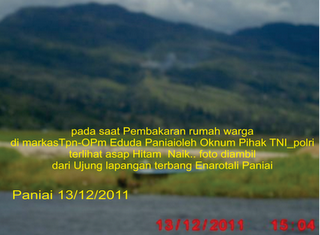
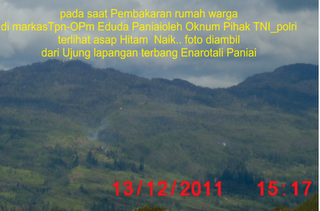
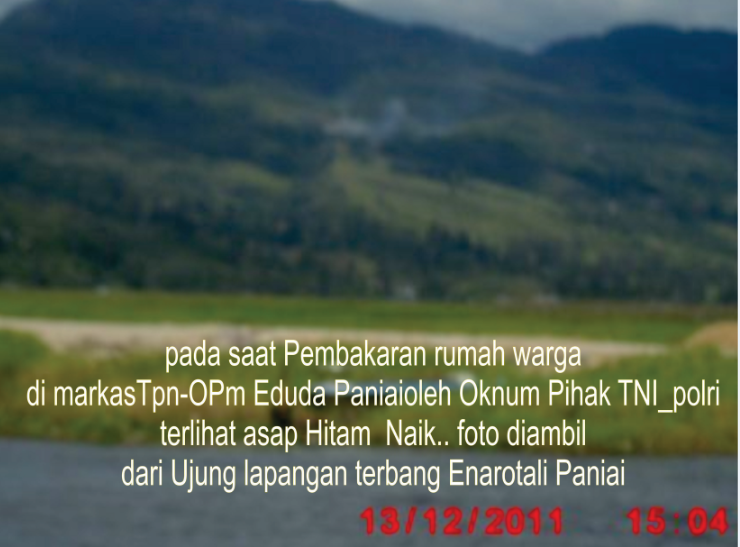
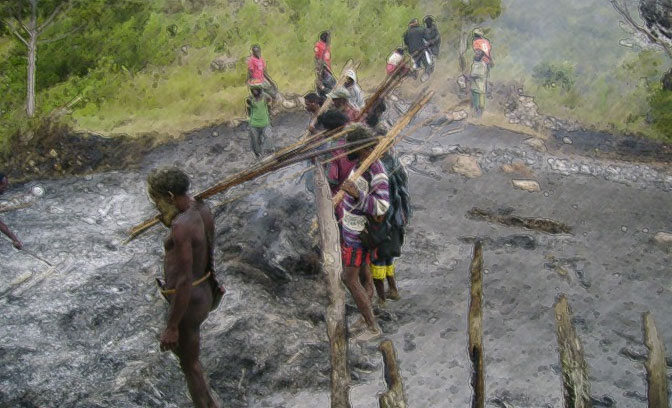
TPN/OPM headquarters Markas Eduda burning after TNI attack, 13/12/2011, Paniai, Papua
Paniai villages burning after TNI attack, 13/12/2011, Paniai, Papua
TPN/OPM headquarters Markas Eduda burning after TNI attack, 13/12/2011, Paniai, Papua

Punitive village burnings and raids are continuing in remote villages around the TPN/OPM headquarters of Markas Eduda.  At the time of writing, seventy-five houses, six schools, and about 25 other buildings have been recorded as burnt down in a total of 27 villages by Indonesian security forces.

Eighteen people are now confirmed dead – fifteen from gunshot wounds, and three refugees who allegedly succumbed to starvation in the so-called care centres under the control of security forces.  The victims’ names from the attack in Eduda are:

Dead:

  1. Tapupai Gobay (30) was shot in the chest.
  2. Tawe Bunai Awe (30) head crushed*.
  3. Uwi Gobay (35) was shot in the abdomen.
  4. Wate Nawipa (25) was shot in the back.
  5. Martinus Gobay (29) head crushed*.
  6. Owdei Yeimo (35) was shot in the back.
  7. Ruben Gobay (25) was shot in the abdomen.
  8. Paul Gobay (42) was shot in the abdomen.
  9. Bernadus Yogi (23) was shot in the chest.
  10. Demianus Yogi (15) was shot in the back.
  11. Simon Kogoya (40) was shot in the abdomen.
  12. Simon Yogi (30) was shot in the head.
  13. Luke Kudiai (25) was shot in the chest.
  14. Alfius Magai (20) head crushed*

Note:  those with “head crushed” allegedly sustained these fatal injuries through severe beatings with rifle butts and “boot stamping”, according to sources

Wounded:

  1. Paschal Kudiai (15) hit by a bullet in the head.
  2. Martinus Kudiai (30) was shot in the hand.
  3. David Mote (40) was shot in the thigh.
  4. Amandus Kudiai (43) was shot in the arm.
  5. Yohan Yogi (21) was shot in the leg.
  6. Mon Yogi (20) was shot in the back.

Credible reports have also confirmed that two civilian “company” helicopters were provided to Security forces, and were allegedly used to drop live grenades and chemical dispersal weapons onto villages surrounding Eduda, and strafe villages with sniper and machine-gun fire on December 13, 14, and 15.  Several independent witnesses have claimed to West Papua Media, and reported elsewhere across social media, that the helicopters are well known in the area for local non-military operations.

"Company" Helicopter alleged by local sources to be used in Indonesia security force offensive in Paniai. Source claims photo taken on Dec 13 aas helicopter was circling group. This photo is not independently verified, however analysis shows the image is consistent with independent witness descriptions, and the terrain and weather conditions are consistent with other photos supplied. (West Papua Media source)

Witnesses interviewed by local human rights workers have claimed that at 0800 local time on December 13, the Company helicopter launched CS gas salvos into the village of Markas Eduda, the TPN headquarters, to flush out villagers and guerrillas.  According to a separate account sent to West Papua Media by TPN/OPM sources, the helicopters landed troops and occupied Eduda for most of the day, with guerrillas taking to forests in retreat.  In retaliation, TPN/OPM fighters shot at the helicopters, unsuccessfully, and several hours of intense fighting ensued which was suspended when Free Papua fighters witnessed many village houses and schools being simultaneously burnt in the surrounding area.  According to the TPN/OPM source, villages were set on fire around Eduda and gunshots were heard for the rest of the day and through the night.  Free Papua fighters have retreated to the forest and are awaiting orders for their next moves, according to the source.

Villagers from across Paniai are continuing to be displaced by the operations, forced to flee en masse into areas around Enaratoli, on the opposite side of Lake Paniai.  As reported on December 14 by West Papua Media, over 131 villages have been abandoned causing at least 10800 Paniai villagers to flee the military operations.

Church sources have further reported that refugees seeking shelter in the Enaratoli area are enduring worsening conditions without any relief.  Armed Indonesian security forces have established a police supervised secure “Care Centre” at Uwatawogi Hall in Enaratoli, and have crammed into it 1715 people from Kopabutu and Dagouto villages.  According to local activists in reports to West Papua Media, local residents are being threatened with arrest and beatings if they try to provide detainees with adequate humanitarian relief.  Police are also preventing people held at the hall from leaving for food or sanitation needs, according to sources.  At the time of writing, three people have died at the “care Centre” since December 9 from Diarrhoea.  They are :

  • OTOLINCEA DEGEI age 2 years , died 8:20pm, 9/12/11;
  • YULIMINA GOBAI Age 4, died 3pm, 14/12/2011;
  • ANNA DEGEI Age 47, died 1030pm, 14/12/2011.

No food, sanitation or medical aid has been made available by any government agency to give relief to this large number of internally displaced people.

Over 9000 refugees are either hiding in the forest or seeking shelter with their own extended families in the region area.  Those with their families are considered safe, however their needs and conditions are difficult to monitor and assess given their isolation

Local teachers have also been in contact with West Papua Media’s stringers.   Since 27 November 2011, teaching and learning activities have been suspended indefinitely in all village schools surrounding Markas Eduda.  Schools such as SD YPPK in Badao Dei, Yimouto, and Obayauweta villages have been suspended, as has Primary, Junior High, “shop” (trade school) and Elementary Instruction in the towns of Dagouto, and Uwani.  The students of these schools have been evacuated with their parents.

A teacher in junior YPPGI Uwani said while repression was occurring in the villages that: “For while we have closed the schools, because school children are frightened and fled with their parents. In addition, we as teachers do not feel safe to make teaching and learning activities. All the teachers have fled Paniai district, and to Nabire. “

On December 15, the army / police battalions have returned to the villages of Uwamani, Dei and Obaipugaida to prepare a major attack for a new phase of the campaign.  It is believed strongly by local activists that the “company” helicopter will still be used in addition to   Unconfirmed reports have been received by West Papua Mediathat the Indonesian arsenal against civilians in Paniai includes one Mil Mi-24 SuperHind gunship, one of two usually stationed near Jayapura.

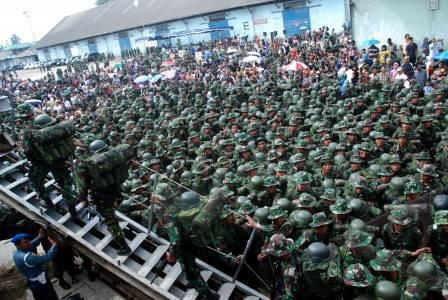
650 Kostrad troops from Battalion 142 being deployed from Palembang to Paniai in Papua, boarding their troop ship on December 9, 2011

West Papua National Committee (KNPB) activists in Paniai reported on December 15 that after the assaults on villages, the Indonesian military forces are now arresting, intimidating and carrying out interrogation on all  residents across the districts of Toko, Kopabaida and Uwamani.   According the KNPB, Indonesian police have arrested scores of  children and adults, and are conducting brutal and physical interrogations and questioning from 11.00 am until the end of the day

The offensive was ongoing throughout December 15, with Indonesian security forces opening fire in many locations around Eduda.  Overnight, from 0200 to 0600, heavy gunfire erupted across the Degeuwo River valley.  Human rights sources in villages and also with refugees conveyed reports that people were being shot at by snipers if they were moving anywhere after dark, even to collect, food, water, or to secure pigs.  It is not known how many people were killed during the night, but local source are expecting the toll to rise.

According to a report provided tonight by a local pilot, Indonesian security forces shot eleven times into houses in the village of Gekoo, where mourners were gathering for a the funeral of a local man who died from illness.  Villagers alleged that some bullets even landed in their cooking fires, exploding their food pots.

Witnesses reported a series of helicopter raids from 11am on December 15, with helicopters being used to machine-gun the villages of Obaiyepa and Uwaman.  Human rights workers have been unable to access these areas to see if any casualties were sustained.

Unidentified village burnt down 13, dec 2011, near Eduda, Paniai

Helicopters landed at Eduda ceremony ground 11 times from 11:00 to 13:00 hours,  and residents suspect logistics, ammunition and additional forces were being deployed.

The area around Paniai has been long subject to conflict and heavy Indonesian  military offensives against civilians, however in recent months the Indonesian police have taken charge of punitive operations against West Papuans harbouring pro-independence sympathies.   The conflict has recently escalated over land rights and the control of local gold mining operations, with Brimob deeply involved in both joint venture security, and direct involvement in gold businesses and associated activities. The Australian gold mining company Paniai Gold is also operating in the Degeuwo River region.

Indonesian soldiers in Paniai, December 2011

Civilians in the foothills are in panic and reliving the trauma of past operations, according to the report from a local pilot.  “They are concerned emotions again will open in Wegeuto  of the 1982 war Memoria Passionis (memory of suffering) and again when the Army conducted ongoing military operations (DOM – Daerah Operasi Militer) from  1989-1993 across the Badauwo area, near Eduda, ” the source said via email.  He explained that during the last DOM period the army accused and stigmatised civilians as being  members of the TPN-OPM, and subsequently tortured thousands of villagers.  Human rights sources at the time documented villagers being waterboarded / tortured for 24 hours;  residents’ houses burned, raped girls and married women, extrajudicial killings, burning off fingers, moustaches and beards,  pulling fingernails and quartering villagers with armoured vehicles.  Troops also conducted burning and destroying food gardens, killing livestock and pets, and fouling water supplies.

Residents are concerned that the current angry and emotional behaviour by the TNI-police toward TPN / OPM will be vented on civilians living on the slope of the hamlet Wegeuto especially, directly adjacent to Markas Eduda.  In a message delivered to West Papua Media local villagers have pleaded for International Advocacy to get Military and Police immediately withdrawn from Eduda and Paniai in general.

Much trauma is being felt by civilians across Paniai as a result of the offensive.  Independent journalist Sonny Dogopia, from  Papuan Voices ,  interviewed local villagers by telephone on December 14.   Magda Tekege, a housewife from Deiyai District, said civil society is very scared and depressed. ” Here also TNI / Police beat us and put us under surveillance, and are one full alert status, ” she explained.   Deiyai Magda called the situation unusual , “this is probably due to invasion by TNI / police in Paniai, therefore Deiyai also suffer the effects.”

Reports from Tuesday described the exercises that the Australian trained, funded and armed Brimob Gegana unit, upon arriving in Enaratoli proceeded to take over the streets immediately, causing normal town life to be immediately disrupted as local people emptied the streets to hide.

On December 6, Human rights, church sources and local activists had independently claimed that 542 people have been forcibly evacuated by troops from the Special Gegana Brimob “Counter” terrorist police unit.  The villages of Dagouto and Kopabatu and surrounding hamlets in the Dagoutu Paniai district were evicted after the Gegana unit decided it wanted to expand a new headquarters facility to deploy in the offensive against Jhon Yogi, the local leader of the armed guerrilla unit of the National Liberation Army (TPN-OPM).

The Gegana unit, a specialised elite anti-terrorist unit of the Indonesian police has been deployed heavily across Papua to crackdown on pro-independence activists engaged in non-violent resistance, as well as to eliminate the armed struggle groups.  Gegana is one of several elite Indonesian police units that receives arms, funding, and training from the Australian Government, and was blamed on December 3 for burning down a church and school in Wandenggobak, in the highland regency of Puncak Jaya.

As this article was going to press, an update was received from a trusted human rights worker in Paniai.  “At 2300 in the evening, Brimob Coconut Battalion 2 burned down buildings of Paniai Districts’ tourism assets, located in Bukit Dupia, in the same location as the Regent’s residence.  This evening in Paniai the situation is very tense”.  TPN fighters reportedly have returned fire on the attack and heavy fighting is still occurring,

The situation is ongoing and developing and West Papua Media will continue to closely monitor events.

Please urgently help us continue this work.  @westpapuamedia ia working tirelessly to end impunity in Papua with effective journalism. But we need your help  – PLEASE DONATE NOW wp.me/P1aPlR-116

New Docos examine upheaval in West Papua

As the 1st of December looms, two new short documentaries published by West Papua Media take a look at the recent wave of unprecedented political and industrial action and state repression in the lead up to the 50th anniversary of West Papuan Independence.

The Third Papuan People’s Congress

PLEASE NOTE: FOOTAGE FROM TIMECODE 04:59 – 05:43, OF PAPUAN GUERRILLAS FROM TPN/OPM RAISING THE MORNING STAR FLAG IS INDICATED AS FILE FOOTAGE FROM “FORGOTTEN BIRD OF PARADISE”, AND IS USED PURELY FOR HISTORICALLY ILLUSTRATIVE PURPOSES.  THIS FOOTAGE WAS SHOT IN 2008 IN THE HIGHLANDS OF PAPUA AND DOES NOT INDICATE, IMPLY OR ILLUSTRATE ANY ARMED PRO-INDEPENDENCE PRESENCE AT THE THIRD PAPUAN PEOPLE’S CONGRESS, WHICH IS FACTUALLY CONFIRMED AS BEING A PEACEFUL, NON-VIOLENT ASSEMBLY, WITH NO WEAPONS OF ANY SORT PRESENT BEFORE, DURING, OR AFTER PROCEEDINGS, OTHER THAN WEAPONS USED AND BELONGING TO INDONESIAN SECURITY FORCES.
PUBLIC OR PRIVATE MISREPRESENTATION OF THIS FACT WILL BE CONSIDERED DEFAMATION AND LEGALLY ENFORCED.

Credits

Production:  traverser11 and Nick Chesterfield

Music: Airi Ingram and Ak Rockefeller

Script: Nick Chesterfield and Mark Davis

Video Supplied by: West Papua Media, Tapol/Down to Earth, Dominic Brown; ABC  Lateline, SBS, TV Papoes, Metro TV Papua
Freeport Miners Strike

Video from the three month long strike at Freeport Mine in West Papua, police repression and actions in solidarity with the miners. Produced by traverser11 with music by Airi Ingram.

Credits

Production:  traverser11 and Nick Chesterfield

Music: Airi Ingram and Ak Rockefeller

Video supplied by:  SPSI Freeport (miners Unions), West Papua Media, Lococonut, Theagapaipho, WPACTION Network, Yerry Nikholas, Beni Pakage

and public domain content from: Al Jazeera English, Reuters

Create a website or blog at WordPress.com

Up ↑