KNPB: Regional Police Chief Must Wipe Clean ‘Wanted Persons’ (DPO) list

Tabloid Jubi

Editor : Victor Mambor

January 6th, 2013

A spokesperson for the West Papua National Committee (KNPB) has claimed that the detention of a number of KNPB activists and the addition of more KNPB members’ names to the Wanted Persons List has been done purely in the interests of the Papuan political elite.

Photo caption: Wim Medlama (in blue hat) with Hakim Pahabol, West Papua National Parliament member, and KNPB members during their press conference.

KNPB stated that the political elite, along with the Regional Police Chief, are trying to place the blame activists and the broader Papuan community [for the lack of democracy].

“Papuan police are suppressing democracy in order to favour the Papuan political elite. It is in the elite’s interest that the people of Papua are being victimised. Many members of society and of KNPB have had their names added to the Wanted Persons List,” KNPB’s spokesperson Wid Medlama said during a press conference on Saturday (5/1), at the Cafe Prima Garden, Abepura, Jayapura, Papua.

KNPB are urging the Regional Police Chief to free a number of KNPB activists and remove their names from the Wanted Persons List. “Clear the names of all KNPB members and activists from the wanted list, and free those detained without clear evidence,” Wim said.

According to the KNPB, the people of Papua wish to have the freedom to fulfil their aspirations and to go about their lives without anyone having to suffer. Space for the people to express themselves collectively must be made available by the government. Without this space, the government cannot talk about a ‘democratic country’ or a ‘democratic society’.

“A democratic space is needed for the people of Papua. Without it, there is no point in [calling ourselves] a democratic nation. What is the meaning of becoming a democratic nation if there is no democracy for the people?” added Hakim Pahabol, a member of the West Papua National Parliament.

(Translated by West Papua Media translators)

Unconfirmed reports: Riots in Nabire leave 2 shot after truck crash kills schoolboy

West Papua Media

January 6, 2013

Tensions flared into a riot in Nabire on Friday, January 4, after a truck travelling at high speed ploughed into a family group injuring several people and killing a young school boy, drove off from the scene, according to credible but unconfirmed reports from human rights sources in Nabire.

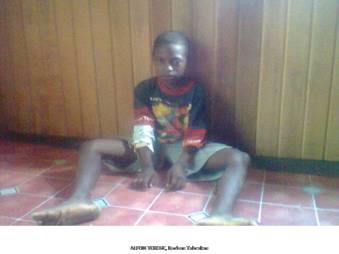
Peter Wakei, a Grade 5 elementary school student, was reportedly buried on Saturday after succumbing from serious head injuries from the collision at 10 am local time on Friday, according to family members spoken to by local human rights activists.  Schoolboy Alfon Tegeke (12, below) was lightly injured from the crash and treated in hospital, with the dead boy’s older brother Anton Wakei (32), the District Head of West Mapia, remains in a critical condition in Nabire hospital.

Indonesian Police were accused by community members of failing to search for the truck driver, according to witnesses, who reported that community members then mounted their own search for the truck driver at the Coral Market on sundown.

A heavily armed unit of Indonesian police confronted the Papuan community members in the market, and opened fire without warning on the group at 1830 local time, hitting two civilians with live bullets.  Apedus Wakei (31), was shot in the buttocks, while John Tekege (26) was shot in the thigh, and were taken to Nabire district hospital in a serious but stable condition, according to reports from Napas (National Papua Solidarity) sources in Nabire.

Police then arrested seven more community members and held them overnight without charge.  The seven detainees were released the following morning after the Nabire Police Chief met with members of the victim’s families together with the new Dogiyai Regent in order to defuse the tense situation in Nabire.  The inflamed situation has since returned to safe conditions after the intensive community negotiations, according to local human rights activists.

Andreas Harsono: Is Repression Against KNPB Legal?

January 4, 2013

by OKTOVIANUS POGAU of SuaraPapua.Com

https://i0.wp.com/suarapapua.com/wp-content/uploads/2013/01/HARSONO-ANDREAS.jpg
ANDREAS HARSONO, Indonesia Consultant for Human Rights Watch. (FOTO: RIDHA/SuaraPapua)

SUARAPAPUA, Jakarta –  Human Rights Watch (HRW) consultant  for Indonesia, Andreas Harsono, questioned the actions of the Indonesian security forces whose shootings led to the death of 22 members of the West Papua National Committee (KNPB) during the year 2012; 55 people were arrested, and hundreds of others were injured.

‘Given that 22 KNPB members died from shootings, dozens were arrested and unknown hundreds were injured, there has been no transparent judicial process, and no internal mechanism to question police procedures in Papua, we have to raise the question of whether this repression of the KNPB is legal?’.

The statement was re-affirmed by Andreas, when interviewed by suarapapua.com on Thursday 3rd Jan 2013).   According to Harsono , the police may justify their actions by incriminating KNPB members in violence, attacks on transmigrant settlers and security forces, but they still need to make their case transparent.

“The problem for police is working with transparency – can the police show this? At the same time, the KNPB needs to carry out an internal investigation in response to police accusations of involvement in violence’, he said.

Harsono also hopes that the organisation led by Victor Yeimo will quickly announce the outcome of the investigation, along with decisions to dismiss KNPB members found to be involved in acts of violence. As previously quoted, the KNPB head Victor Yeimo has stated that 22 KNPB members were killed in 2012 by Indonesian forces, 55 arrested and many among them are currently listed on the police wanted list.

(Translated by West Papua Media translators)


ELSHAM: Reverting to the DOM era: Papua back to being a Zone of Military Operations

PRESS RELEASE FROM ELSHAM PAPUA

December 19, 2012

ELSHAM PAPUA
Lembaga Studi dan Advokasi Hak Asasi Manusia
(Institute for Human Ri ghts Study and Advocacy of Papua)

Reverting to the DOM era: Papua back to being a Zone of Military Operations

There was a significant increase in the intensity of the conflicts and violence in Papua between August 2011 and December 2012. ELSHAM Papua reported on several incidents that had resulted in serious casualties and although the growing severity of the incidents was disturbing, these did not prompt the Government to react.  These events include the overwhelming offensive called “Operasi Aman Matoa I 2011”, terror actions and shootings by unidentified perpetrators (OTK), cases of internal displacements,  as well as cases of extrajudicial killing of civilians by the police.

“Operasi Aman Matoa I 2011” is the designation for an armed crime prevention operation that was set up in the areas of Puncak Jaya and Paniai. This operation was under direct command  of the Chief of Police, and was run by the Operations Task Force (Satgas Ops) through police telegram letter No. STR/687/VIII/2011 dated 27 August 2011.

The Operations Task Force for Operasi Aman Matoa I 2011 was led by Drs. Leo Bona Lubis, the Commissioner of Police. During the execution of Operasi Aman Matoa I 2011 in the Paniai Regency, a number of grave human rights violations were perpetrated, which include:

(a) the taking of the lives of two civilians, Salmon Yogi (20) and Yustinus Agapa (30) who died as a direct result of the armed conflict,
(b) the inflicting of injuries to at least four civilians: Yulian Kudiai (22), Melkias Yeimo (35), Yohanis Yogi (25) and Paskalis Kudiai (21), who became victim as a result of the armed conflict,
(c) great material loss due to the armed conflict in Eduda District which includes 78 houses that were burnt by the Operations Task Force; educational activities at 8 elementary school (SD) and 2 Junior High School (SMP) that had to be halted; religious and worship services could no longer be ensured in eight Catholic churches, seven Kingmi churches and four GKII churches; hundreds of machetes, knives, saws, hammers, bows and arrows were confiscated;
(d) villagers no longer felt secure in their own homes and they fled. As many as 37 people perished while in displacement: 13 toddlers, 5 children, 17 adults and 2 elders;
(e) communities from the Districts of Komopa, Keneugida, Bibida, East Paniai and Kebo have endured material loss due to their displacement.  The villagers were forbidden from going to their gardens by the members of the Operations Task Force. As a result, this primary source of livelihood for the communities was left neglected and unattended. Prior to the evacuation, 1581 heads of livestock were forcibly slaughtered, including  as many as 478 pigs, 3 cows, 11 goats, 132 rabbits, 381 ducks, and 576 chickens. After returning to their homes and villages, the residents experienced severe food shortage. Members of the Operations Task Force had also damaged the fences built by the residents, as they used those as firewood.

Violent acts committed by the security forces, both the military and the police, are still common and they are in flagrant violation of a number of international humanitarian standards and principles. Some of the cases that we note are as follows:

a. The heavy-handed assault carried out by the police against Persipura fans at Mandala Stadium on 13 May 2012, which led to 18 people suffering from respiratory problems due to tear gas that had been fired indiscriminately and six others being detained arbitrarily.
b. The shooting of four people in Degeuwo by the police on 15 May 2012, by which one person was killed and the other three were seriously wounded.
c. The assault against civilians in Honai Lama Wamena on 6 June 2012, by members of the Indonesian army (TNI) Battalion 756 Wimane Sili, which resulted in one person dead and 14 others seriously injured.
d. The arbitrary arrest and torture by the police of 10 people in the town of Serui, as they were commemorating the International Day for Indigenous People on 9 August 2012.
e. The forced disbanding by the police of a KNPB-led demonstration that was about to start in front of the campus of the State University of Papua in Manokwari on 23 October  2012. A total of 15 people were detained by the police, nine of them were tortured, and 2 others suffered gunshot wounds.

Summary executions by the police of pro-democracy activists who are active within the West Papua National Committee (KNPB) continue to occur. The extrajudicial shooting of Mako Tabuni (34), First Chairman of the KNPB on 14 June 2012, is clear evidence of acts of police brutality against civilians. A similar killing occurred in Wamena on 16 December 2012, when the police shot dead Hubertus Mabel (30), militant KNPB Chairman for the Baliem region.

Other violent acts such as terror acts and shootings by unknown assailants increased, both in 2011 and 2012. From 5 July to 6 September 2011, there were 28 shooting incidents where 13 people were killed and at least 32 people were wounded. Meanwhile, throughout 2012, there were 45 attacks by unknown assailants, killing 34 people, injuring 35 people and causing severe trauma to 2 people.

One of the worrisome events that received very little attention from the Government was the crisis which lasted from July to November 2012 in the Keerom where villagers fled their homes as they no longer felt secure because of activities conducted by the security forces. A joint effort between ELSHAM Papua and the Keerom Catholic Church enabled the return to their homes of 38 internally displaced people (IDPs) who had fled into the jungle.

Various cases of violence and human rights violations that occurred in Papua totally escaped the attention of the central Government and that of local Papuans. Conditions such as these indicate that the status of Papua as an autonomous region has turned into a status of “Special Operations Region”, similar to what was experienced in the decades between 1970 and 2000 when Papua was designated as a Military Operations Area (DOM). Legal impunity for the perpetrators of the violence becomes flagrantly visible as the perpetrators of such violence are practically never brought to justice, nor do they receive fitting sentences.

Prohibiting international humanitarian organizations, international journalists and foreign researchers from accessing the Papuan region inevitably gives way to the increasing acts of violence by security forces in that region. Elite units, such as Anti-Terror Special Detachment 88, are conducting activities that are contrary to their mandate as they themselves are the ones creating terror against activists of the pro-democracy movement in Papua.

Bearing in mind the socio-political conditions faced by Papuans today, ELSHAM Papua is calling for:

1. the Indonesian Government, to open access to international humanitarian agencies, international journalists and foreign researchers to the region so they can freely visit and monitor the human rights situation in Papua;
2. the police of the Republic of Indonesia, to immediately reveal to the public the identity of those responsible for the numerous attacks and mysterious shootings that have occurred lately in Papua;
3. the Indonesian Government and groups opposing the Government, to choose dialogue as a way to end the conflict and the ongoing violence in Papua;
4. the military and the police, to uphold and respect the universal principles of human rights that have been ratified by the Government of the Republic of Indonesia.


Baptist leader calls for unconditional release of Forkorus

Bintang Papua
11 December 2012
The Indonesian government has been urged to free all political prisoners in Papua, including Forkorus Yaboisembut and Filep Karma. On the occasion of World Human Rights Day,  the human rights defender Socrates Sofyan Yoman spoke about the activities throughout 2012 of organisations such Polri (the police force), the TNI (the Indonesian military) and vicious armed civilian groups. He said 90  incidents of violence had been committed by these groups in all parts of Papua during the year so far.’As we celebrate Human Rights Day,’ he said, ‘we defenders  of human rights urge the Indonesian government to take the following actions:

‘Firstly, in accordance with its constitutional responsibility to safeguard its citizens, the government should acknowledge that the way it treats prisoners, convicts and the citizens in general is brutal, inhumane and demeaning. This includes the way it treats Papuan civil society and Papuan political prisoners. Such activities  should be prohibited, along with all practices that violate the law. Torture must be clearly identified  and criminalised. This would be seen as a concrete sign of Indonesia’s commitment to the International Covnention Against Torture which it officially ratified  by enactment of Law 5/1998

Secondly, the government should agree to adopt a policy that recognises Papuan citizens as victims. In those cases where legal processes have been resorted to, rehabilitation not imprisonment should be the method  chosen. The government should also adopt measures to  inform the general public about the many civilian victims in Papua.

His next point was to ensure that whenever the law on treason is used in a court of law, this should be non-discriminatory and concrete action should be taken to put an end to all criminal activities by the security forces, including judges, public prosecutors and all those people who are in charge of the prisons.

Furthermore,  the rights of all Papuan political prisoners must be safeguarded, including ending all illegal detentions. In cases where confessions were made under duress and without the presence of legal counsel, they should not be accepted as evidence in a court.of law.

The government should create mechanisms for people to be able to initiate charges. Such mechanisms should be available everywhere and in all places of detention and imprisonment.And in cases where charges are brought by detainees, this must be followed through by independent investigations by law-enforcement institutions as well as the National Human Rights Commission.

His next point  was to urge the National Human Rights Commision, the National Commission to End Violence Against Women and the Ombudsman  of the Indonesian Republic, to establish a mechanism  for a fully independent National Protection Unit to visit all places of detention, especially places of detention where persons charged with treason (/makar/) or other political prisoners  are being held as part of the state’s responsibility to act in accordance with the Anti-Violence Optional Convention.

The seventh point was to press the Indonesian government to enter in peaceful dialogue on the problem of Papua, mediated by a third party, one of the aims of which would to end torture and other forms of violence throughout the Land of Papua.

The eighth point was to press the Indonesian government to invite  the UN Special Rapporteur against Torture and Arbitrary Detentions to visit Papua.

The ninth point was to press the Indonesian government  to allow foreign journalists to visit Papua.

The tenth point was that the Indonesian government should accept responsibility for incidents of gross violations of human rights such as the incident in Abepura on 7 December 2000, the Wasior 2001 incident, the Wamena  2003 inicident and other incidents that have already been investigated by the  National Human Rights Commission, and to ensure that  the results of these investigations  are considered at the human rights court and dealt with in accordance with the principles of justice.

With regard to the role of the churches in Papua, it should be acknowledged that their main mission  has been paralysed by the state and governmental system in Indonesia.

Moreover, its prophetic voice is hardly ever heard in Papua, particularly since Papua was integrated into the Indonesian republic by military means and this the integration was preceded by the bloody events surrounding the Act of Free Choice, which continue to the present day.

‘The churches have forgotten or refused to recognise that Christianity arrived in Papua three centuries ago, on 5 February 1855.’

These thoughts were expressed by Socrates Sofyan Yoman during his opening address of the Congress of the Alliance of Baptist Churches in Papua at the Baptist Church in Wamena in October 2012.

He pointed out that his church  has supported the Papuan people with education, religious belief, healthcare and in the economic sphere, and has helped to improve access to the most remote areas by establishing small airfields which cater for small aircraft, with alll the risks this involves.

The church’s  missionaries live in close proximity with the Papuan people and help to foster the dignity of the Papuan people.in sharp contrast to what Indonesia has done since Papua’s integration, when it became a colonial power, a fact that is rarely criticised by the churches.

As a church leader, Yoman said that he not only studies the Bible but also learns from the history of Papua.  He has learned a great deal from this history, in particular the many untruths that have been told.  It is the role of the churches to insist on correcting these untruths, he said

Until now the churches talk about  ‘peace and well being’ but God’s people are continually  stigmatised as treasonous and accused of being part of the OPM.

As a church leader, he rejects all these allegations  and believes that Christians  must reflect of God’s will, as is stated in Genesis 1:26.  For all these reasons, he said in conclusion:

‘I will continue to speak out and will do everything I possibly can to share in the sufferings of God’s people. There is no future for Papua if it continue to remain a part of Indonesia. Papuans cannot live normal lives The churches must speak out about this and integrate themselves with those people whose very identity has been destroyed. It must speak out about  justice, equality  and the freedom  of all humankind regardless of race, ethnicity, culture or religion.

[Translated by TAPOL]


Create a website or blog at WordPress.com

Up ↑