RAW FOOTAGE OF THE ATTACK ON THE PAPUAN PEOPLE’S CONGRESS

by Numbay Media — via our partners EngageMedia.org

This is raw footage of Wednesday’s attack by the Indonesian military and police on the Third Papuan People’s Congress in Jayapura. The footage shows people dancing, soldiers closing in, and gun shots. The video was shot by several observers. The last sequence was shot while the camera person was hiding from gunfire. Police have now confirmed that five people were killed in the attack – human rights groups say it was more.

1530 21/10/2011 Updates From West Papua

By Newmatilda.com and westpapuamedia.info

CURRENT:
Arrests
Anywhere between 300 and 800 activists arrested, most released
Core group of 5 in custody at least but could be more, all feared tortured:

– Forkorus Yaboisembut – elected as leader of the broad based movement for peace and justice – possibly paralysed witnessed by another detainee
– Edison Waromi – deputy leader
– Argus Krar
– Selfius Bobii
– Dominikus Sorabut

Released
– Abraham Kareni (who’s son lives in Melbourne) with fractured skull

Charges include treason, rebellion, crimes of hatred against the state. These are colonial laws left over from the Dutch era and they carry long sentences — in some cases up to 20 years.

Police violence, dead and wounded
DFAT have confirmed four people are confirmed dead, activists claim six
People identified (all from Petapa or family of:
– Dani Kabepa
– Yakovus Sabonsaba
– Mathias Maidepa
– Martinus Siep
– Tanepi Kobeta
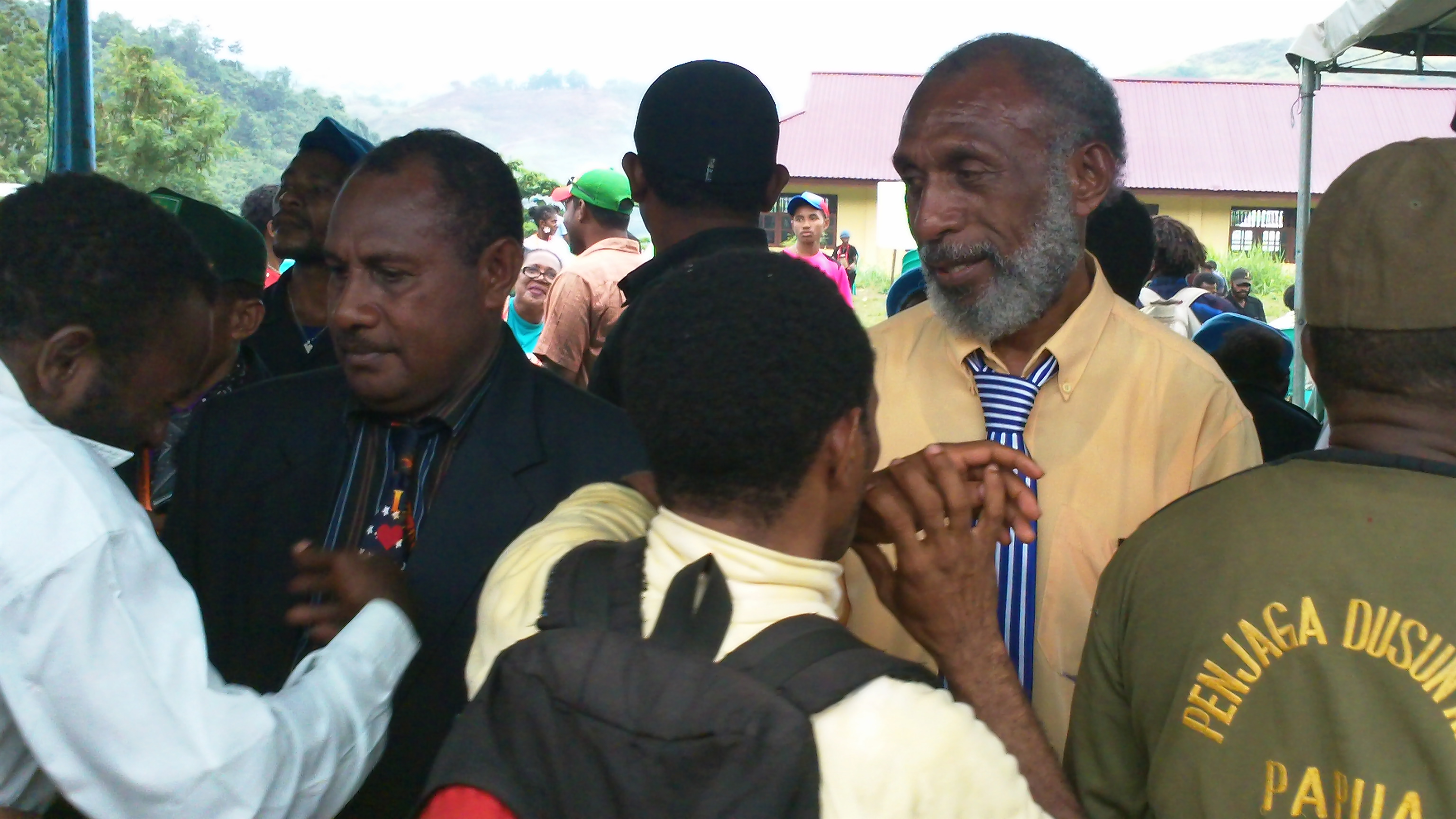
– One additional unidentified member of Petapa, the West Papuan paramilitary guard formed to protect Forkorus Yaboisembut, the man delegates elected as their leader.


Claims:
– Numerous people have been savagely beaten, many are in hiding for fear of arrest or worse
– Unverified claims people were shot at point-blank range and bundled into armoured personnel carriers and other vehicles.
– Five people at the Dian Harapan Hospital suffering several wounds: ”One is a woman, Ana Ana Adi, 41. She has got wounds at her right thigh. Pilatus Wetipo, 40, was shot in the right leg. Wiler Hobi (22) has some wounds in his head because of being beaten by the weapon, the other two have blistered wounds
– four people in Sabron Yaru wounded

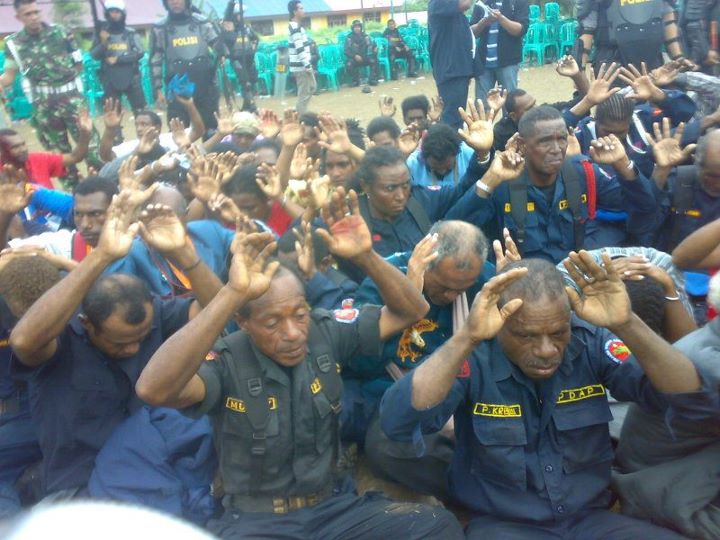
  • Members of the community security force (Petapa) are arrested. Photo: West Papua Media Alerts

Reports of violence by Indonesian troops continue to emerge from West Papua. New Matilda is in contact with local sources. We’re publishing regular updates on the situation here. (Warning: graphic content)

On Thursday, New Matilda published a report on the violence at the Third People’s Congress in West Papua. Indonesia military and police opened fire on participants and took activists and leaders into custody. Reports of fatalities and injuries continue to emerge from Jayapura.

Read Alex Rayfield’s initial report here.

New Matilda is in contact with local sources and will continue to update this page as new information emerges.

UPDATE, Friday 21 October, 10am:
This is a phone interview with journalist Alex Rayfield.

“Ferry Marisan, the director of Elsham — a leading human rights organisation based in the capital, Jayapura — has said that six people are confirmed dead.

“We think that a couple of people were shot as the security forces raided the stage, and some later. There are also lots of people with gunshot wounds, some of whom are in hiding and too scared to get medical assistance.

“We’ve had multiple reports that there were 800 people in jail. Many of those have been released, but a core group is still detained, charged with a range of offences including treason, rebellion, crimes of hatred against the state. These are colonial laws left over from the Dutch era and they carry long sentences — in some cases up to 20 years.

“It’s important for people to know that [Congress] is not a radical fringe movement. It’s made up of mainstream Papuan society: academics, church leaders and senior tribal leaders. In fact the radical fringe stayed away from this event because they think it’s not radical enough. So if the Indonesian government thinks this is a minority view, they are sadly mistaken. It is a mainstream view.

“Meanwhile, we should add for Australian audiences, that the strike continues at the Freeport mine [which is part owned by Anglo-Australian company Rio Tinto]. The two events are intimately connected.”

For more information on the Freeport strikes read New Matilda’s coverage here andhere.

UPDATE Friday 21 October, 4.30PM
These photos were sent by a credible source to West Papua Media Alerts and allegedly show injuries suffered in police custody. They have not been verified by New Matilda.

Photo: West Papua Media Alerts

Photo: West Papua Media Alerts

Photo: West Papua Media Alerts

MORE INFORMATION
Listen to an interview with Elsham’s Ferry Marisan here.

Read Amesty International’s statement on the incident here.

Read an article on Australia’s foreign policy response by Greens spokesperson on West Papua, Richard di Natale, here.

Third National Papua Congress Declaration

[as received in english from Papua National Consensus Team. This was scanned copy. Typos not corrected. – JMM]DECLARATION

FORMING FEDERAL STATE OF WEST PAPUA

On this day Wednesday ,19 October 2011 at the Third National Papua Congress, the people of Papua in Country of West Papua declare:

I.

Proclamation recover and Restore the independence and sovereign of West Papua which was lost to Indonesia annexation on December 1, 1961.

II.

Going into effect Constitution of Federal of West Papua by forming Governance of Federal State of West papua in the form of lifting President and elect Leader of Governance-The Prime Minister.

III.

Government of Federal State of West Papua guarantees the rights of live and rights of endeavor of everyone in the Country of West Papua.

IV.

Indonesia immediately terminates its occupation of West Papua pacifically and prestigious as civilized nation and member of the United Nations.

V.

The Nation Members of the United Nations to confess the Independence of the nation of Papua parallel with the other independences in the globe.

VI.

United Nations Security Council immediately register the Federal State of West Papua becomes the permanent or regular member state of the United Nations

VII.

Authorized the mandate to Papua National Leadership for run of the power of governance, Legislative, Judicative and Commander in Chief of Defense and also as soon as during one year carry out the general Election to chosen the Prime Minister of definitive Governance.

The People of West Papua greatly appreciate on your understanding of the historic injustice that we have suffered and are most grateful for your goverment’s support and recognize for restoration of our sovereign righs.

God Bless us all Sincerely

Forkorus Yaboisembut, SPd.
Head of Papua Customary Law Council Executor of Presidency of West Papua

CC:
1.Secertary General of United Nations
2. The President of United States
3. President of Indonesia
4. Netherland Kingdom
5. Pope in Vatican- Rome
6 .US Members of Congress and Senate

Amnesty: RELEASE PARTICIPANTS OF PEACEFUL GATHERING IN PAPUA

AMNESTY INTERNATIONAL

PUBLIC STATEMENT
Index: ASA 21/033/2011
20 October 2011
Indonesia: R elease participants of peaceful gathering in Papua
Amnesty International calls for the immediate and unconditional release of at least fourteen people who are currently being detained and interrogated by the police in Papua. They were arrested yesterday for participating in the Third Papuan People’s congress, a peaceful gathering held in Abepura, Papua province. Five of them, including Forkorus Yaboisembut, Edison Waromi, August Makbrawen Sananay Kraar, Dominikus Sorabut, and Gat Wenda have been charged for ‘rebellion’ and ‘incitement’ under Articles 106, 110 and 160 of the Criminal Code, which carry up to life imprisonment.
On the afternoon of 19 October 2011, the final day of the congress, military and police units approached the venue and started firing shots into the air to break up the peaceful gathering. This caused widespread panic among the participants who began to flee. As they fled, police units from the Jayapura City police station and the regional police headquarters fired tear gas and then arbitrarily arrested an estimated 300 hundred participants. The participants were held overnight at the regional police headquarters but most have now been released without charge.
Police and military officers allegedly beat participants with their pistols, rattan canes and batons during the arrest. The bodies of two participants, Melkias Kadepa, a student, and Yakobus Samonsabra, were found near the area of the congress with bullet wounds. Later that evening, security forces raided the Sang Surya seminary in Abepura arresting one person and allegedly firing bullets in one of the rooms.
The Indonesian government must immediately investigate allegations of excessive use of force to forcibly disperse the participants and investigate allegations of ill-treatment against some of them. There should also be an independent, impartial and prompt investigation into the deaths of Melkias Kadepa and Yakobus Samonsabra. If the investigations find that there were human rights violations involving the security forces, then those responsible, including persons with command responsibility, should be prosecuted in proceedings which meet international standards of fairness, and victims provided with reparations.
The reported heavy handed actions of the Indonesian security forces to disperse the peaceful gathering is a clear violation of the rights to freedom of expression, opinion and peaceful assembly which are guaranteed under the International Covenant on Civil and Political Rights (ICCPR), to which Indonesia is a state party, as well as the Indonesian Constitution. While the Indonesian government has the duty and the right to maintain public order, it must ensure that any restrictions to freedom of expression and peaceful assembly are no more than is permitted under international human rights law.
Further, the UN Basic Principles on the Use of Force and Firearms state that law enforcement officials must apply non-violent means before resorting to the use of force and firearms. The 2009 Indonesian Police Regulation on the Use of Force also highlights the need to respect the principles of legality, necessity and proportionality when using force.
Several thousand people representing various tribes from all over Papua attended the Third Papuan People’s congress from 17- 19 October 2011. Organisers had informed the Jayapura police of the gathering as required by law. At the peaceful gathering, participants reportedly raised the prohibited Morning Star flag, a symbol of Papuan independence, and made declarations of independence. During the period of the congress there was a build up of an estimated 500 military and police personnel surrounding the venue. In recent years, over a hundred people have been arrested, charged or detained for peacefully raising the Morning Star flag in Papua.
Amnesty International takes no position whatsoever on the political status of any province of Indonesia, including calls for independence. However the organization believes that the right to freedom of expression includes the right to peacefully advocate referendums, independence or any other political solutions that do not involve incitement to discrimination, hostility or violence.

Indonesian crackdown on Papuan Congress sparks outrage


Indonesian crackdown on Papuan Congress sparks outrage

A joint statement by TAPOL (UK), the West Papua Advocacy Team (WPAT,
US) and East Timor Action Network (ETAN, US)

On Wednesday, a meeting of thousands of indigenous Papuans in
Jayapura, West Papua, became the scene of a brutal crackdown by
Indonesian security forces. Indonesian troops and police Mobile
Brigades reportedly fired hundreds of shots to disperse the crowd,
pistol-whipped participants and beat them with batons and rattan
canes. They arrested around 300 participants. According to the
Indonesian press, security forces turned violent when Papuan
indigenous leaders, who had gathered to discuss their basic rights,
issued a declaration of independence.

“This appalling display of excessive force has no place in a modern
democracy,” said Lord Avebury, Vice Chair of the UK Parliamentary
Human Rights Group. Avebury called on the Indonesian government to
immediately release detainees and conduct and publish a full
investigation into the incident.

Two people are confirmed dead, with many more injured and five charged
with treason. Among those arrested were Congress organiser Mr Selphius
Bobii, and prominent indigenous leader Mr Forkorus Yaboisembut, head
of the Papuan Customary Council (Dewan Adat Papua). The arrests are a
provocative response to a peaceful gathering, targeting one of West
Papua’s most respected tribal leaders, said the US-based West Papua
Advocacy Team.

The meeting is the third of its kind to take place in West Papuan
history, and was reportedly attended by around 4,000–5,000 people.
While the Congress attracted thousands more to the surrounding area,
many were prevented from gaining entry to the event by security
forces, or were too afraid to enter.

“It is bitterly ironic that when Papuans meet to discuss their basic
rights, Indonesia responds by violating those rights,” said Carmel
Budiardjo, senior campaigner for the UK-based NGO TAPOL. “The daily
discrimination and violations experienced by Papuans are bad enough,
but an attack of this nature on a democratic congress is an absolute
outrage,” she continued.

The use of the infamous ‘makar’ or treason laws to deny the right to
freedom of expression and assembly is an increasing problem in Papua,
suppressing activists and fuelling simmering resentments among the
indigenous population. On Wednesday, US Congressman Mr Eni
Faleomavaega expressed concerns about the arrests, calling for the
immediate release of Mr Forkorus Yaboisembut. The US-based East Timor
Action Network has also condemned the arrests. “The right to gather
and speak out is a fundamental freedom, it doesn’t just disappear
because the government doesn’t like what is being said,” said John M.
Miller, the network’s National Coordinator.

The situation in Jayapura last night was tense amidst fears of
reprisals and further actions by security forces against local
residents and those involved in the Congress. TAPOL, WPAT and ETAN
call on the international community to urge Indonesia to show
restraint, release the detainees, and commit to a peaceful resolution
of the West Papua conflict.

/ Ends

Contacts

UK: Paul Barber, Coordinator, TAPOL, +44-20-8771-2904
paul.barber@tapol.org

US: Ed McWilliams, West Papua Advocacy Team, +1-575-648-2078
edmcw@msn.com

John M. Miller, East Timor Action Network,
+1-917-690-4391 john@etan.org

Photos and video clips

Photos of victims available from TAPOL on request, including victims
suffering gunshot wounds and beatings.

Check West Papua Media Info for breaking news and video clips direct
from West Papua.

Background notes for editors

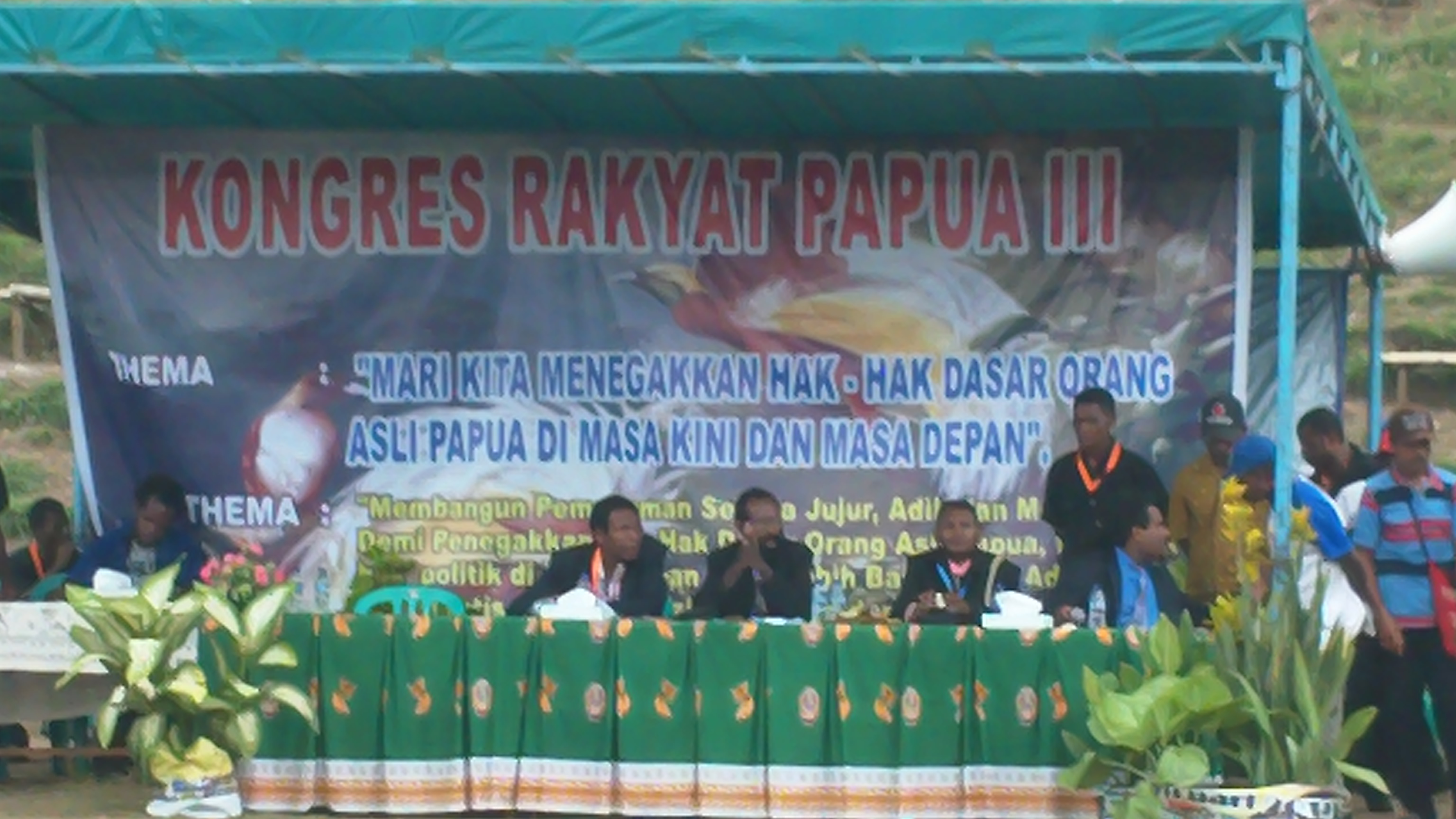
The Third Papuan People’s Congress

The Congress, themed ‘Affirming the basic rights of the indigenous
Papuan people for the present and the future’ was planned to last for
three days. It opened in Abepura, Jayapura, on 16 October 2011 with
between 4,000 and 5,000 delegates in attendance representing more than
200 tribal groups from across the territory. Over 20,000 more
gathered in the vicinity of the Congress. The organisers were forced
to hold the event in an open field as requests to hold it at a more
suitable venue were rejected.

For the first two days the Congress proceeded peacefully, but the
atmosphere was increasingly tense due to the build-up of over 2,000
members of the security forces in Jayapura. According to local sources
reported by West Papua Media Info, troops encircled the conference
with around 70 vehicles including Army Pansers, a water cannon,
Armoured Personnel Carriers and Barracuda armoured jeeps. On the third
day at the close of the conference, Indonesian troops armed with
automatic weapons, along with units of Brimob, the notorious mobile
brigade of the Indonesian police, reportedly opened fire in an attempt
to disperse the Congress.

History of the Papuan People’s Congress

The First Papuan People’s Congress was held on October 16–19 in 1961,
and issued a manifesto declaring their independence. The Second
Congress held in May–June 2000 issued a resolution which affirmed
their sovereignty as a people and led to the establishment of the
representative body, the Papuan Presidium Council (PDP). Just over a
year later, in November 2001, the PDP chairman, Theys Eluay was
kidnapped by a unit of Indonesia’s Kopassus Special Forces and
assassinated. In a travesty of justice which characterises the problem
of impunity for security forces in Indonesia, the perpetrators were
sentenced to between two and three and a half years.

Elsewhere in Papua: strikes at Freeport

At the same time as the Congress was underway, thousands of Papuan
workers employed by the massive Freeport copper-and-gold mine in West
Papua continued their strike to demand a substantial rise in wages.
The strike, which has hit production at the multibillion dollar
company, which is losing millions, has been met by security force
violence. Since the late 1970s Freeport has been the largest taxpayer
to the Indonesian state, while the majority of Papuans continue to
live in dire poverty: the Papuan provinces remain the poorest in
Indonesia.

West Papua Conflict

One of the world’s longest-running conflicts, the independence
struggle between the Free West Papua Organisation (Organisasi Papua
Merdeka, OPM) and the Indonesian state has been raging for 48 years,
since Indonesia took control of West Papua on 1 May 1963. The conflict
escalated when West Papua was formally incorporated into Indonesia
following the controversial Act of Free Choice in 1969.

Recent context

A period of heightened political activity in the middle of 2011,
including the holding of a Papua Peace Conference in Abepura from 5-7
July and calls for dialogue with the central government, generated
positive signs that tentative progress is being made towards resolving
the Papuan problem, but was followed by a series a violent incidents
and human rights violations. The outcomes of the Peace Conference,
organised by the Jaringan Damai Papua (Papua Peace Network) led by
Father Neles Tebay, provided an aspirational agenda for a peaceful
Papua with a series of ‘Indicators of Papua, Land of Peace.’

Note: The term West Papua covers the whole territory of West Papua,
which in 2003 was divided into two provinces: Papua and West Papua.

Create a website or blog at WordPress.com

Up ↑