Letters of solidarity flood in their thousands for Filep Karma

by a Special Correspondent for West Papua Media in Abepura

March 19, 2012

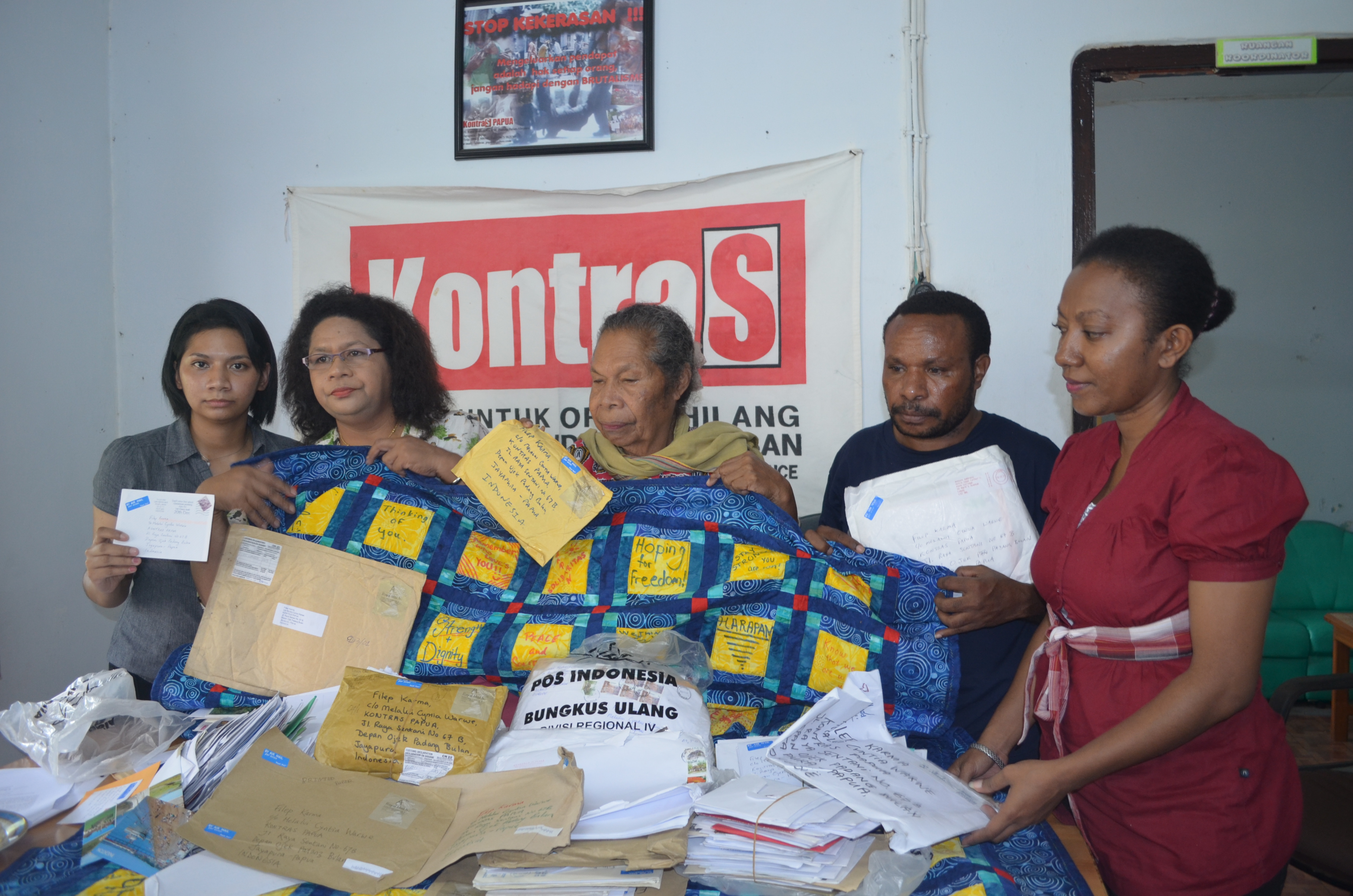
Kontras and Filep Karma's family with some of the nearly 7300 letters sent by international supporters of Karma (Photo: West Papua Media)

Filep Karma, is one of the political prisoners given sentences of 15 years of imprisonment by the government of Indonesia, by raising the Morning Star flag, on December 1, 2004, at Trikora field, Abepura. Ever since a period of 7 years, and 3 months of his prison sentence  have lasted in Abepura prison. During captivity Filep Karma received letters of solidarity sent by the International community through the office of the Commission for missing people and victims of violence in Papua (KontrasPapua).   Nearly 7292 letters of support have been sent in the period of 2011 untill 2012.

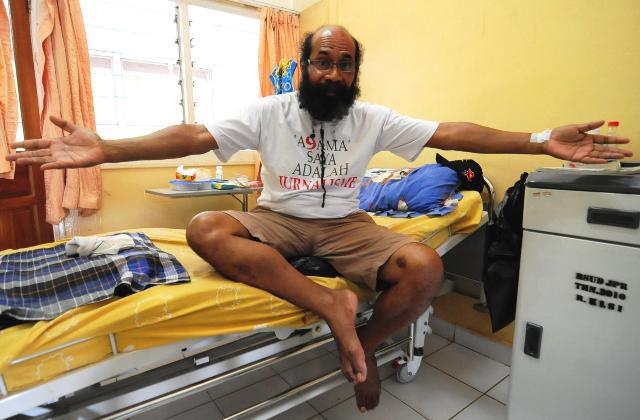
Filep Karma inside the prison hospital (Photo: West Papua Media)

United for the truth (BUK) and Kontras Papua held a Press Conference on March 19, 2012, and immediately submit a letter of support to the family representative of Filep Karma. Andrefina Karma,  Filep Karmas second daughter  said ” International Community support is strong solidarity for the freedom of my father, the people there once a month hold a simple campaign in front of the Indonesian embassy and called for the unconditional release of Filep Karma”, she said.

Letters that came from different parts of the world  proved that there is support for political prisoners in Papua. Olga Hamadi, Director of Kontras Papua says”  the government should not close her eyes  for the injustice suffered by political prisoners in Papua, both in conditions of health and food at the prison, which  received less serious attention”, she said. She also denied the statement by the Minister of Justice and Human Rights Republic of Indonesia during a visit to Papua saying that there are no political prisoners in Papua.

Filep Karma is one of  figures of political prisoners who never made a compromise with the Government of Indonesia. He rejected any form of clemency, amnesty, and abolition that is given by the Government. ” If I receive clemency, that means I ask for forgiveness to the government, but I do not feel guilty at all, I am just making a peaceful protest. Indonesia is a democratic country, am I wrong to fight for the basic rights of indigenous Papuans?

“I will continue to undergo a period of detention up to 15 years in prison, if you want to release me, I ask to be released unconditionaly”, Filep Karma said, as he was undergoing physiotherapy treatment in DOK II general hospital.

westpapuamedia

Filep Karma undergoing Medical care at Hospital DOK II

by a special correspondent in Abepura for West Papua Media

March 3, 2012

(Edited and abridged in translation by WPM)

Concerns have been raised again over the health of internationally renowned West Papuan political prisoner Filep Karma, after a series of visits to hospital to treat his worsening health, amid atrocious conditions in the notorious Abepura prison.

Filep Karma is a political prisoner sentenced to 15 years imprisonment by Indonesia after being found guilty of makar (treason) for making a speech calling for independence and raising the banned Morning Star flag on December 1st 2004.

(Gaoled in atrocious conditions and subjected to early routine torture by Indonesian security forces and prison officers, including beatings causing internal injuries, Karma’s health has been declining since 2008, also due to numerous hunger strikes and illness caused by prison conditions in Abepura prison.  Additionally, In response to a petition filed by Freedom Now, the United NationsWorking Group on Arbitrary Detention issued its opinion that the Government of Indonesia is in violation of international law by detaining Filep Karma. Amongst many other international voices, the Working Group called on the Government of Indonesia to immediately release the human rights advocate. – WPM)

He underwent medical checkups at Hospital Dock II, and underwent a colonoscopy by a Dr Arnold, on 17 February 2012, to check his intestines. He underwent the check because up until this point he regularly discharged blood when using his bowels. The results of the check were to be taken on February 21st, 2012. At the same time he also was assessed by a neurologist, Dr. Nelly Rumpaisum, because for the previous few days he felt the pain to the right of his hip when getting down to clean clothes, and now also when standing. When undergoing the examination, Fliep was accompanied by two officers and a doctor from Abepura prison. Filep was to return to the Hospital II, to undergo X-rays of his waist.

At this time, Filep cooked his own food in prison. He used a traditional stove himself, with milk cans and axes, lit with coconut oil. ‘Eating my own cooking is better for my health at the moment, because if I eat food from Abepura Prison, there can sometimes be a lot of seasoning, and this is less suitable for the condition of my body while undergoing medical treatment at the moment’, he said.

On 21 February 2012, according to Dr. Donald Arronggear at the time of the colonoscopy results, ”Filep is affected by inflammation of the intestine next to the anus, so that he must eat foods high in fibre, like fruit and vegetables”, he said. He also received various medicines from the doctor to drink when back in prison. He also did x-rays on the right side of the waist, and the results were to be checked again on 24 February 2012.

Filep Karma will undergo physiotherapy

On several weekends, Filep Karma underwent some medical treatment at the Hospital Dok II. He was accompanied by two prison officers and doctors from Abepura Prison. On 24 February 2012, he received sequence number 2 at the polyclinic at Hospital DOK II. Filep took the x-rays to neurologist, Dr. Nelly Rumapaisum. According to Dr. Nelly ”The right side of Filep’s waist, has narrowed. So, it must to undergo physiotherapy for 12 sessions. Filep can no longer lift heavy equipment and also sports is a high-risk”, said Dr. Nelly.

Filep Karma said that ‘my waist has already been sore for a while, but it felt sore for a few weeks so it had to be checked”. Filep Karma also must use a corset after undergoing physiotherapy (a very uncomfortable apparatus in the sweaty conditions of the prison – WPM) . He will undergo regular physiotherapy and will be back and forth to the DOK II Hospital for ongoing care.

“My desire is also to be an inpatient at DOK II Hospital, while undergoing physiotherapy, because the distance between the Prison Abepura and Jayapura is about 60 minutes, which makes me making a little exhausted on the journey”, Karma said.

See Also : FILEP KARMA REFUSES INDONESIA’S REMISSION Aug 20, 2011 – Video report by Cyntia Warwe

Responsibility to Protect: Statement regarding the shooting of civilians in Abepura on 19 Oct 2011.

The Asia-Pacific Centre for the Responsibility to Protect has today released a statement regarding the reports about the shooting of civilians in Jayapura, West Papua, on 19 October 2011. To read a copy of the statement, please click here.
For further information in relation to this statement, please contact Annie Pohlman (a.pohlman@uq.edu.au) and Jason MacLeod (j.macleod@uq.edu.au).
Annie Pohlman is Program Leader for Southeast Asia at the Asia-Pacific Centre for the Responsibility to Protect, the University of Queensland.
Jason MacLeod is based at the School of Political Science and International Studies, the University of Queensland, where he teaches conflict and nonviolent change. He is researching civil resistance in West Papua.

26 October 2011

Statement regarding the shooting of civilians in Abepura, Jayapura, on
Wednesday 19 October 2011.

The Asia-Pacific Centre for the Responsibility to Protect appeals to the Indonesian
government to show leadership in protecting and upholding human rights in response
to continuing reports that members of the Indonesian military and police opened fire
on civilians attending the Third Papuan People’s Congress in Abepura, Jayapura, on
the afternoon of Wednesday 19 October 2011.

Reports from Kontras (The Commission for the Disappeared and Victims of
Violence) and Elsham (The Institute for the Study and Advocacy of Human Rights in
West Papua) in the Papua Province of Indonesia state that these shootings occurred on
the third day of the Congress, held on a field (Lapangan Zakheus/Sakeus or Taboria)
in Abepura. Throughout the Congress, military and police personnel maintained a
prominent armed presence. It is also reported that Forkorus Yeboisembut, Chairman
of the Council of Customary Papuan Chiefs, declared Papuan independence from
Indonesia during the afternoon of 19 October.

Subsequently, members of the police and military near the field allegedly fired upon
civilians and moved in to arrest members of the Congress. At least five people were
reportedly killed during this attack. At this time, Yeboisembut and other Congress
leaders – including Selfius Bobi, Edison Waromi, Agus Krar, Dominikus Surabut and
Gat Wenda – are still detained.

Kontras had confimed three of the victims – Daneil Kedepa, Yakobus Samonsabra
and Max Yew – died of gunshot wounds. Two others, Matias Maidepa and Yacop
Sabonsaba, were allegedly found dead behind the military headquarters in Abepura. A
team from the National Commission for Human Rights (Komnas HAM), headed by
Deputy Chairperson Ridha Saleh, arrived in Papua on Tuesday 25 October to
investigate the violence.

One week after this incident, tensions in Papua remain high. The Indonesian National
Police is now on the highest level of alert in Papua and 300 additional members of the
Police Mobile Brigade (Brimob) have been sent after Dominggus Awes, a local Chief
of Police, was shot at the airport in the highlands region of Mulia.

The Asia-Pacific Centre for the Responsibility to Protect is deeply concerned about
reports of a violent assault on a peaceful and unarmed gathering of civilians in
Abepura. It is also concerned by the tone of discussion about the Papuan People’s
Congress in Jakarta. The Congress is seen as an attack on the government and has
been called a “coup” (1)  that must be “put down” with a military solution (2).   The heightened presence of security forces in Papua, in addition to inflammatory language used by public officials in Jakarta, are likely to escalate tensions in Papua. Thus, the potential for further violence is high and immediate action by the government should
be taken to contain further violence.

The Centre recognises and commends the leadership shown by Indonesia in
promoting human rights within the Southeast Asia region and so calls upon the
Indonesian government to respond quickly and effectively to these reports.

In particular, the Centre urges the Indonesian government to:

1. Support the National Commission on Human Right’s independent investigation to
determine the events that took place on the afternoon of Wednesday 19 October 2011
at the Third Papuan People’s Congress in Abepura.

2. Ascertain and provide clear details regarding the whereabouts and wellbeing of all
persons currently detained in connection with the attack on the Third Papuan People’s
Congress.

3. An independent investigation be carried out into the actions of police, military and
any other State officials during the Third Papuan People’s Congress and, in particular,
into their actions on the afternoon of Wednesday, 19 October 2011, and subsequent
actions taken in connection to the incident.

The Centre acknowledges the great strides Indonesia has made under the leadership of
President Susilo Bambang Yudhuyono and expresses hope that the President will do
all he can to protect the rights to life and safety of all Indonesian citizens including
those in Papua.

  Notes:
1  Statement made by Djoko Suyanto, Coordinating Minister for Political, Legal and Security Affairs. See “Minister Defends Papua Response, Denies Govt Role in Deaths,” The Jakarta Globe, 21 October 2011, online at: http://www.thejakartaglobe.com/news/security-minister-defends-papua-congress-was-acoup-detat/473139
[accessed 22 October 2011].

2  See also statements made by the Defence Minister, Purnomo Yusgiantoro. For example, see Made Arya Kencana, Banjir Ambarita and Ulma Haryanto, “Jakarta Gives US Its Side of Story in Papua Deaths,” The Jakarta Globe, 23 October 2011, online at: http://www.thejakartaglobe.com/home/jakartagives-us-its-side-of-story-in-papua-deaths/473590 [accessed 24 October 2011].

Neles Tebay calls for an end to repression and suppo

Bintang Papua, 26 October 2011The head of the Theology and Philosophy College, STFT, Pastor Neles Tebay, speaking after the acts of violence which occurred during the Third Papuan Peoples’ Congress, said that the violence had had a significant impact on the victims of the incident. He said that the security forces had entered the residences of the priests as well as the campus without prior permission and started looking for the Congress participants. This had resulted in material and psychological damage for all those who were staying at the STFT campus.

Speaking at a press conference after the event, he said that they were not concerned about the material damage which had been done but were concerned about the use of physical violence against people who had attended the Congress, which had also impacted on the broader community. He said that every effort should be made to ensure that such acts of violence do not occur again any time in the future. He stressed that the entire faculty of the STFT rejects the use of all kinds of repression in dealing with the problems. Using violence undermines the dignity of all concerned, above all the dignity of the victims as well as the perpetrators.

He said that it was very regrettable that the security forces appear to believe that they have the monopoly of the truth about what happened  and believe that the brothers and fathers residing on the STFT complex had acted wrongfully simply because they provided protection  to people who were fleeing and who were in need of protection, in accordance with universal principles in a situation where people’s personal safety was under threat. ‘It is the duty of the brothers and fathers to provide protection to people who are being chased and under threat from the security forces, in accordance with the principle of humanitarianism, and is not in any way connected with political issues.’

Pastor Neles called on Komnas HAM, the National Human Rights Commission, to investigate the acts of violence that occurred at the end of the Third Papuan People’s Congress in order to determine the extent to which basic human rights had been violated.

Recalling the commitment of the SBY government expressed on 16 August 2011 when the President said that  Papua should be handled with the heart, he fully supported  the call for dialogue between Jakarta and Papua. He said that dialogue would  be of tremendous importance not only as a way of ending the violence but so as to ensure that there would be no further repetition of violence in the  Land of Papua.

He called  on all people of goodwill to jointly  press for dialogue, for the sake of peace in Papua. Dialogue would make it possible to identify the problems and reach an agreement on the way to solve the problems in Papua in a way that is free of violence and bloodshed.

He also admitted that he was the one who had given the Congress permission to use the Zakheus Soccer Pitch as the venue of the Congress. He had done so because the Congress had been refused permission to hold the event either in the UNCEN Auditorium or in the Sports Stadium, GOR.

[Translated by TAPOL]

Theologians & Franciscan Friars about recent post-Congress Indonesian violence affecting their communities

unofficial English translation of the media statement published yesterday (26/10) by the Rector of “Fajar Timur” Catholic School of Philosophy and Theology and the Provincial of the Franciscan Friars in West Papua, Indonesia, in regards to the recent violence affecting their communities.  via ETAN

“WHAT THE CIVITAS ACADEMICA OF ‘FAJAR TIMUR’ SCHOOL OF PHILOSOPY AND THEOLOGY HAVE EXPERIENCED AND SEEN POST THE THIRD PAPUAN CONGRESS”

1.       Wednesday, 19 October 2011, around 9 am, the police, Brimob and the Indonesian army were on guard equipped with armoured vehicle, trucks, along Sosiri Street, Yakonde Street even at the back of “Fajar Timur” School of Philosophy and Theology (STFT). Within those streets the Catholic mission compound is located, including St Paul’s Secondary School and its teachers’ residence, “Nur Jaya” girls’ dormitory, JMJ nuns’ house, staff residence, “Sang Surya” Franciscan friary, “Tunas Harapan” Catholic dormitory, Zakheus football field (where the gathering spot of the congress), Seminary of John Vianney, “Tauboria” dormitory, Inter-diocesan seminary, the campus of Fajar Timur School of Philosophy and Theology, residence of priest staff, a chapel, a dinning hall and other facilities. The deployment of troops without any prior notice to the school made us worried and suspected that the situation would have turned into chaos and we would have been trapped in such circumstances. Therefore, around 10 am, we asked our staff to go home.

2.       Around 11 am, a unit of Indonesian army with heavy guns entered the campus and dormitories (the inter-diocesan seminary) from the hill at the back of the campus. The troops entered our property without asking any permission. They took rest in a multi-purposed hut. Some students gave reactions to them and asked them not to enter the seminary and campus area. So they then left and went back to the hill.

3.       Around 3.30 pm some members of the security services entered the dormitories searching for the participants of the Papuan congress who were running for safety. The security services entered the dormitories of the brothers from the Diocese of Agats. They broke the doors of the study room and bed rooms at the front side, entered and ransacked the computer room while saying, “Take that computer for evidence.” While window glasses were destroyed, another voice said, “Don’t do it. This is the mission complex.” The brothers from the Diocese of Agats were terrified and lying  face down hiding at the front room. A few congress participants who took refuge in the bathrooms were arrested. A harsh voice said, “Run?…get shot!” When the security services wanted to ransack the room at the back where students were hiding, an instruction came out saying, “Enough! Enough! Stop! Back off!” then silence. After waiting for a while, those who were hiding, got out and ran away to the residence of priest staff. When they got there, they realised that one of them was shocked and could not move from his hiding place.

4.       Meanwhile, inside the staff’s study room, Father John Jehuru OSA, Associate Dean and the Rector of Interdiocesan Seminary was stunned when a bullet penetrated his window. He was monitoring the chaos happening in Zakheus football field around 3.30 pm. The bullet razed his glass louvers and curtain, hit the wall, before dropped into a study desk. The bullet and Father John were only separated for about 50-75 cms. The crumbs of the bullet were found.

5.       The security services also entered other dormitories. In the dormitories of the brothers of the Diocese of Manokwari-Sorong, while searching for participants of the congress, they said, “Is it a mission house? Where are those idiot priests? Why priests hide criminals?”

In the dormitory of the brothers of the Archdiocese of Merauke, the security services arrested Agus Alua, a student, who was standing outside when the security services came in. We found a bullet pierced a window but we do not know from which direction the bullet came from. The security services came from the back of the campus with shooting. However, we do not know whether they were the same troops that came ealier at 11 am or not.

6.       Meanwhile in the staff residence, the troops were chasing the participants and threw tear gas. One of the troops entered and found the resident, a woman, lying face down and hiding under the bed. He asked, “Who are you?” and the woman answered, “I’m the resident here!”. “Get out, don’t be afraid” said the security. She came out and wiped her soured eyes saying, “I’m not afraid of you but of your bullets and tear gas”. Then he walked away.

7.       In “Sang Surya” Franciscan friary, many participants took refuge. Mr Forkorus Yaboisembut (the Chair of the Papuan Customary Council) and Dominikus Sorabut, now suspects detained in the police custody, were taking rest after the congress was closed. Father Gonsa Saur OFM, the head of the friary, was taken by surprised when he heard a shooting. He put his Franciscan habit on and came out standing at the stairs that connect the first and the second floor of the friary. Three members of the security forces and some others with plain clothes forced to enter the second level of the house but Father Gonsa denied them. He saw the security services with plain clothes sneaked into the dining room and the front room. They were carrying big guns and pistols. Due to the heavy pressure from the security forces, finally Father Gonsa had to ask those who were hiding to come out. While some of them came out, some others stayed hidding for safety. Father Gonsa asked the security, “You can take them, but don’t beat them.” In front of him, they were not beaten up but once they were out at the road, some of the security services beat them.

Six members of the security forces in plain clothes dragged Mr Yaboisembut and yelled at him. A woman was dragged too out of the friary. One of the security forces tried to penetrate the second level but Father Gonsa asked him to come down. About ten people surrendered but we do not know their identities. They were told to walk by squatting. There were three women among them. Outside the building, many security forces with or without uniform were hanging around with heavy weapons.

8.       In John Maria Vianey’s Seminary of the Diocese of Jayapura, many participants were hiding for safety. The security services searched for the participants and found Father Yan You, the head of the seminary. Three members of the security forces pointed his gun at Father Yan’s head one by one. They said, “You hide them.” He answered, “Kill me, shot me, come on.” Then they smashed the door, entered the room and took those who were hiding. Meanwhile, the brothers convened the participants at the hall. The brothers gave up their bedrooms for the participants for hiding. The brothers put their priest uniform on and protect the participants of the congress but when the security forces entered, some of the participants surrendered and they were taken away. The brothers told the security not to be cruel with the participants. One of the brothers, who tried to help those who were shot, got beaten with a rifle butt on his hand until it was  fractured and with a rubbler baton on his nose until it was bleeding. He had been arrested and detained at the Papua police custody overnight before released on the following day. He is being treated at the intensive care unit at the local hospital.

9.       When the security forces persecuted the crowd and members of the security guards of the Papuan Customary Council (Penjaga Tanah Papua), these people ran through the back of the library and tried to enter the staff room. But they could not make it because it was locked. So they broke two pieces of glass louvers. They ran to the hill but then were stopped with shootings coming from the top of the hill. So they went back to the bushes where they had come from.

Because of this incidence, the “Yerusalem Baru” inter-diocesan seminary and “Fajar Timur” School of Philosophy and Theology were physically and non-physically damaged:
1.       7 doors were ruined, 2 computer units missing, 2 trophies crushed, 2 chairs were broken, 2 sickles and 1 knife were missing, pots of flowers scattered. Window glasses of the dormitory of the Diocese of Merauke was razed with bullet, 2 pieces of glasses louvers of the staff room were smashed, 1 window glass of the staff room was pierced by bullet, window glasses of the seminary office demolished.

2.       One student is being treated in hospital because his face was swollen so there was no difference between his nose and his cheeks.

3.       The brothers remain terrified and worried. They are traumatized because the security services have acted inhumanely.

In regards to this incidence:
1.       We do not ask for compensation for the damaged or missing facilities. The violent acts of the security forces have destroyed the facilities and also infused fear and anxiety among the civitas academica of “Fajar Timur” School of Philosophy and Theology. The building and window glasses can be replaced but it takes a long time to heal fear and anxiety.

2.       We do not ask for compensation for the medical treatment for the brother who is in hospital.

3.       We firmly reject any repressive means to deal with issues because such violent act only undermines the human dignity of victims and perpetrators.

4.       We are deeply concerned that our campus, which is entitled to academic freedom, was penetrated by heavily armed security forces without any permission or prior notice.

5.       We regret that the monopoly of truth by the security forces who assumed the brothers had done something wrong by providing assylums for those who were persecuted by the security forces. We affirm that such an assylum was provided on the basis of the universal humanitarian principle, namely when a person is exposed to a life-threatening situation, s/he has to be given protection and defence. Therefore, the protection provided for the participants of the congress who tried to take refuge from the persecution and threats from the security forces was solely based on the humanitarian principle rather than any political interests.

6.       We appeal to the Indonesian Human Rights Commission (KOMNAS HAM) to investigate the violent incidence post congress to look at how serious human rights abuses have occurred.

7.       Based on the government’s commitment, as expressed by President Susilo Bambang Yudhoyono during his address to the nation on 16 August 2011, namely “dealing Papua with heart,” we support a dialogue to be done between Jakarta and Papua. This dialogue is highly important not only to stop violence but also to prevent any recurrence of violent acts in Papua. We ask all parties of good will to push the idea of dialogue between Jakarta and Papua.

8.       We ask for supports and solidarity from the members of the Catholic Church around the world to pray and support the implementation of dialogue between Jakarta and Papua for peace of Papua. Because only through dialogue, issues that underpin conflicts in Papua can be identified and proper solutions can also be found without resorting to violence and bloodshed.

Jayapura, 26 October 2011

Rector of “Fajar Timur”  STFT The Provincial of the Franciscans Order in Papua

Father Dr. Neles Tebay, Pr Father Gabriel Ngga OFM, Lic Theol.

Create a website or blog at WordPress.com

Up ↑