Papua New Guinea takes a regional lead in supporting a free West Papua

16 March 2013

 by Airileke Ingram and Jason MacLeod

Melanesian support for a free West Papua has always been high. Travel throughout Papua New Guinea you will often hear people say that West Papua and Papua New Guinea is ‘wanpela graun’ – one land – and that West Papuans on the other side of the border are family and kin. In the Solomon Islands, Kanaky, Fiji and especially Vanuatu, people will tell you that “Melanesia is not free until West Papua is free”. This was the promise that the late Father Walter Lini, Vanuatu’s first prime minister made.
benny powes 1
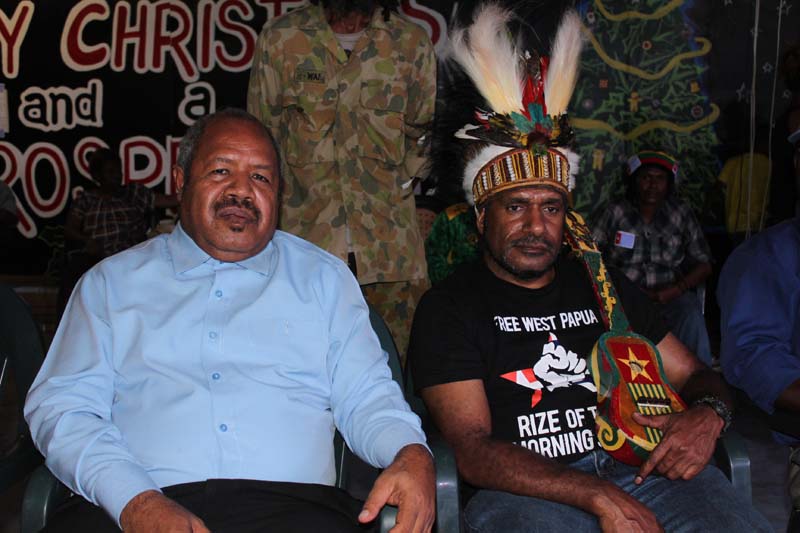
Above: Papua New Guinea National Capital District Governor Powes Parkop with Independence leader, Benny Wenda at the concert for a free West Papua, Jack Pidik Park, Port Moresby 6 March 2013.

Ordinary people in this part of the Pacific are painfully aware that the West Papuan people continue to live under the gun. It is the politicians in Melanesia who have been slow to take up the cause.

But that may be changing.

Last Wednesday 6 March 2013, the Right Honorary Powes Parkop, Governor of National Capital District, Papua New Guinea nailed his colours firmly to the mast. In front of a crowd of 3000 people Governor Parkop insisted that “there is no historical, legal, religious, or moral justification for Indonesia’s occupation of West Papua”. Turning to welcome West Papuan independence leader Benny Wenda, who was in Papua New Guinea as part of a global tour, the Governor told Wenda that while he was in Papua New Guinea “no one will arrest him, no one will stop him, and he can feel free to say what he wanted to say.” These are basic rights denied to West Papuans who continue to be arrested, tortured and killed simply because of the colour of their skin. Governor Parkop, who is a member of the International Parliamentarians for West Papua, which now has representatives in 56 countries, then went on to formerly launch the free West Papua campaign. He promised to open an office, fly the Morning Star flag from City Hall and pledged his support for a Melanesian tour of musicians for a free West Papua.

Governor Parkop is no longer a lone voice in Melanesia calling for change.

Last year Papua New Guinea’s Prime Minister Peter O’Neill broke with tradition and publicly admonished the Indonesian Government’s response to ongoing state violence, human rights violations and failure of governance in West Papua. Moved by 4000 women from the Lutheran Church O’Neill said he will raise human rights concerns in the troubled territory with the Indonesian government. Now Governor Parkop wants to accompany the Prime Minister on his visits to Indonesia “to present his idea to Indonesia on how to solve West Papuan conflict once and for all.” Well known PNG commentator Emmanuel Narakobi remarked on his blog that Parkop’s multi-pronged proposal for how to mobilise public opinion in PNG around West Papua “is perhaps the first time I’ve heard an actual plan on how to tackle this issue (of West Papua)”. On talk back radio Governor Parkop accused Australian Foreign Minister Bob Carr of not taking the issue of West Papua seriously, of “sweeping it under the carpet.”

In Vanuatu, opposition parties, the Malvatumari National Council of Chiefs and the Anglican bishop of Vanuatu, Rev. James Ligo are all urging the current Vanuatu government to change their position on West Papua. Rev. Ligo was at the recent Pacific Council of Churches in Honiara, Solomon Islands, which passed a resolution urging the World Council of Churches to pressure the United Nations to send a monitoring team to Indonesia’s Papua region. “We know that Vanuatu has taken a side-step on that (the west Papua issue) and we know that our government supported Indonesia’s observer status on the MSG, we know that. But again, we also believe that as churches we have the right to advocate and continue to remind our countries and our leaders to be concerned about our West Papuan brothers and sisters who are suffering every day.”

In Kanaky (New Caledonia) and the Solomon Islands West Papua solidarity groups have been set up. Some local parliamentarians have joined the ranks of International Parliamentarians for West Papua. In Fiji church leaders and NGO activists are quietly placing their support behind the cause even while Frank Bainimarama and Fiji’s military government open their arms to closer ties with the Indonesian military. This internationalisation of the West Papua issue is Indonesia’s worst nightmare; it follows the same trajectory as East Timor.

The West Papuans themselves are also organising, not just inside the country where moral outrage against ongoing Indonesian state violence continues to boil, but regionally as well. Prior to Benny Wenda’s visit to Papua New Guinea, Vanuatu based representatives from the West Papua National Coalition for Independence formerly applied for observer status at this year’s Melanesian Spearhead Group meeting due to be held in Noumea, New Caledonia in June, home to another long running Melanesian self-determination struggle. While in Vanuatu Benny Wenda added his support to that move, calling on Papuans from different resistance organisations to back a “shared agenda for freedom”. A decision about whether West Papua will be granted observer status at this year’ MSG meeting will be made soon.

In Australia Bob Carr may be trying to pour cold water on growing public support for a free West Papua but in Melanesia the tide is moving in the opposite direction.


free_west_papua_concert


The West Papua struggle is a difficult one and what outcome will emerge in the years to come is still hard to see. Allot of thoughts crossed my mind on Wednesday night when I attended the Benny Wenda, Free West Papua Concert. But from an Australian perspective, these comments by Daeron on an online forum summed it up quite well for me:


“Despair would be a natural but unproductive reaction to this SMH article yesterday, http://www.smh.com.au/opinion/politics/carr-helps-to-remove-the-blinkers-20120305-1ue67.html

Both Bob Carr and Mr Hartcher are products of an American fantasy about Indonesia which benefits Bechtel, Freeport, Exxon, NewMount, Conoco Phillips, to name a few.. Just find a membership listing of the US Indonesia Society lobby to get a full listing. But an Australian foreign minister needs to know the difference between illusion sprouted in US publications and reality, and he needs to understand our regional interests. Bob Carr is a wonderful choice for Indonesia, but not so much for us.I agree the Balinese are a nice people, but Jakarta is not ruled by the people of Indonesia, it is a oligarchy mostly of Indonesian Generals and US corporate interests. The effect of the 1975 invasion of East Timor was that Portugal Oil was replaced by Conoco Phillips, and the effect of the 1962 American deal (the “New York Agreement”) for the UN to trade our neighbours of West Papua to Indonesian rule, was that Freeport got to mine Papua’s gold & copper etc.The NSW Parliament is well aware that West Papua is victim of an illegal UN resolution (resolution 1752 (XVII)) which Australia supported in August 1962, an act which benefited the US corporations and Jakarta but not Australia or our regional interests. Colonialism is good business for Freeport McMoRan Copper & Gold Inc.; and it is the unspoken Australian policy for the indigenous population of West Papua.Over this coming year watch as Bob Carr, just like Kevin Rudd, refuses to answer a simple question; why did Australia support UN General Assembly resolution 1752 (XVII) ?
Posted by Daeron, Wednesday, 7 March 2012 1:49:53 AM”


But putting aside Independence hopes and geopolitical hurdles for a minute, why would a group of people be causing so many issues for Indonesia if they were happy?


.


Benny Wenda opened his speech with a story of how when he was 6 years old he witnessed his mother being struck down by the butt of a gun at the hands of Indonesian Military and then witnessed as two Aunties who came to help his mother were raped before his eyes. All this at the age of 6.


.


It is no wonder that experiences like this from many West Papuan’s have clearly driven them to dispute the fact that they had a legitimate say in self determination in 1962. Again, even if we accepted the UN resolution, has Indonesia given them appropriate rights and services to lead fulfilling lives?


.


I’m no authority on this issue and I’ve never been to West Papua, but as far as I know there are quite allot of unhappy indigenous West Papuan’s in the world today.


.


So what are they going to do about it? Well Governor Parkop announced on the night that he was going to be setting up a West Papua Office in Port Moresby. Globally as well they would be coordinating with the International Parliamentarians for West Papua, the International Lawyers for West Papua and International Musicians to ramp up the Global Campaign for West Papua’s Freedom.


.


I take my hat off to Parkop, this is perhaps the first time I’ve heard an actual plan on how to tackle this issue. Below are some pics of the night and here’s a good wrap up of Parkop’s speech here.


.


IMG_2504


IMG_2535


IMG_2563


IMG_2580


IMG_2597


IMG_2634


IMG_2681


IMG_2673


IMG_2708


IMG_2715

free_west_papua_concert

The West Papua struggle is a difficult one and what outcome will emerge in the years to come is still hard to see. Allot of thoughts crossed my mind on Wednesday night when I attended the Benny Wenda, Free West Papua Concert. But from an Australian perspective, these comments by Daeron on an online forum summed it up quite well for me:

“Despair would be a natural but unproductive reaction to this SMH article yesterday, http://www.smh.com.au/opinion/politics/carr-helps-to-remove-the-blinkers-20120305-1ue67.html

Both Bob Carr and Mr Hartcher are products of an American fantasy about Indonesia which benefits Bechtel, Freeport, Exxon, NewMount, Conoco Phillips, to name a few.. Just find a membership listing of the US Indonesia Society lobby to get a full listing. But an Australian foreign minister needs to know the difference between illusion sprouted in US publications and reality, and he needs to understand our regional interests. Bob Carr is a wonderful choice for Indonesia, but not so much for us.I agree the Balinese are a nice people, but Jakarta is not ruled by the people of Indonesia, it is a oligarchy mostly of Indonesian Generals and US corporate interests. The effect of the 1975 invasion of East Timor was that Portugal Oil was replaced by Conoco Phillips, and the effect of the 1962 American deal (the “New York Agreement”) for the UN to trade our neighbours of West Papua to Indonesian rule, was that Freeport got to mine Papua’s gold & copper etc.The NSW Parliament is well aware that West Papua is victim of an illegal UN resolution (resolution 1752 (XVII)) which Australia supported in August 1962, an act which benefited the US corporations and Jakarta but not Australia or our regional interests. Colonialism is good business for Freeport McMoRan Copper & Gold Inc.; and it is the unspoken Australian policy for the indigenous population of West Papua.Over this coming year watch as Bob Carr, just like Kevin Rudd, refuses to answer a simple question; why did Australia support UN General Assembly resolution 1752 (XVII) ?
Posted by Daeron, Wednesday, 7 March 2012 1:49:53 AM”
But putting aside Independence hopes and geopolitical hurdles for a minute, why would a group of people be causing so many issues for Indonesia if they were happy?
.
Benny Wenda opened his speech with a story of how when he was 6 years old he witnessed his mother being struck down by the butt of a gun at the hands of Indonesian Military and then witnessed as two Aunties who came to help his mother were raped before his eyes. All this at the age of 6.
.
It is no wonder that experiences like this from many West Papuan’s have clearly driven them to dispute the fact that they had a legitimate say in self determination in 1962. Again, even if we accepted the UN resolution, has Indonesia given them appropriate rights and services to lead fulfilling lives?
.
I’m no authority on this issue and I’ve never been to West Papua, but as far as I know there are quite allot of unhappy indigenous West Papuan’s in the world today.
.
So what are they going to do about it? Well Governor Parkop announced on the night that he was going to be setting up a West Papua Office in Port Moresby. Globally as well they would be coordinating with the International Parliamentarians for West Papua, the International Lawyers for West Papua and International Musicians to ramp up the Global Campaign for West Papua’s Freedom.
.
I take my hat off to Parkop, this is perhaps the first time I’ve heard an actual plan on how to tackle this issue. Below are some pics of the night and here’s a good wrap up of Parkop’s speech here.
.
IMG_2504
IMG_2535
IMG_2563
IMG_2580
IMG_2597
IMG_2634
IMG_2681
IMG_2673
IMG_2708
IMG_2711
IMG_2715

Police question Papuan leader over peaceful demo ‘treason’

Written up Pacific Scoop from Social Media Reports by West Papua Media

March 6, 2013

Markus Yenu, Manokwari Governor of the West Papua National Authority (National Federated Republic of West Papua), was forced to appear at Manokwari Police Sector HQ  today (March 6) for questioning over makar (treason) charges relating to the organising of a peaceful mass demonstration almost two months ago.

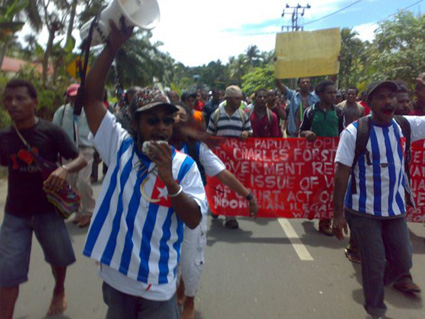
The executive governor of the West Papua National Authority area 2, Markus Yenu, and the chairman of Solidaritas Pemuda Melanesia Papua Barat, Abraham Wainasiri,  lead a peaceful rally at Manokari on January 17. Image: WPM
The executive governor of the West Papua National Authority area 2, Markus Yenu, and the chairman of Solidaritas Pemuda Melanesia Papua Barat, Abraham Wainasiri, lead a peaceful rally at Manokwari on January 17. Image: WPM

Yenu has not yet been released, and no further information has yet been received about his status – whether he will be charged or released.

West Papua Media has contacted police in Manokwari without reply and the Papua Police Criminal Investigation chief in Jayapura – who claims to know nothing about Yenu’s whereabouts.

On January 17, a crowd of peaceful protesters calling for a referendum on the future of Indonesian-ruled West Papua assembled at a rally point in Manokwari.

The crowd – including students and workers – moved towards the Banyan Tree at UNIPA Manokwari together with the protest coordinator, Alex Nekemen, and speakers, among them Silas Ayemi, the area secretary of Bintuni WPNA),; Abraham Waynarisy (SH chairman Solidaritas Pemuda Melanesia Papua Barat SPMPB) and the pro-independence group KNPB.

Political speeches were made accompanied by slogans of “Papua Merdeka” (“Free Papua”) along the way.

The crowd marched around the city of Manokwari towards an open field.

In front of the office of the State Attorney of the Republic of Indonesia, Markus Yenu openly questioned bout the detainees after a an incident on December 14 – Melkianus Bleskadit, Rev. Dance Yenu and 5 students from UNIPA Manokwari who have been held by police for almost four months without charge.

Earlier story by West Papua Media


Paniai sweeps intensify misery under Indonesian control as security forces ban music and torture priest

by West Papua Media

March 6, 2013

Local residents in Paniai regency are bracing for more repression in sweep operations by Indonesian security forces after two separate incidents across the Paniai have intensified ongoing crackdowns on West Papuan independence sentiment, torturing a  local priest and even banning the possession of traditional music.

The latest crackdown, imposed in Paniai after guerrillas from Paniai commander Jhon Yogi’s Paniai unit of the West Papua National Liberation Army (TPN-PB) were involved in armed engagements with the Indonesian army (TNI) and Police throughout February .

Reliable human rights sources in Paniai have reported to West Papua Media that an influx of joint TNI and police have “arrived with total war equipment” to bolster sweeps and raids across Paniai against civilians accused of holding pro-independence sentiments.

“In order to confront the TPN PB and on orders from President SBY, a brigade of TNI / Police have arrived with total war equipment. There were drops of TNI/POLRI in Paniai on 3 March 2013. The brigade arrived by 7 ‘Inova’ vehicles via the coast road,” the source told West Papua Media.

Helicopters belonging to illegal gold miners in Degouwo were again being used by Indonesian troops to support the operation, similar to the massive offensive against Paniai people during 2011 and early 2012, according to both human rights and church sources.

“A yellow and white helicopter owned by an illegal business in Degouwo at 13.00 WPB (west Papua time) made two drops of personnel and logistical war equipment. The first drop was to the Enarotali airport in Paniai district, and the second helicopter drop of the brigade forces together with war equipment was at Obano also, in the west of Paniai district,” the human rights source told West Papua Media.

Independent sources are also reporting that Indonesian colonial occupation forces are putting massive pressure on local civilians, with routine violations of civilian’s dignity, and arbitrary strip searches, that have created opportunities for brutality and torture on local people.

The notorious battalion 753 from Nabire has erected scores of “state of emergency tents” every 5-10 kilometres along the main road between Nabire and Paniai, according to witnesses. “TNI are carrying out very strict checking of everything. The TNI from unit 753 are undoing the clothes of every passenger in the area to check them including females. Advocacy and monitoring is requested,” said the human rights worker.

Military Destruction of traditional culture amounting to cultural genocide
Papuan independent media outlet Tabloid Jubi  has reported remarkable accounts of the extraordinary measures Indonesian police commandos from Paniai police headquarters are taking to destroy traditional Papuan culture by banning music.

Father Saul Wanimbo, the Director of the Commission for Justice and Peace (SKP) in Timika diocese, told Tabloid Jubi that during police sweeps, local people are being forced to hand over their mobile phones.  They analyse the memory cards on the mobile phones to find songs in Papuan language, and if the memory card is found to contain either one or many Papuan folk songs, police will smash the memory card with stones, according to Fr Wanimbo.

“The police are sweeping HP (Handphone) memory cards of Enaro society (people) for the last two months,” Wanimbo told Jubi, citing his own experiences and stories directly from Enaro residents from 1-20 Febrruary 2013.  Wanimbo said that Paniai people have been so demoralised that they just accept the oppressive actions of the occupation forces.

Wanimbo said that the actions by Police were killing three values:  “There is destruction of cultural values, murder of the people’s creativity, and character assassination.”

“The situation is conditioned in such a way so that people cannot resist. How can the people fight if the area has a variety of (security force) members lurking there,” Fr Wanimbo told Jubi.  The police acts were morally and legally wrong, police could not arbitrarily violate people’s privacy for no apparent reason, and such actions must be done with a warrant, he said.

“Paniai Police must explain the meaning of this sweeps. Or the Papua Police chief must stop the actions of the Kapolresnya (local police command) men in Enaro. This is serious. We can say it’s the beginning of the genocide, ” he said.

Priest tortured by police who then demand bribe for his release

Meanwhile, again in the Paniai regional centre of Enarotoli, local human rights workers have documented a serious case of torture of a local priest.  According to human rights workers attached to the Kingmi church, at 8.30 in the morning on March 2, Reverend Yunus Gobai (55 years) was arrested, threatened and tortured by local and Brimob commando police at the Enarotali (Kapolresnya) police compound in Paniai district.

According to the report received and confirmed by West Papua Media, as a result of beating Gobai’s nose was bleeding, his upper and lower lips were split and  bleeding, and he sustained abrasions on his hands, swelling on his forehead and cuts on his head, after which he he was put in a cell at the Police Sector command (Polsek) in Enarotali.

Family members went to request his release from the Police station, but the Paniai police demanded a bribe or ransom money to free him, according to the report.  Family members reported they were forced to gather money in order to pay the police, and a Paniai member of the DPRD directly handed over to police one million rupiah (about US$103) at Polsek Paniai.  Reverend Gobai was then released at 1030am local time, and taken straight home to his village by his family, according to the report.

Rev Gobai is the former pastor and head of the council of the community of KINGMI Maranatha Nabire. According to his family, after Rev Gobai became pastor of the community he suffered from (an undefined) mental disturbance together with epilepsy.  Gobai’s family reported that he would regularly be seen “shouting for no reason or running around shouting”.

Reverend Gobai was arrested after exhibiting these symptoms outside the police station in Enarotoli, causing his arrest, but police did not treat the issue as an illness and used unwarranted torture and inhumane treatment on the pastor, according to the report.

(WPM Editor’s Comment: Whilst the KINGMI report uses unclear terminology describing the pastor’s behaviour as “mental illness”, often random outbursts of unintelligible shouting and psychotic visions are perfectly normal and accepted behaviour of Christian pentecostal pastors, Muslim imans, Hindu holy people, and almost all other religious leaders and clerics across human history.  To arrest and torture someone for this behaviour is to ignore the experience of humanity.)

Paniai is no stranger to unrestrained Indonesian security force violence and torture against local people, primarily made up of members of the Mee tribe.  Previous offensives in the  Paniai since December 2011 have displaced tens of thousands of civilians, and burnt down hundreds of villages.  Paniai was the scene of widespread military operations between 1963-1969, 1977-1978, and again in 1981-1982. During this period U.S. supplied Bronco aircraft were used to bomb villages while helicopters strafed Papuans with machine gun fire.

West Papua Media

Thousands flee in fear of heavy civilian casualties as TNI begin Highlands reprisal offensive

Major Reprisals begin with house to house searches, village and church burnings in Tingginambut by Indonesian Security Forces after TPN shoot dead 8 Indonesian special forces soldiers.

from the West Papua Media investigative team*

February 28, 2013

EXCLUSIVE: Special Investigative Report

Local communities around Sinak, Gurage, Mulia and Tingginambut in Puncak Jaya regency have felt the first effects of Indonesian military reprisals, after West Papuan independence guerrillas under General Goliat Tabuni confirmed that they had killed eight Indonesian special forces soldiers and four non-Papuan civilians on February 21 in two separate incidents.

The shootings were carried out after Kopassus officers continued to build military posts on a local sacred burial site, despite being requested not to by both community representatives and emissaries from the West Papua National Liberation Army (Tentara Pembebasan Nasional Papua Barat  – TPN-PB) under Tabuni.  TPN spokespeople have said that the shootings were done “to assert West Papuan sovereignty against Indonesian colonial occupation”, and to assert West Papuan cultural rights to defend their customary practices against ongoing military brutality.

A spokesman for the Goliat Tabuni’s TPN-OPM command, Nikolas Tabuni, told West Papua Media in a statement that the killings were not without cause.

“Prior to the incident TNI had wanted to make a military post in the region of Tingginambut and the TPN OPM had sent a letter to the TNI asking them not to’ go ahead with the military post construction at Tingginambut.   As that is an area of which the land is formally claimed to be owned by the TPN OPM, and as it is also a sacred area under indigenous customary law of the indigenous community of that area. However TNI disregarded the request (in principle) and continued with the construction. As a result TPN OPM carried out the shooting on 21 February,” the statement read.
Nikolas Tabuni also denied statements from the Indonesian President and Police that the shootings were connected with Indonesian election campaigns in Papua.  “This shooting had absolutely nothing to do with the election of the Bupati (Regency leader) for the region of Ilaga in the Regency of Puncak Jaya in the Province of Papua, and had nothing to do with the general election of the Provincial Governor. The shooting was purely concerned with Papuan independence and the activities of the TNI in West Papua.”

Evidence of collective punishment emerges

Despite an effective information blockade imposed by thousands of Indonesian army (TNI) troops and Police, and unchallenged by a compliant Jakarta-based colonial media, detailed reports are beginning to filter through from independent sources in the area of the military offensive, painting a vastly different picture to that reported by Indonesian and international media since the shooting of the Kopassus soldiers.

TNI_puncak_jaya
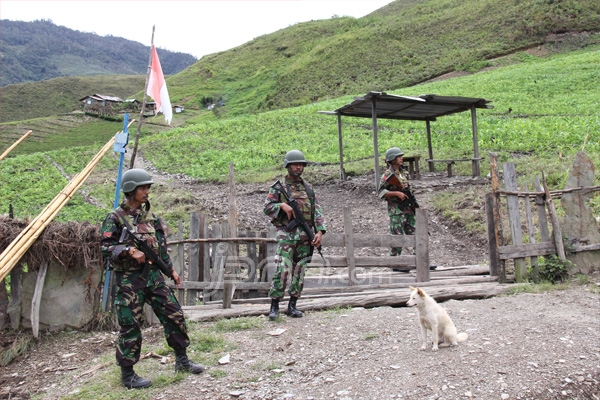
TNI soldiers manning checkpoint near Sinak, Puncak Jaya (Photo: jpnn.com/ malanesia.com)

At least 1000 members of various Indonesian security forces are currently occupying and laying siege to entire communities around Puncak Jaya, with thousands more troops being sent in from other centres in Papua, according to local church, human rights, and  sources in contact with West Papua Media stringers across the conflict area.

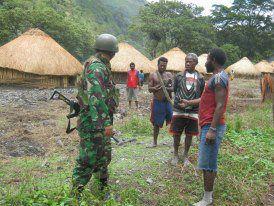
TNI 753 Btn interrogating locals in Sinak (photo: Malanesia.com)

According to these sources, the villages of Tingginambut, Trugi and Nelekom have been occupied by TNI forces since Sunday February 24, with villagers being forced to give all their food and houses to soldiers, and being subject to arbitrary and harsh interrogations.  TPN sources have also stated that troops are using the villages as strategic hamlets to prepare for a hunt and destroy mission to flush out the forces of Tabuni, who have claimed they are well prepared for guerrilla defence.

In Nambut and Gurake (Gurage) villages in Sinak District, security forces began to carry out house to house sweeping operations on February 26, and in villages in  Tingginambut, Puncak Jaya.  According to our sources, the TNI Commander in the area has commanded “that the sweeping operation is to be continued until the culprits from last Thursdays killings are arrested”.  The TNI have stated to local people they “need to see 11 persons sentenced,” according to the reliable source.

Two civilians were said to be arrested on February 27, according to Indonesian military reports, however independent sources could not confirm if any other civilians have been arrested.

As of February 26, at least 18 houses have been burned to the ground, 5 GIDI churches razed, 2 schools and a library have been destroyed by the combined Police/TNI forces in Tingginambut, according to reliable church sources who have safely relayed data from witnesses to West Papua Media stringers.   Witnesses have also reported that soldiers are deliberately burning and destroying food gardens and shooting livestock, including over one hundred pigs.  There are fears of a major humanitarian disaster unfolding with the reports of the destruction of food gardens and livestock, an act of collective punishment on a civilian population.

Thousands of people from the surrounding villages have fled to the high mountains and according to church sources, the entire community populations have fled throughout the area of Gurake, Sinak, Tinggi Neri, Trugi and Nelekom.  Exact numbers are not currently known but local sources indicate that several thousand people, mainly subsistence farmers, live in the area.

Human rights workers have also reported from Mulia in Puncak Jaya that townspeople are greeting news of the offensive with panic and preparing to flee.

Reports are difficult to verify as the only media personnel allowed into the operations area are those with approval from the Indonesian army, and very few of these journalist have actually ventured into the area.  Stringers for West Papua Media in Puncak Jaya and the Baliem Valley have reported that independent journalists and human rights workers have been prevented from travelling into the area by a de facto Military Operations Area being applied across the entire highlands, including the regional centre of Wamena.

Civilians are staying off the streets as reliable local sources report a massive combat army and police show of force, including house to house searches.  On the morning of February 28, witnesses have reported to West Papua Media stringers that 8 Brimob trucks have left

Troops patrolling Wamena - February 25 (photo: supplied)
Troops patrolling Wamena – February 25 (photo: supplied)

Wamena heading to Puncak Jaya this morning, with large numbers of troops patrolling the streets across Wamena also..

Thousands more troops flooding in to attempt to destroy Tabuni’s TPN.

Thousands of heavily armed combat soldiers from Battalions 751 (Jayapura), 753 (Nabire) , and supported by the Wamena 756 Batallion, are reportedly being flown into Tingginambut over the next few days from several centres across Papua.  They are joining together with over 1000 extra Brimob paramilitary police (in addition to the at least 1000 Polda Papua police already in the highlands), and allegedly several units of the notorious Australian-funded Detachment 88 anti-terror commando, to hunt for Tabuni’s forces.  Several media reports in Indonesia are also claiming a Kostrad (Strategic Reserve) battalion is being deployed from outside Papua, though this has not been independently confirmed.

Local sources have reported that each TNI platoon is accompanied by a platoon of police, as the operation is officially under control of the Police as a “law enforcement” operation.  However, the witnesses have reported that the TNI are clearly in command.   TNI spokespeople in Jakarta have told Indonesian media outlets that there is no plan to increase non-organic troop presence in the area, but local sources are reporting a vastly different story.

West Papua Media sources in Wamena observing the airport have confirmed that two TNI Puma Helicopters are involved in the operation constantly ferrying troops between Wamena and Tingginambut, and stopping only for refuelling and crew changes.  Three Hercules c130H aircraft have each made 3 drops to Wamena then the troops have entered by road from Wamena.   Observers in Nabire have also noted daily departures of three trucks of troops from the notorious Battalion 753 Nabire, to the west of the highlands to reinforce the offensive in Tingginambut.

Human rights and church sources in Puncak Jaya and internationally have expressed deep concern about the potential for heavy civilian casualties to occur with the intensified military campaign, given extra impetus after the Indonesian President, General Susilo Bambang Yudoyhono, called for firm action on Tabuni.

Multiple narratives from Jakarta

The exact circumstances of the deaths of the eight Kopassus special forces soldiers are now mired in claim and counter-claim, with soldiers’ personal accounts of the attack conflicting with the official narrative picked up by Jakarta media.  What is confirmed is that the eight commandos – Sertu (Chief Sergeant) Udine, Sertu Frans, Sertu Romadhon, Pratu (Private 1st class) Mustofa, Sertu Edy, Praka (Chief Private) Jojon, Praka Wempi and Sertu Mudin – were killed by a cascading attack led by guerrillas of Goliat Tabuni’s TPN group as they went to the Sinak airstrip to collect cellular monitoring equipment designed to track international phone communications in the area.

However, one survivor of the attack testified in the Jakarta Post that his group was attacked by men, women and children all carrying spears, machetes and knives.  According to the TNI survivors as relayed to JP, the platoon of Kopassus was unarmed at the time of the attack, which happened as the soldiers were installing and moving communications monitoring equipment.

Troops in Tingginambut after being shot at in helicopter by TPN, Feb 24 (Photo: TNI)
Troops in Tingginambut after being shot at in helicopter by TPN, Feb 21 (Photo: TNI)

TPN forces also opened fire on a Puma helicopter that was evacuating the wounded commandos, lightly injuring three helicopter crew.

West Papua Media sources have provided a highly credible and technical but unconfirmed report that two “very large weapons” that were being moved into Sinak, and went missing during the raid by TPN.  According to our sources, there is “extreme concern from the TNI around this particular issue.”

“Apparently they have been trying to find out the whereabouts of these weapons, which suggests they might be too heavy to quickly and easily move,” explained the source.  Further investigation is still required, but credible observers in the area believe that these heavy weapons may be artillery pieces – the presence of which in Puncak Jaya represents a serious and dangerous escalation of TNI hardware to be used against civilians.  West Papua Media believes any confirmed presence of artillery is connected with the TNI’s stated aim to destroy Goliat Tabuni’s group, but any use of these weapons will place a large number of civilians at risk.  It is not the first time the TNI have used artillery against West Papuan civilians: the Bloody Wamena massacres of 2000 and 2003, as well as the aerial bombardment campaigns in the 1977 and 1984.

Indonesian outrage fuels civil society questions on Papuan motivations for resistance

The killings of the soldiers have generated outrage in Jakarta, with nationalist politicians calling for cordon and destroy missions in what human rights observers have said amount to collective civilian punishment by an occupying force.

Sjafrie Sjamsoeddin – indicted as a war criminal

Indonesian Deputy Defence Minister Lieutenant-General (LG) (Rtd) Sjafrie Sjamsoeddin – indicted as a war criminal by the UN for his role in East Timor – on Friday ordered the TNI to conduct heavy “tactical actions” in order to prevent the shooting from occurring again.  “The tactical action includes to chase, apprehend and destroy,” the deputy minister said here on Friday.  He said the latest shootings by the separatist rebels did not affect TNI`s strategic policies in Papua. TNI so far did not have a plan to send more troops to Papua, he added.

However SBY also claimed in an interview with MetroTV that “no violence” would be used to solve the situation.  The situation on the ground has illustrated that security forces have no interest in making SBY’s words truthful.

Despite  the nationalist rhetoric, there are many in Indonesia who are seeing this as a wake up call to end Jakarta’s use of state violence against civilians in Papua as it default policy.

The Indonesian Regional Representatives Council, or DPD, called for a necessary cessation of military operations to end the prolonged violence in Indonesia’s easternmost provinces, according to a report in the Jakarta Post on Wednesday.

The presence of the non-organic personnel from TNI special forces cause animosity among Papuan groups, who have launched attacks against them, according to the report.  “If Jakarta wants to end violence, the militaristic approach has to stop, and all non-garrison troops from the military elite forces must be withdrawn from the two provinces because their presence and their irregular operations have triggered attacks on garrison troops and innocent civilians,” DPD deputy chairman Laode Ida said on Tuesday.

A coalition of Papuan human rights groups urged the National Commission on Human Rights (Komnas HAM) to conduct a thorough investigation into the soldiers’ killings, saying the presence of Komnas HAM could prevent human rights violations that occurred during TNI sweep operations after shooting incidents, according to a report in the Jakarta Globe.

“We encourage law enforcers to be professional in carrying out their tasks. They must ensure that their attempts to find the perpetrators do not turn into seeking revenge against all Papuans,” Ferry Marisan from the Institute for Policy Research and Advocacy (Elsam) said in Jayapura on Monday.

The TNI has loudly complained in Indonesian media of hurt feelings about the loss of its soldiers, with the National Human Rights Commission (Komnas HAM) leaders have been forced to apologise for “insensitive” remarks saying killing soldiers is not a human rights abuse.   But not all observers are showing sympathy for the loss of the soldiers lives, pointing to the fact that the military are occupying Papuan land against the wishes of the local people.

“One has to remember that soldiers who were shot were Kopassus special forces who have been involved in ongoing human rights abuses right across Puncak Jaya, including village burnings, collective arrests and punishment, burning of villages, and acts of torture.  Many observers suspect these soldiers were part of units involved in conducting many OTK (Unknown persons) shootings blamed on West Papuans,” a long time human rights worker in the highlands told West Papua Media by email.  “These are not innocence, nor babes in the woods; Kopassus are the original wolves in the forest.”

Still, other observers believe the actions point to an assertion of tribal identity, as a complex motivator behind the declaration of Papuan sovereignty inherent in the armed resistance against Indonesia’s militarist policy in the highlands.  An Australian church worker who worked for many years with highland communities in Puncak Jaya made the observation to West Papua Media that this was not simply an act of resistance to Indonesian colonisation, but an assertion of traditional and indigenous Papuan law and cultural survival against the onslaught of an occupying colonial army.

“This must be looked at from another perspective that is relevant.  As many indigenous communities including Australian Aboriginal Peoples and traditional highland Papuan people, observe around the world, if outsiders came into their sacred lands, they would also feel compelled at whatever cost to themselves to spear the outsider to compensate (violations of) their traditional law if they belonged to the clan that was legally responsible (under customary law) to guard that site,”  she explained.

“Indigenous Law is simply not negotiable on things like that. Things have only changed in Australia because non-Indigenous systems have for years now in Australia been locking up those indigenous peoples who have acted to maintain their law,” the former church worker explained.

“As I understand the TNI despite warnings were acting in a way that broke the Papuans’ traditional laws regarding adat (Customary law), and as the TPN are still holding strong to their traditional laws, so they acted in accordance with the laws they are living by. I can’t see any difference at that level as Melanesian peoples separated historically but only a short distance of water. The difference is that the TPN OPM represent groups that have not yet been overcome by the laws of a colonising power whereas RI does not recognise the traditional Papuan customary laws,” she said

A prominent Papuan human rights activist, Yasons Sambon, has reported that the killings are causing many military families to reconsider  their support for the Indonesian colonial occupation of Papua.  In an interview with the wife of one of the eight soldiers killed at Sinak, recorded on February 23 after the soldiers funeral in a car by the old market in Sentani, the widow called for Indonesia to abandon its occupation of Papua.

Funeral of Sentani based Kopassus officer killed in SInak incident, Feb 24. (supplied)

The wife of an Indonesian soldier from Sentani said in a regretful tone, “SBY would be better off giving independence to the people of Papua if it meant our husbands wouldn’t become victims. Our husbands have been murdered. What will be my fate, and the fate of my children, now that my husband has been murdered? We want to hold onto our husbands but they also have a duty to the country. They are murdered and it’s the women and children who become victims, because if they aren’t at work, then what will we eat?”

“It’s better if independence is given to the people of Papua so that we can be safe,” she said.

*from the West Papua Media Editorial team, with additional reporting from stringers in Wamena, Tingginambut, Jayapura, Nabire and sources in Jakarta.

Oksibil community challenge police in provincial election boycott: allow our free expression or let us fill your prison

January 20, 2013
West Papua Media
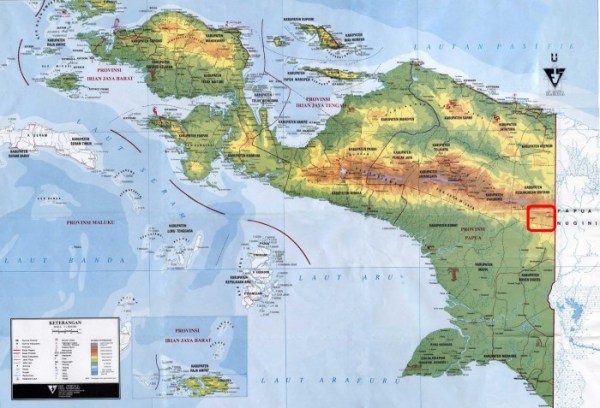
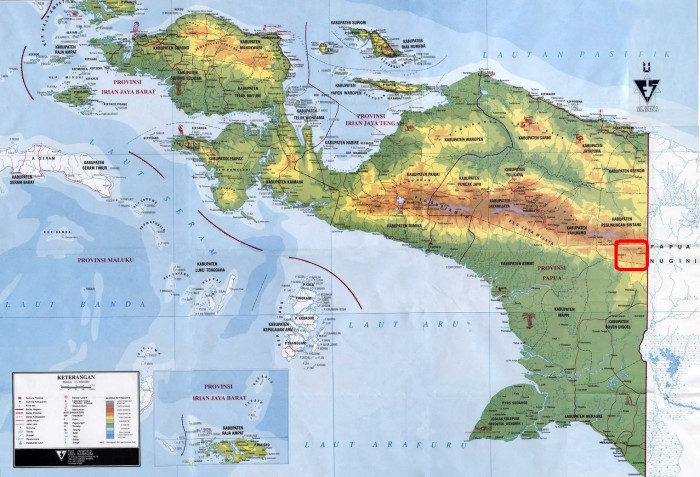
Oksibil, Papua (in red square)
Oksibil, Star Mountains, Papua (in red square)
A  January 19 demonstration of over 500 people asserting Papuan rights to freedom of expression defied a police ban on gatherings in the remote town of Oksibil, in the Pegunungan Bintang (Star Mountains) Regency, close to the Papua New Guinea border.  Challenging police to arrest over 500 people, the protest also announced a boycott of provincial gubernatorial elections being held in the regency until January 29.
Credible local sources reported to West Papua Media that local Papuan people had been frustrated with ongoing restrictions on independent Papuan political expression, and were asserting their human rights to free expression despite the risk of arrest.
“(We are here) to express the community’s opinion through a statement from the indigenous community of Papua, in regards to the matter of the blocking of the planned visit by the U.N Special Rapporteur on the Promotion and Protection of the Right of Freedom of Expression and Opinion, Mr Frank La Rue, to Indonesia from 14-26 January 2012 which relates to the the decisions of the Human Rights Committee 107 and 108 at the U.N Session in Geneva,” a spokesperson for the local rights group West Papuan Interest Association told West Papua Media via email.
The sources also reported that the gathering was angered by the Regency police chief’s ban on public free expression, and so withdrew their consent and participation to the notoriously corrupt and divisive Indonesian imposed provincial gubernatorial election process.

The WPIA spokesperson told West Papua Media on Saturday afternoon via SMS that a large (but unspecified number) of police were physically blocking the demonstration from occurring, despite the rights to Freedom of Expression being guaranteed in both Indonesian law and also Special Autonomy legislation.

“The WPIA had sent a letter to the Head of Police in Pegunungan Bintang regarding the matter of the above peaceful gathering and advising them it would be carried out at Oksing-sing (in Pegunungan Bintang) on 23 January 2013, and that the group would remain in one location, nor would not disturb the proper order of public affairs or public activities, and would not be breaking any rules,” said the WPIA spokesperson.
“However the Head of Police in Pegunungan Bintang gave a letter in response saying they would not authorise the gathering,” said the spokesperson.
According to witnesses though, the gathered people were determined to go ahead with the planned action.   Speakers said that if the action was prevented from occurring, the entire crowd of over 500 people would go immediately with the WPIA Organiser to the Pegunungan Bintang Police Headquarters.
“They would demand that the Police detain every one of them in the prison until 29 January 2013 after the general Election for the Provincial Governor, and then release them after that,” the WPIA spokesperson told West Papua Media.
Police reportedly backed down after this, though West Papua Media has not as yet been able to independently verify this.
Oksibil historically only has sporadic public events of political free expression, and remote area expressions of political dissent have usually been met with brutality.  For the police to not forcefully disperse a gathering is exceptionally uncommon.
The demonstration self-dispersed without reported incident, and no reports have been received as yet about any reprisal actions from police.
West Papua Media

Create a website or blog at WordPress.com

Up ↑