The following information has been received from a reliable source in Papua:This is to inform everyone who struggles consistently about the problem of human rights in the Land of Papua that one of the Papuan political prisoners, Kanius Murib, died on 10 December. He died at his family home in Hokilik Village, district of Wamena, Papua.
He had been suffering from 2010 up until December 2011. The prison authorities reached an agreement with his family that, in accordance with the family’s wishes, he would be able to stay with the family so as to ensure that he died surrounded by his family because of his physical condition as well as the fact that he had become mentally unstable.
1. Kanius Murib was serving a sentence of twenty years.
2. The government paid little attention to his state of health and just allowed his condition to linger on.
3. None of his children have been able to go to school.
The way he was treated is extremely unjust. This is the way all Papuans are being treated. The Indonesian government has ignored the recommendations made during the Universal Period Review, while the Co-ordinator Minister for Politics and Human Rights said while on a visit to Papua in 2012 that there are no political prisoners in Papua.
11 December 2012
———————————————————————
INDONESIA: A Papuan was tortured on the unreasonable allegation of engagement with separatist group
ISSUES: Arbitrary arrest and detention; inhuman and degrading treatment; police violence; torture
———————————————————————
Dear friends,
*The Asian Human Rights Commission (AHRC) wishes to inform you of the case regarding the torture of a Papuan in Mimika, Papua. The victim was arrested by officers from the Mimika Sub-District Police wearing civilian clothes without any warrant. The police randomly accused him for being involved in the separatist movement organised by Free Papua Organisation (Organisasi Papua Merdeka, OPM). As result of the torture, the victim was severely injured and could not walk for four days.
CASE NARRATIVE:
According to the information from the Justice, Peace and Integrity of Creation of the Evangelical Christian Church in Papua (JPIC GKI), Frengki Uamang was visiting a church and about to buy mineral water from a local shop on 27 November 2012 when a silver-painted car approached him at 11am. Two unidentified men wearing civilian clothes came out the car and arrested Frengki. One of the men told him that he was a police officer.
Frengki was taken in the car to a place located about 20 metres away from the church and asked for the reason of his visit to the church. Frengki explained that he was attending a religious event at the church but the police instantly told him ‘don’t lie to us. You want to buy weapons, so don’t lie to us!’
The police later took Frengki to Kwamki Baru Sub-District Police at 11.45 where he was interrogated and accused of committing various actions, one of which was providing food for the military members of OPM. During the interrogation, the police tortured Frengki for approximately four hours. Frengki was kicked by police officers wearing boots and he had his head, ears, face and chin kicked and beaten. The police also hit Frengki on his chest, legs and tights which resulted in him not being able to walk for four days.
At 3.30pm on the same day, the police took Frengki out of the police station and drove him to Irrigation Street in Mimika. In addition to the car that was taking him, another car full of police officers was also following. In total there were about 10-12 police officers came to Irrigation Street with Frengki. The police asked Frengki to show them two houses where OPM’s military members were allegedly hiding in. Frengki told the police officers that he himself is only a visitor to Mimika and he has no idea of what houses they were talking about, yet the police insisted on taking him to Irrigation Street.
On their way to the Irrigation Street, the police again tortured Frengki. The police officers pulled his fingernails using pliers. As they arrived at the Irrigation Street, the police took Frengki to a plantation area. Frengki was asked to slither on his stomach while his hands were handcuffed. Three police officers pointed their guns at Frengki and asked him to pray. One of them told Frengki, ‘you killed my fellow police officers. You are a member of OPM’s military. You’re obviously from Kali Kopi’. Kali Kopi is one of the headquarters of OPM’s military.
As the three officers were pointing their guns at Frengki and he himself was praying, the rest police officers coming with Frengki randomly opened fire towards the trees, creating the impression that they were in crossfire against the OPM’s military members. Out of nowhere, one of the police officers took Frengki to Mimika Sub-District Police. Frengki was again interrogated, yet this time the police asked him of his link to the shooting that took place in the area owned by PT Freeport, an American gold mine company. Frengki was detained at the police station for one night, his hands and legs were chained to a table in the police’s cell.
The next day at around 2pm, Frengki was released by the police. He was not able to walk so a police officer took him to Immigration Street where Frengki was staying.
ADDITIONAL INFORMATION:
As of today, torture is yet to be criminalised in Indonesia and the legal proceeding on such abuse is far from independent. Due to the absence of law criminalising torture, state officials who committed it are usually charged with provisions concerning physical assault which is not in accordance with the definition of ‘torture’ stipulated in the UN Convention against Torture and Other Cruel, Inhuman or Degrading Treatment or Punishment (UN CAT). As the physical assault article under the Penal Code only carries a maximum punishment of two years and eight months imprisonment, those who committed torture are sent to light punishment, if they were punished at all.
In addition to the absence of law criminalising torture, the unavailability of independent legal mechanism to investigate torture allegation has aggravated the problem. For a criminal proceeding on torture allegation to take place, the victims need to submit a criminal complaint to the police whereas it’s actually the police themselves or their colleague who committed the abuse. As a result, most of torture complaints are not followed up and criminally investigated by the police. Torture victims may also submit a complaint to the monitoring mechanism within the police called the Professionalism and Security Division (Propam). Yet this mechanism is not transparent and only has the power to impose disciplinary punishment to police officers practising torture.
Report of Human Rights Investigation by Monitoring Team from LP3PH (Institute for Research and Development of Legal Aid), Manokwari, as assembled from various local sources and members of the victim’s family.
December 6, 2012
Wednesday 5 December 2012, the weather was overcast without rain, seeming to restrain the usual busy activities of the local population, government and private company staff, white and blue collar workers, market traders, farmers, fishers, schoolkids and students, plus the security forces: army, police and intelligence.
From early morning the atmosphere was tense: from about 07.00 to 09.oo [Papua time] groups of local people could be seen moving to blockade various major road intersections in Manokwari Town. Primary official routes like Jl. Yos Sudarso, [near Sanggeng in front of the Bank Mandiri, Bank BRI and Bank Papua complex] as far as the three-way intersection on Jl. Merdeka & Jl. Gunung Salju [Makelew Fanindi complex] were blocked by mobs using wood, old tyres set on fire, tables, and tree branches, all thrown on the road. Various intersections of roads heading out to the residential areas of Fanindi beach [beside the Swissbel Hotel], Arkuki [beside the Bahagia store], Sanggeng market, and Jl. Serayu Sanggeng were blockaded by a populace brewing with anger.
While the atmosphere in Manokwari has been tense there has never been any trouble between groups in civil society or between the local community and the security forces. Several witnesses said that ‘people are very emotional, they are making these protests because of the shooting of Timo Ap’. The police secretively shot and killed Timo Ap, and then took his body to his house in Wirsi, Manokwari.
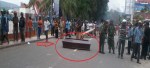
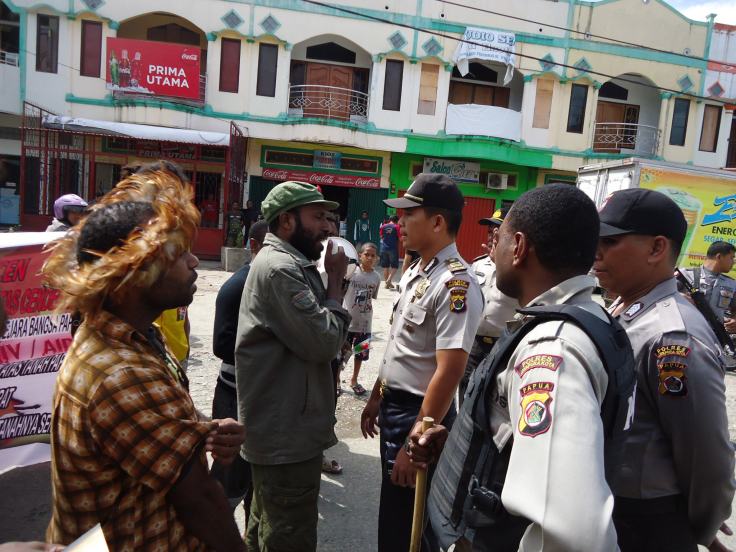
Demainus Waney [red circle] in the hands of authorities after demanding the crowd to break up using a loudhailer
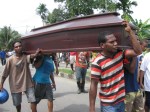
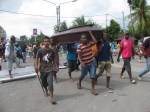
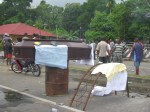
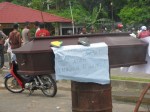
Timo AP’s coffin is returned to the people by the Police
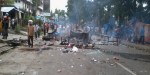
The atmosphere at Jl. Siliwang in front of the West Papuan Governor’s office: many street traders’ sites have been smashed and burned.
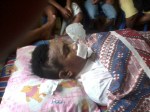
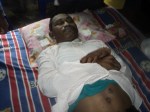
The victim Timo Ap has been bandaged around the chin after death [rigor mortis]
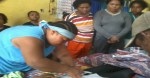
Mrs Nelestin, the victim’s aunt, opens the victim’s clothing to show his wound.(LP3PH)
Several news sources in Manokwari reported that the victim had been shot in the head, however it is clear there is no injury to his head.
A wound has been stitched in the stomach where the victim was shot
All Photos: LP3PH/West Papua Media
Chronology
A chronology of events has been put together as follows, from various civilian sources including the family of the victim Timotius Ap:
1) More than 3 days ago the victim Timotius Ap, grandson of the late Timotius Ap, [former area head of Wirsi complex in West Manokwari], returned from Java to Manokwari: in Java he had been staying with family and working as a Marine;
2) Timo Ap returned home to Manokwari with his wife Iwanggin;
3) Timo was rarely present at the Wirsi house, he was mostly elsewhere due to being on the DPO [Wanted List], related to various cases that the Police accused him of;
4) On Tuesday, 4 December 2012, as morning was turning to midday, Timo Ap was hanging out with his friends at Wirsi and wanting to eat areca nuts [?] but after eating them, his friends cannot account for his whereabouts;
5) By the evening of 4 December, at around 09.00 Papuan time [21.00?] Timo was received and treated at the Dr Azhari Hospital [Navy Hospital] Manokwari;
6) Around 10.00 [22.00?] Papuan time on 4 December, a friend of the family brought a message to Timo’s aunt Nelestin Ap, to ‘please come to the hospital to see Timo, whether he is still alive or already dead’. So then Timo’s aunt and other relatives hurried to the Navy Hospital but on the way they passed police and medical vehicles taking Timo’s corpse home to his grandmother’s house at Jl. Simponi Rindu, Wirsi, West Manokwari;
7) On arriving at the house, there was only the victim’s grandmother, in her 70’s, living alone. She had no idea that her grandson’s body was being brought to her house. ‘The employees bringing in the corpse said nothing at all to the grandmother’, and then those employees just left the coffin there and went off;
8) After several minutes the aunt and several of the victim’s loved ones arrived, or came back from the hospital and cried hysterically upon seeing the body wearing only underpants and a clean T-shirt that he had been dressed in. His friends said that he had no other clothes apart from the clean T-shirt and underpants he had been dressed in. At the hospital he had been wrapped up in bandages around his chin and neck as though he were injured, but there appeared to be no injury to his neck, chin or head in general. His only wound was discovered to be on his stomach near the centre, where a surgical incision to remove the projectile [bullet] had been stitched up.
9) By 11.30 the news had started to spread widely, that the victim Timo Ap had been shot dead by Police, and the local community began arriving to pay their respects and condolences.
10) In the morning at about 06.00 [Papua time] various family members began blockading the route into Wirsi [Jl. Simponi Rindu]. Blockades then spread to various road junctions in Manokwari, while the local daily paper MEDIA PAPUA released in its Headline news that Timo Ap had been shot dead by the OPNAL [Professional Operations Team] of Polsek [Police sector] Manokwari town at Maripi beach, South Manokwari district at about 16.00 Papua time. This was due to his opposing the officers with an improvised pistol; he was killed with a shot to the head;
11) From around 07.00 to 09.00, Papua time, the community closed off the main roads of Mankwari such as Jl. Yos Sudarso, Jl. Merdeka, the route to Sanggeng settlement, Jl. Siliwangi, Jl. Soedjarwo Condronegoro [?], Jl. Gunung Salju [heading to Ambun];
12) At the same time, activities in Manokwari came to a complete standstill. The business centre, Hadi department store, Orchid Swalayan, the market, stalls and shops were closed en masse by their owners. Offices also shut their doors – the Manokwari Regency Government office of West Papua province, schools, banks: from early this morning until mid-morning as this report is written;
13) At 10.00 Papua time, large groups began violent action, smashing shops along the length of Jl. Yos Sudarso and Jl. Merdeka as far as Jl. Siliwangi. Tens of buildings along the road suffered quite serious damage, and many cars and motorbikes were wrecked by the mob;
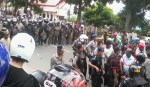
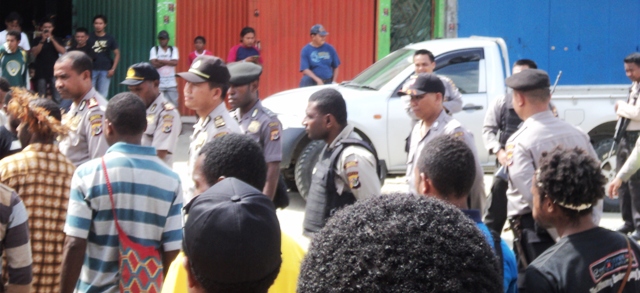
14) Around 12.00, as the mob moved towards the town centre right in front of the West Papuan governor’s office, patrols of Brimob [mobile brigade], Dalmas Polres [area police] backed up with Indonesian Army forces were seen closing off the intersection that the crowd wanted to pass;
15) A local man, Demianus Waney held a megaphone in front of the security forces, asking the crowd to disperse and go home…. ‘I say go home’… said Demianus Waney….. but hearing those words, the crowd became more worked up. In the process of their demonstrations against Demianus Waney, a number of buildings, restaurants owned by transmigrants around the harbour and PT Pelni [national shipping line] became targets of their anger;
16) The police, Brimob and TNI [Indonesian army] started to rush forward but were stopped by an attempt at negotiation by a priest, who said he had been the victim’s priest [i.e. Timo Ap who had been shot and killed]. However at the same time Demianus Waney said that every avenue had been tried already, inviting the armed forces to action;
17) The security forces then moved forward to break up the crowd. The police, Brimob and soldiers using trucks, paddy-wagons and Barracuda vehicles moved rapidly to take over the main road that had been controlled by the mob;
18) Around 13.00, Papua time, the situation had become calm and back to normal.
Police Captain Kiki Kurnia: “We’re Ready To Clash.”
“Victor, we are ready to wreak havoc and clash with all of you.”
Those are the words spat out by police captain Kiki Kurnia, who yesterday (December 1) led hundreds of fully-armed police officers to put a stop to the Long March of students and the people. I was very sad to hear these words so righteously issued by the police, who present themselves as being on the side of safety. Do the police want safety, or do they not?
When I was the leader of the Long March headed for Expo Waena on December 1 in Sentani, police backed by the Indonesian military had already closed off access to the people of West Papua who would pray. Since the late afternoon (30/11), Theys H. Eluay field, which is the field of (great significance and sacredness to) the West Papuan national struggle, had been controlled by the military and by the national police, although all the civil society organizations had long since said that their prayers and celebrations would take place there.
On November 19, police entered a prayer room in Aula STAKIN in Sentani and tried to stop me as I was giving a reception after prayers, and then yesterday on December 1 the people wanted to worship and eat at the Theys H. Eluay field but were prohibited, blockaded and arrested by the full force of the military. The question is, why did the military and the police force deliberately take control of the field and then shamelessly hold a traditional stone cooking event (a Indonesian-appropriated Papuan Custom) with a handful of residents who were offered money?
If the police are tasked with security, why exactly is that security so insecure when facing inhabitants who are conducting prayers peacefully? Is the Theys H. Eluay field, owned by the traditional people of West Papua, only permitted for use by the Indonesian military and the police force? If the law is just, why wasn’t police captain Kiki Kurnia charged with incitement to violence? As he himself clearly (attempted) incited the mass action I led to commit violence on the streets in front of Dian Harapan Hospital yesterday.
If the police prohibit students from campaigning to put a stop to AIDS on West Papua’s Independence Day, why must it be prohibited? Do the police not want HIV/AIDS awareness campaigns to take place? Isn’t his proof that the police are ensuring and championing ethnic cleansing in West Papua? Why do the police prevent worship on West Papua’s Independence Day? Why do the police see more political and economic motivations than the goodwill and intentions of the people who want to interpret December 1, 2012 as World AIDS Day, the opening of Christmas festivities and the Independence Day of West Papua?
I lead my people safely and with restraint. I have personally guaranteed that I will be arrested or shot if there is a criminal act committed by people, but why in the safe Long March were we forcibly dispersed and captured like animals? Actually, who was it that committed the crime? Was it the people, or the police?
The police did not only incite the violence that happened, but yesterday (1/12) the police, through (Adjunct Senior Commissioner) Alfred Papare, publicly lied. Myself and the masses did not throw rocks at the police, however it was covered by several media sources that the police chief said we did so. In an era of openness such as this, why is there a need for mutual deceit when everybody saw yesterday that the police had no reason to blockade, arrest and attack people with tear gas? After I “escaped” from Abepura Sub-District Command, I had not received a call from the Jayapura Chief of Police, the aforementioned Alfred Papare, as stated by Wakapolda Papua, Paulus Waterpau, to Tabloid Jubi.
Better for the Police to become the Social Services
The idea of Papua’s Chief of Police, Tito Karnavian, to give out groceries and distribute help the mountain people of Papua in Jayapura and the Jayapura municipality makes me wonder a little. Has the police chief already switched functions from a chief of police who must preserve security, only to become the head of the Department of Social Services who must give social support to the people? Is this country unhealthy? Money for providing support to the people is redirected into the Police Department and the Police Department takes over the functions of the Department of Social Services.
For me, the efforts of the police department to muffle and destroy the basis of the Papua Independence conflict are obviously speculative, as well as inappropriate. Go ahead, if the police department and the Republic of Indonesia believe that our ideology can be bought off with money. Tens to hundreds of millions have been redirected to the Asrama Rusnawa Uncen, since becoming the basis for conflict, and the police are very hopeful that students will regard them as righteous people, as kind people. Well, again, it is better that the Police Institution in Jayapura be renamed as the Department of Social Security or the Department of Education, so that matters concerning the improvement of the Asrama Rusnawa Uncen and student welfare can just be taken over by the police.
Does Indonesia believe that money can silence the aspiration and ideology of independence for the people of West Papua? I am convinced the people of Papua that are given money and material aid from the police are only making use of them, because within the individual West Papuan person there is a flesh-and-blood desire for Papuan Independence, however difficult it is. So, go ahead, half-dead police and a waste of money to the people of Papua. Go ahead and pan the sympathy and dreams of the people who have hated the occupation of this land. Almost half a century practicing the policies of the Republic of Indonesia, and all models of development cannot turn the people of West Papua into people of Indonesia. Papua will rise and awaken by itself alone.
Idea of Separatists and Terrorists is a project of the TNI and Police
There are no separatists and terrorists in West Papua; only those who demand the right to self-determination as legally protected under international law. The idea of separatists and terrorists is created by the state to disgrace the legal struggle of the West Papuan people, and created by the Indonesian military and the police with a view to expanding their territory, and their wealth. For the sake of money alone, the circumvention of the state apparatus and the deception of the state apparatus, alias “bullshitting a lot” (direct translation).
My organization, the National Committee of West Papua (KNPB), struggles in peace and does not want to create chaos that will strengthen the funds of the military and the police force. Consequently, the national police force does not like peaceful action, because in a situation that is safe and peaceful, the military and the police force will be poverty-stricken. Many security institutions in Indonesia have hundreds of troops that must be paid by the state. Moreover in Papua, there are now many civilian militias formed by the state; thousands have been recruited, and must be paid. All are created with the objective of “stripping bare” the security responsibility from the Indonesian government in West Papua that fall under the name of “eradicating separatists and terrorists.”
Forgive me; my group and I will not accept food from the military or the police, so there is no need to criminalise or drop that bomb on the National Committee of West Papua to stigmatise us, so that the project money can be maintained. These ways have become commonplace, and we are bored of them. The people are smart, and getting smarter: they have already been taught these ruses by the colonialists. Ways such as this will finally tarnish the image of the Republic of Indonesia in West Papua. So it is best not to try to painstakingly search for such an image. Oh, and yesterday in Guyana, Member of Parliament told Benny Wenda: “Oppression alone will burn the spirit of the independence struggle.”
Why not kill me, or imprison me? Why was I released? Oh, it is certainly not because I cheated. I will see this for what it truly is. There are demonstrations in the streets. Now that I have planted the seeds of resistance here and the invaders sow these seeds with their own actions. I must thank the colonialists for continuously teaching us to aspire to true humanity by means of rebellion.
Victor Yeimo wrote this article immediately upon his release from police custody on Monday December 3.
Translated by West Papua Media volunteer translators
By West Papua Media, with Victor Mambor at TabloidJubi.com, and Julian Howay at SuaraPapua.com
December 2, 2012
UPDATED DECEMBER 3, 2012
Three leaders of the West Papua National Committee (KNPB) who were detained at a West Papuan independence rally on December 1 have been allegedly disappeared by Indonesian security forces, prompting fears of ill treatment at the hands of police.
As reported earlier by Tabloid Jubi and West Papua Media, Victor Yeimo, Alius Asso and Usman Yogobi were arrested by Police while leading a long march enroute to a planned mass rally commemorating the West Papuan “Day of Independence” of December 1st at the tomb of Theys Eluay. All three were arrested for allegedly being responsible for these demonstrations, according to Police who spoke with Jubi.
Victor Yeimo, Chairman of KNPB, negotiating with Kalpores Alfred Papare moments before his arrest, December 1, 2012, Abepura (Photo: WK, KNPB)Indonesian police prevent KNPB demo; arrests of Victor Yeimo (Photos: West Papua Media stringers)
This slideshow requires JavaScript.
KNPB members and human rights lawyers are currently trying to confirm his whereabouts and legal status, however Indonesian police have claimed to West Papua Media that all detainees being held at the Police headquarters. Legal access has not been allowed at time of writing and human rights observers hold grave fears for the safety of the detainees.
Victor Yeimo, KNPB Chairman, has been on a wanted list (Daftar Pencarian Orang or DPO) and has up to now evaded a massive Papua-wide manhunt by the Australian trained Detachment 88 counter-terror unit, allegedly on treason charges imposed after his appearance on the Australian ABC 7.30 Report where he presented evidence of the Densus 88 assassination of his predecessor Mako Tabuni.
However, after the arrests, the whereabouts of Victor Yeimo, Alius Asso and Usman Yogobi remain unknown until time of writing, with no indications if they still being detained or have been released by police.
“Yes. There are journalists who say that Victor (Yeimo) was released earlier. But we do not know where he is. KNPB members are still trying to find him. Their mobile phone (three KNPB’s members were arrested) was (switched) off.” Sebby Sambom, a Human Rights Activist, told tabloidjubi.com on Saturday afternoon (1/12).
Some human rights lawyers who commonly accompany Papuan activists also still looking for them (Victor Yeimo, Alius Asso and Usman Yogobi). Because when they checked into the both of Police Office (Polda and Polresta), human rights lawyers was told by police that no one was arrested after rally this morning.
“We had been to the police office, Polda and Polresta, but they (Victor Yeimo, Alius Asso and Usman Yogobi) were not there. Police said no one was arrested there (Police and Police),” said Olga Hamadi, a Papuan human rights lawyer.
Papua Police Head of Public Relations, Chief I Gede Sumerta Jaya confirmed to tabloidjubi.com, mention that the three activists will be released after the investigation at the Police Sector office of Abepura.
“After being interrogated in Abepura police station, according to the police chief, three of them will be released as they could not to do any further investigation.” said I Gede Jaya Sumerta.
However, West Papua Media twice contacted the Police Sector (Polsek) headquarters in Abepura this (Sunday) morning, where an officer named Mas Arbi claimed that Yeimo and the other prisoners were still in custody. Officers immediately volunteered further information on the second phone call that “none of the prisoners have been tortured,” despite West Papua Media having not yet asked that question. WPM has not been able to independently verify the claims of police, as legal representation is still barred from seeing Yeimo.
Massive security presence
The December 1 commemorations in Jayapura were amongst national mobilisations in most centres across Papua, and solidarity gatherings internationally.
Reports from Abepura early in the morning described a massive security presence to prevent West Papua people from engaging in peaceful acts of free expression, and from engaging in flagraisings of the Morning Star flag, the Indonesia-banned West Papuan independence flag.
Unknown persons had blockaded the entrance to the Cenderawasih University (UNCEN) by welding iron crossbars and erecting a 2 metre high steel fence around the university in anticipation of events.
From 7.30 on Saturday morning, students and activists with KNPB leaders (including Yeimo) gathered in small numbers by the site of former KNPB head Mako Tabuni’s murder, in front of the Perunmans 3 Housing Complex in Waena, where many highland students are domiciled.
Intelligence officers and plain-clothed Densus 88 personnel posing as ojek (motorcycle taxi drivers) become more aggressive towards participants converging prior to the long march, according to West Papua Media stringers and SuaraPapua.com.
At 0845 three platoons of heavily armed Dalmas riot police arrived on site, followed by Jayapura police chief Adjunct Senior Commissioner Alfred Papare and his men. Papare began negotiations with Yeimo on the route and plan of action for the day, which was to make speeches and a prayer service at the tomb of slain Papuan leader Chief Theys Eluay, to commemorate December 1 and also World AIDS Day.
Participants carried many banners also demanding that the Indonesian government do more to combat HIV/AIDS, which is taking a heavy toll on Papuan society, in a situation that many Papuans believe is a deliberate policy by Jakarta of neglect and genocide.
Kapolres Papare asked the students to not go to Eluay’s tomb as he “could not be held responsible for anything that happened outside his Jayapura jurisdiction”, according to our stringers. Having heard the explanations and assurances from the students who accompanied Victor Yeimo (KNPB Chairman), police chief Papare then left the scene and ordered the Jayapura Police Dalmas riot police officers to leave the Perumnas 3. After negotiation, the students resumed speeches for the next 1 hour.
The march began slowly from Waena, passing an Indonesian army (TNI) post about 50 meters from the housing complex, which was packed with military personnel moonlighting as taxi drivers, and several platoons of heavily armed TNI on guard, who rang a warning bell as students ran past.
According to reports from Suara Papua, the march was blocked by dozens of police officers from Jayapura Police at the corner near Dian Harapan Hospital (RSDH) in Waena. forming a three layer formation blockade. The first layer is riot police, while the second and third layers are heavily armed police, who were supported by large numbers of plainclothes police who parked their motorcycles and cars nearby.
Yeimo’s Arrest
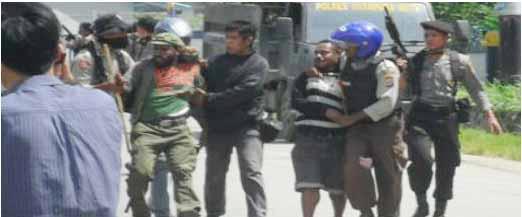
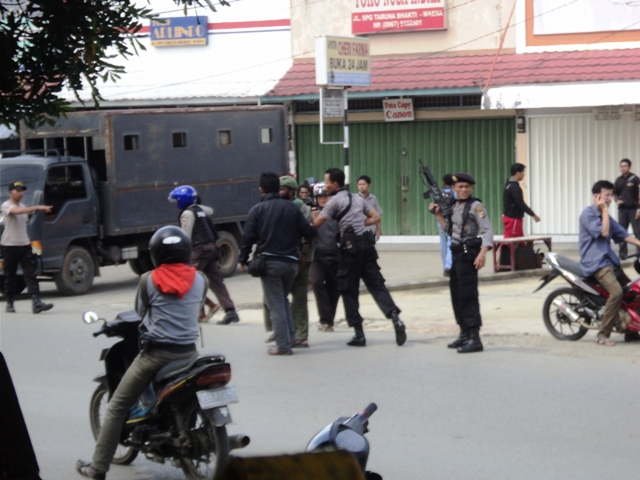
Yeimo told police through a megaphone that more students were joining them to continue the journey to Sentani. The Police Head of Operations AKP Kiki Kurnia ordered participants to disperse, but students refused the order to move on. Kiki Kurnia then advanced toward Victor Yeimo and seized him violently. Yeimo did not resist as Kurnia gave the command to capture him and a large number police descended on Yeimo, violently immobilising him as Yeimo, Julian Douw and Usman Pahabol were thrown into the Dalmas truck and taken away, according to witnesses.
According to an Australian counter-terrorism source operating in Indonesia, who securely contacted West Papua Media on December 3 on condition of anonymity, the “gentleman holding Yeimo’s left arm” during his arrest, “is a Densus 88 officer”.
Victor Yeimo’s arrest on December 1 (Photo: West Papua Media/KNPB)
The source elaborated that this individual received training from the Australian Federal Police run Joint Centre for Law Enforcement Co-operation in Jakarta. West Papua Media has been unable to independently verify the source’s claims with police in Jayapura, nor with Australian Federal Police, before updating this story.
Just as the three were taken away, at about 11 am outside Dian Harapan Hospital (RSDH). police violently dispersed the remaining group of students to disperse them, firing tear gas and six live warning shots into the air. A number of students were also beaten by police, according to witnesses.
Soldiers from the TNI post also joined in the pursuit of students who were forced to flee via alleyways between homes, most running back in the direction of the Perumnas 3 dormitories, and all the armed police began raids again.
According to reports from Suara Papua, dozens of students desperately sought shelter inside the UNCEN Campus, where they were funneled into a dead end by police, back at the locked front gate, though they managed to escape for the time being. KNPB sources have reported that several students sustained injuries from beating, but this has yet to be independently verified.
However, unconfirmed reports to West Papua Media overnight have said that the police, allegedly backed by Densus 88 personnel, have been conducting brutal raids on student dormitories and highlander’s residences across Jayapura.
It is confirmed that at 1235 local time Densus 88 raid occurred on the KNPB office in Sentani an hour later, seizing laptops, Morning Star flags and the United Nations flag. No reports of injuries or arrests were received during that raid.










 West Papua Media Alerts