Freeport Mine Managers turn rabid on Indonesian Grasberg Strikers

Grasberg mine
Image via Wikipedia

PT Freeport Mine Managers Turn Rabid on Indonesian Grasberg Strikers
26 September 2011

ICEM InBrief

Government-mediated talks broke off last week and labour relations further soured between Freeport-McMoRan and 8,000 striking Indonesian miners of ICEM affiliate FSP-KEP (SPSI), the Trade Union of Chemical, Energy, and Mine Workers (CEMWU). The PT Freeport Indonesia Workers’ Union this week meets the halfway mark of its 30-day strike that now could be prolonged at the world’s largest gold and third largest copper mining complex – Freeport McMoRan’s Grasberg mine in eastern Papua Province, New Guinea Island.

Management spite was apparent at the strike’s start on 15 September and it worsened following the breakdown of three days of talks with the Manpower Ministry in Jakarta on 22 September. PT Freeport managers relieved 138 union shop stewards of their job duties on Friday. The union responded by stating the strike likely will be extended beyond 15 October.

Since the wage, pension, and community funds strike started, managers have coerced workers to return to work with threats of dismissal, they have pressed contractors’ employees into production, and now they try to decimate the union by sacking union stewards and isolating the branch union’s other leaders.

PT Freeport management has attempted to coerce workers to sign a statement saying they will return to work or face getting fired. But despite this, only 500 workers are manning operations and many are staff of contractors. (See a list of contractorshere.)

Freeport-McMoRan last week issued a statement last week saying it was losing three million pounds of copper production daily, and 5,000 ounces of lost gold output daily. To increase pressure on miners to abandon the strike, the company also warned of lost revenues to the Indonesian government and to the seven native groups around Timika, Papua, that Freeport-McMoRan is obliged to support.

The opening salvo came at the strike’s outset when Managing Director Armando Mahler announced a “no-work, no-pay” policy. After last week’s mediation failure, union and government sources said “complete distrust” exists between Mahler and his team and the union.

Thus, PT Freeport Indonesia Workers’ Union asked that US-based Freeport-McMoRan Chairman James Moffett enter discussions. Mine union leaders remember Moffett’s visit a few years ago when he encouraged workplace leaders to engage in “win-win” principles of labour relations.

At last week’s mediation, PT Freeport, 91% owned by Freeport-McMoRan and 9% by Indonesia’s government, said it would not budge from a wage offer of 11% in each year of a two-year accord. (The bi-annual contract comes due on 1 October.) The average miner’s wage rate at Grasberg is US$1.50-per-hour. The union was seeking a doubling of that to US$3-an-hour but in mediation last week, the FSP-KEP miners’ branch union offered a compromise and proposed a 65% increase. The company would not move from 11%.

It has offered slight increases in education and housing support and in shift pay, but has said it would not deviate from wage increments that other foreign investors pay in Indonesia. It also refuses to base a pension scheme – 50% paid into by workers – on multiplied years of service, or hear the union’s demands for enhanced development and opportunities for the indigenous people of Papua.

Grasberg is Freeport-McMoRan’s biggest revenue maker and a year ago, the company’s chief financial officer called it “very low cost and a high cash flow generating asset with a very long life.” The company’s revenues this year from Grasberg are expected to be lower because it is mining lower-grade sections of the open pit mine. But Freeport-McMoRan is bullish on the future; it is developing a deep underground mine adjacent to Grasberg that contains high grades of copper and gold in the same ore body.

The ICEM has intervened in this dispute and through its Indonesian Affiliates’ Union Chairman, D. Patombong Sjaiful of FSP-KEP’s CEMWU, is giving direct aid and support to the Grasberg strikers. They need the solidarity and support of all miners and all trade unions in mining and other industrial sectors. Please send a short message in your own words to the PT Freeport Indonesia Workers’ Union.

In ICEM outreach to the union, when asked to characterise the strike, one officer responded by saying, “determination. That’s the one word that describes workers. We’re determined to change our future through the work we do for this company.”

Indonesia: Recent outbursts of violence underscore dire need for a rights-based approach to conflict resolution in Papua

http://www.fidh.org/Recent-outbursts-of-violence

Indonesia: Recent outbursts of violence underscore dire need for a rights-based approach to conflict resolution in Papua


Paris-Jakarta-Bangkok, 21 September 2011. The recent spike in violent incidents in Papua in July and August underscore the urgent need for Jakarta to re-assess its military approach to solve the situation of unrest in the region and to place the respect for human rights at the heart of conflict resolution policies and practices, said the Asian Forum for Human Rights and Development (FORUM-ASIA), the Commission for the Disappeared and Victims of Violence (KontraS), the Indonesian Human Rights Monitor (Imparsial) and the International Federation for Human Rights (FIDH) today.


Kontras recorded at least ten violent clashes between 5 July to 3 August, 2011[1], involving members of the state security forces and local armed groups. Civilians were injured and killed in some of these clashes. Thirteen Papuans were arrested by the police on 31 August in Kampung Nafri, Abepura, for allegedly causing unrest during a religious ceremony. There were also allegations that these 13 individuals were involved in a shooting incident on 3 August, in which three civilians and one TNI soldier were killed. However, local rights groups pointed out that the police made the arrests without properly investigating and substantiating these allegations. These detainees were reportedly tortured while in police custody.

“Freedoms of expression, association and assembly are routinely violated in Papua, which seriously fuels tensions. Besides, gross human rights abuses, such as acts of torture, remain unaccounted for.” said Poengky Indarti, Executive Director of Imparsial.

“While the use of violence to achieve political and other goals is unacceptable, the heavy military presence and the military-centered approach by Jakarta to Papua’s demand for autonomy serve to sideline human rights and do not provide a viable and peaceful solution to the conflict,” said Souhayr Belhassen, FIDH President.

Another element of Jakarta’s security-centered approach is the strict restriction to access to Papua. As a result, peaceful activities of civil society groups and human rights actors operating in Papua are known to be under extensive surveillance by the Indonesian military. This form of intimidation goes against the United Nations Declaration on the Right and Responsibility of Individuals, Groups or Organs of Society to Promote and Protect Universally Recognized Human Rights and Fundamental Freedoms, and oversteps the lawful limit of intelligence gathering. Internal documents of the Indonesian military recently obtained and publicized by the media revealed both the extent of this kind of surveillance and the military authorities’ mistrust towards peaceful civil society and human rights activities, which they perceive as a threat to national security.

“Monitoring human rights work is seen by the military as threatening to national security and this bodess ill for the safety of human rights defenders and other peaceful activists in Papua, as they could bear the brunt of harassment and physical intimidation by state security forces under the pretext of fighting separatism,” said Yap Swee Seng, Executive Director of FORUM-ASIA.

Some of the activists and individuals named in the leaked military documents have already faced arrest, detention, and intimidation, such as independence activists Filep Karma and Buchtar Tabuni, who were both arrested and convicted for their role in organizing peaceful demonstrations during which the Morning Star flag, a banned symbol, was raised.

A recent report released by Imparsial estimates that there are more than 14,000 military personnel deployed to Papua. The report identifies the key features of such a military-centered approach by the central government, including the continuous military operations in Papua without adequate parliamentary oversight, deployment of a large number of non-organic troops to Papua, and the addition of new territorial command structure in the region.

In sum, accountability for human rights abuses perpetrated by state security forces is still lacking in Papua. In addition, in the few rare cases in which perpetrators were brought to court, they were either acquitted or convicted on lesser charges that do not reflect the gravity of their crimes, such as acts of torture.

The four organizations call on the Indonesian government to:

  • Instruct its military to immediately cease all unlawful surveillance activities in Papua and revise its current draft intelligence bill by incorporating recommendations by civil society and bringing it into line with the Indonesian Constitution and Criminal Procedure Code, as well as international human rights law;
  • Take steps to reduce the heavy presence of non-organic military personnel and their involvement in civil administration in Papua and seriously implement security sector reform;
  • Fully and credibly investigate all past and new allegations of human rights abuses, especially those perpetrated by state security forces, and promptly bring perpetrators to justice;
  • Strengthen civilian oversight and rigorous parliamentary scrutiny of military policies, operations and budget; and
  • Respect the role of human rights defenders and ensure unfettered access to Papua by civil society groups and actors, including foreign and domestic journalists and independent human rights monitors.

[1] The documented violent incidents occurred in Kampong Kalome, Tingginambut district, Puncak Jaya (5 July and 12 July); Mulia, Puncak Jaya (13 July and 21 July); Timika, Mimika (30 July); Illga district, Puncak (30-31 July); Kampung Nafri, Abepura (1 August and 3 August); and Mulia, Puncak Jaya/Wamena (3 August). See documentation by KontraS: http://www.kontras.org/index.php?hal=siaran_pers&id=1339.

Indonesia gives full backing to Palestinian independence at the United Nations, what about West Papua?

Opinion/Article

by Victor Yeimo,
International Spokesperson for West Papua National Committee [KNPB]

21st September 2011

[Jayapura]: As the UN General Assembly begins today (21/9) in New York, Indonesia will be in front line of supporting Palestinian efforts to become a member of the United Nations.

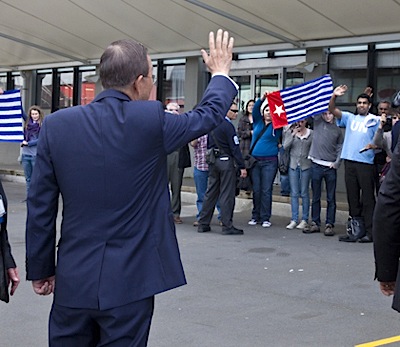
Ban Ki-moon waves to protestors for West Papua, PIF NZ Sept 2011 (Photo: Henry Yamo/ PMC)

Indonesia has been supporting the Palestinian case ever since they declared their independence. But what about the fate of West Papua which has been under Indonesian rule for half a century?

This week, from 19 to 28 September 2011, Foreign Affairs Minister, Marty Natalegawa, will be representing Indonesia at the UN General Assembly during its 66th session in New York, United States. He previously recalled, in a press release last Thursday (15/9), that Indonesia had recognized the independence of Palestine just a few hours after it had been declared in 1988.

Mahfudz Siddiq, chairman of House of Representative’s Commission I overseeing foreign affairs, also stated that agreement had been reached by the Indonesian Parliament and Government, for the full support of Palestinian independence and the Palestinian State bid at the UN General Assembly in New York this week.

As a logic consequence of this backing, Indonesia’s foreign policy should also be shown in its commitment to support the right to independence and the recognition of the sovereignty of the people of West Papua. If Indonesia is aware that Israel’s occupation of Palestinian territories is a state of colonization, then Indonesia has to realize that the occupation of West Papua by Indonesia since 1963 is likewise a state of colonization.

Already too many Palestinians have fallen victims of the Zionist regime of Israel, and already too many West Papuans have fallen victims of the colonialist and militarist regime of Indonesia. It is time for the people of West Papua to set their own destiny, in the same way that the Palestinian people, the people of South Sudan, Kosovo, and others, are deciding their own.

Indonesia as a member of the United Nations should actively participate in promoting and creating world peace. But, what about the fate of the people of West Papua? It has been a while since Indonesia and the international community decided to look away from the suffering of the people of West Papua. West Papuans continue to be victims of the vested interests of Indonesian colonialism and global capitalism on their land.

Because of those interests, the United Nations and Indonesia have been denying the right of independence to the people of West Papua, a right which should have been granted to them in accordance with General Assembly Resolution 1514, through the Decolonization Committee. Indonesia should welcome the statement of UN Secretary-General, Ban Ki-Moon in Auckland, New Zealand, on 7 September 2011, when he stated that the issue of West Papua should be discussed again in the UN decolonization committee, a committee which has several times been chaired by none other than Marty Natalegawa.

15 Papuans mistreated and tortured by army and police

16 September 2011

FIFTEEN PAPUANS MISTREATED AND TORTURED BY ARMY AND POLICE


TAPOL strongly condemns the use of violence and torture against Papuan detainees

A report has been released following a joint investigation into the maltreatment and torture of a group of 15 Papuans in connection with two criminal incidents that occurred recently in West Papua.  The report, published by Papuan church leaders, the NGO network Foker and the Papua Human Rights Commission, states that 15 Papuans were arrested in Jayapura on 31 August and were mistreated and tortured for nine hours by a joint force of military and police.  They were reportedly beaten with  rifle butts, punched, kicked in the stomach with army boots and subjected to continual verbal abuse in an attempt to force them to
confess to the as yet unsolved murders at Nafri and Skyline in Jayapura.

One of the men said he had been threatened with death if he failed to confess to owning items including a bullet and some documents which he said he had not seen before, and another was reportedly tortured until he confessed to the murders and named another of the men as his accomplice.  During police interrogation, the two were threatened with death if they did not confess to the crimes. They were then charged with the murders and remain in detention.

After the remaining thirteen men were released, they said that they had also been forced to lie on their backs on the ground facing the blazing sun for seven hours. They further commented that they felt as though they were being treated like cattle. They were deprived of water and food for lengthy periods while being beaten and tortured and no attention was paid to the injuries and bruises that they suffered during their ordeal. They said that they were weak and in some cases fell ill as a result of their treatment but were denied access to a toilet and ordered to urinate and defecate out in the open.

Apart from the appalling treatment to which they were reportedly subjected, the detainees were arrested without arrest warrants and during their interrogation, they were not accompanied by lawyers despite the associated requirement for persons in detention when they are given notice that they are about to be questioned.

Moreover, according to legal requirements they should have been released within 24 hours, a binding requirement for persons who are held without being charged for any crime. They were in fact held for 27 hours.

TAPOL strongly condemns the atrocious treatment of these Papuans. We call on Komnas HAM, the National Human Rights Commission, to conduct an investigation into the treatment of these Papuan detainees. TAPOL also calls on the Minister of Justice and Human Rights to call to account all those persons who were responsible for using extreme violence and torture against this group of men.

The government of Indonesia should make it absolutely clear that all persons who work for government agencies within the military and the police, including those which were involved in the detention and mistreatment of these fifteen men should at all times treat persons being held in detention without resorting to violence and torture and should be instructed to refrain from using such methods or face dismissal if they do so.

AHRC: Manokwari court sentences two Papuan activists in flawed trial

Urgent Appeal Update: AHRC-UAU-041-2011

15 September 2011

[RE: AHRC-UAC-117-2011: Police ill-treats peaceful protesters and forces rebellion charges in a flawed process]
———————————————————————
INDONESIA: Manokwari court sentences two Papuan activists in flawed trial

ISSUES: Freedom of expression; right to fair trial
———————————————————————

Dear friends,

The Manokwari district court in West Papua has sentenced two peaceful activists to seven and a half months and two years imprisonment respectively. The trial was characterised by a series of violations of the Indonesian criminal procedure and appeared to be politicised and biased. The victims had participated in a peaceful protest in December 2010. The Manokwari Court ignored several basic rights of the accused and the verdict was given despite the lack of sufficient evidence. Five more victims are still undergoing their trial process.

UPDATED INFORMATION:

On 14 December 2010, seven persons were charged with rebellion after they conducted a peaceful protest following a flag raising event. At the correctional facility, they were ill-treated and denied medical care for weeks resulting in serious health conditions. The AHRC issued this urgent appeal regarding their case.

The AHRC has now received information from LP3BH, a local legal aid group in Manokwari that the judges panel led by Cita Savitri, issued the verdict that two of the peaceful protesters, Melki Bleskadit (also known as Melkianus Bleskadit) and Daniel Yenu, were guilty of acts of rebellion, while the other accused are still undergoing the trial process. (photos:Daniel Yenu (left) and Melki Bleskadit (right) in court, source:LP3BH)

On 18 August 2011, the verdict against Mr. Bleskadit was declared and he was sentenced to two years imprisonment. The AHRC also learned that the verdicts were declared based on flawed testimonies. At the trial of both victims, no witnesses to the alleged crime were presented and the judges declared a testimony from a person who had not seen, heard or experienced the incident as sufficient evidence for a criminal conviction. According to article 1.26 and 1.27 of the Indonesian criminal procedure law (Law 8/1981) such a person is not permitted to be a witness in a trial. Responding to the two year sentence, the public prosecutor, Mudeng Sumaila submitted an appeal, demanding a higher sentence of five years. (photo: public prosecutor at Yenu’s trial source:LP3BH)

On 23 August 2011, Mr. Yenu was convicted to seven months and 16 days imprisonment. At Mr. Yenu’s trial, the judge also convicted the suspect in a trial based on flawed procedure. For example, according to the victim’s lawyer the prosecutor successfully present fabricated evidence such as a megaphone that was not actually used by Mr. Yenu. On 16 August 2011, the judge forced Mr. Yenu to appear before the court trial session without access to his lawyer.

On 19 August 2011, the judges refused the request of Mr. Yenu’s legal counsel to submit the plea to the court, although the Indonesia’s criminal code in article 182.1b entitles the suspect to submit such a plea.

The AHRC is very concerned that local authorities in West Papua frequently apply rebellion charges to peaceful Papuan activists and sentence them in flawed processes that lack proper evidence. The Police, prosecution and judges have thus shown serious disregard for the basic criminal procedure standards and fundamental principles of rule of law. The verdict in this case appears to be quite blatantly fabricated. The AHRC deplores the dysfunction and apparent politicisation of courts in West Papua as this leaves people without access to the law-based and impartial justice mechanisms, they are entitled to. (photo: judges at Yenu’s trial, source:LP3BH)

SUGGESTED ACTION:
Please join us in writing to the authorities listed below, asking them to thoroughly review and examine the trial process against Mr. Bleskadit and. Mr. Yenu and to review the criminal code application against the peaceful expression of opinion.

Please be informed that the AHRC is sending letters on this case to the and protection of the right to freedom of opinion and expression, the Special Rapporteur on the rights of indigenous peoples, and the Special Rapporteur on the independence of judges and lawyers calling for their interventions.

To support this appeal, please click here:

SAMPLE LETTER:

Dear ___________,

INDONESIA: Manokwari court sentences two Papuan activists in flawed trial

Name of victim: Melki Bleskadit, Daniel Yenu
Names of alleged perpetrators: The examining judges, Cita Savitri, I Gusti Ngurah Taruna W and Helmin Somalay
Date of incident: August 2011
Place of incident: Manokwari District Court

I am writing to voice my deep concern regarding the verdict against two Papuan activists, who were sentenced to imprisonment for conducting a peaceful protest in December 2010.

I know that on 14 December 2010, seven persons were charged with rebellion after they conducted a peaceful protest following a flag raising event. At the correctional facility, they were ill-treated and denied medical care for weeks resulting in serious health conditions.

I have receive information that the judges panel led by Cita Savitri, declared the verdict that two of the peaceful protesters, Melki Bleskadit and Daniel Yenu, were guilty for acts of rebellion, while the other five victims are still undergoing their trial process.

On 18 August 2011, the verdict against Mr. Bleskadit was declared and he was sentenced to two years imprisonment. The AHRC also learned that the verdicts were declared based on flawed testimonies. At the trial of both victims, no witnesses of the alleged crime were presented and the judges declared a testimony from a person who had not seen, heard or experienced the incident as sufficient evidence for a criminal conviction. According to article 1.26 and 1.27 of the Indonesian criminal procedure law (Law 8/1981) such a person is not permitted as a witness in trials. Responding to the two year sentence, the public prosecutor, Mudeng Sumaila submitted an appeal, demanding a higher sentence of five years.

On 23 August 2011, Mr. Yenu was convicted to seven months and 16 days imprisonment. At Mr. Yenu’s trial, the judge also convicted the suspect in a trial based on flawed procedure. For example, according to the victim’s lawyer the prosecutor successfully present fabricated evidence such as a megaphone that was not actually used by Mr. Yenu. On 16 August 2011, the judge forced Mr. Yenu to appear before the court trial session without access to his lawyer.

I learned that on 19 August 2011, the judges refused the request of Mr. Yenu’s legal counsel to submit the plea to the court, although the Indonesia’s criminal code in article 182.1b entitles the suspect to submit a plea to the court.

I am very disturbed to hear that local authorities in West Papua frequently apply rebellion charges to peaceful Papuan activists and sentence them in flawed processes that lack proper evidence. The police, prosecution and judges have thus shown serious disregard for the basic criminal procedure standards and fundamental principles of rule of law in this case. The verdict appears to be fabricated and I am very concerned about the impartiality of the local courts and their disregard for Indonesian criminal procedure.

Therefore, I urge you to review and examine the trial process of both victims. The authorities concerned should look into the victim’s allegations of procedural failures in the local institutions and the ongoing lack of intervention – as far as I am aware – following the victims earlier complaints. The principle of fair trial as required by international and national law must be applied in the appeal’s process in the case of Mr. Bleskadit, Mr. Yenu and the ongoing trials of the other five accused.

Yours sincerely,

—————-
PLEASE SEND YOUR LETTERS TO:

1. Mr. Susilo Bambang Yudhoyono
The President of Indonesia
Jl. Veteran No. 16
Jakarta Pusat
Indonesia
Phone : +62 21 3863777, 3503088.
Fax : +62 21 3442223

2. Head of National Commission on Human Rights of Indonesia
Jalan Latuharhary No.4-B,
Jakarta 10310
Indonesia
Phone: +62 21 392 5227-30
Fax: +62 21 392 5227
Email : info@komnas.go.id

3. Office of The Anti Judicial Mafia Task Force (Satgas)
PO Box 9949
Jakarta 10 000
INDONESIA
Contact on website: http://www.satgas-pmh.go.id/?q=node/157

4. Chief Justice of the Republic of Indonesia
Mahkamah Agung
Jalan Medan Merdeka Utara No.9-13, Jakarta 10110
INDONESIA
Phone: +62 21 3843557 -3453348
Fax: +62 21 383541

5. Chairman of Judicial Commission
Komisi Yudisial Republik Indonesia
Jl. Kramat Raya No. 57, Jakarta Pusat
INDONESIA
Phone: +62 21 3905455;
Fax: +62 21 3905455;
Email: kyri@komisiyudisial.go.id

6. Head of Manokwari District Court
Jl. Merdeka No. 69
Nabire, Jayapura 98815
INDONESIA
Phone: +62 984 21007
Fax: +62 984 24087

7. Head of Jayapura High Court
Jl. Tanjung Ria No. 98. Base “G”
Jayapura 99117
INDONESIA
Phone: +62 967 541045, 541443, 541248
Fax: +62 967 541045

Yours sincerely,

Thank you.

Urgent Appeals Programme
Asian Human Rights Commission (ua@ahrc.asia)


Create a website or blog at WordPress.com

Up ↑