
This new book from the West Papua Project is an edited volume of the collection of papers presented at the February 2011 University of Sydney conference “Comprehending West Papua”. It represents the views of the world’s leading scholars and activists currently working on understanding the conflict in West Papua.
Click to download Comprehending West Papua.
Click to download the Appendix of Images.
Editors’ Introduction
Peter King, Jim Elmslie and Camellia Webb-Gannon
Comprehending West Papua derives from a report that the co-editors wrote for
the Centre for Peace and Conflict Studies (CPACS) at Sydney University in July
2010 entitled, Get up, stand up; West Papua stands up for its rights.
The coeditors — Peter King, Jim Elmslie and Camellia Webb-Gannon — are coconveners (King and Elmslie) and coordinator (Webb-Gannon) respectively of the West Papua Project at CPACS. The Project was established in 2000 as an
intellectual meeting place and research centre focused on the profound onflict
that is occurring in West Papua.
The Get up, stand up report covered the mass civil society protests by West Papuans against Indonesian rule in mid-2010 and the background to this political insurrection. The report received widespread publicity and positive feedback so we decided to capitalise on this by organising a conference at Sydney University in February 2010. We asked those whom we considered the world’s leading authorities on the political impasse in West Papua and its historical roots to present short papers on the theme, Comprehending West Papua, with a view to helping Papuans, Indonesians and the rest of the world conceive new (or reconceive old) ways out of the impasse. We gave invitees the option of sending their papers for proxy presentation if they were unable to attend. The conference was a resounding success, with participants from West Papua, Indonesia, Vanuatu, New Zealand, The Netherlands, England, the United States, Singapore, Japan and Australia. We believe that it is the most significant academic-level conference that has ever been held on the political situation in West Papua.
Another aim of the conference was to map and update the global spread of
opinion on West Papua. Besides academic assessments, the conference also
had important West Papuan speakers and writers representing different diaspora factions pressing for independence or self-determination as well as a few who favour accommodation of the Indonesian government. Unity amongst the West Papuans (long derided) was also examined, set alongside the dramatic demographic transition caused by organised and “spontaneous” in-migration from the rest of Indonesia, which now makes the Melanesians a light minority in their own homeland.
The year 2010 ushered in a new wave of West Papuan independence politics.
This momentum-gathering wave is characterised by student and youth leadership with a tougher stance on West Papuan self-determination, the vigourous promotion of the cause through social media and greater international attention to Papuan politics through mechanisms such as WikiLeaks and YouTube, both of which have served to reveal often obscured and sometimes horrific conditions in West Papua.
Evidence of this new wave emerged dramatically in June and July 2010, when
civil demonstrations, led by a new NGO, FORDEM (Democratic Forum of the
United Papuan People), amassed up to 20,000 protesters on the streets of
Jayapura. FORDEM comprises the self-proclaimed and widely recognised
provisional government set up by the West Papua National Authority (WPNA)– represented in this volume by chapters from Jacob Rumbiak and Herman
Wainggai–and various civil society organisations drawn from the churches and the student and women’s movements. These demonstrations were triggered in response to Jakarta’s rejection of an MRP (Majelis Rakyat Papua—the all-Papuan upper house of the provincial parliament) decision popularly known as SK14, which ordains that “all candidates for elected office at the sub-provincial level had to be indigenous Papuans.”
The Home Affairs Ministry rejection of SK14 was considered to blatantly undermine the spirit of the Special Autonomy Law of 2001 which specifies that the provincial governors, vice governors and district (regency) chiefs (bupatis) in West Papua must be indigenous Papuans.
Thus, as discussed in Jacob Rumbiak’s chapter in this volume, the biggest demonstrations in West Papua’s history were launched against Special
Autonomy and for a referendum on West Papua’s political status. (These demands were two of the MRP’s 11 bold “recommendations” to the Papua
provincial government).
Papuan politics experienced a positive shift in the surrounding Pacific region as well during this time. Vanuatu’s parliament passed the Wantok Blong Yumi Bill which committed the Vanuatu parliament to work towards independence for West Papua through avenues such as the UN General Assembly and Decolonization Committee and the International Court of Justice. Vanuatu’s long term support of West Papuan independence is discussed in this volume in chapters by Rex Rumakiek and John Otto Ondawame, the latter making an impassioned plea for the success of the Papua Road Map. The Road Map constitutes a push for effective dialogue between Papua and Jakarta coming from Muridan Widjojo and the Indonesian Institute of Science in Jakarta and Neles Tebay and the Papua Peace Network in Jayapura. Father Neles has blessed the umbrella group established in Vanuatu in 2008, the West Papuan National Coalition for Liberation (with John Otto as Vice Chairman and Rex as Secretary General), as pivotal for bringing Papuans to the dialogue table.
Nick Chesterfield’s chapter shows the ways in which technology and social media have also been used to West Papuan political advantage by Papuans (who use Facebook prolifically to publicise their cause) and, inadvertently, by Indonesian troops. For example, the trend of capturing “incidents” on mobile phones has recently backfired on Indonesian military and police torturers in West Papua in a string of high profile cases that elicited deep international concern. In August 2009, West Papuan Yawan Wayeni was disembowelled with a bayonet and taunted by Brimob (Indonesian mobile police) as he lay dying. This was captured on camera by one of the torturers and subsequently leaked online. The public nature of torture in West Papua is discussed in Budi Hernawan’s chapter on this topic. In October 2010 another couple of horrific videos taken by Indonesian troops emerged. The soldiers hogtied, suffocated with a plastic bag and burned the genitals of one West Papuan man; held a knife to another’s neck, and kicked yet others in the head as they sat helpless on the ground. These videos were also leaked via YouTube, causing an international sensation. As political leaders from other countries responded to these videos by pressing the Indonesian government to investigate and punish the offenders, whistleblowers leaking other files, including Kopassus (army special forces) blacklists and diplomatic cables, brought further humiliation upon the Indonesian government for its attitude towards West Papua. In November 2010 US journalist Alan Nairn published a leaked Kopassus list of enemies of the state in Papua, all of whom were civilians. (At the top of the list is the Reverend Socrates Sofyan Yoman, who also contributes a chapter here.) Then, in December 2010, a series of WikiLeaks sourced US embassy cables from Jakarta was published in the Melbourne Age newspaper, revealing the extent to which politicians in Jakarta (and internationally) were and are aware of what has become the military fiefdom of West Papua, and the degree of natural resource exploitation, financial and political corruption and human rights abuse that prevails as a result. That these leaks and others published in The Sydney Morning Herald concerning the alleged corruption of the Indonesian president, Susilo Bambang Yudhoyono, and his family, caused the Indonesian government considerable humiliation is evident from the ensuing Indonesian lawsuit against the Australian newspapers for publishing the cables.
All of these events and trends were converging with a momentum that we would have been remiss not to follow up. The West Papua Project decided it was timely to invite a cadre of international experts on West Papua to a conference at the University of Sydney who would try to comprehend, as a group with diverse experiences and perspectives, this new wave in West Papuan politics and its likely future trajectory.
The conference unfolded at International House, Sydney University, over two
days, February 23-24, 2011. It attracted an audience of 80 people to hear 22
papers presented–three of them in absentia and one by virtual presence.
Participants were invited to pay or find donors to pay their fares and
accommodation, and the conference conveners-cum-editors can recommend this as a simplifying and surprisingly successful ploy for underfunded NGOs, even university-based ones. However the School of Social and Political Sciences and the Arts Faculty at Sydney University must be thanked for their prompt and generous response to last-minute requests for subsidy of conference venue hire, function costs and book publication.
Paper presenters included three women, five Papuans (all in exile) and two non Papuan Indonesians, as well as non-Papuan/non-Indonesian scholars, activists
and scholar-activists from Europe, North America, South East Asia and Australasia, as mentioned above.
Discussion did focus mainly on how to interpret and react to the new youth-led
turn towards mass mobilisation around independence, a referendum on self-determination and rejection of Special Autonomy in Papua since mid-2010. Apart from papers already mentioned above, Bilveer Singh’s presentation laid out political options for Papua in fine forensic detail; Jason McLeod, leading expert on non-violent resistance, perceived growing synergy between local and international mobilisation for the Papuans, and editor King chimed in that the deoccupation of Papua could yield large benefits in military reform, corruption reform and democratic reform for Jakarta and Indonesia.
Akihisa Matsuno persuaded large numbers of participants that the rising trend of “self determination as conflict resolution” (Kosovo, South Sudan, East Timor) and the “unsustainability” of Indonesian occupation have created a momentous opportunity for Papua, while Richard Chauvel was also persuasive with his distinction between the politics of independence and the politics of pork (elected Papuans’ massive looting of Special Autonomy funding)– and in dubbing Papua the Achilles heel of a still ostensibly reforming post-Suharto Indonesia. These two speakers led media coverage of the conference.
Editor Webb-Gannon, expert on West Papuan diaspora personalities and
perspectives, explored the cultural underpinnings, ancient and novel, of the
Papuan planetary resistance to conclude that independence was still a viable
option. Absentee cultural anthropologist Eben Kirksey meditated on the
extraordinary congressional hearing on Crimes against Humanity in Papua which was held in Washington DC during September 2010 (which he did much to organise), and concluded that the “messianic multiple”—a future with multiple messianic political options — could work even for a Papua “off the radar” in Washington.
Absentee editor Jim Elmslie (as presented by co-editor King) continued his
alarming and influential investigations into the demographic threat to West
Papuan identity and survival from unconstrained Indonesian settler arrivals in
Papua and called for an international fact-finding mission on the issue of “slowmotion genocide”.
John Saltford, in absentia in London (and spoken for by editor Webb-Gannon),
the world’s leading authority on the Act Of Free Choice which sealed Papua’s
fate under occupation in 1969, called for negotiations without preconditions
between Jakarta and Jayapura, while Paul Barber of TAPOL and Rosa Moiwend,
also absent and similarly represented in Sydney, outlined the emerging threat of giant, largely foreign-funded food estates to Papuan forests, subsistence and
survival.
Like Saltford, Maire Leadbeater, New Zealand’s leading pro-Papuan campaigner, commended the peace process which resolved Papua New Guinea’s Bougainville crisis in 1998, specifically, New Zealand’s mediation which did so much to calm and clarify that other bloody conflict caused by a heedless giant mining company, while Kylie McKenna and John Braithwaite also identified giant resource companies as a threat to peace–in occupied as well as independent Melanesia–but gave a passing grade (so far) to BP’s giant Bintuni Bay LNG mining operation for its contribution to conflict avoidance in Papua.
And, finally, Pieter Drooglever, who wrote a 700 page commissioned study of the Papua conflict for the Dutch government (which was rejected by the then government on publication in 2007!), reminded us in his introductory presentation how much was lost in the sorry history of 1962-69.
* * *
The ambience of the conference was special. Two inter-Papuan conflicts were
seen as liable to surface and had caused mild apprehension among the
conveners. One was between the partisans of the two leading umbrella
organisations of the Papuan resistance as it exists and evolves internally and externally—the Coalition (WPNCL) and the Authority (WPNA). However, photographs on these pages show factional partisans not only chatting amicably, dancing and singing together but hugging each other indeed.
While personality conflicts may persist, the marginal policy disagreements between the factions were overshadowed by good fellowship and fruitful dialogue on the occasion of the conference.
The other conflict that threatened to haunt the conference was between the proJakarta or at least pro-collaboration ex-diaspora faction led by Franzalbert Joku (and including Nic Messet who actually represented the Indonesian government point of view at the congressional hearing of September 2010 mentioned above) and the mainstream of Papuan independentists–Coalition, Authority and Other.
However in fact there were revelations at the conference of counter-intuitive
collaboration between the apparent enemies. It transpired that Jacob Rumbiak’s semi-clandestine visit to Jakarta in late 2010 (his first since 1999 when he departed Cipinang prison), during which he presented political conditions to be met in the context of a possible dialogue with Jakarta about a peace settlement for Papua, and engaged in talks with ministers up to and including SBY himself, had been arranged and facilitated by none other than Franzalbert Joku.
In conference socialising and his own presentations Franzalbert argued that
Papua’s way ahead lay in a cooperative division of labour between Papuan
independence seekers able to highlight the deficiencies of Special Autonomy and military occupation and Papuan insiders like himself able to not only call for dialogue with Jakarta but actually arrange it. Whether many of the mainstream would really welcome long-term cooperation with business-oriented Papuans widely thought to be agents of BIN, the murderous Indonesian national intelligence agency, remains to be seen, but the value of the conference dialogue across factional boundaries seems to have been indisputable.
They could also be seen and heard dancing and singing a la Papouenne together.
The editors hope the chapters which follow will yield invaluable insights into the current situation in West Papua, which is well covered in updated chapters by Chauvel and King, since the conflict has important ramifications for many
countries in the immediate region, not least Indonesia, Australia and Papua New Guinea. Our authors suggest that the conflict is not receding, but rather
intensifying and complexifying, generating opportunities for conflict resolution and peacemaking which need to be urgently acted upon.
Please note: for all footnotes, please download ebook here:
Click to download Comprehending West Papua.
Click to download the Appendix of Images.


 Police arrest attendees of the Third Papuan PeopleCongress in Jayapura, Indonesia‘s Papua province onOctober 19, 2011. © 2011 Reuters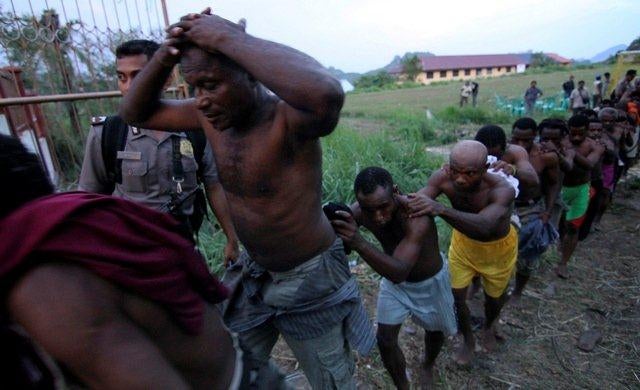



 West Papua Media Alerts