Freeport Workers willing to meet and speak directly to James R. Moffett and Richard C. Adkerson

THOUSANDS WORKERS of PT.Freeport Indonesia, Privatization and Contractor Strike

Statement by Frans Bernhard Okoseray, PUK FSP KEPmuSPSI PT Freeport Indonesia

July 9, 2011

In preparation for the Joint Working Agreement negotiations on the Welfare PT.Freeport Indonesia thousands of workers, there were problems in the Organization of Trade Unions of the Regional Leadership FSP KEP SPSI and SPSI PT Freeport Indonesia’s Trade Union Committee, the Chairman and Board Member in charge of PUK SPSI PTFI solve the problem.

At the Chairman of the Board PUK SPSI PT Freeport Indonesia and resolve the internal problems of the organization, the Management Department of Industrial Relations PT.Freeport Indonesia issued a
Violation Call Work.

Team SPSI PTFI PUK, led by Chairman Sudiro, invitation and clarifies the issue.

In the absence of good faith on the part of Management PT.Freeport Indonesia, to conduct negotiations of the Joint Working Freeport, after the union SPSI PUK PTFI solve problems of organization and filed a Request for Collective Labor Agreement Negotiations, Department of Industrial Management PT.Freeport Indonesia convey Disciplinary Action Letters Termination of Employment and laid-Chairman and Board SPSI PUK PUK PTFI the Union FSP KEP SPSI deliver Notice of Strike Action Peace to the Leadership Company PT.Freeport Indonesia, from June 4 to 11 July 2011.

On July 30, 2011 The meeting was held in the building between the Union Bappeda Mimika PUK FSP KEP SPSI PT Freeport Indonesia, Chairman of the SPSI Branch, Regional and Central and Time States Interagency Committee established by the Chairman of the Workers Union Local FSP KEP SPSI (Nurhaidah), Head of Department of Labor Mimika regency, Assiten Mimika District III Secretary and Management PT.Freeport Indonesia.

In the meeting of the Central Executive FSP KEP SPSI Workers Union issued a decision letter from the post of Chairman of Dismissal Nurhaidah Regional Leadership FSP KEP SPSI.

The meeting resulted in 3 (three) things:
1. Troubleshooting Internal Organization
2. Troubleshooting layoffs given to the Chairman and Administrator SPSI
3. And Revocation of Letters Strike

Stage of completion:
1. Night On July 30, 2011 issue of Internal Organization has been completed with each of the Chairman of FSP KEP SPSI
2. On 1-2 July 2011 meetings were held with the Head of Department of Labor Mimika. In the meeting request of Trade Unions to Revoke Management PTFI the Termination Letter is given to the Chairman of PUK SPSI PT Freeport Indonesia and board members, and recognize the existence of Sudiro as Chairman of PUK SPSI elected democracy by Freeport Workers with board members to conduct the Joint Working Deliberations PT.Freeport Indonesia the period 2011-2013. If the request is accepted by Management, the Mail Strike in Disconnect. The willingness of the parties PTFI Management is to lose the status of Termination of Letter of Warning to a 3 (three), whereas the Union offer a Warning Letter 1 (one), in bidding between the two sides between the Unions and Management PT Freeport Indonesia, the Head of Department of Labor Work offers a Warning Letter 2 (two), the Offer will not be received by the Management PTFI, so that the two sides, namely the Trade Unions and Management PTFI SPSI PUK declared there was no agreement, resulting in strike action of workers in accordance with the Notice.

With distrust Workers Union of Management PT.Freeport Indonesia, so in today’s day meeting Wednesday, July 6, 2011 at the Administration Building of Kuala Kencana and Freeport as well as thousands of workers who struggle to walk from Tembagapura to Timika, the entire Workers’ demands and requested that the Supreme Leader Freeport McMoran James R. Moffett and Richard C. Adkerson soon came to Timika in Papua to meet and talk with the PUK SPSI PT Freeport Indonesia under the leadership SUDIRO Chairman.

On July 4, 2011 6:00 Thousands of workers had gathered at the Bus Terminal Bus Tembagapura waiting to escort workers to Timika. At 08:00 Hour Management PT.Freeport Indonesia will not provide bus transport, so that thousands of workers took the decision to walk away. In as far as 40 mile trip, many workers are thirsty, hungry, and tired. On the day evening Management PTFI send two buses to transport workers, but workers will be transported back to Tembagapura below, so that workers do not want to ride the bus and the workers told the other workers there apabilah workers no longer able to walk because of fatigue can increase the bus to return to Tembagapura.

Workers who thirst and hunger in the support by the Escort (PTFI Security Guard Unit) and Executive Board members Trade Unions and the PUK led by Union Chairman Sudiro (PUK SPSI PTFI).

Seeing the conditions that do not allow for workers who are tired, tired and sore feet that already then, at 18:00 Board of Trade Unions under the leadership of Chairman PUK SPSI Sudiro lobbied several parties to urgently provide transportation PTFI Management Bus.

At about 22:30 three (3) buses imported from Tembagapura to transport workers still on the trip and 15 buses imported from mile 28Timika to transport thousands of workers who had gathered at the check point Mile 50.

With tears and blood that comes out of the thousands of workers who walk as far as 80 km from Tembagapura to Timika, then we ask Mr.James R. Moffett and Mr.Richard C. Adkerson must come to Timika in Papua, to meet and talk with us. Any strike action PT.Freeport Indonesia thousands of workers have been extended to July 18, 2011.

‘If You Mess With Us You’re Dead’

via NewMatilda.com

By Jason MacLeod

indo soldier in west papua

There was nothing clandestine about the beating of human rights activist Yones Douw in West Papua last week. Jason MacLeod reports on the latest in a long pattern of public violence by the Indonesian military

“You can mess with the police,” said the Indonesian soldiers, “but if you try it with us, you’re dead.”

According to witnesses that was what was said to Yones Douw, a 42-year-old Papuan human rights defender as he was beaten with lumps of wood by soldiers from Kodim 1705, Nabire’s District Military Command in the Indonesian province of Papua. Immediately after the beating Douw went to the local Siriwini hospital but was refused treatment. Local staff demanded a letter from the police before they would treat his wounds. Douw now fears for his safety and has gone into hiding.

The incident occurred on the 15 June. Douw, a church worker with the Kingmi Church’s Bureau of Justice and Peace in Nabire, heard that a protest was going to take place at the 1705 District Military Command (Kodim) base in Nabire, Papua province, and he went to the base to monitor it. Thirty minutes after he arrived, a group of protesters turned up in three trucks, broke into the front entrance of the base and started to shatter the windows and throw objects. Douw immediately rushed into the base to calm the protesters.

In response, the military fired shots into the air and started hitting the protesters. Douw was struck on the head with pieces of wood many times. He also sustained injuries on his shoulder and wrists from the beatings. The protesters fled the scene, pursued by members of Kodim 1705 and armed troops from neighbouring Battalion 753. This is what gave Douw time to escape.

Yones Douw was not the accidental victim of some random act of violence. And the protesters he was defending were not some random mob of outraged Papuans or an attack by the Papuan Liberation Army, Papua’s lingering guerrilla force. The attack on the Nabire District Military Command was an expression of a grief stricken family angered at the senseless killing of one of their own. The family wanted to hold the military accountable for the killing of Derek Adii, a man who was beaten to death by soldiers a few weeks earlier.

In mid-May Douw, a chronicler of human rights violations in the troubled Paniai region for some years now, published a report that was picked up by Jubi, West Papua’s only independent news service. Douw’s report detailed the killing of Derek Adii on 14 May 2011. Adii, a 26-year-old Nabire man had just completed his application to join Papua’s burgeoning civil service.

According to Douw’s report, Adii was boarding the crowded passenger vessel KM Labobar at Nabire’s dock when he was beaten by six members of the military. One of the soldiers allegedly pulled out a bayonet and stabbed Adii in the head. The six men then threw his body overboard. Adii died at the scene.

Douw believes he was beaten by the military for retribution — not only for reporting Adii’s killing but also for continuing to shine a spotlight on human rights abuses in West Papua, an area the Indonesian police and military are trying to close off from international scrutiny by locking out journalists and even diplomats.

The circumstances surrounding Adii’s very public murder and Douw’s public beating in the front yard of a military base located on a main road in the middle of a town is typical of the patterns of human rights abuses in West Papua. Australian National University scholar and former Director of the Catholic Office of Justice and Peace in West Papua, Br Budi Hernawan OFM who is studying torture in West Papua, says that torture and human rights abuses in Papua are a kind of “public spectacle”.

In the 400 odd cases of torture that Hernawan has studied it is mostly poor and innocent Papuan civilians are rounded up and publicly abused. The perpetrators are nearly always the Indonesian military and police. It is classic state terror, the purpose of which is to violently pacify the population, to enforce the security apparatus’ control over human bodies and the body politic — and to intimidate and silence Papuan dissent.

It is a script that Yones Douw has refused to buy into. In the meantime other Papuans have stepped into Douw’s shoes. They are now chronicling the military’s attack on him and sending reports out to a domestic and international network in the same way that Douw has been ceaselessly reporting on the human rights abuses of others.

WPNA Statement: WEST PAPUANS WALK FOR PEACE: “Thou Shalt Not Kill”

PRESS STATEMENT                                                        10 June 2011


WEST PAPUANS WALK FOR PEACE: “Thou Shalt Not Kill”

~ the value of trust as a noble door to the solution of Indonesia’s primary problem in West Papua ~


In the distinguished tradition of non-violence, West Papua National Authority’s rally in Manokwari on Friday 10 June begins with a three-mile jigjog—from the Sanggeng soccer stadium to the government’s provincial office—with five-to-ten thousand Papuans chanting ‘Thou Shalt Not Kill”.

The Authority’s rally position is the release of Papuan political prisoners. According to rally organizers, lawyer Abraham Wainarisi SH and security co-ordinator Matheus Maryen, these political prisoners are local leaders required by their village communities to negotiate their security with unprecedented levels of Indonesia military and intelligence agents.

The release of political prisoners was the first of five trust-building conditions Jacob Rumbiak placed on the table during his visit to Jakarta in February 2011. There has been no response to The Authority’s encouraging demands.

The other four conditions which The Authority believes are pre-conditional for creating trust between the two nations are:

  • The government’s guarantee of safe and secure conditions for a conference of Papuan leaders that would include those living in the jungle and others domiciled abroad
  • The government’s dismantling of regulations whereby Melanesian West Papuans living abroad and in exile needing to visit family and relatives are treated as ‘foreigners’
  • The government’s implementation of policy and regulations banning use of the word ‘separatist’ which enrages security forces bound by oath to defend the ‘territorial integrity’ of the republic.
  • The government to return all Military and Intelligence units in West Papua to Jakarta

The Arab Spring: a harbinger for a “global spring” against oppressive rule?

(published with especial relevance to West Papua)

by Edmund McWilliams

Democracy, respect for human rights, good governance – these are the themes that have been on the lips of peaceful demonstrators from the Mediterranean to the Arabian sea.

In country after country, Arab men and women, young and old have showed extraordinary courage, facing down dictators and autocrats even when those corrupt leaders have employed the full weight of their armed forces against the unarmed protesters.

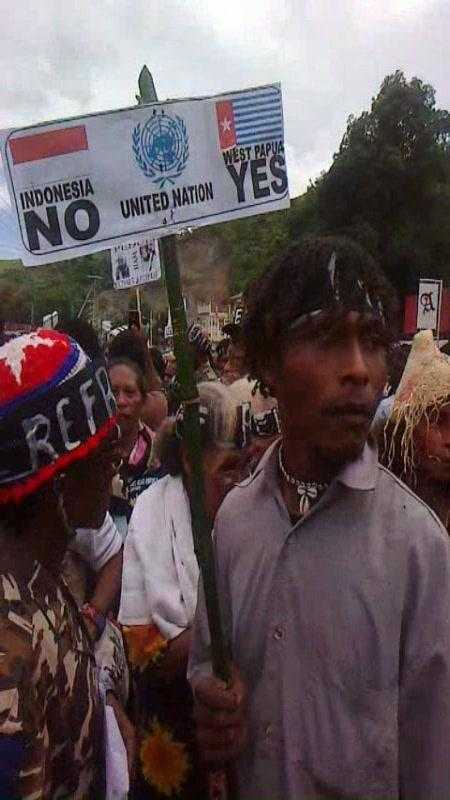
The Choice of Papuan People (Photo courtesy KNPB)

The inspiration of one young Tunisian who sacrificed himself in protest has spread from one Arab nation to another, in each country people coming to the profound realization, ‘if they can do it there, we can do it here.’

The largely peaceful demonstrations have not had an Arab or a Muslim character. Rather, common to all these peaceful revolts is a pent up desire for freedom and a new sense that change is possible.

We have seen similar uprisings which have swept vast areas:  the East European spring in the late 1980’s; the anti-colonial movement that followed World War II.  These, like the “Arab Spring” were trans-cultural, and transnational.   They derived their power from a common frustration with abusive, and sometimes foreign rule and a conviction that, in the words of the revolutionary mantra, “a people united can never be defeated.”

So we are left with the question of whether this movement will be confined to
Arab peoples, and largely to Muslims.  Or will this struggle for democracy and respect for human rights extend to non-Arab and non-Muslim cultures and peoples who also have suffered under brutal rule?  Will Tahrir square be emulated in Beijing, in Tashkent, in Hanoi, in Vientiane, in Rangoon and Pyongyang.  Will the Papuans, Montagnards, Hmong and Karen draw inspiration from the “Arab Spring” and break the colonial chains that have enslaved them to demand genuine autonomy or even full independence?  The physical and cultural distance separating Papuans in the Puncak Jaya or Hmong in Phong Saly from the “Arab Street” may seem to place them
in different worlds but they have a common experience in their suffering under undemocratic rule.

Is the “Arab Spring” a harbinger for a “global spring” that challenges oppressive rule around the world? For now, we can only assume that autocrats around the globe are sleeping more fitfully.

May their nightmares come true.

Edmund McWilliams
Retired senior U.S. Foreign Service Officer

Agus Alue Alua: A life of dedication to the Papuan People

Obituary of Agus Alue Alua
A life of dedication to the Papuan People 

Agus Alue Alua was born on 13 September 1962.  He studied at the Catholic secondary school Dok V, Jayapura and later worked as a teacher, then spent three years studying at the Catholic University in Leuven, Belgium.

From 1997, he took part in discussions within Catholic circles about the need to wage a struggle for the rights of the Papuan people, always stressing the importance of eschewing violence and pursuing the path of peace.

During the reformasi era that followed in the wake of the downfall of Suharto, he made good use of the newly-found freedoms to discuss such issues as development and the basic rights of the people of West Papua. Under discussion at the time were two alternatives for West Papua, autonomy or independence from Indonesia.

Agus Alua was one of several Papuan intellectuals to be appointed to the Committee of 100 which held important talks with President B.J. Habibie on 25 February 1999.  According to a colleague, he impressed everyone as he spoke with conviction and dignity: ‘We want our freedom,’ he said. ‘We want to organise our own homeland.’

The meeting ended inconclusively. The Papuans were advised to go away and consider their situation but the talks were never resumed. He was one of the first Papuans following that aborted encounter with Habibie to spread the idea about the need for dialog with Indonesia.

Catholic church leaders made good use of the more conducive political atmosphere to discuss the role of the church in Papua’s political struggle. While Bishop Leo Laba Ladjar OFM who was then the Bishop of the Jayapura Diocese, was hesitant about siding with the Papuan people, Agus who was a lecturer at the STFT -Fajar Timur (the High School of Philosophy and Theology) at the time challenged these thoughts, warning that if the Church failed to side with the Papuan people, he and others would set up a Papuan Catholic Church.

At the historic Second Papua Congress in June 2000, Agus Alua was elected deputy secretary-general of the Central Council of the newly-created PDP, the Papuan Presidium Council, one of two Papuans from the Central Highlands, along with Tom Beanal, and two from the coastal regions, one of whom was Theys Hijo Eluay, who became chairman of the PDP. Theys was assassinated in November 2001 by members of the army’s elite force, Kopassus. As a member of the PDP Central Council, Agus Alua played a key role in drafting documents that gave voice to the need to struggle for the Papuan people’s aspirations.

He later became the Rector of STFT-Fajar Timor, where he had previously been a student, as well as Director of the Catholic Senior Seminary. He also wrote and published several books about the culture of the Dani people and about a whole range of Papuan political issues.

However, the Papuan spring ended in 2002 when Kopassus agents infiltrated the PDP leadership and set about destroying the movement from within. Some of its leaders withdrew, several died under mysterious circumstances, while others gave up the struggle and threw in their lot with Indonesia. Agus remained true to the Papuan struggle, using all means possible at home and abroad, frequently visiting countries in the Pacific and Europe to win support for the Papuan people.

When the Special Autonomy Law, OTSUS, was enacted in October 2001, a special council composed solely of Papuans, the Majelis Rakyat Papua, the Papuan People’s Council, was set up which he recognised as an institution of crucial importance in the fight for Papuan aspirations. He became its first chairman with the support of Bishop Leo Ladjar, a position he held for the first five-year term of the Council till shortly before his death.

He fought strenuously throughout his term to expose the malicious strategies of the central government which sought to undermine OTSUS. From the start, the central government had been half-hearted about OTSUS and had even delayed its establishment for several years, fearing that it might become a springboard for Papuan political aspirations One of the moves from the central government to undermine the unity of the Papuan people was the decision to split West Papua into two provinces which Agus Alua vehemently opposed. He continually worked hard to counter the government’s attempts to create divisions and conflicts among the Papuan people.

After the creation of the two provinces, he insisted that there should be a single MPR and whenever Jakarta pushed for policies to undermine OTSUS, he strenuously resisted, along with his close colleagues Frans Wospakriek, former rector of Cendrawasih University, and Hanna Hikoyobi who was deputy secretary-general of the MRP.

Among the many central government decisions he opposed was Presidential Decree No 77 which banned the use of Papuan symbols such as the Morning Star flag, the mambruk bird and the Papuan song, Hai Tanahku Papua, insisting that these were legitimate cultural symbols provided for within the terms of OTSUS. Another of his decisions was to make it obligatory for all positions of leadership in the Papuan provinces and regions to be held by indigenous Papuans.

Before ending his term as chairman of the first MRP, Agus oversaw the adoption of eleven recommendations. These recommendations included a declaration that OTSUS had been a failure and should be returned to Jakarta, that there should be an internationally-mediated dialogue, facilitated by a neutral third party, and that a referendum should be held on the question of Papuan sovereignty. These eleven recommendations comprehensively set forth the basic demands of the Papuan people and continue to inspire the Papuan struggle to this day.

Agus Alua was always steadfast in his support for Papuan efforts to make Special Autonomy a reality against constant obfuscations from central government, and continually used his outstanding intellectual abilities to promote Papaun interests and aspirations.

At the time of his tragic death, the second-term MRP was due to be inaugurated amid disputes about its membership, with Jakarta rejecting the appointment of Agus Alu and Hanna Hikoyobi. According to sources in Jayapura, these two had been elected as members of the new body, against the wishes of central government. The appointment of the second-term MRP is still in dispute; some of his colleagues believe that the pressures and intimidation he experienced at the time plunged him into deep depression, leading to his untimely death on 7 April. On that day, he was found lying on the floor at home and was rushed to hospital but was dead on arrival.

He is survived by his wife Cornelia Pekey and his three children, Liberta Claudia Alua, Liberto Claudia Alua and Hilerti Alua.

Carmel Budiardjo [with help from Octovianus Mote]

Create a website or blog at WordPress.com

Up ↑