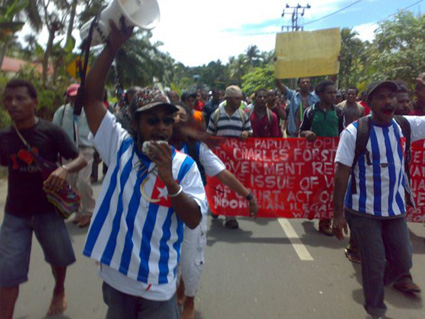
Papua New Guinea takes a regional lead in supporting a free West Papua

16 March 2013

 by Airileke Ingram and Jason MacLeod

Melanesian support for a free West Papua has always been high. Travel throughout Papua New Guinea you will often hear people say that West Papua and Papua New Guinea is ‘wanpela graun’ – one land – and that West Papuans on the other side of the border are family and kin. In the Solomon Islands, Kanaky, Fiji and especially Vanuatu, people will tell you that “Melanesia is not free until West Papua is free”. This was the promise that the late Father Walter Lini, Vanuatu’s first prime minister made.
benny powes 1
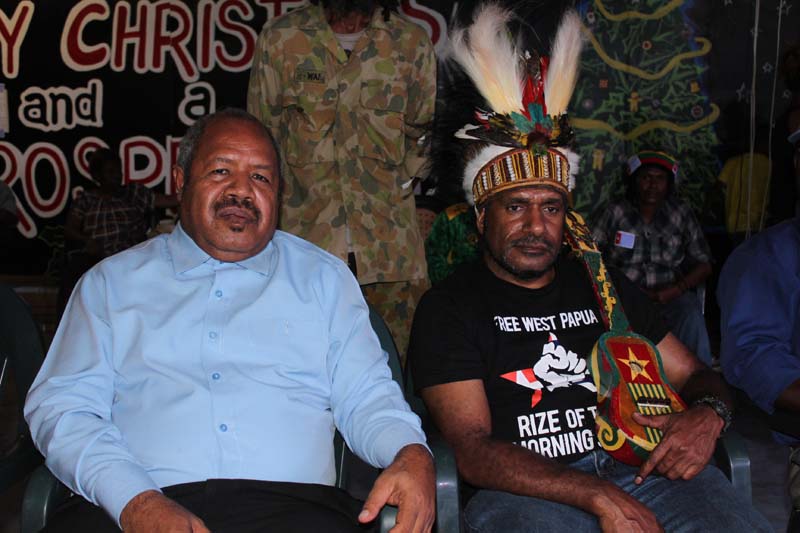
Above: Papua New Guinea National Capital District Governor Powes Parkop with Independence leader, Benny Wenda at the concert for a free West Papua, Jack Pidik Park, Port Moresby 6 March 2013.

Ordinary people in this part of the Pacific are painfully aware that the West Papuan people continue to live under the gun. It is the politicians in Melanesia who have been slow to take up the cause.

But that may be changing.

Last Wednesday 6 March 2013, the Right Honorary Powes Parkop, Governor of National Capital District, Papua New Guinea nailed his colours firmly to the mast. In front of a crowd of 3000 people Governor Parkop insisted that “there is no historical, legal, religious, or moral justification for Indonesia’s occupation of West Papua”. Turning to welcome West Papuan independence leader Benny Wenda, who was in Papua New Guinea as part of a global tour, the Governor told Wenda that while he was in Papua New Guinea “no one will arrest him, no one will stop him, and he can feel free to say what he wanted to say.” These are basic rights denied to West Papuans who continue to be arrested, tortured and killed simply because of the colour of their skin. Governor Parkop, who is a member of the International Parliamentarians for West Papua, which now has representatives in 56 countries, then went on to formerly launch the free West Papua campaign. He promised to open an office, fly the Morning Star flag from City Hall and pledged his support for a Melanesian tour of musicians for a free West Papua.

Governor Parkop is no longer a lone voice in Melanesia calling for change.

Last year Papua New Guinea’s Prime Minister Peter O’Neill broke with tradition and publicly admonished the Indonesian Government’s response to ongoing state violence, human rights violations and failure of governance in West Papua. Moved by 4000 women from the Lutheran Church O’Neill said he will raise human rights concerns in the troubled territory with the Indonesian government. Now Governor Parkop wants to accompany the Prime Minister on his visits to Indonesia “to present his idea to Indonesia on how to solve West Papuan conflict once and for all.” Well known PNG commentator Emmanuel Narakobi remarked on his blog that Parkop’s multi-pronged proposal for how to mobilise public opinion in PNG around West Papua “is perhaps the first time I’ve heard an actual plan on how to tackle this issue (of West Papua)”. On talk back radio Governor Parkop accused Australian Foreign Minister Bob Carr of not taking the issue of West Papua seriously, of “sweeping it under the carpet.”

In Vanuatu, opposition parties, the Malvatumari National Council of Chiefs and the Anglican bishop of Vanuatu, Rev. James Ligo are all urging the current Vanuatu government to change their position on West Papua. Rev. Ligo was at the recent Pacific Council of Churches in Honiara, Solomon Islands, which passed a resolution urging the World Council of Churches to pressure the United Nations to send a monitoring team to Indonesia’s Papua region. “We know that Vanuatu has taken a side-step on that (the west Papua issue) and we know that our government supported Indonesia’s observer status on the MSG, we know that. But again, we also believe that as churches we have the right to advocate and continue to remind our countries and our leaders to be concerned about our West Papuan brothers and sisters who are suffering every day.”

In Kanaky (New Caledonia) and the Solomon Islands West Papua solidarity groups have been set up. Some local parliamentarians have joined the ranks of International Parliamentarians for West Papua. In Fiji church leaders and NGO activists are quietly placing their support behind the cause even while Frank Bainimarama and Fiji’s military government open their arms to closer ties with the Indonesian military. This internationalisation of the West Papua issue is Indonesia’s worst nightmare; it follows the same trajectory as East Timor.

The West Papuans themselves are also organising, not just inside the country where moral outrage against ongoing Indonesian state violence continues to boil, but regionally as well. Prior to Benny Wenda’s visit to Papua New Guinea, Vanuatu based representatives from the West Papua National Coalition for Independence formerly applied for observer status at this year’s Melanesian Spearhead Group meeting due to be held in Noumea, New Caledonia in June, home to another long running Melanesian self-determination struggle. While in Vanuatu Benny Wenda added his support to that move, calling on Papuans from different resistance organisations to back a “shared agenda for freedom”. A decision about whether West Papua will be granted observer status at this year’ MSG meeting will be made soon.

In Australia Bob Carr may be trying to pour cold water on growing public support for a free West Papua but in Melanesia the tide is moving in the opposite direction.


free_west_papua_concert


The West Papua struggle is a difficult one and what outcome will emerge in the years to come is still hard to see. Allot of thoughts crossed my mind on Wednesday night when I attended the Benny Wenda, Free West Papua Concert. But from an Australian perspective, these comments by Daeron on an online forum summed it up quite well for me:


“Despair would be a natural but unproductive reaction to this SMH article yesterday, http://www.smh.com.au/opinion/politics/carr-helps-to-remove-the-blinkers-20120305-1ue67.html

Both Bob Carr and Mr Hartcher are products of an American fantasy about Indonesia which benefits Bechtel, Freeport, Exxon, NewMount, Conoco Phillips, to name a few.. Just find a membership listing of the US Indonesia Society lobby to get a full listing. But an Australian foreign minister needs to know the difference between illusion sprouted in US publications and reality, and he needs to understand our regional interests. Bob Carr is a wonderful choice for Indonesia, but not so much for us.I agree the Balinese are a nice people, but Jakarta is not ruled by the people of Indonesia, it is a oligarchy mostly of Indonesian Generals and US corporate interests. The effect of the 1975 invasion of East Timor was that Portugal Oil was replaced by Conoco Phillips, and the effect of the 1962 American deal (the “New York Agreement”) for the UN to trade our neighbours of West Papua to Indonesian rule, was that Freeport got to mine Papua’s gold & copper etc.The NSW Parliament is well aware that West Papua is victim of an illegal UN resolution (resolution 1752 (XVII)) which Australia supported in August 1962, an act which benefited the US corporations and Jakarta but not Australia or our regional interests. Colonialism is good business for Freeport McMoRan Copper & Gold Inc.; and it is the unspoken Australian policy for the indigenous population of West Papua.Over this coming year watch as Bob Carr, just like Kevin Rudd, refuses to answer a simple question; why did Australia support UN General Assembly resolution 1752 (XVII) ?
Posted by Daeron, Wednesday, 7 March 2012 1:49:53 AM”


But putting aside Independence hopes and geopolitical hurdles for a minute, why would a group of people be causing so many issues for Indonesia if they were happy?


.


Benny Wenda opened his speech with a story of how when he was 6 years old he witnessed his mother being struck down by the butt of a gun at the hands of Indonesian Military and then witnessed as two Aunties who came to help his mother were raped before his eyes. All this at the age of 6.


.


It is no wonder that experiences like this from many West Papuan’s have clearly driven them to dispute the fact that they had a legitimate say in self determination in 1962. Again, even if we accepted the UN resolution, has Indonesia given them appropriate rights and services to lead fulfilling lives?


.


I’m no authority on this issue and I’ve never been to West Papua, but as far as I know there are quite allot of unhappy indigenous West Papuan’s in the world today.


.


So what are they going to do about it? Well Governor Parkop announced on the night that he was going to be setting up a West Papua Office in Port Moresby. Globally as well they would be coordinating with the International Parliamentarians for West Papua, the International Lawyers for West Papua and International Musicians to ramp up the Global Campaign for West Papua’s Freedom.


.


I take my hat off to Parkop, this is perhaps the first time I’ve heard an actual plan on how to tackle this issue. Below are some pics of the night and here’s a good wrap up of Parkop’s speech here.


.


IMG_2504


IMG_2535


IMG_2563


IMG_2580


IMG_2597


IMG_2634


IMG_2681


IMG_2673


IMG_2708


IMG_2715

free_west_papua_concert

The West Papua struggle is a difficult one and what outcome will emerge in the years to come is still hard to see. Allot of thoughts crossed my mind on Wednesday night when I attended the Benny Wenda, Free West Papua Concert. But from an Australian perspective, these comments by Daeron on an online forum summed it up quite well for me:

“Despair would be a natural but unproductive reaction to this SMH article yesterday, http://www.smh.com.au/opinion/politics/carr-helps-to-remove-the-blinkers-20120305-1ue67.html

Both Bob Carr and Mr Hartcher are products of an American fantasy about Indonesia which benefits Bechtel, Freeport, Exxon, NewMount, Conoco Phillips, to name a few.. Just find a membership listing of the US Indonesia Society lobby to get a full listing. But an Australian foreign minister needs to know the difference between illusion sprouted in US publications and reality, and he needs to understand our regional interests. Bob Carr is a wonderful choice for Indonesia, but not so much for us.I agree the Balinese are a nice people, but Jakarta is not ruled by the people of Indonesia, it is a oligarchy mostly of Indonesian Generals and US corporate interests. The effect of the 1975 invasion of East Timor was that Portugal Oil was replaced by Conoco Phillips, and the effect of the 1962 American deal (the “New York Agreement”) for the UN to trade our neighbours of West Papua to Indonesian rule, was that Freeport got to mine Papua’s gold & copper etc.The NSW Parliament is well aware that West Papua is victim of an illegal UN resolution (resolution 1752 (XVII)) which Australia supported in August 1962, an act which benefited the US corporations and Jakarta but not Australia or our regional interests. Colonialism is good business for Freeport McMoRan Copper & Gold Inc.; and it is the unspoken Australian policy for the indigenous population of West Papua.Over this coming year watch as Bob Carr, just like Kevin Rudd, refuses to answer a simple question; why did Australia support UN General Assembly resolution 1752 (XVII) ?
Posted by Daeron, Wednesday, 7 March 2012 1:49:53 AM”
But putting aside Independence hopes and geopolitical hurdles for a minute, why would a group of people be causing so many issues for Indonesia if they were happy?
.
Benny Wenda opened his speech with a story of how when he was 6 years old he witnessed his mother being struck down by the butt of a gun at the hands of Indonesian Military and then witnessed as two Aunties who came to help his mother were raped before his eyes. All this at the age of 6.
.
It is no wonder that experiences like this from many West Papuan’s have clearly driven them to dispute the fact that they had a legitimate say in self determination in 1962. Again, even if we accepted the UN resolution, has Indonesia given them appropriate rights and services to lead fulfilling lives?
.
I’m no authority on this issue and I’ve never been to West Papua, but as far as I know there are quite allot of unhappy indigenous West Papuan’s in the world today.
.
So what are they going to do about it? Well Governor Parkop announced on the night that he was going to be setting up a West Papua Office in Port Moresby. Globally as well they would be coordinating with the International Parliamentarians for West Papua, the International Lawyers for West Papua and International Musicians to ramp up the Global Campaign for West Papua’s Freedom.
.
I take my hat off to Parkop, this is perhaps the first time I’ve heard an actual plan on how to tackle this issue. Below are some pics of the night and here’s a good wrap up of Parkop’s speech here.
.
IMG_2504
IMG_2535
IMG_2563
IMG_2580
IMG_2597
IMG_2634
IMG_2681
IMG_2673
IMG_2708
IMG_2711
IMG_2715

Testimony of Markus Yenu of his arrest and interrogation

Manokwari, 7th March 2013

Markus Yenu was arrested at the side of the road in from of Daniel Sakwatorey’s house (former political prisoner in Papua, 2008) at Sanggeng Manokwari West Papua. The arrest was by Manokwari’s Criminal Police Unit at 11.32am West Papua time, on the order of Manokwari’s Criminal Police AKP. KRISTIAN SAWAKI. The Manokwari Criminal Police officers were driving a black Inova with the number plate DS.9977.

According to Markus Yenu’s evidence (he’s the Executive Governor of the West Papua National Authority District 2 Manokwari) after he was arrested and taken to the police station at Manokwari, he was immediately taken to an interrogation room and asked to give information about a peaceful demonstration on the 17th January 2013 during which the morning star flag was flown. There were various sized flags flown, and also biased political speeches from several leaders from the Free Papua movement who were inciting people to overthrow the legitimate government.

Markus Yenu also gave evidence that when he was in the interrogation room at the Manokwari Police Station he was visited by Kombes (Pol) Yakobus Marzuki former chief of police in 2008 and now Director of Papuan Police Intelligence. Marzuki told Yenu:

  • Comprehensive data from the Police indicated Markus Yenu was involved with provoking the acts of arson and destruction that three police officers faced on the 5th December 2012 following the shooting of Thimotius Ap.
  • In the near future police plan to meet with Kesbangpol to get rid of all organisations that don’t support the Ideology of a United Republic of Indonesia (NKRI)
  • Eight people are already dead, but police and TNI will be pursuing and removing any subversive groups both in the forest and the city.
  • Whereas for Markus Yenu there was an order from police headquarters to disable him.

According to Yenu, the Director of Papuan Police Intelligence said many other things indicating a threat to human rights and democracy activists in Papua.

Yenu said that, ‘After me, the police will arrest another six people who have been identified as suspects

1). Frans Kapisa,

2). Billy Auparay,

3). Ottow Rumaseb,

4). Jakobus Wanggai,

5). Eliazer Awom, and

6). Zeth Wambrauw


Source: WPNA Manokwari


West Papua Report March 2013

This is the 107th in a series of monthly reports that focus on developments affecting Papuans. This series is produced by the non-profit West Papua Advocacy Team (WPAT) drawing on media accounts, other NGO assessments, and analysis and reporting from sources within West Papua. This report is co-published by the East Timor and Indonesia Action Network (ETAN). Back issues are posted online at http://www.etan.org/issues/wpapua/default.htm Questions regarding this report can be addressed to Edmund McWilliams at edmcw@msn.com. If you wish to receive the report directly via e-mail, send a note to etan@etan.org.

The Report leads with “Perspective,” an opinion piece; followed by “Update,” a summary of some developments during the covered period; and then “Chronicle” which lists of analyses, statements, new resources, appeals and action alerts related to West Papua. Anyone interested in contributing a “Perspective” or responding to one should write to edmcw@msn.com. The opinions expressed in Perspectives are the author’s and not necessarily those of WPAT or ETAN.

For additional news on West Papua see the reg.westpapua listserv archive or on Twitter.

CONTENTS

  • Civilians Suffer as Security Force Sweeps Perpetuate Cycle of Violence

UPDATE

CHRONICLE

PERSPECTIVE

Civilians Suffer as Security Force Sweeps Perpetuate Cycle of Violence

In late February, the Indonesian military (TNI) and National Police (POLRI) launched new “sweeping operations” in the Central Highlands of West Papua. The security force campaign follows the February 21 attack by the armed anti-Indonesian resistance which killed eight Indonesian military soldiers and two Indonesian civilians in Tingginambut, Puncak Jaya, reportedly carried out by Goliat Tabuni-led elements of the National Liberation Army of the Free Papua Movement (TPN-OPM). These latest Indonesian security force sweeps are disrupting civilian life in communities around Sinak, Gurage, Mulia and Tingginambut in Puncak Jaya District. Papuan leaders have condemned the violence and called anew for a Jakarta-Papua dialogue. (see for example https://westpapuamedia.info/2013/03/06/forkorus-regrets-the-death-of-indonesian-soldiers-and-civilians/ )

The latest “sweeping operation” parallels a similar ongoing operation in the neighboring Paniai area., where “helicopters belonging to illegal gold miners in Degouwo were again being used by Indonesian troops to support the operation.”

The West Papua Advisory Team (WPAT) condemns the February 21 violence. Such violent acts only perpetuate the cycle of violence that has trapped Papuans, particularly in the Central Highlands, for decades.

WPAT vigorously condemns the actions of the Indonesian state security forces which, regardless of the provocation, have a fundamental international obligation to protect civilian life. The seizure and destruction of civilian homes and communal buildings as well as destruction of civilian food sources inevitably will force the flight of civilians to inhospitable forests and mountains. Many of those caught in such a maelstrom will surely soon begin to die.

We call on governments, especially those like the United States which have partnered with Indonesian security forces , to use the influence garnered by such dubious cooperation to bring an end to these sweeps. The United States government, which condemned  the February 21 attack on the Indonesian military is obliged to forthrightly condemn and seek an end to the Indonesian security forces ongoing assault on innocent civilians.

We urge international bodies, especially the appropriate offices of the United Nations, including the Human Rights Commission, to turn their attention to these sweeping operations and which pose a lethal threat to large numbers of civilians.

Humanitarian mechanisms must be immediately established to provide for the welfare of civilians whose lives have been disrupted and the area must be opened to both the humanitarian offices that will undertake that vital work and to credible reporting by journalists and human rights reporters.

As of February 26, the Indonesian security force sweeps had burned at least 18 houses to the ground, destroyed five GIDI (Protestant) churches, and destroyed a library and two schools in Tingginambut, according to reliable church sources who relayed eyewitness accounts to West Papua Media.

The toll on local civilians posed by the military/police operations is grave: “Witnesses have also reported that soldiers are deliberately burning and destroying food gardens and shooting livestock, including over 100 pigs. There are fears of a major humanitarian disaster unfolding with the reports of the destruction of food gardens and livestock, an act of collective punishment on a civilian population,” writes West Papua Media.

Entire populations in villages the area of Gurake, Sinak, Tinggi Neri, Trugi and Nelekom have fled to the mountains. Several thousand people, mainly subsistence farmers, are said to live in the area. Townspeople from Mulia in Puncak Jaya are preparing to flee. As in the past, civilians who flee to the remote forests and mountains face possibly deadly separation from sources of food, shelter and medical care.

Another trademark of these sweeping operations, also employed in the current military/police campaign, is the prevention of reporting on developments by the authorities. The only media personnel allowed into the operations area are those with approval from the Indonesian army. Independent journalists and human rights workers have been prevented from traveling into the area by a de facto Military Operations Area being applied across the entire highlands, including the regional center of Wamena.

Papuan civil and religious leaders Rev. Dr. Benny Giay and Rev. Socratez Sofyan Yoman, among others, have pointed to the failure of Indonesian authorities to control the illegal sale of weapons in the Central Highlands as contributing to the February 21 attack. They have also noted the government’s long term objective of creating a new military command in the Central Highlands, an intention that is well served by violence in the area. “We believe that the Indonesian government and the security forces  are part of the problem of violence [emphasis in original] which has been created by the state, preserved by the state and allowed to continue in order to legitimize yet more acts of violence in the Land of Papua and to take advantage thereof in order to strengthen the security forces,” they wrote.  Both leaders called anew for “the Indonesian government to enter unconditionally into a dialogue based on the principle of equality between Indonesia and West Papua, with mediation by a neutral party, which is what happened in the dialogue between GAM (Gerakan Aceh Merdeka — the Aceh Liberation Movement) in Aceh. ” They urged the release of political prisoners and an end to the violence. Giay is Chair of the Synod of KINGMI Church, Papua; Yoman, Chair of the Executive Board of the Alliances of Baptist Churches in Papua.

UPDATE

Papuans Seek to Join Melanesian Spearhead Group

Radio Australia, on February 5 reported that West Papuans are seeking membership in the Melanesia Spearhead Group (MSG), a regional political and trade block which represents Melanesian peoples in the region, with the exception of the Papuan people in Indonesian-controlled New Guinea. The West Papua National Coalition for Liberation presented its petition asking to join the group to the MSG Secretariat in early February.

The MSG is comprised of four nation states: Papua New Guinea, Vanuatu, Fiji, and the Solomon Islands. The group also includes the FLNKS of New Caledonia. The inclusion of the FLNKS, a non-state actor, could serve as a precedent for inclusion of the Papuan petitioners.

U.S. Author Defames Papuan People; Ignores Consequences of Indonesian Occupation

Papuan civil society leaders strongly protested statements in a book by U.S.-based author Jared Diamond which portray Papuans (in both parts of New Guinea) as warlike and backward. Diamond’s argues in The World Until Yesterday that “most small-scale societies… become trapped in cycles of violence and warfare” and that “New Guineans (Papuans) appreciated the benefits of the state-guaranteed [Indonesian Government] peace that they had been unable to achieve for themselves without state government.”

Papuan leaders noted that Diamond ignored the extraordinary violence meted out to Papuans by Indonesian security forces since Jakarta forcibly annexed West Papua over four decades ago. Diamond also ignored Jakarta’s deliberate marginalization of indigenous peoples in favor of non-Papuan “transmigrants” brought to West Papua in a decades-long project that amounts to ethnic cleansing.

Among the many protests was one by Dominikus Surabut, currently jailed for treason for peacefully declaring West Papuan independence. He aptly compared the relationship of Papuans and the Indonesian state to South African apartheid. In a statement smuggled out of his jail cell, he said, “This is the very nature and character of colonial occupation of indigenous peoples, where they are treated as second class citizens whose oppression is justified by painting them as backwards, archaic, warring tribes — just as suggested by Jared Diamond in his book about tribal people.”

Diamond was sued for defamation by purported “sources” from Papua New Guinea for article published in the New Yorker magazine in 2008. While the suit was withdrawn, it is expected that it will be re-filed soon.

WPAT Comment: The U.S. government leaders, in justifying the betrayal of Papuan self-determination aspirations in the infamous New York Agreement of 1962, similarly demeaned the supposed backwardness of the Papuan people. Both  the U.S. then and Diamond in his recent analysis rely on defamation of the people being victimized.

See various statements by Papuan leaders at: http://assets.survivalinternational.org/documents/877/papuanstatementsupdated.pdf

Tensions Grow Along Indonesia-PNG Border

The Papua New Guinea government announced the deployment of new military forces to its border in order to protect PNG citizens located near the border from the Indonesian military. The surprising February 18 announcement was accompanied by a formal protest by PNG Prime Minister Peter O’Neill’s government over the Indonesia’s construction of new military posts along the border. The protest also addressed Indonesian military harassment of PNG citizens.

WPAT Comment: The Indonesian military has long operated smuggling operations across the Indonesia-PNG border and has regularly harassed Papuan refugees who have fled military pressure from Indonesia-controlled West Papua to Papua New Guinea.

CHRONICLE

A Half Century of Failure

Bobbie Anderson in Inside Indonesia provides a detailed and insightful portrayal of life in remote, rural West Papua. Anderson describes how life is extraordinarily difficult and dangerous for Papuans and writes that the population there is completely bereft of government services. The government’s neglect of the majority of Papuans who live in rural West Papua over a half century is perhaps the most devastating critique of Indonesian governance.

Urgent Appeals on Behalf of Papuans Detained and Tortured by Police

Amnesty International is calling for action to help two men detained in Jayapura. The February 25 Urgent Action states that “Daniel Gobay and Matan Klembiap are currently detained at the Jayapura district police station in Papua province. Police officers allegedly tortured or other otherwise ill-treated them and five other men while interrogating them about the whereabouts of two pro-independence activists.” While the other five were released, the other Gobay and Klembiap “have not received medical treatment and they have not had access to a lawyer since their arrest.”  The Asian Human Rights Commission (AHRC) also released an alert on the case, as well as a video with an interview with two of those picked up at the same time as Gobay and Klembiap. The two activists, Eneko Pahabol and Obed Bahabol, describe how they “were arrested and tortured by the police on 15 February 2013 on the false allegation of being related with two pro-independence activists.” The video is available on AHRC’s YouTube Channel on http://www.youtube.com/watch?v=eMI1HouWMv4.

Prison Torture

On February 22, AHRC has issued an Urgent Appeal on behalf of prisoners at the Abepura Correctional Facility. The appeal cites allegations of  torture by guards. It details how three prison guards “with the acquiescence of the head of the prison,” beat the prisoners “with bare hands as well as whipped [them] with thick wire until some parts of their bodies were bleeding. The guards did not give any medical treatment to the tortured prisoners.”

Papuans Behind Bars

Papuans Behind Bars published an “Update” in which it reports that “At the end of January 2013 there were 33 political prisoners in Papuan jails.”  The Update contains important information on prisoners, prisoner releases and ongoing and upcoming political trials in the region. Papuans Behind Bars is a new grassroots initiative of Papuan civil society groups working together as the Civil Society Coalition to Uphold Law and Human Rights in Papua. The project plans to “provide accurate and transparent data, published in English and Indonesian, to facilitate direct support for prisoners and promote wider debate and campaigning in support of free expression in West Papua.”

The project will publish records of over 200 current and former political prisoners on its website, which will go live in March.

Link to this issue: http://etan.org/issues/wpapua/2013/1303wpap.htm

Back issues of West Papua Report


Police question Papuan leader over peaceful demo ‘treason’

Written up Pacific Scoop from Social Media Reports by West Papua Media

March 6, 2013

Markus Yenu, Manokwari Governor of the West Papua National Authority (National Federated Republic of West Papua), was forced to appear at Manokwari Police Sector HQ  today (March 6) for questioning over makar (treason) charges relating to the organising of a peaceful mass demonstration almost two months ago.

The executive governor of the West Papua National Authority area 2, Markus Yenu, and the chairman of Solidaritas Pemuda Melanesia Papua Barat, Abraham Wainasiri,  lead a peaceful rally at Manokari on January 17. Image: WPM
The executive governor of the West Papua National Authority area 2, Markus Yenu, and the chairman of Solidaritas Pemuda Melanesia Papua Barat, Abraham Wainasiri, lead a peaceful rally at Manokwari on January 17. Image: WPM

Yenu has not yet been released, and no further information has yet been received about his status – whether he will be charged or released.

West Papua Media has contacted police in Manokwari without reply and the Papua Police Criminal Investigation chief in Jayapura – who claims to know nothing about Yenu’s whereabouts.

On January 17, a crowd of peaceful protesters calling for a referendum on the future of Indonesian-ruled West Papua assembled at a rally point in Manokwari.

The crowd – including students and workers – moved towards the Banyan Tree at UNIPA Manokwari together with the protest coordinator, Alex Nekemen, and speakers, among them Silas Ayemi, the area secretary of Bintuni WPNA),; Abraham Waynarisy (SH chairman Solidaritas Pemuda Melanesia Papua Barat SPMPB) and the pro-independence group KNPB.

Political speeches were made accompanied by slogans of “Papua Merdeka” (“Free Papua”) along the way.

The crowd marched around the city of Manokwari towards an open field.

In front of the office of the State Attorney of the Republic of Indonesia, Markus Yenu openly questioned bout the detainees after a an incident on December 14 – Melkianus Bleskadit, Rev. Dance Yenu and 5 students from UNIPA Manokwari who have been held by police for almost four months without charge.

Earlier story by West Papua Media


Biak District court decides to continue hearings against two KNPB Biak activists

from KNPB sources in Biak – verified by WPM

March 7, 2013

The Biak district court again carried out the trial against two Biak KNPB  (West Papua National Committee) activists, in the fourth hearing to hear the judge’s decision whether the case is continued or returned to the DA (District Attorney) because of incomplete material.

Biak Prosecutors indicted the two KNPB Biak activists, Barnabasl Mansoben and Paulus Alua, with charges under Indonesia’s national emergency laws for allegedly “intentionally carrying sharp tools and explosive bombs”, which carries a maximum 20-year prison sentence.

The lawyer for two of the KNPB activists said in their defence, the indictments were excessive, and with the absence of strong evidence to prosecute the two KNPB Biak activists, they appealed to the judge to release the two activists.

However, the judge rejected the lawyer’s submission to release the two activists, and said the trial will resume next week, to hear witnesses and examine evidence.

Meanwhile Apollos Sroyer, Chairman of KNPB Biak, said after the hearing that “this is the scenario of Indonesian police to criminalize peaceful movements of struggle performed by the KNPB.”

Create a website or blog at WordPress.com

Up ↑