Komnas HAM meets military commander to discuss human rights violations
Jayapura: Many human rights violations are now confronting the National
Human Rights Commission – Komnas HAM in Papua. Commission deputy
chairman Nurcholis paid a visit to the command centre of the Cenderawasih Military Command to discuss two important problems.
The first was about the security situation at Freeport. ‘A few weeks ago, we
received complaints from workers at Freeport about the security situation at the company and this is now being discussed with the military commander.’
The security problem began when some Freeport employees made complaints
about the situation and the families of the victims went to Komnas HAM, seeking assurances that legal processes would begin quickly.
The second problem relates to the shooting of members of the TNI in Puncak Jaya. But apart from these casualties, there were four civilian casualties, a woman and three small children. ‘We need to know whether these casualties were wounded or had died,’ he said. Nurcholis stressed the need for caution about information being received, so as to correctly determine what measures need to be taken. ‘We are now gathering more complete information with the help of the human rights commission in Papua, to ensure that speedy action can be taken to solve the issue.’
Meanwhile, there are reports that some villagers have fled their homes because of armed skirmishes between civilian forces and the TNI in Puncak Jaya. He said: ‘If this is indeed happening, we hope to solve the problem so that our activities can focus on restoring security,’ he said.
No access to Puncak Jaya
He said that Komnas HAM is not at present able to gain access to Puncak Jaya and can only establish contact by phone. ‘The core of the problem needs to be dealt with through dialogue while recognising that this will not be easy. The next move will be to consult with the ministry of political and legal affairs, with dialogue being the only choice, and one that is supported by most of those involved so as to ensure that the difficulties can be overcome.’
Komnas HAM is checking whether the victims are civilian or military and whether the victims were wounded or have died. When asked how long this would take, Nurcholis said that he could not say.
‘The best indicator for solving human rights issues is not fixing a time frame but finding the best way to solve the problem ,’ said Nurcholis.
ARE AUSTRALIAN MEDIA REPORTS THAT KINGMI CHURCH SUPPORTS PAPUA MERDEKA TRUE?
The KINGMI Church in the the Land of Papua has raised its concern about a report in an Australian newspaper on 7 July alleging that the KINGMI Church is using special autonomy (OTSUS) funds it receives from the provincial government to fund activities to prepare for Papuan
independence and secession from the Republic of Indonesia. The Synod of
the Church referred to Major-General Erfi Triassunu, the military
commander of the Cenderawasih Military Command XVII, as the source of
the report.
The KINGMI Church has asked the military commander to acknowledge
responsibility for the statement.
This was stated by the chairman of Commission A of the Papuan
Legislative Assembly, the DPRP, Ruben Magai, along with commission
member, Ignasius W. Mimin during a meeting with leaders of the KINGMI
Church Synod.
When Bintang Papua sought confirmation from the military commander that he thought the KINGMI Church was separatist, he denied it, saying that he had never said this. All he wanted was that the conflict should not be used by a third party to disrupt peace in the Land of Papua.
The military commander said that he was frequently asked for assurances of security from churches that were being overwhelmed by internal conflicts, but he had asked the provincial governor to resolve these matters.
‘It is not the task of TNI (Indonesian army) institutions to resolve conflicts but we are prepared to help if requested to do so by the regional government,’ he said.
Ruben Magai said that by making such a statement, the military commander was brushing aside a number of serious problems in Papua such as corruption and recent shooting incidents which the Indonesian government had failed to resolve. He said he would be calling on the military commander to acknowledge responsibility for making a statement that stigmatises the KINGMI Church for allegedly using OTSUS funds to fund Papua’s independence as well as calling on the provincial government to give a clarification about OTSUS funds being used for religious guidance in the Land of Papua.
The chairman of the Synod of the KINGMI Church, Dr Beny Giay, said that
he had conveyed his concerns about the military commander having
disseminated a political document which apparently says that the KINGMI Church had been set up to use money received from the government to support Papuan independence. ‘The military commander’s document was leaked to us and when we checked the report, it was confirmed. We believe that what has been reported in the Australian media is indeed correct.’
Meanwhile, the legal advisor of the KINGMI Church Synod, Benny W.
Pakage, said he had called on the military commander to explain what the legal basis was for his statement. ‘We want to know what his intentions are,’ he said.To indicate their rejection of such a statement, they are planning to hold a demonstration and prayer meeting outside the DPRP office on Wednesday.
The deputy chairman of Commission IV of the Indonesian parliament, Firman Soebagyo, said that Freeport’s IPPKH (Forestry Area Use loan) has done nothing to improve conditions for the local communities and the company has failed to involve local human resources and the economic community in general in the areas, with the people continuing to be very poor.
The environmental impact has led to the loss of vegetation and biodiversity in the protected forestry areas that have been exploited. ‘The quality of the water has deteriorated and the environment and mangrove forests have been damaged downstream of the river.’
He said that as a member of Commission IV, he was very concerned about Freeeport’s IIPKH license which has caused problems for local development and the welfare of the local communities. He quoted forestry ministry data that indicated that Freeport was one of thirteen companies exploiting forestry areas which includes 10,000 ha in Mimika and another 202,980 ha in Mimika, Paniai and Jayawjaya.
JUBI reported that members of the commission had gained access to data that Freeport does not have license to operate in protected forests from the forestry ministry as required under Law 41/1999. The company has been operating in Papua since 1967 which means that the world’s biggest mining company has not been paying the required taxes known as Non-Tax Levies to the State (PNBP) as a result of which the country has suffered the loss of tens of billions of rupiahs. The company has ignored two requests regarding this license.
Firman also said while Freeport contributes Rp.400 billion annually to the local people, the facts on the ground show that the local people are still suffering, while children are unable to get a decent education. He said that with the seas having been turned into dry land because of the impact of the tailings, Freeport should be held accountable for damaging the biodiversity and destroying people’s livelihoods. He would therefore recommend that the government should stop issuing any more licenses to the company.
Member of Commission IV of the Indonesian Parliament, Markus Nari, has reported that Indonesia has suffered the loss of Rp 30 trillion as a result of Freeport Indonesia ‘s failure to work on the basis of a licensing permit to operate within forestry areas known as Regulation in lieu of Law (Perpu) Ijin Pinjam Pakai Kawasan Hutan, despite two official requests from the Indonesian forestry minister.
Commission member Markus Nari, made this statement during a visit to Timika, to see the tailings waste spilling into the Ajkwa River. He pointed out that all mining companies which operates within forestry regions must be in possession of an IPPKH. ‘The company has been pressed twice by the forestry minister to obtain this license but has until now failed to do so. Instead of being requested for a third time, the company should be sent a very strong warning,’ he said.
According to information received by JUBI, Freeport Indonesia is using of 202,000 ha of land, much of which is adjacent to the Lorenz National Park. There are altogether thirteen companies operating within these protected forestry areas, including Freeport.
Nari said that he had received reports from local communities during his visit to the area that the forests had been damaged, while silt had affected the depth of the river and the nearby sea.
He said that the team from parliament and the forestry ministry had paid close attention to Freeport’s utilisation of forestry areas, and had seen the impact of the tailings in silting the estuary and the sea.
by Nick Chesterfield, with local sources and agencies
WestPapuaMedia.Info – Indonesian Army (TNI) troops have shot 3 young children and a mother in Puncak Jaya, West Papua, in the latest atrocities carried out during a two-week military offensive aimed at ending armed resistance to Indonesian Rule over the occupied colony.
Ny Dekimira, 50, was hit on the right foot, and the three children – Jitoban Wenda 4, and their neighbors Dekimin Wenda, 3, and Dimison Wenda, 8 – all had bullets hit their left legs after Indonesian troops fired indiscriminately into the honai (huts) just before dawn on July 14, according to local witnesses.
Credible reports about the scale of the offensive are beginning to filter through from the remote and inaccessible area about the scale of the offensive The Indonesian government has closed off access to the Tingginambut district to both Indonesian and foreign human rights and media observers, and local activists have had to march for days across rugged terrain to get out verified information. Local human rights observers and Papuan activists have independently reported to West Papua Media that TNI headquarters staff have threatened their safety if they alert journalists to abuses carried out by Indonesian security forces against West Papuan people.
Undeterred, the mass based Papuan activist network West Papua National Committee (KNPB) have accused the Indonesian Military “under the regime of General Susilo Bambang Yudhoyhono”
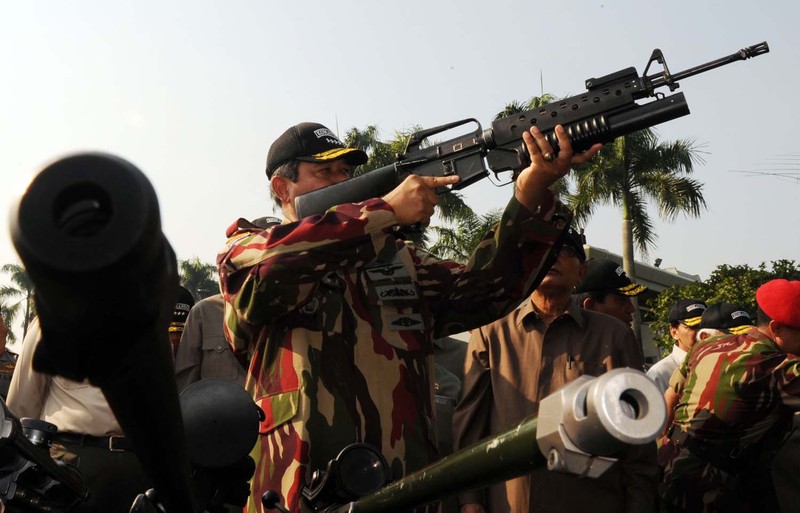
General SBY - Military approach will not solve Papua's problems
of manipulating the situation in Puncak Jaya to conduct military domination and control of the local population, despite the recent public relations offensive that it was engaged in “bakti” social service campaigns to help the people. According the KNPB, the TNI should not cover up their mistakes and militarism by engaging in social activities – they should cease military activities on civilians altogether.
“Their reasons make no sense, because it’s so funny that the military themselves who set fire to the houses of citizens in almost all settlements, Indonesian military who burned alive the people’s animals, burned residents’ gardens; and now the TNI and Police are trying to justify themselves as heroes by playing a cheap propaganda in the media, ” said a KNPB spokesperson on Saturday.
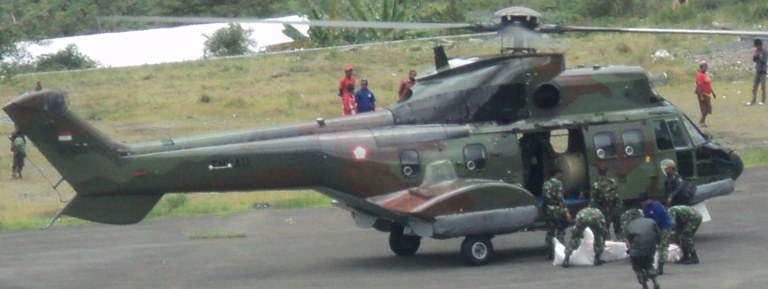
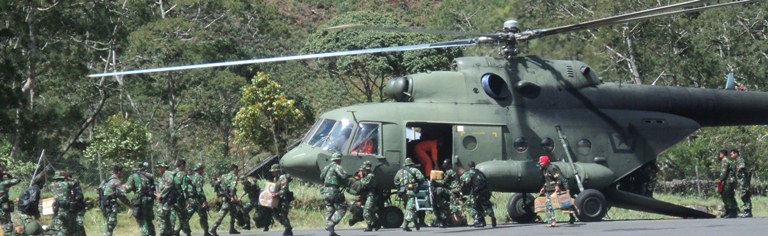
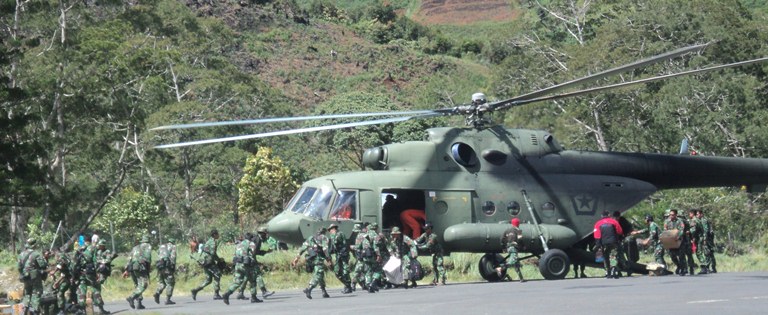
Activists from the area have provided photographs to West Papua Media
General SBY – Military approach will not solve Papua’s problems
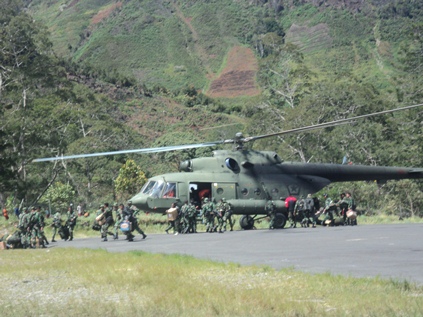
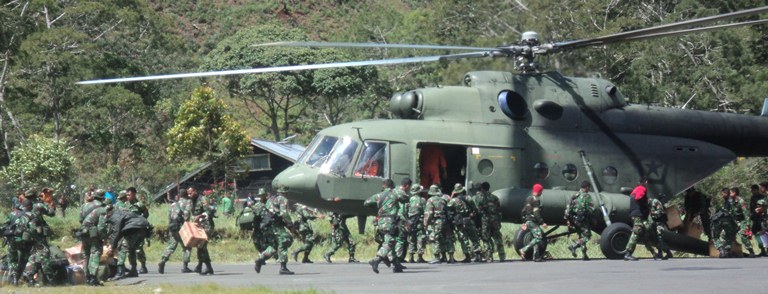
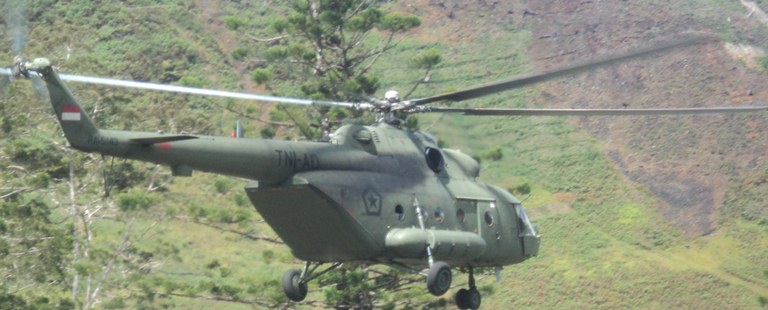
showing the fully armed troops previously working on the Bakti projects suddenly boarding Puma helicopters in transit to the combat zone around Kalome.
TribuneNews.com quoted the TPN Secretary General for the Highlands Area, General Anthony Wenda, saying that villagers reported the shooting in Kalome on July 7 happened before dawn when residents were still asleep. “At that time, we’re on guard night and day in Kalome, and a barrage of bullets from the TNI were directed into a house of children and the elderly,” said Wenda to Tribunnews.com. “We always will be ready to make contact with TNI weapons until we are free, because this is the struggle of our people of West Papua.”
After this shootout, the force reportedly involving over 600 soldiers from the notorious 753 Battalion based in Nabire, have sought to enforce their control over the rugged and remote district. 753 Battlalion’s operations in the Kalome area reached international infamy in 2010 when troops tortured and killed Rev Kindeman Gire, and also with the torture of Tunaliwor Kiwo. Kiwo’s torture, captured on video and uploaded to Youtube, created outrage that shone an international spotlight on the TNI’s behaviour against civilians in Papua. The Indonesian government was later caught red-handed as it switched the defendants in the torture trial widely seen as farcical, and ran a military trial on issues of discipline instead of human rights abuses. Since this time, TPN fighters been permanently around the village for protection. However, the TPN are poorly armed and their hardware is no match for a fully equipped modern military.
The current offensive comes as the Indonesian military is attempting to convince international observers that it is improving its human rights practice. Last week, as troops were engaging both civilians and fighters from the National Liberation Army (TPN-PB), the commander of the TNI in West Papua,
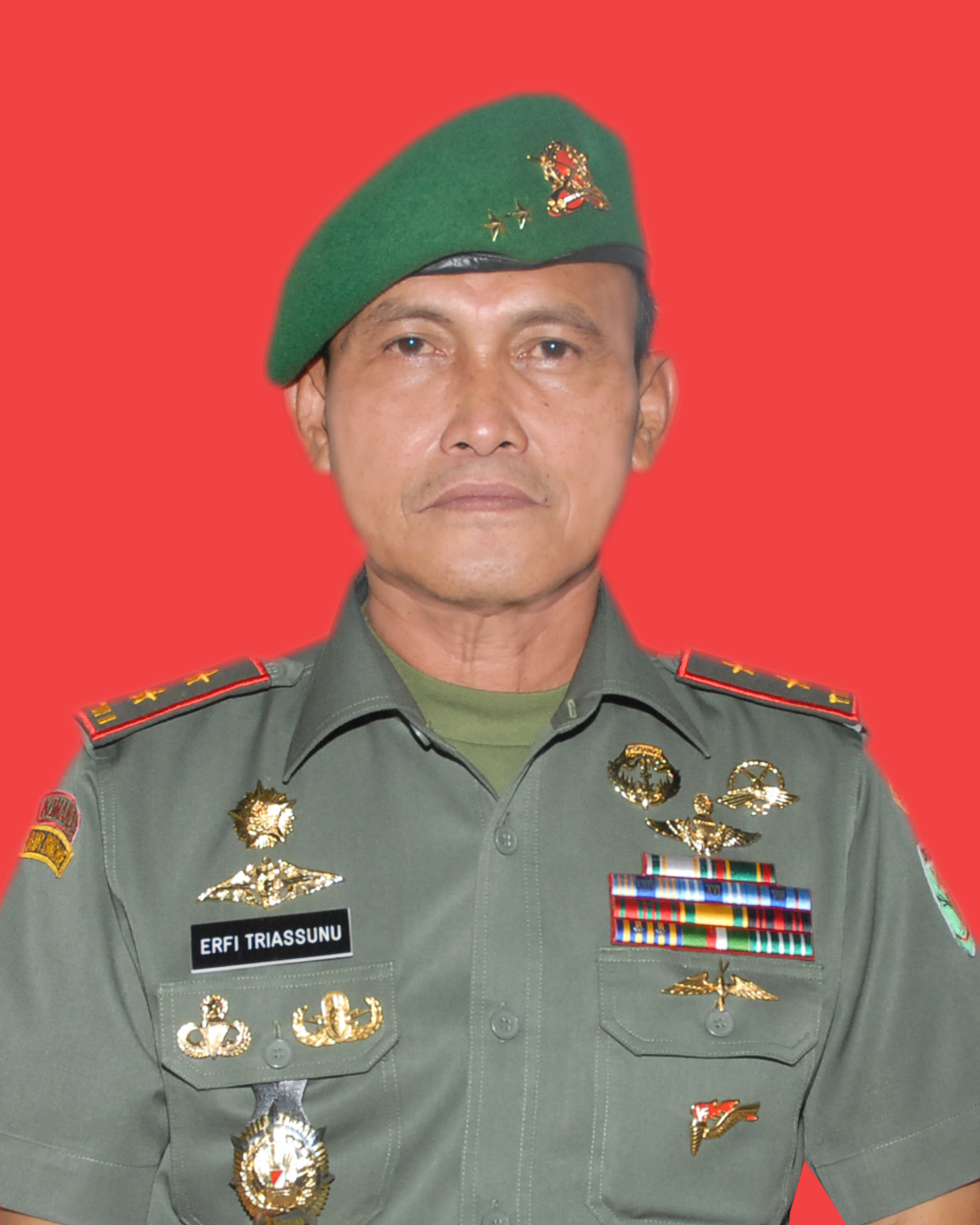
Erfi Triassunu - duplicitous
Major General Erfi Triassunu, was duplicitous in speaking about ending impunity and abuses by its soldiers at the Jakarta-sponsored Papua Peace Network (Jaringan Damai Papua or JDP) conference in Jayapura. Dr Neles Tebay and the Indonesian Institute of Sciences (LIPI), the organisers of the conference, were apparently unaware of the contradiction at this time, a contributing factor in the boycott or skepticism of the Peace Talks by the majority of Papuan representative organisations.
Yet according to the KNPB, one of the several sectors suspicious of the JDP, this peace process is illegitimate. “Do not imagine Peace (will be brought) by the JDP, Indonesian Government through Governor, DPRP, TNI or the police in Papua. Because in reality, Papua is a military zone by their physical and systematic actions done to destroy the Papuans and to control this region for the glory of foreign investors.”
According to Tribunnews.com, Maj-Gen Triassunu conceded that troops may have shot the Kalome villagers. “The possibility exists, but we have not received a report from our post in Puncak Jaya”. Triassunu denied the incident in Kalome was proof that civilians were targeted. “We just pursued the TPN OPM in mountainous regions, because Papua is part of the Unitary Republic of Indonesia,” he told Tribune News.
However, the Head of Information Department of the Army (Kadispenad) Brigadier General Wiryantoro would not comment on this allegation. “It’s related to operations of TNI forces deployment. When it comes to coaching the Army personnel, or related to the pure strength of the army, I can not answer” (Tribunnews.com)
When contacted by West Papua Media, no spokespeople for either the Indonesian military or Police made themselves available for comment on the allegations of the offensive, nor were replies made to telephone voice and text messages, or emailed questions.
West Papua Media also has made a decision to protect the identity of its sources*, as they have reported significant threats to their safety. Political activists reporting on the events have also come under significant threat. Victor Yeimo from the KNPB reports that when the Press Conference for local and national journalists to report on the Puncak Jaya incidents was called, phone and physical threats were received from persons claiming to be Pangdam (Indonesian Army Regional Commander), and Police. Yeimo reports that these callers forced KNPB to cancel the press conference about the case in Puncak Jaya. “Many journalists did not come after they terrorized by the Indonesian Military,” said Yeimo.
Siege Conditions may create humanitarian crisis
Credible local clandestine activists have relayed reports to West Papua Media of the TNI laying siege to several villages in the immediate area of Kalome, but they cannot get close enough to verify any casualties, displacement or destruction. With village sieges and actions on other villages in the past having caused significant displacement, local human rights observers fully expect the civilian death toll to rise significantly.
Hundreds of people have reportedly fled to neighbouring villages or to the hills, and observers have expressed concern that in the depths of winter, with their food crops destroyed, locally people internally displaced who may have no alternative to seek refuge in higher ground, may succumb to starvation or exposure. The areas high in the cloud forests and above the treeline are not suitable for sheltering large numbers of people, as they have been denuded by countless thousands of internally displaced refugees from previous military offensives.
Since the first aerial bombing campaigns by the Indonesian Air Force in 1978 in Puncak Jaya, almost every year from July to August, the TNI has launched offensives against civilians across the highlands. An identical offensive in 2003 was investigated by Komnas HAM (Indonesian National Human Rights Commission), which found that the Australian-trained Kopassus special forces committed gross human rights abuses and crimes against humanity. Similar offensives occurred in 2005, 2006, and 2007, which forced several thousand people into famine conditions high in the mountains, above the treeline. Last year also marked a particularly brutal operation, only noted by foreign media due to the inescapable viral distribution of the torture videos.
In light of the allegations of brutality by the TNI in Kalome, independence activists are also challenging the notion that the armed resistance practiced by Tabuni’s forces is terrorism. According to a KNPB spokesman, “The TPN under the Goliat Tabuni continues to struggle, not for a personal profit nor to legitimise the habit of TNI and POLRI to obtain security protection payments. The struggle is resistance to colonial occupation by Indonesia of West Papua, especially in Puncak Jaya … the reason the TPN was formed”
The recent deaths of TNI and Police.in Puncak Jaya is the fault of the generals in the view of the KNPB, who say that their policies and command structure sacrifice the members of it security apparatus. “Victims will continue to fall if SBY and (TNI Command) prioritize militaristic ways to solve West Papua’s problems, by dropping hundreds of soldiers everyday to Puncak Jaya”.
“If SBY does not take political will to solve the problem of West Papua immediately (by allowing an) act of self determination via a referendum then human rights violations will continue to occur,” stated the KNPB spokesman.
West Papua Media was this week contacted by a retired European missionary who had formerly served in Puncak Jaya regency who was concerned about the current situation. He offered the following comments on condition of anonymity, as he is concerned for reprisals for his former colleagues:
“Burning villages, causing people to flee with nothing but the clothes they wear, creating absolute terror amongst ordinary people, condemning babies to die starving and frozen hiding from the soldiers high in the mountains, killing and torturing priests and laymen alike… who are the real terrorists? This is not new, this slaughter happens every year since Indonesia first came – they are not hunting guerrillas, they are hunting Papuans until they are dead. Whilst we might not always agree with the strategies employed by TPN, and that we pray for a peaceful solution, they are a legitimate army of national liberation there to protect their people in the absence of any international concern.”
West Papua Media will continue to provide monitoring and coverage of this evolving situation. Please send any tips or corrections to editor<at>westpapuamedia.info
*Please note: bona fide journalists can be provided with sources if they are doing a story on this issue, but for their safety, their identities are strictly not for publication.





 West Papua Media Alerts