This is raw footage of Wednesday’s attack by the Indonesian military and police on the Third Papuan People’s Congress in Jayapura. The footage shows people dancing, soldiers closing in, and gun shots. The video was shot by several observers. The last sequence was shot while the camera person was hiding from gunfire. Police have now confirmed that five people were killed in the attack – human rights groups say it was more.
Congressman Faleomavaega announced today that he has sent a letter to Ambassador Dr. Dino Patti Djalal of Indonesia raising concerns about the safety and treatment of Mr. Forkorus Yaboisembut and many others who were arrested at the recent meeting of the Papuan People’s Congress in West Papua. It has been reported by the international media that the Indonesian Armed Forces and police have beaten and arrested hundreds of civilians who attended the meeting.
The full text of the Faleomavaega’s letter, which is copied to U.S. Ambassador Scot Marciel to Indonesia, is included below:
Dear Mr. Ambassador:
I am writing to request your intervention in ensuring the safety and the humane treatment of Mr. Forkorus Yaboisembut and many others who were arrested on Wednesday, October 19, 2011, at the third meeting of the Papuan People’s Congress in West Papua.
According to numerous media outlets, it has been reported that the Indonesian Armed Forces (TNI) fired shots during the meeting where a crowd of thousands of defenseless and unarmed civilians were engaged in peaceful political assembly. While the crowds dispersed after the shots were fired, many West Papuans, including journalists, were attacked and apprehended by the Indonesian military and police.
Enclosed are photos that display the heavy military presence of the TNI and police at the meeting prior to the chaos. Clearly, the presence of the Indonesian military was to intimidate the peaceful citizens, which is a continuation of the human rights violations by the TNI as reported in the U.S. State Department 2010 Human Rights Report.
Media reports also continue to circulate that Imam Setiawan, Chief Police of Jayapura Province, may have played a significant role in the attacks given his reported links to the death of a West Papuan leader, the fatal attack on a journalist reporting from West Papua, and many West Papuans attacked and killed within the past few years.
I have very serious concerns in the matter and I do not condone the serious acts of violence by the TNI and police on the peaceful demonstration by unarmed civilians who were simply voicing their opinions about the failure of the Government of Indonesia to seriously implement the Special Autonomy law for West Papua. It is obvious the actions by the TNI and police are contrary to the commitments made by President Yudhoyono to solve the issues in West Papua in a “peaceful, just, and dignified manner.”
For these reasons, I am concerned about the events that have transpired and I want to be assured by the Government of Indonesia that Mr. Yaboisembut and others will be treated humanely while in custody and that you will work for their release. I would like to meet with you sometime early next week to discuss the matter further.
The violence in West Papua this week is deeply worrying – and raises uncomfortable foreign policy questions for the Australian government, writes Senator Richard Di Natale
Yesterday afternoon news reached my office that unarmed Papuans — women, young people, church leaders, academics, tribal elders — and at least one Australian citizen, were being shot at by the Indonesian security forces.
We now know that at least four people are confirmed dead, scores severely wounded and hundreds have been detained at the police station in Jayapura, the capital of West Papua.
We are deeply concerned that a number of these people including Forkorus Yaboisembut, the Chair of the Papuan Customary Council, were beaten or tortured. Their crime? Reading an aspirational declaration of independence and meeting to discuss how West Papuans might peacefully secure basic freedoms that you and I in Australia take for granted.
It is not my place to get into the politics of independence. That is for the Papuans to decide. It must be said, however, that until there is a free and fair vote of all eligible Papuan citizens in the territory, any claim by the Indonesian government that there is democracy in West Papua will be highly contested.
The fact is that the Australian government and many other western countries were party to a fraudulent transfer of sovereignty during the 1960s. That is not hyperbole. It is fact. Professor Pieter Drooglever and Dr John Saltford have separately documented the travesty of justice that unfolded in West Papua during the transfer from Dutch to Indonesia rule. Less than 0.01 per cent of the population participated in the so-called Act of Free Choice in 1969 and those that did were forced to do so.
But this week’s peaceful gathering at Zaccheus Field in Abepura was not about the past. It was about the kind of future that West Papuans want. The Papuans’ desire for freedom is irrepressible. Many of the civil and political rights Papuan people want — like freedom of expression, the release of political prisoners, an opening up of the province to foreign media, and respect of land rights — could be realised within the framework of the Indonesian state. By shooting and jailing Papuans who peacefully demand these legitimate rights, the Indonesian government is creating a bigger problem and fuelling political instability.
These events in our nearest neighbour raise serious questions back home. We are we providing funds, training and equipment to the Indonesian Military (Tentara Nasional Indonesia, or TNI) and the Police force, including the counter-terrorism police (Detachment 88). There is mounting evidence that they are anything but a positive force for human rights in the region. By furthering our close military ties, we become complicit in acts of repression by the TNI such as that unfolding in West Papua today.
The Australian government has been secretive with regards to these links. We don’t know exactly what kind of military assistance is being supplied to the TNI and the police. The Australian government needs to come clean about the extent and nature of our level of defence cooperation with Indonesia. The shootings in West Papua — and indeed in other places in Indonesia — raise serious questions about what, if anything, the Indonesian military and police have learnt from East Timor. And whether our own government has learned anything, either.
One thing we do know from East Timor is that when violence like this occurs and political rights are continually repressed you can guarantee that West Papuan resistance will continue and eventually become a mainstream issue. West Papua is on our doorstep. I hope we can be good neighbours.
We can not ignore West Papua any longer, and we need to send the strongest possible signal to the Indonesian government that violent repression of peaceful meetings, people merely exercising their right to free speech and assembly, is totally unacceptable.
Indonesia insists it is a democracy. Its constitution guarantees all its citizens the right to free speech and free assembly. We should hold them to this promise by immediately suspending all military assistance to and cooperation with Indonesia. There is no compelling evidence that on the balance of things Australia’s military assistance in Indonesia has improved human rights. I fear that our anti-terrorism support is sometimes being used to harasses and intimidate human rights defenders.
I want to be a part of a Parliament that can encourage the Indonesian government and the West Papuan people to find peaceful and democratic ways to address the root causes of conflict in West Papua. Guaranteeing free speech and releasing political prisoners would be a good first step. The President has promised an open dialogue, and he must keep that promise.
In the meantime those of us in Parliament need to seriously reflect on the kind of relationship we want with Indonesia. For the sake of our West Papuan neighbours, and for Australia’s long-held commitment to human rights, we must be prepared to take a bold stand.
CURRENT: Arrests
Anywhere between 300 and 800 activists arrested, most released
Core group of 5 in custody at least but could be more, all feared tortured:
– Forkorus Yaboisembut – elected as leader of the broad based movement for peace and justice – possibly paralysed witnessed by another detainee
– Edison Waromi – deputy leader
– Argus Krar
– Selfius Bobii
– Dominikus Sorabut
Released
– Abraham Kareni (who’s son lives in Melbourne) with fractured skull
Charges include treason, rebellion, crimes of hatred against the state. These are colonial laws left over from the Dutch era and they carry long sentences — in some cases up to 20 years.
Police violence, dead and wounded DFAT have confirmed four people are confirmed dead, activists claim six
People identified (all from Petapa or family of:
– Dani Kabepa
– Yakovus Sabonsaba
– Mathias Maidepa
– Martinus Siep
– Tanepi Kobeta
– One additional unidentified member of Petapa, the West Papuan paramilitary guard formed to protect Forkorus Yaboisembut, the man delegates elected as their leader.
Members of the community security force (Petapa) are arrested. Photo: West Papua Media Alerts
–
Claims:
– Numerous people have been savagely beaten, many are in hiding for fear of arrest or worse
– Unverified claims people were shot at point-blank range and bundled into armoured personnel carriers and other vehicles.
– Five people at the Dian Harapan Hospital suffering several wounds: ”One is a woman, Ana Ana Adi, 41. She has got wounds at her right thigh. Pilatus Wetipo, 40, was shot in the right leg. Wiler Hobi (22) has some wounds in his head because of being beaten by the weapon, the other two have blistered wounds
– four people in Sabron Yaru wounded
Members of the community security force (Petapa) are arrested. Photo: West Papua Media Alerts
Reports of violence by Indonesian troops continue to emerge from West Papua. New Matilda is in contact with local sources. We’re publishing regular updates on the situation here. (Warning: graphic content)
On Thursday, New Matilda published a report on the violence at the Third People’s Congress in West Papua. Indonesia military and police opened fire on participants and took activists and leaders into custody. Reports of fatalities and injuries continue to emerge from Jayapura.
New Matilda is in contact with local sources and will continue to update this page as new information emerges.
UPDATE, Friday 21 October, 10am:
This is a phone interview with journalist Alex Rayfield.
“Ferry Marisan, the director of Elsham — a leading human rights organisation based in the capital, Jayapura — has said that six people are confirmed dead.
“We think that a couple of people were shot as the security forces raided the stage, and some later. There are also lots of people with gunshot wounds, some of whom are in hiding and too scared to get medical assistance.
“We’ve had multiple reports that there were 800 people in jail. Many of those have been released, but a core group is still detained, charged with a range of offences including treason, rebellion, crimes of hatred against the state. These are colonial laws left over from the Dutch era and they carry long sentences — in some cases up to 20 years.
“It’s important for people to know that [Congress] is not a radical fringe movement. It’s made up of mainstream Papuan society: academics, church leaders and senior tribal leaders. In fact the radical fringe stayed away from this event because they think it’s not radical enough. So if the Indonesian government thinks this is a minority view, they are sadly mistaken. It is a mainstream view.
“Meanwhile, we should add for Australian audiences, that the strike continues at the Freeport mine [which is part owned by Anglo-Australian company Rio Tinto]. The two events are intimately connected.”
For more information on the Freeport strikes read New Matilda’s coverage here andhere.
UPDATE Friday 21 October, 4.30PM These photos were sent by a credible source to West Papua Media Alerts and allegedly show injuries suffered in police custody. They have not been verified by New Matilda.
UPDATE, Friday 10am: The following is a phone interview with journalist Alex Rayfield.
“Ferry Marisan, the director of Elsham — a leading human rights organisation based in the capital, Jayapura — has said that six people are confirmed dead.
“We think that a couple of people were shot as the security forces raided the stage, and some later. There are also lots of people with gunshot wounds, some of whom are in hiding and too scared to get medical assistance.
“We’ve had multiple reports that there were 800 people in jail. Many of those have been released, but a core group is still detained, charged with a range of offences including treason, rebellion, crimes of hatred against the state. These are colonial laws left over from the Dutch era and they carry long sentences — in some cases up to 20 years.
“It’s important for people to know that [Congress] is not a radical fringe movement. It’s made up of mainstream Papuan society: academics, church leaders and senior tribal leaders. In fact the radical fringe stayed away from this event because they think it’s not radical enough. So if the Indonesian government thinks this is a minority view, they are sadly mistaken. It is a mainstream view.
“Meanwhile, we should add for Australian audiences, that the strike continues at the Freeport mine [which is part owned by Anglo-Australian company Rio Tinto]. The two events are intimately connected.”
For more information on the Freeport strikes read New Matilda’s coverage here andhere.


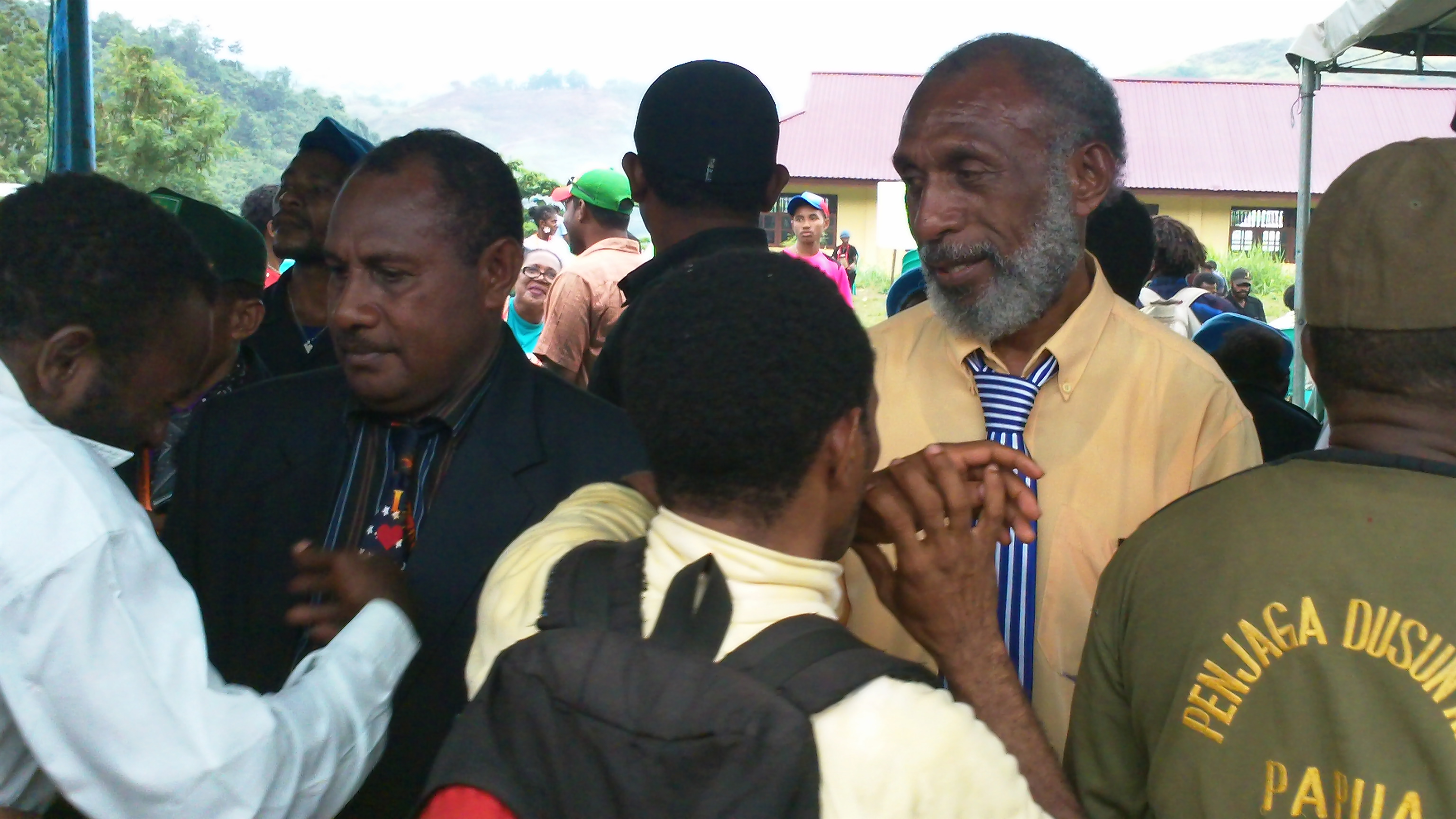
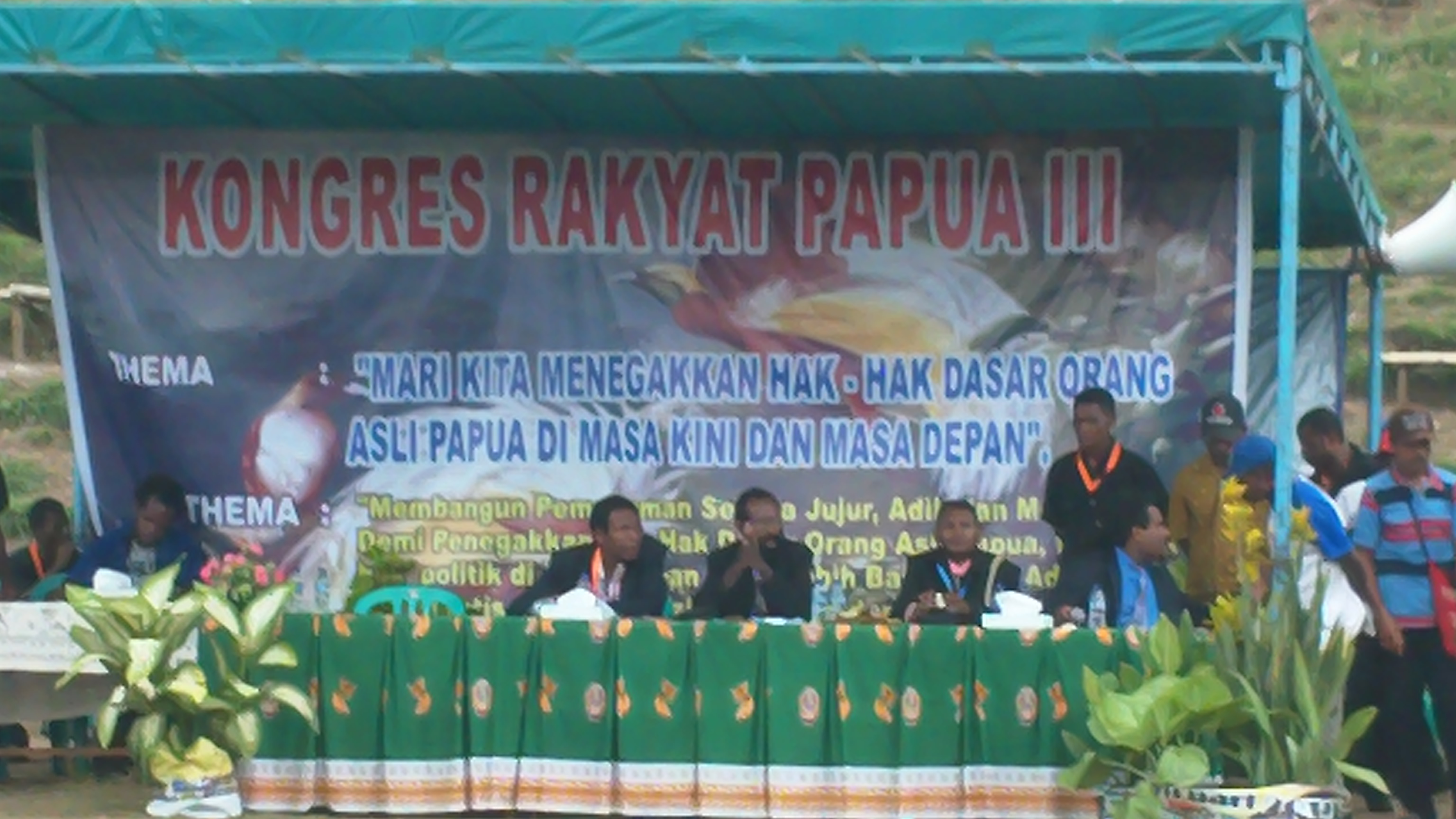

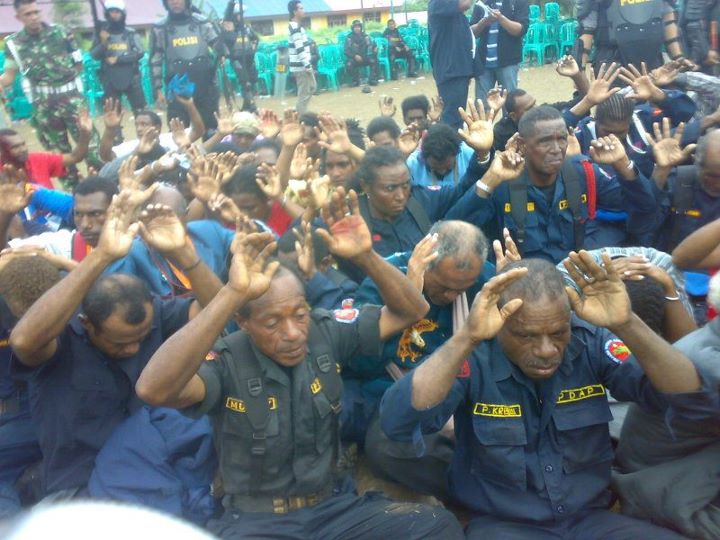
 Photo: West Papua Media Alerts
 Photo: West Papua Media Alerts
 Photo: West Papua Media Alerts



 West Papua Media Alerts